Occupational safety International framework and country guides
Occupational safety and health in Kazakhstan: law, authorities and employer duties
Abstract
Kazakhstan regulates OSH mainly through Section 4 of the Labour Code of 2015, enforced by state labour inspectors of the Ministry of Labour. Hazardous production facilities also fall under the Law on Civil Protection and the industrial safety authority; Ex equipment and PPE need EAEU certification.
Occupational safety and health (OSH) in Kazakhstan is governed mainly by Section 4 "Safety and labour protection" of the Labour Code of 23 November 2015 No. 414-V and by its chapters on state and internal control, and enforced by state labour inspectors of the Ministry of Labour and Social Protection of the Population and its regional departments. Employers must assess occupational risk, run an OSH service or appoint an OSH specialist, train and test every worker, arrange medical examinations and report any work accident to the labour inspection within 24 hours. Hazardous production facilities are also supervised by the industrial safety authority under the Law on Civil Protection, and Ex equipment and personal protective equipment (PPE) must carry the EAC mark of the Eurasian Economic Union (EAEU).
This guide covers the legal framework, the authorities, employer and worker duties, OSH services, risk assessment, training, medical surveillance, accident reporting, worker participation, inspections and penalties, chemicals, explosive atmospheres, major-hazard rules and PPE, with a comparison with the EU and Türkiye. Provisions were checked against the consolidated texts of November 2026.
Key points
- The core law is the Labour Code of the Republic of Kazakhstan (Трудовой кодекс Республики Казахстан; Қазақстан Республикасының Еңбек кодексі) No. 414-V of 23 November 2015: Section 4, chapters 17 to 20 (Articles 179 to 190), plus chapters 21 and 22 of Section 5 on state and internal control (Articles 191 to 203-1).
- An organisation with production activity and more than 50 workers must have an OSH service reporting to the head of the organisation; with up to 50 workers the employer appoints an OSH specialist or gives the duty to another specialist (Article 202).
- A work accident must be reported within 24 hours to the territorial labour inspection and worker representatives (and other bodies where relevant), and to the insurer within 3 working days of learning of it (Article 187).
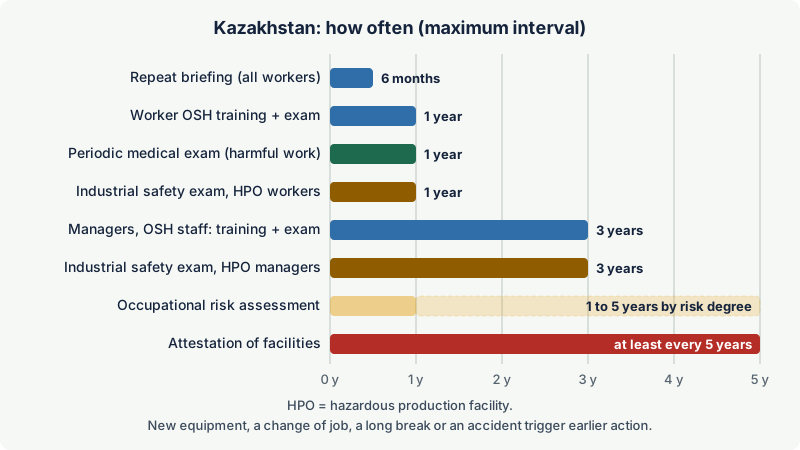
- Occupational risk assessment is a statutory duty, repeated every 1 to 5 years by risk degree under the 2026 rules; workplaces must also be attested for working conditions at least every 5 years (Articles 182 and 183).
- Every worker is trained and examined on OSH at least once a year; managers and persons responsible for OSH every 3 years in a listed training organisation.
- Fines are set in monthly calculation indices (MCI, МРП); one MCI is 4,325 tenge in 2026 (budget law No. 239-VIII, Article 7). Breaches causing harm can be prosecuted under Article 156 of the Criminal Code.
- Ex equipment needs a certificate under TR CU 012/2011 and PPE must comply with TR CU 019/2011, both EAEU technical regulations marked with EAC.
Legal framework: Labour Code, by-laws and other laws
Kazakhstan has no separate OSH act: the duties sit in the Labour Code, and the Ministry of Labour issues the detailed rules. The texts an employer meets most often are listed below, with Russian names and English translations.
| Text | What it covers |
|---|---|
| Labour Code No. 414-V of 23.11.2015, Section 4 (Arts 179-190) and chapters 21-22 (Arts 191-203-1) | State regulation, worker and employer duties, attestation, medical examinations, accident investigation (Section 4); state inspection and internal control (chapters 21-22) |
| Rules on training, briefing and knowledge testing (Правила и сроки проведения обучения, инструктирования и проверок знаний по вопросам безопасности и охраны труда), Order No. 1019 of 25.12.2015, revised from 12.07.2026 | Worker training and exams, briefings, training of managers and OSH staff |
| Rules on occupational risk management (Правила управления профессиональными рисками), Order No. 363 of 11.09.2020, revised from 12.07.2026 | Identification and assessment of occupational risk, review intervals |
| Rules on attestation of production facilities (Правила обязательной периодической аттестации производственных объектов по условиям труда), Order No. 1057 of 28.12.2015 | Measurement-based classification of working conditions |
| Order of the Minister of Health No. ҚР ДСМ-131/2020 of 15.10.2020 | Pre-employment, periodic and pre-shift medical examinations |
| Law on Civil Protection (О гражданской защите) No. 188-V of 11.04.2014 | Industrial safety of hazardous production facilities, fire safety, emergencies |
| Code of Administrative Offences No. 235-V of 5.07.2014 and Criminal Code No. 226-V of 3.07.2014 | Fines and criminal liability |
The Labour Code is amended often (Article 203-1 on technical inspectors was added by Law No. 295-VIII of 3 June 2026), so check the consolidated text on the official legal information system Әділет (Adilet) before relying on an article number.
Authorities: who enforces what
State labour inspection. State control of labour law, including OSH, is carried out by state labour inspectors (Article 191): the Chief State Labour Inspector of the Republic, chief inspectors of the ministry, and the chief and other inspectors of the territorial units in the capital, the regions and the cities of republican significance. Under Government Decree No. 628 of 6 August 2024 the ministry's Committee of State Labour Inspection (Комитет государственной инспекции труда) has a department in each region and main city; check the current structure on the ministry's portal, as the Labour Code definitions were amended again in 2026.
Industrial safety authority. Hazardous production facilities (опасные производственные объекты) are registered with, and supervised by, the authorised body for industrial safety and its territorial units. On the government portal this function is held by the Committee for Industrial Safety of the Ministry of Emergency Situations.
Sanitary-epidemiological authority. Occupational diseases, poisoning, production control of harmful factors and the organisation of medical examinations involve the state body for sanitary and epidemiological welfare of the Ministry of Health.
Employer and worker duties
Article 182 lists the employer's duties. The most important for a site manager are:
- assess occupational risk and reduce or remove it (prevention, safer equipment and processes);
- train, brief and test workers on OSH, and provide safe-work documents, at the employer's cost;
- have managers and persons responsible for OSH trained and tested at least once every 3 years;
- provide welfare facilities, workwear, PPE, first-aid kits and, where required, milk or therapeutic nutrition;
- register, record and analyse accidents and occupational diseases, and ensure their investigation;
- attest production facilities for working conditions at least once every 5 years, with worker representatives;
- insure workers against accidents at work and report the insurance contract to the ministry;
- arrange mandatory, periodic and pre-shift medical examinations at the employer's cost;
- introduce an OSH management system (система управления охраной труда) and monitor it;
- comply with inspectors' orders, and provide OSH monitoring information quarterly to the ministry and, on written request, to worker representatives.
Workers (Article 181) must follow OSH rules, use the PPE provided, report every injury and dangerous situation immediately, attend medical examinations and training. They may refuse work, with written notice to the manager, when PPE is not provided or a situation threatens their life or health.
On a construction site shared by two or more organisations, the general contractor coordinates OSH compliance (Article 184).
OSH services, risk assessment and attestation
OSH service or OSH specialist
Article 202 links the OSH organisation to headcount. A firm with production activity and more than 50 workers creates an OSH service (служба безопасности и охраны труда) reporting directly to the head of the organisation. With up to 50 workers, the employer creates the post of OSH specialist or assigns OSH duties to another specialist reporting to the head. Small businesses may organise OSH under a contract with an individual or a company. The service must analyse accidents and occupational diseases every month, organise training and exams, and ensure correct accident investigation.
Unlike Türkiye, the Labour Code does not require an in-house occupational physician. Medical examinations are done by licensed medical organisations; the medical commission for periodic examinations is chaired by an occupational pathologist (профпатолог).
Occupational risk assessment
Since the 2026 revision of the risk management rules, the assessment is organised through the unified digital system of the social and labour sphere (ЕЦС). The employer's production council, or an expert group of employer and worker representatives, lists the jobs and the harmful and dangerous factors; a specialised organisation from the ministry's list, with at least three certified experts and an accredited testing laboratory, measures and assesses. Each job receives a risk degree from 1 (acceptable) to 5 (very high), which sets the review interval:
| Risk degree | Next assessment |
|---|---|
| 1, acceptable | once in 5 years |
| 2, low | once in 3 years |
| 3, medium | once in 2 years |
| 4, high | every year |
| 5, very high | every year, after urgent corrective measures within 3 months |
An unplanned assessment is due within 90 calendar days after new jobs are introduced or rebuilt or re-equipped facilities are put into operation. Small businesses with up to 100 workers in risk classes 4 to 22 may use a simplified online checklist of 15 criteria. For high-risk, one-off or changing work (at height, outdoors, underground) the work supervisor carries out a shift-by-shift risk check before work starts.
Attestation of production facilities
Attestation (аттестация производственных объектов по условиям труда) is a separate, measurement-based classification of working conditions by harmfulness and danger. It is done at least once every 5 years by a specialised attestation organisation; the employer appoints an attestation commission that includes the manager or a deputy, OSH staff and worker representatives, and the specialised organisation sends the results to the ministry within 10 calendar days (Article 183). Its results show which workplaces have harmful or hazardous working conditions.
Training and medical examinations
Under the training rules in force from 12 July 2026, OSH training includes briefings, on-the-job training, safe-work training and further training. New and transferred workers are trained and examined within one month of the contract or the change, and then at least once a year. Theoretical training lasts at least 10 academic hours (an academic hour is at least 40 minutes) and practical training at least 16 hours. An exam commission of at least three people, created by the employer, holds the exam; a worker who fails is retrained, retested within a month and kept off the job until he or she passes.
Briefings are introductory (on hiring, also for visitors and contractors at hazardous production facilities), primary at the workplace, repeated at least once every six months, unscheduled (new rules, changed equipment, a breach, a break of more than 60 calendar days) and targeted (one-off tasks). Managers and persons responsible for OSH attend a listed training organisation every 3 years: at least 16 academic hours for first managers and 40 hours for heads of OSH services.
At hazardous production facilities, industrial safety training is added: workers are examined every year after at least 10 hours of training, managers and engineers every 3 years after at least 40 hours (Law on Civil Protection, Article 79).
Medical examinations follow Order ҚР ДСМ-131/2020. Pre-employment examinations check fitness for the job; workers exposed to harmful factors have periodic examinations once a year; workers in listed high-hazard jobs have a pre-shift check within one hour before the shift, and drivers pre-trip and post-trip checks. By 1 December each year the employer, with the medical organisation, draws up the list of workers to be examined and agrees it with the sanitary authority; it may not admit anyone who has not been examined or has been found unfit.
Accident reporting and investigation
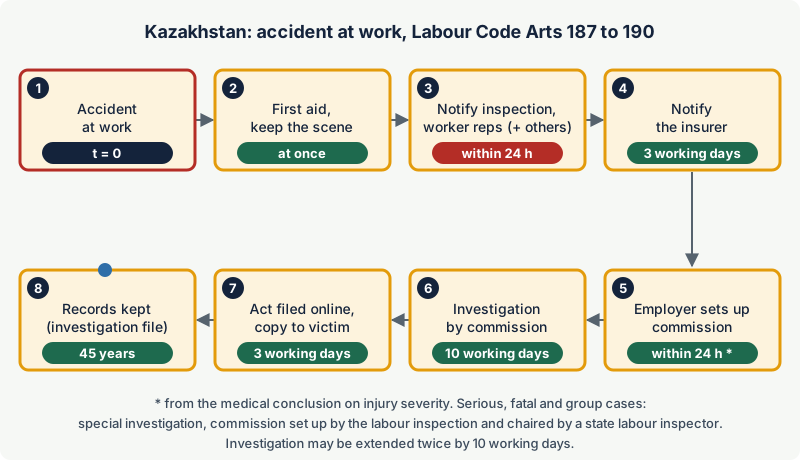
When an accident happens, the employer organises first aid, keeps the scene as it was (unless this endangers others), photographs it and informs the family (Article 187). Within 24 hours the employer reports on the official form to:
- the territorial unit of the labour inspection;
- the industrial safety authority, if the organisation operates hazardous production facilities;
- the sanitary authority, for occupational disease or poisoning;
- the worker representatives;
- the police and the relevant supervisory bodies, in cases subject to special investigation.
The insurer is notified at once, and no later than 3 working days after the employer learns of the accident.
The employer sets up an investigation commission within 24 hours of the medical conclusion on the severity of the injury, chaired by the head of the organisation or a deputy, with the head of the OSH service and a worker representative (Article 188). The supervisor directly responsible for safety at that spot may not sit on it. At organisations operating hazardous production facilities and in the power sector, a state industrial safety inspector and an energy supervision official also join the commission; in acute poisoning, the sanitary authority does. Serious and fatal accidents, accidents with two or more workers and group acute poisoning need a special investigation: the commission is created by the labour inspection within 24 hours of the medical conclusion and chaired by a state labour inspector. A group accident with two deaths is investigated under the chief state labour inspector of the region or city, with three to five deaths by a commission of the ministry, and with more than five deaths by the Government. Where the injury results from an industrial accident (авария) at a hazardous production facility, a representative of the industrial safety authority chairs the commission and the labour inspector is a member.
The investigation takes no more than 10 working days and may be extended twice by 10 working days (Article 189). Within 3 working days after it ends, the employer completes the accident act, files it electronically with the ministry and gives a copy to the victim; the insurer and the inspection also receive copies. The file is kept for 45 years (Article 190).
Example: A fitter at a fertiliser plant registered as a hazardous production facility breaks a wrist on Monday at 10:00. By Tuesday 10:00 the employer has notified the regional labour inspection, the territorial industrial safety unit and the worker representatives, and by Thursday the insurer. The hospital's conclusion (not serious) arrives on Monday afternoon, so the employer's commission, which here must include a state industrial safety inspector, is set up by Tuesday afternoon and has 10 working days; the act then goes online within 3 working days. Had two fitters been injured, a special investigation chaired by a state labour inspector would have been needed.
Worker participation, inspection and penalties
A production council for safety and labour protection (производственный совет по безопасности и охране труда) is created within 15 working days when the employer, the workers or their representatives take the initiative (Article 203). It has equal numbers of employer and worker representatives, its chair rotates every two years, and its decisions bind both sides. The council approves technical inspectors for labour protection (технический инспектор по охране труда), worker representatives who carry out internal OSH control, take part in accident investigations and propose improvements (Article 203-1). Where there is no council, the risk rules require an expert group of employer and worker representatives.
Employers can also make a self-declaration of compliance with labour law through the digital system; a firm found compliant receives a "certificate of trust" (сертификат доверия) for three years, which is taken into account when inspection lists are drawn up (Article 200).
Fines under the Code of Administrative Offences are graded by the size of the business. Selected articles, with amounts at the 2026 MCI of 4,325 tenge:
| Breach (Code of Administrative Offences) | Small business or non-profit (Art. 93: also officials) | Medium | Large |
|---|---|---|---|
| No OSH service or specialist; medical examinations; PPE; training and testing (Art. 93 parts 1-4) | 20 MCI (86,500 tenge) | 30 MCI | 120 MCI (519,000 tenge) |
| Briefings other than the introductory one missing, or OSH documents absent (Art. 93 part 6) | 40 MCI | 60 MCI | 120 MCI |
| Breach of attestation rules (Art. 94) | 20 MCI | 35 MCI | 50 MCI |
| Failure to ensure accident investigation (Art. 95) | 60 MCI | 100 MCI | 200 MCI |
| Failure to report an accident in time (Art. 96) | 100 MCI | 150 MCI | 200 MCI (865,000 tenge) |
Repeating a breach of Articles 93, 95 or 96 within a year of a penalty roughly doubles the amounts. Under Article 156 of the Criminal Code, a person responsible for OSH rules whose breach causes, through negligence, moderate or serious harm faces fines or arrest, and where it causes death, restriction or deprivation of liberty for up to 5 years (up to 7 years for two or more deaths), with a ban on holding certain posts. The MCI changes every year with the republican budget law, so recalculate amounts for the year of the breach.
Chemicals, explosive atmospheres, major hazards and PPE
Chemicals. The EAEU technical regulation on the safety of chemical products, TR EAEU 041/2017, was adopted by Council Decision No. 19 of 3 March 2017 and is intended to align hazard classification, labelling and safety data sheets in the union with the Globally Harmonized System (GHS). Its application depends on further union acts (the Council adopted the rules for the union register of chemical substances and mixtures and notification of new substances by Decision No. 61 of 1 August 2025), and it was not on the Commission's list of regulations in force when we checked in November 2026, so confirm the labelling and safety data sheet rules with the supplier at the date of supply.
Explosive atmospheres and Ex equipment. Equipment for explosive atmospheres placed on the Kazakh market must be certified under TR CU 012/2011 "On safety of equipment for work in explosive atmospheres" (Customs Union Commission Decision No. 825 of 18 October 2011, in force since 15 February 2013) and marked with EAC and the special Ex sign. ATEX or IECEx marking has no legal effect on its own. There is no single workplace regulation like the EU's directive 1999/92/EC: protection comes from sector industrial safety rules, the electrical installation rules and interstate standards largely based on IEC 60079. At a hazardous production facility, technologies and hazardous technical devices may also need an industrial safety expertise and a permit for use; no permit is needed for a hazardous technical device that has passed conformity certification (Law on Civil Protection, Articles 73 and 74).
Major hazards. A facility is a hazardous production facility (HPO) if it produces, uses, processes, stores, pipes or destroys flammable, combustible, oxidising, explosive, toxic, highly toxic or environmentally hazardous substances or sources of ionising radiation, melts metals, or carries out mining, drilling, blasting or underground work (Article 70 of the Law on Civil Protection). HPOs are registered with the territorial unit of the industrial safety authority (Article 77) and need production control, an emergency response plan (план ликвидации аварий) agreed with a professional rescue service, drills and incident investigation (Articles 40, 80 to 82). HPOs meeting the authority's criteria must prepare and register an industrial safety declaration (декларация промышленной безопасности); operating such a facility without a registered declaration is prohibited, and an amended declaration is re-registered within three months (Article 76). This is Kazakhstan's counterpart to the Seveso safety report, built on a different, national threshold system.
PPE. PPE must comply with TR CU 019/2011 "On safety of personal protective equipment" (Customs Union Commission Decision No. 878 of 9 December 2011, in force since 1 June 2012) and carry the EAC mark. The employer must provide PPE free of charge under the ministry's norms; failing to do so is fined under Article 93.
Kazakhstan compared with the EU framework and Türkiye
| Topic | Kazakhstan | EU (Directive 89/391/EEC) | Türkiye (Law No. 6331) |
|---|---|---|---|
| Main law | Labour Code 2015, Section 4 and chapters 21-22 | Framework Directive, transposed nationally | OSH Law No. 6331 of 2012 |
| OSH staff | OSH service above 50 workers; specialist or assigned person up to 50 | Competent protective and preventive services, size set nationally | OSH professional and workplace physician for all employers (plus other health staff in very hazardous firms with 10 or more workers); in-house, external or, within limits, by the employer (Art. 6) |
| Risk assessment | Statutory; 1 to 5-year review by risk degree, through a specialised organisation | Employer must be in possession of an up-to-date risk assessment | Statutory (Art. 10); review intervals by hazard class set by regulation |
| Accident report | Labour inspection within 24 hours | Set by each member state | Social Security Institution (SGK) within 3 working days (Art. 14) |
| Joint body | Production council on initiative; technical inspectors | Consultation of workers and representatives | OSH committee where 50 or more workers and continuous work lasts over 6 months (Art. 22) |
| Ex equipment mark | EAC under TR CU 012/2011 | CE under ATEX 2014/34/EU | CE under the Turkish ATEX equipment regulation |
Common mistakes
- Treating the 24-hour notice as an investigation deadline. The 24 hours is for the first report; the investigation has its own 10 working days, and the act its own 3 working days.
- Bringing an ATEX or IECEx certificate as proof of conformity. Kazakhstan requires an EAC certificate under TR CU 012/2011 issued by an accredited union body; foreign certificates only help prepare the file.
- Confusing attestation with risk assessment. Both are required: attestation classifies working conditions at least every 5 years, while the occupational risk assessment follows the 1 to 5-year cycle of the risk rules.
- Training only once at hiring. Workers need a repeat briefing at least every six months and an OSH exam at least once a year.
- Quoting fines in tenge from an old year. Fines are fixed in MCI; convert with the MCI of the current year.
Frequently asked questions
From how many workers is an OSH service mandatory?
An organisation with production activity and more than 50 workers must create an OSH service reporting to the head of the organisation. With up to 50 workers, the employer appoints an OSH specialist or assigns the duty to another specialist, and small businesses may contract out.
Do foreign contractors have to follow Kazakh OSH rules?
Yes. OSH requirements bind all employers and workers operating in Kazakhstan (Labour Code Article 180). Contractor staff at hazardous production facilities receive an introductory briefing and need industrial safety training (Law on Civil Protection, Article 79). For workers placed on the site by another employer (the "sending party", направляющая сторона), the receiving party organises any accident investigation and controls access to the site (Labour Code Article 186).
Is GHS labelling mandatory in Kazakhstan?
The EAEU regulation on chemical products, TR EAEU 041/2017, is designed around GHS classification and labelling, but its application depends on further union acts. Check the status on the Eurasian Economic Commission's page at the date of supply and agree labels and safety data sheets with the importer.
Where can the official texts be found?
Consolidated texts of laws and ministerial orders are published in Russian and Kazakh on the Әділет legal information system of the Ministry of Justice. EAEU technical regulations are on the Eurasian Economic Commission's website and legal portal.
Related on excodex
- What is the main OSH law in Kazakhstan and who enforces it?
- How and within what time must a workplace accident be reported in Kazakhstan?
- How are explosive atmospheres and Ex equipment regulated in Kazakhstan?
- CE, UKCA and EAC certification marks for work equipment and PPE
- What is the EAC Ex certificate and is it needed for Russia and Kazakhstan?
- OSH law comparison: appointments and reporting deadlines
Standards and further reading
- Labour Code of the Republic of Kazakhstan No. 414-V of 23 November 2015, Section 4 (Articles 179-190) and Chapters 21-22 (Articles 191-203-1), consolidated text: adilet.zan.kz
- Order of the Minister of Health and Social Development No. 1019 of 25 December 2015, Rules and terms of OSH training, briefing and knowledge testing, as revised by Order No. 223 of 30 May 2026: adilet.zan.kz
- Order of the Minister of Labour and Social Protection No. 363 of 11 September 2020, Rules on occupational risk management, as revised by Order No. 211 of 28 May 2026: adilet.zan.kz
- Order of the Minister of Health and Social Development No. 1057 of 28 December 2015, Rules on mandatory periodic attestation of production facilities by working conditions.
- Government Decree No. 628 of 6 August 2024 on certain matters of the Ministry of Labour and Social Protection of the Population (Committee of State Labour Inspection).
- Order of the acting Minister of Health No. ҚР ДСМ-131/2020 of 15 October 2020 on mandatory medical examinations.
- Law of the Republic of Kazakhstan No. 188-V of 11 April 2014 "On Civil Protection", Articles 40, 69-88. Committee for Industrial Safety of the Ministry of Emergency Situations: gov.kz
- Code of Administrative Offences No. 235-V of 5 July 2014, Articles 93-96; Criminal Code No. 226-V of 3 July 2014, Article 156.
- Law No. 239-VIII of 8 December 2025 on the republican budget for 2026-2028, Article 7 (MCI of 4,325 tenge from 1 January 2026).
- TR CU 012/2011 and TR CU 019/2011, Eurasian Economic Commission pages: Ex equipment, PPE; TR EAEU 041/2017: chemical products
- Ministry of Labour and Social Protection of the Population, government portal: gov.kz
- ILO, labour inspection profile of Kazakhstan (background, partly outdated): ilo.org
This article is general occupational safety and health information prepared by the excodex editorial team. It does not replace the applicable legislation, standards, manufacturers' instructions or the assessment of a competent OSH professional or occupational physician.
Questions on this topic
- What is the main occupational safety and health law in Kazakhstan and who enforces it?
- Must an employer in Kazakhstan appoint a safety professional or an occupational physician?
- Is a written risk assessment mandatory in Kazakhstan, and how often must it be reviewed?
- How and within what time must a workplace accident be reported in Kazakhstan?
- What OSH training must employers provide to workers in Kazakhstan?
- Are pre-employment and periodic medical examinations required for workers in Kazakhstan?
- What are the penalties for breaking occupational safety rules in Kazakhstan?
- Is a safety committee or a worker safety representative required in Kazakhstan?
- How are explosive atmospheres and Ex equipment regulated in Kazakhstan?
- Which rules apply to major-hazard chemical sites in Kazakhstan?