Occupational safety International framework and country guides
Is a written risk assessment mandatory in Kazakhstan, and how often must it be reviewed?
Part of: Occupational safety and health in Kazakhstan: law, authorities and employer duties
Short answer
Yes. Labour Code Art. 182 requires an occupational risk assessment, recorded in the state digital system under the 2026 risk management rules. It is repeated every 5, 3 or 2 years or yearly by risk degree, and within 90 days of new jobs or re-equipment.
Yes. Article 182 of the Labour Code obliges every employer to assess occupational risk (оценка профессионального риска) and to reduce or remove it, and the Rules on occupational risk management, revised from 12 July 2026, require the assessment to be documented through the state's unified digital system. The review interval depends on the risk degree found: once in 5 years for acceptable risk, once in 3 years for low, once in 2 years for medium and every year for high and very high risk.
Short answer
- Legal basis: Labour Code Article 182 (duty to assess and reduce occupational risk) and Article 201 (risk assessment is part of internal control); Rules on occupational risk management, Order No. 363 of 11 September 2020, revised by Order No. 211 of 28 May 2026.
- Form: the assessment and its report are produced in the unified digital system of the social and labour sphere (ЕЦС); a written record is therefore always created.
- Who: the production council for safety and labour protection, or an expert group of employer and worker representatives, prepares the lists of jobs and hazards; a specialised organisation from the ministry's list measures and assesses.
- Review interval: 5, 3, 2 years, yearly, or yearly after urgent measures, according to risk degree 1 to 5.
- Unplanned review: within 90 calendar days after new jobs appear or rebuilt, modernised or re-equipped facilities are put into operation.
- Small firms: small businesses with up to 100 workers in occupational risk classes 4 to 22 use a simplified online checklist, except some class 4 firms that pay compulsory occupational pension contributions or had a work accident in the last 5 years.
How the assessment works under the 2026 rules
The rules split occupational risk management into four steps: identification, assessment, corrective measures, and control and monitoring. In practice:
- The employer defines the jobs to assess, sets a schedule and names the people who coordinate the work.
- The production council, or the expert group, lists every job and every harmful or dangerous factor for it, using the classifier annexed to the rules, and collects accident and sickness data and production control results.
- The employer files an application in the digital system and chooses a specialised organisation from the ministry's list. Such an organisation must have at least three certified experts on working conditions and risk assessment (including one sanitary-epidemiological expert and one specialist in occupational medicine) and an accredited testing laboratory.
- The specialised organisation measures the factors, checks equipment documentation and the suitability of the personal protective equipment (PPE) issued, and the digital system calculates an individual risk degree for each job.
- The employer draws up a corrective action plan and monitors it.
For high-risk, one-off or changing work, such as work at height, outdoors or underground, the work supervisor also carries out a shift-by-shift risk check before work starts, using the form annexed to the rules.
Review intervals by risk degree
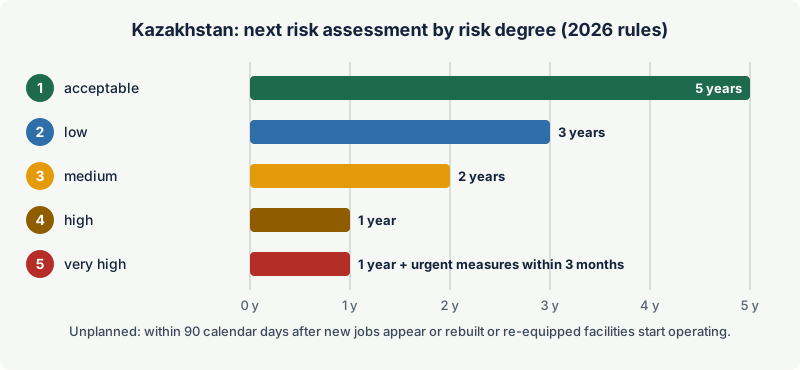
| Individual risk degree | Next planned assessment |
|---|---|
| 1, acceptable | once in 5 years |
| 2, low | once in 3 years |
| 3, medium | once in 2 years |
| 4, high | every year |
| 5, very high | every year, after urgent corrective measures within 3 months of the assessment |
In addition, an unplanned assessment is due no later than 90 calendar days after new jobs or job groups appear, or after rebuilt or modernised production facilities (new equipment or processes) are put into operation.
Under the simplified procedure, a small business answers a 15-criterion online checklist; each criterion scores 1 % to 10 % if the supporting documents exist. Meeting more than 91 % of the requirements gives degree 1, 71 to 90 % degree 2, 51 to 70 % degree 3, 31 to 50 % degree 4 and 30 % or less degree 5. At degree 4 or 5 the employer draws up a corrective action plan to be completed within 6 months.
Example: A warehouse operator assessed in 2026 receives degree 2 (low) for storekeepers and degree 4 (high) for forklift drivers loading at night. The storekeepers' next planned assessment is due in 2029 and the drivers' in 2027. In March 2027 the operator installs a new automated racking system, so it must carry out an unplanned assessment of the affected jobs by early June 2027, within 90 calendar days of commissioning.
Risk assessment is not attestation
Kazakhstan keeps a second, older instrument: the attestation of production facilities for working conditions (Article 183), done at least once every 5 years by a specialised attestation organisation, with an employer's attestation commission that includes worker representatives. Attestation classifies working conditions by measured harmful and dangerous factors; the occupational risk assessment estimates the risk of injury or occupational disease for each job and drives corrective action. Both are mandatory.
Common mistakes
- Treating the risk assessment as a one-off document. The rules set fixed intervals and event-driven reviews.
- Doing it without worker participation. The production council, or an expert group with equal employer and worker representation, must take part.
- Assuming attestation covers it. Attestation and occupational risk assessment are separate duties with different cycles.
Related on excodex
- Occupational safety and health in Kazakhstan: law, authorities and employer duties
- Is a safety committee or a worker safety representative required in Kazakhstan?
- Workplace risk assessment: process, team, records and review
- Dynamic and point-of-work risk assessment
Standards and further reading
- Labour Code of the Republic of Kazakhstan No. 414-V of 23 November 2015, Articles 182, 183 and 201: adilet.zan.kz
- Rules on occupational risk management, Order of the Minister of Labour and Social Protection No. 363 of 11 September 2020, as revised by Order No. 211 of 28 May 2026 (in force 12 July 2026): adilet.zan.kz
- Rules on mandatory periodic attestation of production facilities for working conditions, Order of the Minister of Health and Social Development No. 1057 of 28 December 2015.
- ISO 45001, occupational health and safety management systems (international reference for hazard identification and risk assessment).
This article is general occupational safety and health information prepared by the excodex editorial team. It does not replace the applicable legislation, standards, manufacturers' instructions or the assessment of a competent OSH professional or occupational physician.
More questions on this topic
- What is the main occupational safety and health law in Kazakhstan and who enforces it?
- Must an employer in Kazakhstan appoint a safety professional or an occupational physician?
- How and within what time must a workplace accident be reported in Kazakhstan?
- What OSH training must employers provide to workers in Kazakhstan?
- Are pre-employment and periodic medical examinations required for workers in Kazakhstan?
- What are the penalties for breaking occupational safety rules in Kazakhstan?
- Is a safety committee or a worker safety representative required in Kazakhstan?
- How are explosive atmospheres and Ex equipment regulated in Kazakhstan?
Part of: Occupational safety and health in Kazakhstan: law, authorities and employer duties