Occupational safety International framework and country guides
Occupational safety and health in Saudi Arabia: law, authorities and employer duties
Abstract
Saudi OSH rests on the Labor Law (Royal Decree M/51, 2005, Part VIII), MHRSD decisions and NCOSH regulations. Employers must prevent hazards, run an OSH system at 50+ workers, employ OSH staff (1 per 50 or 100 workers) and report fatal accidents within 24 hours on the NCOSH platform.
In Saudi Arabia, occupational safety and health (OSH) is governed by the Labor Law (نظام العمل), issued by Royal Decree No. M/51 of 23/8/1426 AH (27 September 2005), whose Part VIII (Articles 121 to 148) sets the employer's duties to prevent work hazards, major industrial accidents and work injuries. Detailed rules come from decisions of the Ministry of Human Resources and Social Development (MHRSD), which inspects and fines, and from regulations of the National Council for Occupational Safety and Health (NCOSH). There is no separate OSH act.
This guide sets out the legal instruments with their Arabic names, who enforces them, the employer's and worker's duties, OSH staff and medical surveillance, accident reporting deadlines, inspections and penalties, chemicals, explosive atmospheres, major hazards and PPE, and how the Saudi system compares with the EU and Türkiye.
Key points
- The Labor Law of 2005 (as amended), Part VIII, is the base: the employer must take the precautions needed to protect workers from work hazards, diseases and machinery, post safety instructions in Arabic and any other language workers understand, and never charge workers for this protection (Article 122).
- The OSH Management Regulation (Ministerial Decision No. 161238 of 10/8/1439 AH, 26 April 2018) applies to establishments with 50 or more workers: the intermediate level in listed high-risk activities such as construction, oil and gas, mining and chemicals, the minimum level in all other activities.
- Ministerial Decision No. 76509 of 15/4/1441 AH (12 December 2019) requires establishments with 50 or more workers to employ OSH staff at a ratio of 1 per 50 workers in high-risk activities and 1 per 100 in other activities, with at least 70% Saudi nationals among them from 1 January 2022.
- Under the NCOSH reporting policy (Decision No. 82885 of 4/6/1445 AH, 17 December 2023), fatal accidents must be reported on the national electronic platform within 24 hours of confirmation of death, serious accidents within 3 working days, non-serious accidents within 7 working days and near misses within 10 working days.
- Workers exposed to scheduled occupational diseases must have a comprehensive medical examination at least once a year (Labor Law Article 143); an NCOSH regulation in force since April 2026 adds pre-employment, periodic and exceptional fitness examinations.
- Outdoor work in the sun is banned from 12:00 to 15:00 between 15 June and 15 September each year (Ministerial Decision No. 3337 of 1435 AH).
- Equipment and protective systems for explosive atmospheres, electrical and non-electrical, need a SASO conformity certificate under a technical regulation adopted on 28 September 2023 and published on 17 November 2023.
The legal framework: Labor Law, ministerial decisions and NCOSH regulations
The Labor Law is published by the Bureau of Experts at the Council of Ministers; the Arabic text is authoritative. Part VIII has four chapters: prevention of work hazards (Articles 121 to 126), prevention of major industrial accidents (Articles 127 to 131 and 131 bis), work injuries (Articles 132 to 141) and health and social services (Articles 142 to 148). Other parts add OSH-relevant rules: women may not be employed in hazardous or harmful occupations defined by the Minister (Article 149), minors may not do hazardous work (Article 161), and Part XII sets safety rules for mines and quarries, including a rescue point, a register of workers entering and leaving and a limit of seven hours of actual work underground per day (Articles 185 to 193).
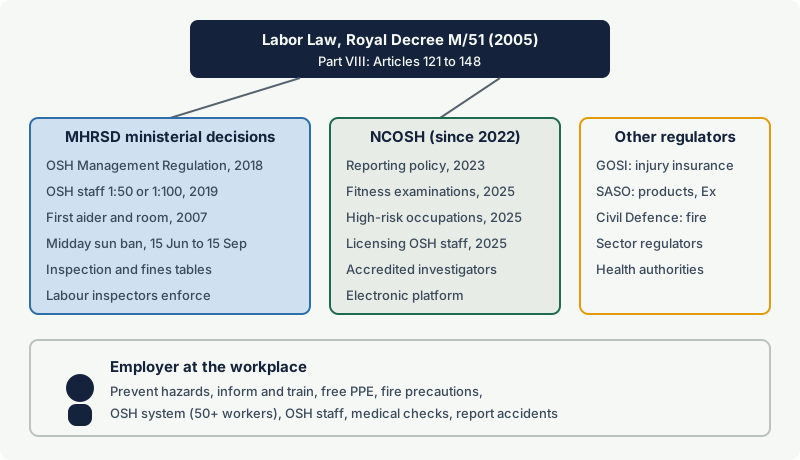
| Instrument | Official name | What it covers |
|---|---|---|
| Labor Law, Royal Decree No. M/51 of 23/8/1426 AH (2005), as amended | نظام العمل | Part VIII duties, injury compensation, health services; penalties in a later part |
| Ministerial Decision No. 161238 of 10/8/1439 AH (2018) | لائحة إدارة السلامة والصحة المهنية (OSH Management Regulation) | OSH policy, organisation, competence and training, initial review, hazard prevention, emergencies; minimum, intermediate and higher levels |
| Ministerial Decision No. 76509 of 15/4/1441 AH (2019) | قرار توطين مهنة السلامة والصحة المهنية | Number of OSH staff per worker and Saudi share |
| Ministerial Decision No. 1/400 of 1/4/1428 AH (2007) | First aid room decision | Full-time first aider at 50+ workers, first aid room, ambulance for remote large sites |
| Ministerial Decision No. 1559/1 of 1431 AH, amended by No. 3337 of 1435 AH | حظر العمل تحت أشعة الشمس (midday sun ban) | No outdoor work in the sun 12:00 to 15:00, 15 June to 15 September |
| NCOSH Decision No. 82885 of 4/6/1445 AH (2023) | سياسة البرنامج الوطني الشامل للتبليغ عن حوادث وإصابات العمل والأمراض المهنية | National accident reporting and investigation programme |
| NCOSH regulations issued in 2025 (published October 2025 and January 2026) | لائحة فحوصات اللياقة المهنية والأمراض غير المعدية; لائحة تنظيم العمل في المهن ذات المخاطر العالية; لائحة ترخيص واعتماد مزاولي ومقدمي خدمات السلامة والصحة المهنية | Fitness examinations; high-risk occupations; licensing of OSH practitioners and service providers |
Each of the three NCOSH regulations applies 180 days after its publication in the Official Gazette (Umm Al-Qura). The fitness examinations regulation (Decision No. 33232 of 11/3/1447 AH) was published on 24 October 2025 and so applies from April 2026; the high-risk occupations regulation and the licensing regulation (Decision No. 64764 of 13/5/1447 AH) were both published on 9 January 2026 and apply from July 2026.
The National OSH Policy was issued by Council of Ministers Decision No. 328 of 13/6/1442 AH (26 January 2021). For the International Labour Organization (ILO) conventions Saudi Arabia has ratified, see its country profile in the ILO NORMLEX database.
Who enforces OSH in Saudi Arabia
| Body | Role |
|---|---|
| Ministry of Human Resources and Social Development (MHRSD, وزارة الموارد البشرية والتنمية الاجتماعية) | Issues ministerial decisions, labour inspection including OSH inspection, fines under the violations table |
| National Council for Occupational Safety and Health (NCOSH, المجلس الوطني للسلامة والصحة المهنية) | Set up by Council of Ministers Decision No. 379 of 7/7/1443 AH (8 February 2022), chaired by the MHRSD minister; national OSH governance, reporting platform, regulations, licensing of OSH practitioners and accident investigators |
| General Organization for Social Insurance (GOSI, المؤسسة العامة للتأمينات الاجتماعية) | Occupational hazards insurance branch: injury notification, treatment and benefits |
| Saudi Standards, Metrology and Quality Organization (SASO, الهيئة السعودية للمواصفات والمقاييس والجودة) | Technical regulations and conformity certificates for products, including Ex equipment |
| Civil Defence (الدفاع المدني) | Fire prevention and fire safety of buildings and facilities |
| Sector regulators | Authorities that license or supervise an economic sector follow up accident reports from their establishments, approve investigation reports and impose sanctions under the NCOSH policy; some industrial sectors also have their own safety and security rules |
MHRSD's OSH inspection mechanism (November 2019) tells inspectors to check, in an office review, the OSH policy approved by top management, the OSH system, internal inspection and audit reports, the hazard register and corrective actions, the accident investigation record, training records and emergency plans, then to verify on the floor that the system is really applied.
Employer and worker duties
The Labor Law duties apply to every employer, whatever its size.
- Keep the establishment clean and healthy, lit, with drinking and washing water, and apply the protection, safety and health rules set by ministerial decision (Article 121).
- Take the precautions needed to protect workers from work hazards and diseases and from the machinery used; post safety instructions in a visible place in Arabic and, where needed, in any other language the workers understand; charge nothing for protection (Article 122).
- Before work starts, inform the worker of the hazards of the job, require the prescribed protective measures, supply suitable personal protective equipment (PPE) and train workers to use it (Article 123).
- Take fire precautions, provide firefighting means and escape routes kept usable at all times, and post detailed fire prevention instructions (Article 125).
- Answer for accidents to non-employees who enter the workplace in the course of their duties or with the employer's permission, if they result from neglect of the technical precautions the work requires (Article 126).
Workers must use and look after the protective means provided, follow health and safety instructions and must not disable or misuse safety devices (Article 124).
The OSH Management Regulation and its three levels
The 2018 regulation states that it draws on international practice and ILO standards, and it follows the structure of ILO-OSH 2001: policy, organising, planning and implementation, evaluation and improvement. Most clauses are written as "should", but the ministerial decision makes them binding for establishments with 50 or more workers and applies Labor Law penalties to breaches.
| Element | Minimum level (50+ workers, other activities) | Intermediate level (50+ workers, high-risk activities) |
|---|---|---|
| Written OSH policy, Arabic as main language, reviewed at least every two years | Yes | Yes |
| Named managers with OSH responsibility and authority | Yes | Yes |
| Competence and training: needs analysis, free training in an understandable language, records | Yes | Yes |
| Initial review: legal compliance, hazard identification and risk evaluation, action plan | Yes | Yes |
| Prevention and control measures, regularly reviewed | Yes | Yes |
| Emergency prevention, preparedness and response plan | Yes | Yes |
| Worker participation, joint OSH committee or working group | No | Yes |
| Objectives, contractor control, performance monitoring, investigation, management review | No | Yes |
The higher level adds management of change, procurement, audits, corrective action and continual improvement.
High-risk occupations
Article 131 bis lets the Minister define hazardous or harmful occupations and the groups of workers barred from them or allowed only under conditions. The NCOSH Regulation on Organising Work in High-Risk Occupations (in force from July 2026) lists the activities concerned, including work at height, confined spaces, lifting, electrical work, hot work, chemicals, radiation and work in hazardous and explosive atmospheres. Employers must send workers for the training and medical examinations needed to obtain a licence for these occupations and must not assign anyone without a valid licence.
OSH staff, first aid and medical surveillance
OSH professionals
Ministerial Decision No. 76509 (2019) applies to establishments with 50 or more workers; smaller ones are outside it. In the listed high-risk activities, it requires 1 OSH worker per 50 workers (2% of the workforce); in all other activities, 1 per 100 (1%). Between 30% and 40% of the OSH staff must be at "professional" level and 60% to 70% at "practitioner" level. The Saudi share of OSH staff rose from 30% (2020) and 50% (1 January 2021) to at least 70% from 1 January 2022. The guide attached to the decision is binding: it rounds fractions of 0.5 or more up and smaller fractions down, and its tables give the numbers by workforce band, for example 2 OSH staff for 50 to 100 workers in a high-risk activity but 1 in other activities. The OSH staff must work in OSH as their main job, not as an add-on to another role.
The NCOSH Regulation on Licensing and Accreditation of OSH Practitioners and Service Providers (published January 2026, in force from July 2026) adds that nobody may practise an OSH occupation or provide OSH services without a licence or accreditation from NCOSH, and no entity may employ or assign OSH tasks to anyone who lacks one. Licences and accreditations are valid for three years.
First aid
Ministerial Decision No. 1/400 of 1/4/1428 AH (2007) requires employers with 50 or more workers to appoint a full-time first aider with certified qualifications, whether or not a visiting or full-time doctor is available, and to provide a first aid room no more than 200 metres from the farthest workplace unless rapid transport is available. Establishments with more than 500 workers located at least 10 km from the nearest health unit must provide an ambulance and a telephone. Article 142 requires first aid cabinets in every establishment.
Medical examinations
Article 143 requires the employer to have one or more doctors give a comprehensive examination, at least once a year, to workers exposed to the occupational diseases listed in the schedules of the Social Insurance Law, and to record the results. The NCOSH Regulation on Occupational Fitness Examinations and Non-Communicable Diseases (in force from April 2026) adds pre-employment, periodic and exceptional examinations under the supervision of an occupational medicine physician accredited by the Saudi Commission for Health Specialties. The employer sees only the fitness decision (fit, fit with restrictions, unfit), not the diagnosis.
Example: A construction contractor in Riyadh has 600 workers on a site 15 km from the nearest health unit. As construction is a listed high-risk activity, it needs 600 / 50 = 12 OSH staff; the decision's guide table for 551 to 600 workers gives 5 professionals and 7 practitioners, and at least 8 Saudi nationals (70% of 12 is 8.4, rounded down). It also needs a full-time first aider, a first aid room within 200 m of the farthest work area or rapid transport, and, being over 500 workers and more than 10 km from a health unit, an ambulance and telephone. Workers exposed to scheduled diseases, for example silica dust, need an annual medical examination. The OSH Management Regulation applies at intermediate level, including a joint OSH committee.
Risk assessment, training and heat stress
The Labor Law does not use the term "risk assessment", but Articles 122 and 123 require precautions against the hazards of the work and informing workers of them before they start. The OSH Management Regulation makes the establishment responsible for identifying and assessing the risks to workers' safety and health, documenting the results of the initial review in an action plan, and reviewing the agreed controls regularly. MHRSD inspectors ask to see a document of the hazards facing the work environment and the hazard register. No fixed review interval is set in these texts: review when activities, equipment or substances change, after accidents and as the system's own review schedule requires.
Training duties come from Article 123 (hazards and PPE before work), the OSH Management Regulation (training needs identified, training free of charge, in a language workers understand, during working hours where possible, by competent people, recorded) and the emergency provisions (regular drills). Workers in high-risk occupations need the training and licence described above.
Heat is a national priority. Besides the midday sun ban, MHRSD issued a procedural guide on protection from sun exposure and heat stress (Ministerial Decision No. 196086 of 29/10/1442 AH, 10 June 2021), and NCOSH publishes guidance on working in hot places. The original 2010 ban (Decision No. 1559/1) excluded oil and gas workers and emergency maintenance workers, provided they were protected from the sun; check whether exemptions still apply to your work.
Accident and occupational disease reporting
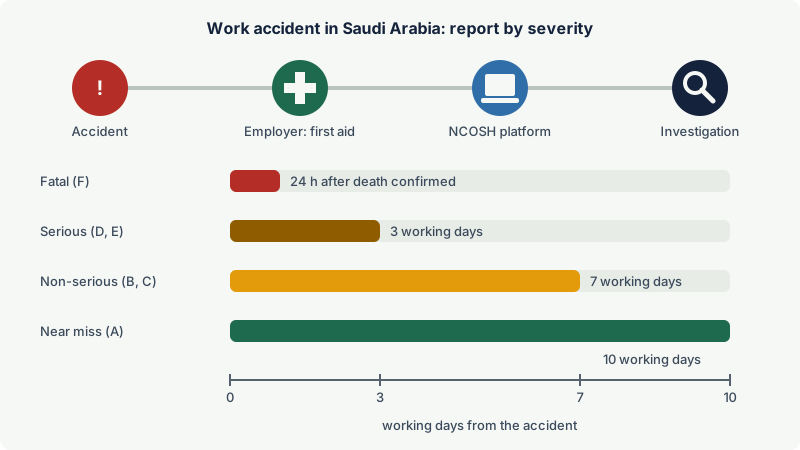
The NCOSH policy applies to the public, private and non-profit sectors. The employer (or the senior official in the public sector) reports through its account on the NCOSH electronic platform, registers its workers so that they can also report, and must respond to a worker's report within two working days. Health facilities report injuries and occupational diseases they treat.
| Grade | Examples in the policy | Deadline on the NCOSH platform |
|---|---|---|
| F (serious, level 2) | One or more deaths, serious injury causing permanent disability | Within 24 hours of confirmation of death by the competent authority |
| D and E (serious, level 2) | Severe injury to vital organs, injury that may cause partial disability, hospital admission, probable occupational disease | Within 3 working days of the accident |
| B and C (non-serious, level 1) | Injury needing medical treatment, lost time, temporary change of job, symptoms of occupational disease | Within 7 working days |
| A (near miss, level 1) | First aid case, near miss, unsafe conditions and acts | Within 10 working days |
The policy words the grade F limit around deaths; where a grade F injury involves no death, report without delay and confirm the timing with NCOSH. A separate table grades accidents with only material damage by loss as a share of the establishment's capital. For level 1 accidents, the employer appoints an investigator accredited by NCOSH to find the root causes and uploads the report; for level 2, the sector regulator may ask NCOSH to form an investigation team.
Insurance runs in parallel. Workers covered by GOSI's occupational hazards branch are compensated under the Social Insurance Law (Labor Law Article 132), and GOSI's employer guidance asks the employer to notify GOSI within three days of learning of an injury that needs more than first aid; the worker should tell the employer within seven days. Check the current GOSI online procedure, as its legacy guidance still refers to paper forms.
Inspections, penalties and liability
MHRSD inspectors visit establishments, record violations and fine according to the ministry's violations table. Fines depend on the violation and the establishment size and, for some violations, are multiplied by the number of workers affected. Employers can object to a violation or apply for a settlement through MHRSD services.
The violations table published in MHRSD's employer compliance guide (2021 edition) gives, for example: failure to apply OSH rules and precautions under Article 122, SAR 10,000 for 51 or more workers, SAR 5,000 for 11 to 50 and SAR 2,500 for 10 or fewer; employing a worker in the sun during the banned hours, SAR 3,000 per worker; failing to give the annual medical examination to exposed workers, SAR 3,000, 2,000 or 1,000 per worker by size. The table may have been revised since 2021; use the current MHRSD table for any calculation.
Civil liability for injuries rests on Articles 133 to 140 where GOSI does not cover the worker: the employer pays treatment, wage replacement and compensation, with a minimum of SAR 54,000 for death or permanent total disability (Article 138).
Chemicals, explosive atmospheres, major hazards and PPE
Chemicals. No stand-alone OSH chemicals regulation was found among the MHRSD and NCOSH texts. The NCOSH hazardous chemicals guide recommends the Globally Harmonized System (GHS) for classification and labelling, and Saudi Arabia is not listed on the UNECE GHS implementation page. Confirm current labelling and safety data sheet rules with SASO and the environmental and sector regulators.
Explosive atmospheres. SASO's Technical Regulation for Electrical Devices and Equipment Intended for Use in Explosive Atmospheres (اللائحة الفنية للأجهزة الكهربائية والمعدات المعدّة للاستخدام في الأجواء القابلة للانفجار) was adopted at SASO Board meeting No. 194 of 13/3/1445 AH (28 September 2023) and published on 17 November 2023. It applied 365 days after publication, with 548 days for suppliers to correct products already on the market. Despite its title, its scope follows the EU ATEX equipment directive: electrical and non-electrical equipment, protective systems, and safety and control devices, in equipment groups I (mining, categories M1 and M2) and II (categories 1 to 3). It requires a SASO conformity certificate before products are placed on the Saudi market, and its reference standards include SASO adoptions of the IEC 60079 series, ISO 80079-36 and ISO 80079-37 and EN 1127-1. Area classification and the selection and inspection of Ex installations are not set out in the Labor Law; in practice they follow IEC 60079 standards and the requirements of the operator and sector regulator. See which Ex certification is needed in the Gulf.
Major hazards. Labor Law Articles 127 to 131 apply to major-hazard establishments: facilities that handle hazardous materials above set quantities. The ministry sets the criteria, employers must determine with the ministry whether they fall under them, and the Minister is to issue the detailed rules on prevention, public protection and workers' rights. No published implementing regulation was found on the MHRSD or NCOSH sites (November 2026); large process sites also answer to their sector, industrial security and Civil Defence regulators.
PPE. PPE must be free (Article 122) and suitable (Article 123). The high-risk occupations regulation requires protective equipment to conform to SASO technical regulations and standards.
Comparison with the EU framework and Türkiye
| Topic | Saudi Arabia | EU (Directive 89/391/EEC) | Türkiye (Law No. 6331) |
|---|---|---|---|
| Main law | Labor Law 2005, Part VIII, plus decisions and NCOSH regulations | Framework Directive transposed into national law | Stand-alone OSH law, 2012 |
| OSH professionals | 1 per 50 (high-risk) or 1 per 100 workers at 50+ workers, licensed by NCOSH | Protective and preventive services, size per national law | OSH specialist and workplace physician for every employer, in-house or external; limited self-service for small low-risk firms |
| Risk assessment | Part of the OSH Management Regulation at 50+ workers; precautions for all | Mandatory, documented | Mandatory, renewed at least every 2, 4 or 6 years by hazard class |
| Injury reporting | NCOSH platform: 24 h fatal, 3, 7 or 10 working days; GOSI notification | Deadlines set nationally | Social Security Institution (SGK) within 3 working days of the accident |
| Committees | Joint committee at intermediate and higher levels | Consultation and participation of workers | OSH committee at 50+ workers for work lasting over 6 months |
| Ex equipment | SASO technical regulation and certificate | ATEX 2014/34/EU | Regulation transposing 2014/34/EU (2016) |
Common mistakes
- Reporting only to GOSI. GOSI covers insurance; the NCOSH platform has its own deadlines by severity, starting at 24 hours for fatal accidents.
- Using the 1:100 ratio in a high-risk activity. Construction, oil and gas, mining, chemicals and the other listed activities need 1 OSH worker per 50 workers; use the band tables in the decision's guide, which round fractions of 0.5 or more up.
- Hiring unlicensed safety officers. Under the licensing regulation in force since July 2026, OSH practitioners and service providers need an NCOSH licence or accreditation.
- English-only signs. Article 122 requires Arabic plus the languages workers understand; MHRSD's employer compliance guide asks for safety instructions in all the workers' languages, at least Arabic and English.
- Planning outdoor work at noon in summer. The ban from 12:00 to 15:00 runs from 15 June to 15 September and fines are per worker.
- Relying on an ATEX or IECEx certificate alone. Equipment in scope needs the SASO conformity certificate.
Frequently asked questions
Does Saudi Arabia have a separate occupational safety and health law?
No. OSH duties sit in Part VIII of the Labor Law of 2005, ministerial decisions of MHRSD and regulations and policies of NCOSH. Fire, products and specific industries have their own regulators.
Who inspects workplaces for safety?
MHRSD labour inspectors carry out OSH inspections and impose fines under the violations table. Civil Defence inspects fire safety, and sector regulators supervise the establishments they license.
When must a fatal accident be reported?
Within 24 hours of confirmation of death by the competent authority, on the NCOSH electronic platform. GOSI must also be notified for insured workers.
Do small firms need an OSH management system?
The OSH Management Regulation and the OSH staffing ratio apply to establishments with 50 or more workers. Smaller employers still have every Labor Law duty: precautions, instructions, PPE, fire safety, first aid and medical examinations for exposed workers.
Is the midday break the same every year?
Yes. Since Decision No. 3337 of 1435 AH the ban runs from 15 June to 15 September, 12:00 to 15:00, for outdoor work in the sun. Exemptions in the original 2010 decision for oil and gas and emergency maintenance work require other sun protection.
Related on excodex
- What is the main OSH law in Saudi Arabia and who enforces it?
- How and within what time must a workplace accident be reported in Saudi Arabia?
- Must an employer in Saudi Arabia appoint a safety professional or an occupational physician?
- How are explosive atmospheres and Ex equipment regulated in Saudi Arabia?
- Occupational safety and health in the United Arab Emirates
- Heat stress, WBGT and cold stress
Standards and further reading
- Labor Law, Royal Decree No. M/51 of 23/8/1426 AH (27 September 2005), Bureau of Experts: laws.boe.gov.sa; Part VIII on MHRSD: hrsd.gov.sa
- NCOSH, OSH rules and regulations library (OSH Management Regulation 2018, OSH staffing decision 2019, first aid decision 2007, sun ban decisions, reporting policy 2023, 2025 regulations, inspection mechanism, employer compliance guide): ncosh.gov.sa
- Ministerial Decision No. 1559/1 of 22/6/1431 AH on outdoor work in the sun, English translation: hrsd.gov.sa
- Umm Al-Qura (Official Gazette): Council of Ministers Decision No. 379 of 7/7/1443 AH on the NCOSH organisation (uqn.gov.sa); NCOSH regulations on occupational fitness examinations (uqn.gov.sa), licensing of OSH practitioners and service providers (uqn.gov.sa) and work in high-risk occupations (uqn.gov.sa)
- GOSI, employer questions on occupational injuries: gosi.gov.sa
- SASO Technical Regulation for Electrical Devices and Equipment Intended for Use in Explosive Atmospheres (2023): saso.gov.sa
- UNECE, GHS implementation by country: unece.org
- ILO Guidelines on occupational safety and health management systems, ILO-OSH 2001.
- IEC 60079 series, explosive atmospheres.
This article is general occupational safety and health information prepared by the excodex editorial team. It does not replace the applicable legislation, standards, manufacturers' instructions or the assessment of a competent OSH professional or occupational physician.
Questions on this topic
- What is the main occupational safety and health law in Saudi Arabia and who enforces it?
- Must an employer in Saudi Arabia appoint a safety professional or an occupational physician?
- Is a written risk assessment mandatory in Saudi Arabia, and how often must it be reviewed?
- How and within what time must a workplace accident be reported in Saudi Arabia?
- What OSH training must employers provide to workers in Saudi Arabia?
- Are pre-employment and periodic medical examinations required for workers in Saudi Arabia?
- What are the penalties for breaking occupational safety rules in Saudi Arabia?
- Is a safety committee or a worker safety representative required in Saudi Arabia?
- How are explosive atmospheres and Ex equipment regulated in Saudi Arabia?
- Which rules apply to major-hazard chemical sites in Saudi Arabia?