Occupational safety International framework and country guides
Must an employer in Saudi Arabia appoint a safety professional or an occupational physician?
Part of: Occupational safety and health in Saudi Arabia: law, authorities and employer duties
Short answer
Yes, from 50 workers: 1 OSH staff member per 50 workers in high-risk activities or per 100 in others (Decision 76509, 2019), licensed by NCOSH, plus a full-time first aider. No in-house physician is required, but exposed workers need a doctor's examination every year.
Yes, a safety professional is required once an establishment has 50 or more workers: Ministerial Decision No. 76509 of 15/4/1441 AH (12 December 2019) requires 1 OSH staff member per 50 workers in listed high-risk activities and 1 per 100 in other activities, applied in bands (for example 2 OSH staff for 50 to 100 workers in a high-risk activity). No headcount rule requires an in-house occupational physician, but a doctor must examine exposed workers at least once a year and a full-time first aider is required from 50 workers.
Short answer
- OSH staff: establishments with 50 or more workers; ratio 1:50 (2%) in high-risk activities such as construction, oil and gas, electricity, water and gas, health services, mining and quarrying, cement, petrochemicals and listed manufacturing, 1:100 (1%) in other activities.
- Levels: 30% to 40% "professional" and 60% to 70% "practitioner" level.
- Saudi nationals: at least 70% of OSH staff since 1 January 2022.
- Licence: under the NCOSH licensing regulation (2025), OSH staff need an NCOSH licence or accreditation, valid three years.
- Medical: annual examination by a doctor for workers exposed to scheduled occupational diseases (Labor Law Article 143); fitness examinations under an accredited occupational medicine physician (fitness examinations regulation, Ministerial Decision No. 33232 of 2025).
- First aid: full-time certified first aider at 50 or more workers (Decision No. 1/400 of 1428 AH).
The OSH staffing decision
The 2019 decision was issued under the Nitaqat localisation programme and uses its establishment sizes: medium A (50 to 99 workers), medium B (100 to 199), medium C (200 to 499) and large and giant (500 or more). The OSH staffing ratio and the Saudi share apply to all of them; establishments below 50 workers are not covered by the ratio, though every Labor Law duty still applies.
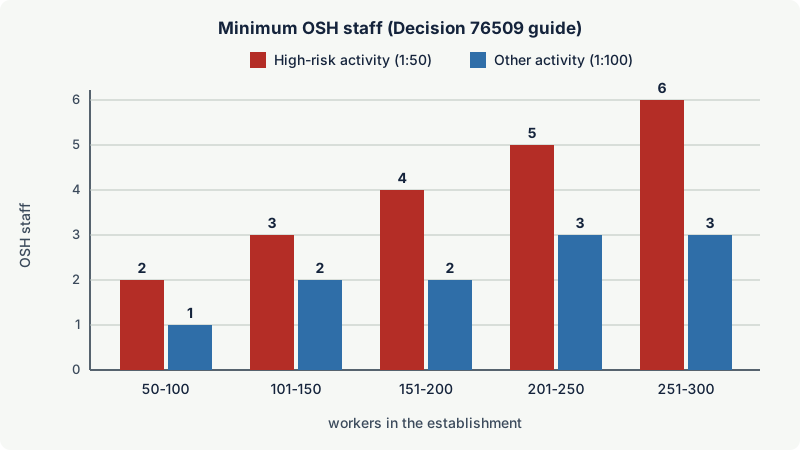
The guide attached to the decision converts the ratios into bands. Its tables give these minimum numbers of OSH staff:
| Workers | High-risk activity (1:50) | Other activity (1:100) |
|---|---|---|
| 50 to 100 | 2 | 1 |
| 101 to 150 | 3 | 2 |
| 151 to 200 | 4 | 2 |
| 201 to 250 | 5 | 3 |
| 251 to 300 | 6 | 3 |
| 951 to 1,000 | 20 | 10 |
For the Saudi share and the professional and practitioner split, fractions of 0.5 or more are rounded up and smaller fractions down. An establishment that employs more OSH staff than the minimum must still meet the Saudi share and the level split for all of them. Sector regulators may add stricter localisation requirements for OSH roles.
The 2025 NCOSH Regulation on Licensing and Accreditation of OSH Practitioners and Service Providers states that no entity may appoint, employ or assign OSH tasks to anyone without an NCOSH licence or accreditation, and that consultancies and occupational health providers also need licensing. It defines a "professional" track (at least a bachelor's degree in OSH or equivalent, or long experience with professional certificates) and a "practitioner" track (basic OSH qualifications or other degrees with OSH experience and training). It applies 180 days after publication in the Official Gazette; confirm the date.
Doctors, nurses and first aiders
The Labor Law does not require a full-time occupational physician by size. Instead:
- Article 143: one or more doctors must give workers exposed to the occupational diseases scheduled under the Social Insurance Law a comprehensive examination at least once a year, recorded in the employer's and the worker's files.
- Article 144: preventive and curative health care to the Minister's standards, taking cooperative health insurance into account.
- Decision No. 1/400 (2007): from 50 workers, a full-time first aider with certified qualifications and a first aid room within 200 m of the farthest workplace (unless rapid transport exists); above 500 workers and at least 10 km from a health unit, an ambulance and telephone.
- The Regulation on Occupational Fitness Examinations and Non-Communicable Diseases (Ministerial Decision No. 33232 of 11/3/1447 AH, September 2025, published by NCOSH) requires pre-employment and periodic examinations to be carried out under an occupational medicine physician accredited by the Saudi Commission for Health Specialties.
Example: A food factory (food manufacturing is a listed activity) has 300 workers. The guide's table gives 6 OSH staff: 2 professionals and 4 practitioners, and at least 4 Saudi nationals (70% of 6 is 4.2, rounded down to 4). It needs a full-time first aider and room. It may contract an accredited occupational health provider for the fitness and annual examinations instead of employing a physician.
Related on excodex
- Occupational safety and health in Saudi Arabia: law, authorities and employer duties
- Are pre-employment and periodic medical examinations required for workers in Saudi Arabia?
- Is a safety committee or a worker safety representative required in Saudi Arabia?
- OSH law comparison: appointments and reporting deadlines
Standards and further reading
- Ministerial Decision No. 76509 of 15/4/1441 AH on localisation of the OSH profession, with guide: ncosh.gov.sa
- NCOSH Regulation on Licensing and Accreditation of OSH Practitioners and Service Providers (2025): ncosh.gov.sa
- Ministerial Decision No. 1/400 of 1/4/1428 AH on first aid rooms: ncosh.gov.sa
- Labor Law Articles 142 to 144: hrsd.gov.sa
This article is general occupational safety and health information prepared by the excodex editorial team. It does not replace the applicable legislation, standards, manufacturers' instructions or the assessment of a competent OSH professional or occupational physician.
More questions on this topic
- What is the main occupational safety and health law in Saudi Arabia and who enforces it?
- Is a written risk assessment mandatory in Saudi Arabia, and how often must it be reviewed?
- How and within what time must a workplace accident be reported in Saudi Arabia?
- What OSH training must employers provide to workers in Saudi Arabia?
- Are pre-employment and periodic medical examinations required for workers in Saudi Arabia?
- What are the penalties for breaking occupational safety rules in Saudi Arabia?
- Is a safety committee or a worker safety representative required in Saudi Arabia?
- How are explosive atmospheres and Ex equipment regulated in Saudi Arabia?
Part of: Occupational safety and health in Saudi Arabia: law, authorities and employer duties