Occupational safety International framework and country guides
Occupational safety and health in Iraq: law, authorities and employer duties
Abstract
Iraq has no stand-alone OSH act: duties are in Chapter 13 of Labour Law No. 37 of 2015, enforced by the Ministry of Labour and Social Affairs, its National Centre for OSH and labour inspectors. Employers report injuries on occurrence, pay for medical checks and PPE and staff medical cover by size.
Iraq does not have a stand-alone occupational safety and health (OSH) act. The core duties are in Chapter 13 of the Labour Law No. 37 of 2015 (قانون العمل رقم 37 لسنة 2015), Articles 113 to 135, and in instructions issued by the Minister of Labour and Social Affairs. They are enforced by the Ministry of Labour and Social Affairs (وزارة العمل والشؤون الاجتماعية), its National Centre for Occupational Health and Safety (المركز الوطني للصحة والسلامة المهنية) and tripartite labour inspection committees, which can order urgent measures, suspend work and close premises.
This guide sets out the legal framework, the authorities, employer and worker duties, medical cover thresholds, reporting, inspection and penalties, and the gaps (risk assessment, Ex equipment, major hazards) where employers must rely on contract requirements and international practice. It also compares Iraq with the EU framework and Türkiye.
Key points
- The main OSH rules are in Chapter 13, Part 1 of Labour Law No. 37 of 2015 (Articles 113 to 125); Part 2 (Articles 126 to 135) covers labour inspection. The law does not apply to public officials appointed under the Civil Service Law or a special legal text, or to the armed forces, police and internal security forces (Article 3).
- The employer must provide a safe working environment, train workers, give written information on hazards before work starts, provide personal protective equipment (PPE) free of charge and arrange initial and periodic medical examinations at no cost to the worker (Articles 114, 117, 118 and 120).
- Medical cover depends on headcount: first aid everywhere; above 50 workers a nurse and a contracted physician with a clinic at the workplace; above 100 the physician attends at least two hours a day; above 500 a resident physician and a dispensary (Article 121).
- Work injuries and occupational diseases must be reported to the competent health authority as soon as they occur, and the National Centre for OSH must be informed (Article 114(2), item 6). The law gives no hour or day limit.
- Labour inspection committees may enter any workplace at any time without notice, take samples and, in serious danger, suspend work wholly or partly or evacuate the workplace (Article 129). After a warning, the Ministry may close premises or stop machines, and workers keep full pay during closure (Article 122).
- Breaches of the OSH provisions carry a fine of IQD 500,000 to 1,000,000 or imprisonment of one to six months (Article 125). These are the 2015 amounts; no later revaluation was found.
- There is no Iraqi regulation equivalent to ATEX or Seveso that we could identify. In practice, oil, gas and chemical projects apply IEC 60079 equipment certified under IECEx or ATEX, and international process safety practice, through contract specifications.
The legal framework: Labour Law No. 37 of 2015 and its instructions
Labour Law No. 37 of 2015 replaced the earlier Labour Law No. 71 of 1987. It entered into force 90 days after publication in the Official Gazette, Al-Waqai al-Iraqiya (الوقائع العراقية), under Article 174. Article 172 keeps regulations and instructions issued under the old law in force as far as they do not conflict with the new law, until they are replaced. This matters for OSH, because much of the technical detail has always been in ministerial instructions rather than in the law itself.
| Instrument (original name) | What it covers for OSH |
|---|---|
| Labour Law No. 37 of 2015 (قانون العمل رقم 37 لسنة 2015) | Chapter 13: OSH duties (Arts. 113 to 125) and labour inspection (Arts. 126 to 135); Chapter 12: quarries and mines; Chapters 10 and 11: women and minors |
| OSH instructions under the Labour Law (تعليمات الصحة والسلامة المهنية) | Technical requirements issued by the Minister (Arts. 116, 118(2), 173); Iraqi legal literature refers to instructions No. 12 of 2016 replacing instructions No. 22 of 1987 |
| Workers' Retirement and Social Security Law No. 18 of 2023 (قانون التقاعد والضمان الاجتماعي للعمال رقم 18 لسنة 2023) | Social security, including the work injury and occupational disease branch |
| Law No. 27 of 2009 on the Protection and Improvement of the Environment (قانون حماية وتحسين البيئة رقم 27 لسنة 2009) | Environmental impact reports with emergency measures, dangerous chemicals and wastes, incident reporting by oil and gas operators |
We could not open the text of the 2016 instructions, so this guide does not attribute specific technical duties to them. Employers should obtain the current instructions from the Ministry or the National Centre for OSH before relying on any detail.
At international level, Iraq ratified the ILO Safety and Health in Agriculture Convention, 2001 (No. 184), in 2020, the first Arab country to do so, and it has been in force for Iraq since May 2022. It ratified the Social Security (Minimum Standards) Convention, 1952 (No. 102), in 2022, in force since March 2023 (UN in Iraq, July 2024). In November 2022, unions, the ILO and the National Centre for OSH (Basra branch) at a workshop on the oil and gas sector called for the speedy enactment of an OSH law in line with the Occupational Safety and Health Convention, 1981 (No. 155), which shows that a comprehensive OSH act had not yet been adopted. Check the ILO NORMLEX country profile for the current ratification list, including C155 and C187.
Note: The Kurdistan Region has its own Ministry of Labour and Social Affairs, which co-signed the ILO-supported labour inspection policy and national OSH profile in November 2022. A 2024 academic study of industrial workshops in Duhok reports that labour directorates in the Kurdistan Region still rely on the OSH instructions No. 22 of 1987 to assess enterprises and grant work licences. In the Kurdistan Region, confirm with the regional ministry which labour law and instructions apply to your site.
Who enforces OSH in Iraq
Ministry of Labour and Social Affairs (MOLSA). The Ministry is responsible for the national OSH authority and for reviewing the national OSH policy with employers' and workers' organisations (Article 115). The Minister issues the minimum OSH requirements after consulting the most representative unions or employers' associations (Article 116).
National Centre for Occupational Health and Safety. Under Article 113, the Centre plans and monitors OSH. It grants OSH licences to enterprises after checking that the safety requirements are met and the workers have been examined (Article 114(2), item 10), authorises the bodies that inspect boilers, pressure equipment, lifts and lifting gear (items 7 and 9), keeps the standard form for occupational disease exposure and prepares an annual report on accidents and injuries at workplaces with more than 50 workers (item 6). Article 115(2) gives the national OSH authority further tasks, such as evaluating workplace health hazards, taking pollution measurements and samples, monitoring workers' health and analysing accidents. The Centre has governorate branches; for example, the Basra branch took part in a November 2022 workshop on the oil and gas sector organised by the IndustriALL Global Union with the ILO.
Labour inspection. The labour inspection directorate supervises all workplaces covered by the law (Articles 126 and 127). Inspection committees are chaired by a Ministry labour inspector with a university degree and include an employers' and a workers' representative; a representative of the National Centre for OSH joins when needed (Article 128).
Other authorities. The competent health authority receives reports of injuries and diseases. The workers' social security administration handles work injury benefits. The Ministry of Environment approves environmental impact reports and receives incident reports from oil and gas operators. The Central Organization for Standardization and Quality Control, COSQC (الجهاز المركزي للتقييس والسيطرة النوعية), issues Iraqi standards, the quality mark and conformity certificates.
Employer and worker duties
The law makes cooperation between employer and workers the basis of OSH at enterprise level (Article 114(1)) and keeps full responsibility on the employer even if workers do not comply (Article 120(2)).
| Employer duty | Article |
|---|---|
| Provide a suitable, healthy and safe working environment and protect workers against hazards from work and machinery | 114(2), 118(1) |
| Train workers on how to avoid occupational hazards; spread an OSH culture; post the hazard rules visibly | 114(2), 117(2) |
| Inform each worker in writing, before work starts, of the hazards and prevention measures | 117(1) |
| Provide first aid; arrange nurse and physician cover by headcount | 114(2), 121 |
| Arrange initial and periodic medical examinations | 114(2) |
| Report injuries and occupational diseases on occurrence to the health authority and inform the Centre | 114(2) |
| Have boilers, pressure equipment, lifts and lifting gear inspected yearly by bodies authorised by the Centre | 114(2) |
| Provide PPE free of charge; no deductions from wages for protective means | 114(2), 118(1) |
| Organise emergency plan management | 114(2) |
| Give workers' representatives sufficient information on OSH measures | 123 |
Workers must follow OSH orders and instructions, use preventive equipment and wear PPE, keep the dates of periodic medical examinations set by the enterprise physician or the medical authority, not bring psychotropic substances to work or work under their influence, cooperate with the employer, and stay away from the work site in case of real danger (Article 119). Repeated breach of OSH instructions is one of the grounds on which the law allows dismissal (Article 141).
Special groups have extra protection. Pregnant and nursing women may not be made to do work the health authority considers harmful (Article 85). Minors aged 15 to 18 may not do hazardous work, need a medical fitness certificate before employment and are examined at least yearly (Articles 95 to 97). In quarries and mines, a medical examination is required before employment and again before the contract ends (Article 106).
Medical cover, safety staff and OSH services
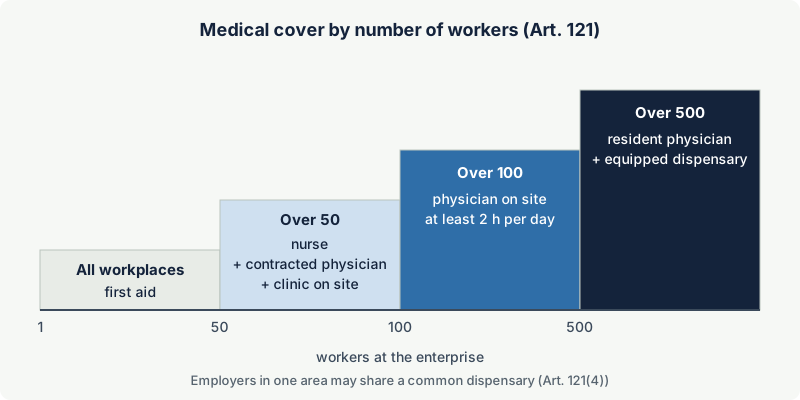
Article 121 is the clearest staffing rule in Iraqi OSH law. Every workplace must have first aid. Above 50 workers, the employer engages a nurse for first aid and contracts a physician who treats workers in a clinic at the workplace, free of charge. Above 100 workers, the physician must attend at least two hours a day. Above 500 workers, the employer appoints a resident physician and sets up an equipped dispensary. Employers in one area may share a common dispensary (Article 121(4)).
Labour Law No. 37 of 2015 does not require a safety engineer or OSH officer by name or set a headcount for one. We could not verify whether the ministerial instructions do. In practice, oil, gas, power and construction clients in Iraq almost always require contractors to name HSE staff in their contracts, so the contract is often the stricter requirement.
Example: A contractor employs 120 workers on a site near Basra. Under Article 121 it needs first aid points, a nurse, a contracted physician with a clinic on site attending at least two hours a day, and free medicines and treatment during work. Pre-employment and periodic medical examinations are at its cost (Article 120(3)). Each worker receives written information on the hazards before starting (Article 117), PPE is issued free, cranes on site have a valid annual inspection report from a body authorised by the National Centre for OSH, and the enterprise holds an OSH licence from the Centre. The client's contract adds an HSE plan, a named HSE manager and incident reporting within hours, which the contractor must also meet.
Risk assessment, training and medical surveillance
Risk assessment. The law does not use the term "risk assessment" or require a written assessment with a review interval, as EU law and Türkiye's Law No. 6331 do. It does require the employer to know the hazards: written hazard information to each worker (Article 117), posted hazard rules, measures against hazards from work and machinery (Article 118), and the national authority's role in identifying and evaluating workplace health hazards (Article 115(2)). A documented risk assessment is the practical way to show compliance with these duties, and it is a standard requirement in oil and gas and international contracts.
Training. The employer must train workers on how to avoid occupational hazards and disseminate an OSH culture (Article 114(2)). No minimum hours, renewal period or trainer qualifications are set in the law. Keep records of induction and job-specific training, because inspectors may examine any records the law and instructions require (Article 129).
Medical surveillance. Initial and periodic medical examinations are required for all workers (Article 114(2)), with the cost borne by the employer, including laboratory tests and X-rays (Article 120(3)). The law does not list exposure-specific tests or intervals; the enterprise physician or competent medical authority sets the schedule (Article 119). Minors and mine and quarry workers have the specific rules described above.
Accident and disease reporting
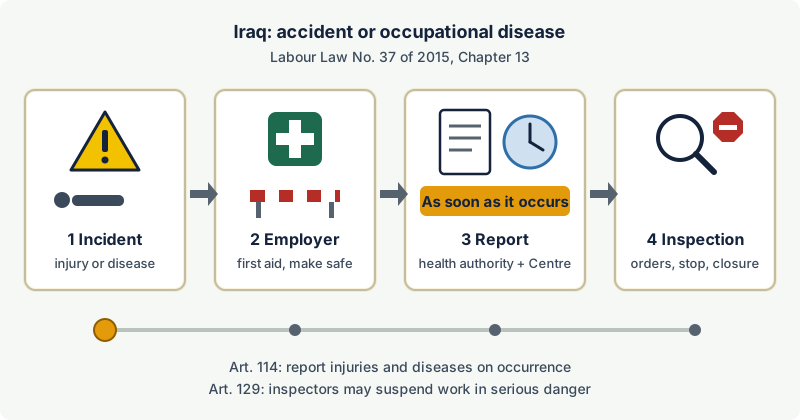
Article 114(2), item 6 requires the employer to report incidents, work injuries and occupational diseases to the relevant health authority as soon as they occur and to inform the National Centre for OSH. The notice must include details of the enterprise and employer, the injured person, the nature of the injury or disease, the workplace and the circumstances. For occupational diseases, the exposure circumstances are recorded on a standard form of the Centre.
Three further reporting routes often apply:
- Social security. For insured workers, work injury benefits are handled under the Workers' Retirement and Social Security Law No. 18 of 2023. For uninsured workers, Article 124 applies the work injury provisions of the social security law and makes the employer pay the social security administration 50% of the worker's wage for one year for partial disability, or 100% for one year where the injury causes disability or death. Confirm the notification form and deadline with the social security administration.
- Environment. Oil and gas operators must report to the Ministry of Environment the causes of fires, explosions, leaks and pipeline accidents and the measures taken (Law No. 27 of 2009, Article 21).
- Police and prosecution. A fatal or serious accident may also lead to a police investigation and criminal proceedings under the general criminal law.
Participants at the November 2022 oil and gas workshop, including the ILO, called for the activation of the accident, injury and occupational disease notification and recording system developed by the ILO in Iraq. Ask the National Centre for OSH branch in your governorate how reports are submitted in practice.
Inspections, closure and penalties
Inspection committees may enter workplaces at any time, day or night, without prior notice; question the employer and workers; examine and copy records; take samples after notifying the employer; order changes to installations within a set time; and take emergency measures in case of imminent danger, including total or partial suspension of work or evacuation (Article 129). The police assist when asked (Article 130). Inspectors keep the source of a complaint confidential (Article 132).
| Measure or offence | Consequence | Article |
|---|---|---|
| Breach of the OSH provisions of Chapter 13 | Fine of IQD 500,000 to 1,000,000, or imprisonment of 1 to 6 months | 125 |
| OSH instructions not applied after a warning | Closure of premises or shut-down of machines until corrected; wages paid in full | 122(3) |
| Serious and immediate danger | Total or partial suspension of work, evacuation | 129(2) |
| Obstructing inspectors | Imprisonment of at least 1 month, or a fine of IQD 100,000 to 500,000 | 135 |
| Breach of the quarry and mine provisions | Imprisonment of 10 days to 3 months, or a fine of IQD 100,000 to 500,000 | 112 |
The Minister must warn the employer before referral to the labour court, and the inspection report is accepted as evidence unless disproved (Article 134). The amounts are those in the 2015 law; we found no later revaluation. The English translation consulted misprints the upper limit of the Article 125 fine; the IQD 1,000,000 maximum is taken from the Arabic text as quoted in a 2025 Iraqi legal study. Civil compensation and criminal liability for negligent death or injury apply in addition.
Chemicals, explosive atmospheres, major hazards and PPE
Chemicals and GHS. Iraq is not listed on the UN Economic Commission for Europe (UNECE) page of countries that have implemented the Globally Harmonized System (GHS), checked in November 2026. Law No. 27 of 2009 allows national registers of dangerous chemicals and wastes (Article 19) and prohibits producing, importing, transporting or storing dangerous substances without the required procedures and approvals (Article 20). In practice, use GHS labels and 16-section safety data sheets from suppliers and keep them in Arabic and the workers' languages.
Explosive atmospheres and Ex equipment. We found no Iraqi regulation on explosive atmospheres or a national Ex certification scheme. The legal hooks are general: protection against hazards from work and machinery (Article 118), safety verification of dangerous machinery by bodies authorised by the Centre (Article 114(2)), and COSQC's role in technical inspection of machinery and conformity certificates. Oil, gas and petrochemical owners specify hazardous area classification to IEC 60079-10-1 and equipment certified under IECEx or ATEX. Check import conformity requirements for the product category with COSQC. See the IECEx scheme explained.
Major-hazard sites. There is no Seveso-type law in Iraq that we could identify. New projects need an environmental impact report covering emergency pollution cases and precautions (Law No. 27 of 2009, Article 10), and the employer must organise emergency plan management (Labour Law, Article 114(2)). Most major-hazard operators in Iraq are in oil, gas and petrochemicals and apply their owners' process safety standards. Check NORMLEX for the status of the Prevention of Major Industrial Accidents Convention, 1993 (No. 174).
PPE. PPE must be suitable and free of charge (Articles 114(2) and 118). The National Centre for OSH sets the instructions on preventive equipment and how to use it, issued by the Minister (Article 118(2)). We found no Iraqi PPE conformity mark. Specify PPE to recognised standards (EN, ISO or ANSI/ISEA) and keep the certificates.
Iraq compared with the EU and Türkiye
| Topic | Iraq | EU (Directive 89/391/EEC) | Türkiye (Law No. 6331) |
|---|---|---|---|
| Main OSH law | Labour Law No. 37 of 2015, Chapter 13 | Framework Directive, transposed by each member state | Law No. 6331 of 2012 (İş Sağlığı ve Güvenliği Kanunu) |
| Written risk assessment | Not named in the law; hazard information in writing | Required, documented | Required (Art. 10) and detailed regulation |
| Safety professional | Not required by the law | Designated workers or external services (Art. 7) | OSH expert for every employer, own staff or a joint OSH unit; the trained employer may act in less hazardous firms under 50 workers (Art. 6) |
| Physician | Contracted above 50, resident above 500 workers | Set by national law | Workplace physician for every employer (Art. 6) |
| Accident reporting | On occurrence, to the health authority and the Centre | Set by national law; list of accidents causing more than three working days' unfitness (Art. 9) | To the Social Security Institution (SGK) within 3 working days (Art. 14) |
| Committee and representatives | Information to workers' representatives (Art. 123) | Consultation and worker representatives (Art. 11) | OSH committee at 50 or more workers and work over 6 months (Art. 22) |
Notable national specifics
- Heat. Summer temperatures reach up to 50 °C, and in August 2022 the ILO called for suitable clothing, drinking water, shade, work in cooler hours and breaks; about one in four workers is in construction or agriculture. Law No. 37 lets the Minister shorten hours for arduous or harmful work on the Centre's proposal (Article 67(3)), but we found no current heat-specific instruction.
- Oil and gas. A November 2022 workshop of unions, the ILO and the Basra branch of the National Centre for OSH raised serious concerns about OSH in the southern oil and gas sector, including gas emissions and occupational disease linked to poor compliance. Contract HSE requirements in this sector are usually far stricter than the legal minimum.
- Policy work. With ILO support, the federal and Kurdistan Region ministries launched a labour inspection policy and a national OSH profile in 2022, and work on a national OSH policy for agriculture began in 2024.
Common mistakes
- Assuming there is a stand-alone OSH act. The duties are in Chapter 13 of Labour Law No. 37 of 2015 and in ministerial instructions; read both, and the contract.
- Waiting for a deadline to report. The law requires reporting as soon as the injury or disease occurs; report the same day and keep proof.
- Charging workers for PPE or medical checks. The law prohibits wage deductions for protective means and puts all medical costs on the employer.
- Ignoring the physician thresholds. Above 50 workers a nurse and contracted physician with a clinic are required; above 500, a resident physician.
- Applying federal rules unchecked in the Kurdistan Region. Confirm the applicable law and instructions with the regional ministry.
- Treating the absence of an ATEX-type law as freedom to use non-Ex equipment. The general duty to protect against machinery hazards and every serious client specification still require certified Ex equipment in hazardous areas.
Frequently asked questions
Does Iraq have a specific OSH law?
Not as a separate act. OSH is regulated by Chapter 13 of Labour Law No. 37 of 2015 and instructions issued under it. A comprehensive OSH law in line with ILO Convention No. 155 has been called for, so check whether one has since been adopted.
Who inspects workplaces in Iraq?
Labour inspection committees under the Ministry of Labour and Social Affairs, chaired by a labour inspector and including employers' and workers' representatives. A representative of the National Centre for OSH joins when needed, and the committees may enter without notice.
Does the Labour Law apply to foreign workers and contractors?
Yes. Article 3 applies the law to all workers in Iraq, except public officials appointed under the Civil Service Law or a special legal text and members of the armed forces, police and internal security forces. Foreign workers and contractor staff are therefore covered, and the contractor as their employer carries the duties.
Is a written risk assessment legally required in Iraq?
The law does not name a written risk assessment, but it requires written hazard information for every worker and measures against all work hazards. A documented risk assessment is the practical way to prove this and is required by most clients.
What is the OSH licence of the National Centre?
Article 114(2) lets the Centre grant an OSH licence to an enterprise after checking that the safety requirements are met and the workers have been examined, for fees set by ministerial instructions. Ask the Centre's governorate branch for the current procedure.
Related on excodex
- What is the main OSH law in Iraq and who enforces it?
- How and within what time must a workplace accident be reported in Iraq?
- Must an employer in Iraq appoint a safety professional or physician?
- How are explosive atmospheres and Ex equipment regulated in Iraq?
- OSH law comparison: appointments and reporting deadlines
- EU Framework Directive 89/391/EEC explained
Standards and further reading
- Labour Law No. 37 of 2015 (قانون العمل رقم 37 لسنة 2015), Iraq, Chapter 13, Articles 113 to 135; unofficial English translation consulted: alnoor.edu.iq. The Arabic text in Al-Waqai al-Iraqiya is authoritative.
- Law No. 27 of 2009 on the Protection and Improvement of the Environment, FAO FAOLEX: faolex.fao.org
- Workers' Retirement and Social Security Law No. 18 of 2023 (text not opened; summary in the UN source below).
- ILO and UN in Iraq, national OSH policy work for agriculture (July 2024): iraq.un.org
- ILO, OSH in the Iraqi oil and gas sector (November 2022): ilo.org
- ILO, labour inspection policy and national OSH profile launched (November 2022): ilo.org
- ILO, OSH during extreme heat in Iraq (August 2022): ilo.org
- COSQC, functions of the standards body: cosqc.gov.iq
- UNECE, GHS implementation by country: unece.org
- Iraqi Academic Scientific Journals, study of OSH rights under Labour Law No. 37 of 2015, quoting Article 125 and the OSH instructions (2025): iasj.rdd.edu.iq
- Iraqi Academic Scientific Journals, evaluation of OSH procedures in industrial workshops in Duhok (2024): iasj.rdd.edu.iq
- IEC 60079 series (explosive atmospheres): equipment, area classification, installation and inspection.
This article is general occupational safety and health information prepared by the excodex editorial team. It does not replace the applicable legislation, standards, manufacturers' instructions or the assessment of a competent OSH professional or occupational physician.
Questions on this topic
- What is the main occupational safety and health law in Iraq and who enforces it?
- Must an employer in Iraq appoint a safety professional or an occupational physician?
- Is a written risk assessment mandatory in Iraq, and how often must it be reviewed?
- How and within what time must a workplace accident be reported in Iraq?
- What OSH training must employers provide to workers in Iraq?
- Are pre-employment and periodic medical examinations required for workers in Iraq?
- What are the penalties for breaking occupational safety rules in Iraq?
- Is a safety committee or a worker safety representative required in Iraq?
- How are explosive atmospheres and Ex equipment regulated in Iraq?
- Which rules apply to major-hazard chemical sites in Iraq?