The IECEx scheme explained: CoC, ExTR, QAR and the online certificate database
Abstract
IECEx is the IEC's international certification system for Ex equipment, services and people. How it is organised, what the ExTR, QAR and CoC are, how to read a CoC and check its status online, and what the service facility, personnel and mark schemes do.
IECEx, the IEC System for Certification to Standards Relating to Equipment for Use in Explosive Atmospheres, is the International Electrotechnical Commission's certification system for the Ex sector. In its equipment scheme, an approved certification body (ExCB) issues a Certificate of Conformity (CoC) only when two reports exist: an Ex Test Report (ExTR) showing that a sample complies with the listed IEC or ISO/IEC standards, and a Quality Assessment Report (QAR) showing that the factory can reproduce that sample consistently. Every CoC is published in the IECEx online database, where its status (current, suspended or cancelled) is the controlling record. IECEx also certifies repair and service facilities and the competence of individual people.
This article explains how the system is organised, what each document proves, how to read a CoC field by field and check it online, and what the other IECEx schemes do. For the comparison with European law, see ATEX vs IECEx.
Key points
- IECEx was set up in 1996 and is one of the IEC's four conformity assessment systems; it has 36 member countries and is endorsed by the UN Economic Commission for Europe (UNECE).
- It runs four schemes: certified equipment, certified service facilities, certification of personnel competence, and the conformity mark licensing system.
- A CoC requires both an ExTR (design tested to the standards) and a QAR (factory audited, using ISO/IEC 80079-34); the ExTR, QAR and CoC may come from different IECEx bodies.
- A CoC has no expiry date. It stays valid while its status online is "Current", which depends on factory surveillance audits every 12 months, or every 18 months where the site also holds ISO 9001 certification.
- New CoCs may be issued only against the current edition of a standard or the one before it; existing CoCs need not be upgraded when a new edition appears.
- CoC numbers read
IECEx ABC 26.0012: issuing body code, last two digits of the year, running number, plus X or U where applicable. - IECEx is not a law. It becomes binding where a regulator or a contract adopts it; for example, Queensland's electrical safety regulator accepts IECEx CoCs as the way to show compliance for hazardous area equipment.
How the IECEx system is organised
IECEx sits inside the IEC, which itself does not certify. The system is run by the IECEx Management Committee (ExMC), which reports to the IEC Conformity Assessment Board. Its members are countries, each represented by a national member body, and a country must already be a full or associate member of the IEC to join. An Executive group takes operational decisions between ExMC meetings, working groups handle technical topics, and a Secretariat in Sydney, Australia, runs the system day to day.
The work is done by two kinds of approved bodies:
- ExCBs (IECEx Certification Bodies) issue ExTRs, QARs and CoCs. A candidate must be located in a member country, be recognised for certification at home, be free of manufacturing interests, be endorsed by its national member body and pass a peer assessment, after which the members vote on its acceptance. ExCBs are regularly reassessed.
- ExTLs (IECEx Testing Laboratories) carry out the tests. Each ExCB either has an ExTL in its organisation or an agreement with an accepted one, and ExTLs must take part in IECEx proficiency testing programmes.
ExCBs and ExTLs work to ISO/IEC 17065 (certification bodies) and ISO/IEC 17025 (laboratories) plus the IECEx rules and operational documents, and each one's scope lists the exact standards it may certify or test to. The equipment standards themselves are developed mainly by IEC Technical Committee 31. The approach differs from ATEX, where a body is notified by its national government under EU law; see EU-type examination certificates and notified bodies.
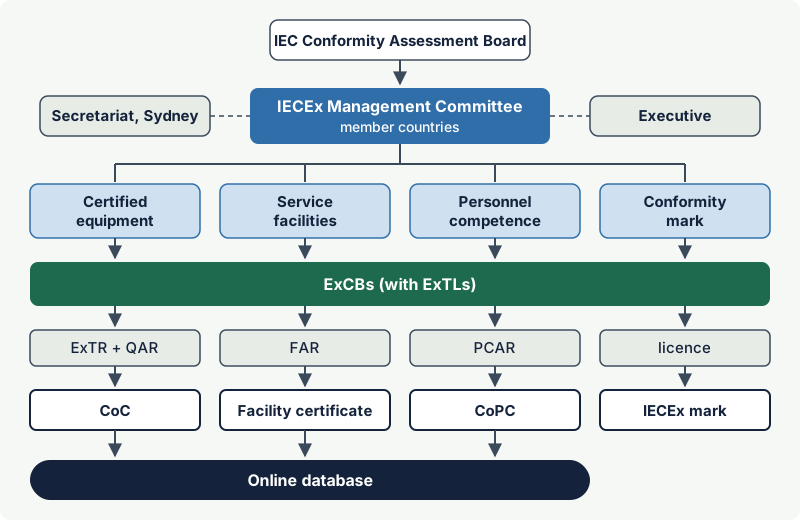
The certified equipment scheme: ExTR, QAR, CoC
The ExTR: does the design comply?
The Ex Test Report records the assessment and tests of a representative sample against every applicable clause of the standards listed, for example IEC 60079-0 and IEC 60079-1 for a flameproof enclosure. It is compiled by the ExTL, reviewed by the ExCB and registered on the IECEx website. Its number follows a pattern such as XX/ABC/ExTR26.0012/00: country code, issuing body, report number with year, and a revision suffix, and it is printed on the CoC. Because ExTRs follow common rules and a common format, an ExTR from one ExCB can support a CoC issued by another, and IECEx bodies must accept each other's test reports when issuing national certification. This is the basis of IECEx's value for national approvals.
The QAR: can the factory build it consistently?
The Quality Assessment Report records the audit of the manufacturing site, using ISO/IEC 80079-34 as the reference, and checks that the factory can reproduce the tested sample. ISO 9001 certification is not required, but where it exists the surveillance interval is 18 months instead of 12. A QAR covers a manufacturing site, so one QAR often supports several CoCs for products made there. Details are in quality assurance for Ex manufacturers.
The CoC: the certificate itself
The ExCB issues the Certificate of Conformity once it has confirmed that the ExTR and QAR are complete, cover the same product and match the manufacturing sites named. The ExTR and QAR may come from different IECEx bodies, which is common; the issuing ExCB takes final responsibility for the CoC. CoCs are prepared and issued in the IECEx online system, so the website version is the master and any printout is a copy.
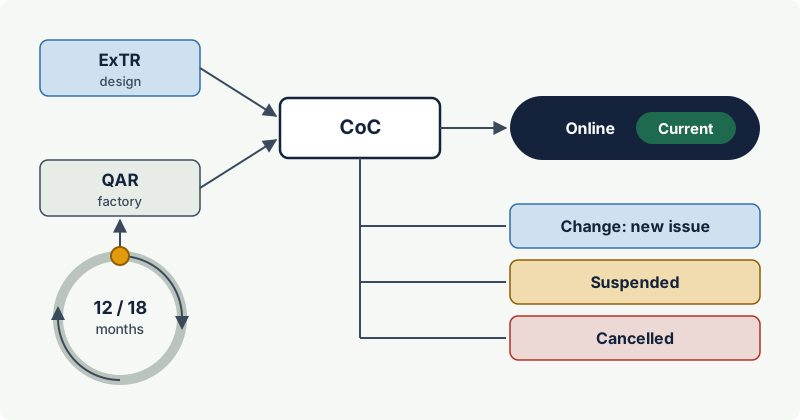
Unit verification
For specific individual items, an ExCB can issue a unit verification certificate instead. It rests on testing and assessment of those items only, without a factory audit or ongoing surveillance, so it covers only the items verified and not later production.
How to read an IECEx CoC
The CoC has a fixed layout. Reading it in order answers most questions a buyer, installer or inspector has.
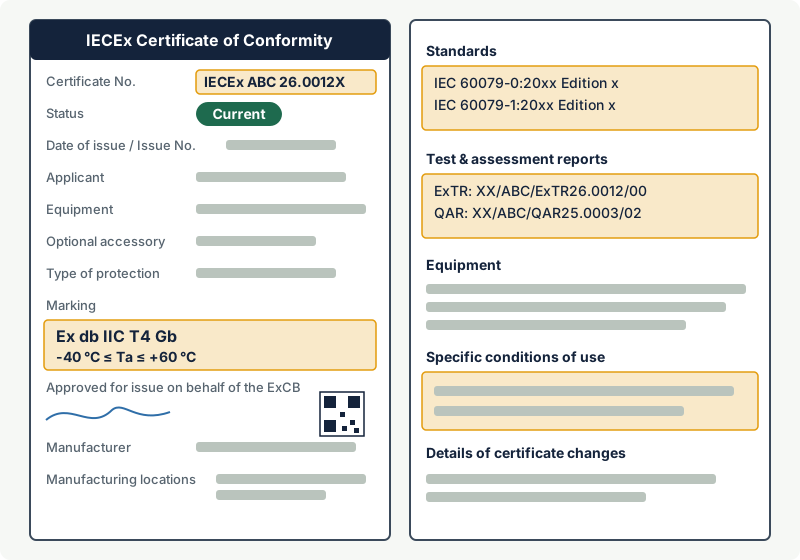
| Field | What it tells you | What to check |
|---|---|---|
| Certificate No. | IECEx ABC 26.0012X: issuing ExCB, year, number, X or U | X means specific conditions of use apply; U means an Ex component |
| Status | Current, Suspended or Cancelled | Must be Current online today |
| Date of issue, Issue No. | Issue 0 is the original; later issues follow changes | The issue that covers your product's date of manufacture |
| Applicant, Manufacturer, Manufacturing locations | Who applied and where it is made | The factory is listed for the product you received |
| Equipment, Optional accessory | Product name, models and accessories covered | Your model and accessories appear |
| Type of Protection | For example flameproof enclosure "d" | Matches what your area needs |
| Marking | The full Ex marking, for example Ex db IIC T4 Gb and the ambient range | Identical to the nameplate |
| Standards | IEC or ISO/IEC standards with editions | Editions used for certification |
| Test & Assessment Reports | ExTR and QAR numbers | Present; cross-reference for the issuing body |
| Equipment (schedule) | Description, ratings, variants | Ratings and variants fit your use |
| Specific conditions of use | Only for X certificates | Must reach the installer and the inspection file |
| Details of certificate changes | What each later issue changed | Whether a change affects you |
The certificate also states what it does not do. It confirms that a representative sample was tested to the listed standards and that the quality system was found to meet IECEx requirements, and it states that it covers no safety or performance requirements other than those in the listed standards. A flameproof gas detector's CoC therefore says nothing about how accurately it measures gas; that needs a performance standard such as IEC 60079-29-0 and its own certification.
Status, issues and editions
According to the IECEx FAQ, a suspension is temporary and allows the manufacturer to correct problems; the suspension date appears on the certificate, and equipment made before that date is not affected. A cancellation ends the certificate, for example when a product is discontinued; as with a suspension, equipment made while the certificate was Current is not affected. Both remain visible online. When a design changes, the manufacturer must tell the ExCB, which decides whether a new issue is needed; earlier issues stay current until cancelled or suspended. Additional factories can be added by a new issue after audit.
New certificates may be issued only to the current edition of a standard or the one before it. There is no rule that existing certificates must be upgraded when a new edition is published, and the IECEx FAQ points out that a new edition does not make earlier equipment unsafe, but users and manufacturers should assess what changed. This matters in 2026, when IEC 60079-0 edition 8 has just been published.
The online database: checking a certificate in practice
The public IECEx website lets anyone search certificates and see the current status and every issue of a CoC. Certificates themselves state that their status and authenticity may be verified on the IECEx website or with the QR code printed on them. A practical check takes four steps:
- Search the CoC number from the nameplate or the documentation, not from a PDF supplied by a third party.
- Confirm that the status is Current and the manufacturer and factory match the supplier and the country of origin.
- Open the latest issue and compare the marking and model designation with the nameplate, character by character.
- Read the specific conditions of use if the number ends in X, and check that the standards and their editions are acceptable to your project or regulator.
If the number cannot be found, the certificate may be mistyped, forged or not an IECEx CoC at all; ask the supplier and, if needed, the issuing ExCB. More detail is in how to verify that an Ex certificate is genuine.
Example: A buyer receives a PDF CoC for a set of Zone 1 junction boxes. Online, the same number shows the status Current, but the latest issue is number 3, while the PDF is issue 1. Issue 3 added a new factory and changed the ambient range from -40 °C to -20 °C at the lower end for one enclosure size. The nameplates show the new factory, so the buyer checks the ambient range on the plates against the site's winter minimum before accepting the delivery.
The other IECEx schemes
Certified service facilities
Repair workshops and service providers can be certified for one or more services: area classification (IEC 60079-10-1 and IEC 60079-10-2), installation design and erection with initial inspection (IEC 60079-14), inspection and maintenance (IEC 60079-17), and repair, overhaul and reclamation (IEC 60079-19). An ExCB audits the facility and issues a Facility Assessment Report (FAR) and an IECEx certified service facility certificate, both published online. The certificate shows that the facility has an independently confirmed ability to deliver the service; it is not a certificate for any particular installation, classification drawing or repaired item. See repair, overhaul and modification of Ex equipment.
Certification of personnel competence
Individuals can obtain an IECEx Certificate of Personnel Competence (CoPC) for units of competence, from Ex 000 (basic knowledge and awareness for entering a site with a classified hazardous area) to Ex 010 (audit inspection), plus a newer unit Ex 011 on basic knowledge of hydrogen system safety. An ExCB carries out theoretical and practical assessments, issues a Personnel Competence Assessment Report (PCAR) and creates the CoPC in the online system; a CoPC is typically valid for five years, after which the holder is reassessed. Training by a recognised training provider is not certification. See competence of people working in hazardous areas.
| Unit | Activity |
|---|---|
| Ex 000 | Basic knowledge and awareness to enter a site with hazardous areas |
| Ex 001 | Applying basic principles of protection |
| Ex 002 | Classifying hazardous areas |
| Ex 003 | Installing explosion-protected equipment and wiring |
| Ex 004 | Maintaining equipment |
| Ex 005 | Overhauling and repairing explosion-protected equipment |
| Ex 006 | Testing electrical installations |
| Ex 007 | Visual and close inspection |
| Ex 008 | Detailed inspection |
| Ex 009 | Designing installations |
| Ex 010 | Audit inspection |
| Ex 011 | Basic knowledge of the safety of hydrogen systems |
Conformity mark licensing
The IECEx conformity mark is a voluntary mark that tells users a product is covered by an IECEx CoC. Under the scheme rules (IECEx 04), the IEC owns the mark and licenses it to ExCBs, which license manufacturers; the mark may be used only on products covered by a valid CoC and must carry a reference to the licensing ExCB and licence number. A product without the mark can still be fully IECEx certified; the CoC number is what counts.
Where IECEx is accepted
Acceptance is decided by each country, not by IECEx. Some regulators accept CoCs directly: Queensland's electrical safety regulator, for example, states that compliance of hazardous area equipment with Australian Standards is demonstrated through IECEx certificates of conformity, and that ATEX certification is in general not accepted there. Most member countries, however, still require national processing to issue their own approval or mark. The IECEx rules help here, because every ExCB must accept test reports from other bodies in the scheme when issuing national certification, so an ExTR often shortens the national route. A few non-member countries also accept IECEx CoCs. In the EU, only ATEX conformity gives market access; in North America, national certification is required (see North American hazardous location approvals); and other national schemes are covered in Ex certification in other markets.
Common mistakes and misconceptions
- Trusting a PDF. The online record is the master. A printed or e-mailed CoC may be an old issue, or the certificate may have been suspended or cancelled since.
- "The CoC has expired." IECEx CoCs have no expiry date; what matters is the status online. Conversely, an old issue date does not prove the certificate is still current.
- Confusing ExTR and CoC. An ExTR alone is a test report, not a certificate. Without a QAR and a CoC, the product is not IECEx certified.
- Ignoring X and U. An X certificate is valid only with its specific conditions of use applied; a U certificate covers an Ex component that cannot be installed on its own. See the X and U suffixes.
- Reading an Ex certificate as a performance approval. A CoC covers explosion protection to the listed standards, not measuring accuracy or functional safety.
- Assuming IECEx is legal everywhere. It is a voluntary international system; a national regulator or a contract decides whether it is required or accepted.
Frequently asked questions
What is an IECEx CoC?
An IECEx Certificate of Conformity is issued by an IECEx certification body when a product's design has passed testing to the listed IEC or ISO/IEC standards (documented in an ExTR) and its factory has passed a quality audit (documented in a QAR). It is published in the IECEx online database, which shows whether it is current.
Do IECEx certificates expire?
No. A CoC has no expiry date and remains valid while its status online is Current. The status depends on the manufacturer passing surveillance audits, every 12 months or every 18 months for ISO 9001 certified sites.
What is the difference between an ExTR and a QAR?
The ExTR (Ex Test Report) shows that a sample of the product complies with the standards. The QAR (Quality Assessment Report) shows that the factory's quality system can reproduce that sample consistently. A CoC needs both.
How do I check an IECEx certificate online?
Search the certificate number on the IECEx website and confirm that the status is Current, the manufacturer and factory match, and the marking and models in the latest issue match the nameplate. Recent certificates also carry a QR code that leads to the online record.
What do the letters in an IECEx certificate number mean?
In IECEx ABC 26.0012X, ABC identifies the issuing certification body, 26 is the year of issue, 0012 is the running number for that year, and the final X means specific conditions of use apply. A final U marks an Ex component certificate.
Does IECEx certify people and repair shops?
Yes. The certified service facilities scheme covers repair, overhaul, installation, inspection, maintenance and area classification services, and the personnel competence scheme certifies individuals for units Ex 000 to Ex 011, with reassessment typically every five years.
Related on excodex
- ATEX vs IECEx: differences, similarities and which one you need
- Quality assurance for Ex manufacturers: QAN, QAR and ISO/IEC 80079-34
- How to verify that an Ex certificate is genuine
- Competence of people working in hazardous areas: IECEx CoPC and other schemes
- The X and U suffixes on Ex certificates
- Standards spaces: IECEx, ISO/IEC 80079-34, IEC 60079-19; tool: Ex marking check
Standards and further reading
- IECEx 02, rules of the certified equipment scheme; IECEx 04, conformity mark licensing scheme rules; IECEx operational documents
- ISO/IEC 80079-34, application of quality systems for Ex product manufacture
- ISO/IEC 17065 (requirements for product certification bodies) and ISO/IEC 17025 (requirements for testing laboratories)
- IEC 60079-14, -17 and -19 (installation, inspection and maintenance, repair and overhaul), the basis of the service facility and personnel schemes
- IECEx certified equipment scheme FAQ: iecex.com
- IECEx management structure: iecex.com
- IECEx certification bodies and member countries: ExCBs, countries
- IECEx certified service facility scheme: iecex.com
- IECEx personnel competence scheme and FAQ: overview, FAQ
- Workplace Health and Safety Queensland, electrical safety with hydrogen equipment (acceptance of IECEx): worksafe.qld.gov.au
This article is general technical information prepared by the excodex editorial team. It does not replace the applicable standards, the equipment certificates and instructions, national regulations or the assessment of a competent person.