Ex certification in other markets: UKEX, EAC, INMETRO, CCC, PESO and others
Abstract
Outside the EU, Ex equipment needs national approval: UKEX/UKCA in Great Britain, EAC under TR CU 012/2011, INMETRO in Brazil, CCC in China, PESO in India and more. Which schemes accept IECEx test reports, which need local testing or factory audits.
ATEX applies only in the EU and the countries linked to it, and the IECEx certificate is not law anywhere by itself. Most other markets therefore have their own Ex certification: UKEX with the UKCA marking in Great Britain, EAC certification under technical regulation TR CU 012/2011 in the Eurasian Economic Union, INMETRO certification in Brazil, CCC in China, PESO approval in India, plus national schemes in Japan, Korea, the United Arab Emirates and others. Many of them build on IECEx test reports and quality assessment reports, but they differ widely in how much they accept: some take the IECEx certificate as it is, some issue a national certificate from the IECEx reports plus their own factory audit, and some require testing in their own laboratories.
This article gives an overview by market with the scheme names that are current in 2026, explains how IECEx reports are used in each, and shows how to plan certification for several markets at once.
Key points
- In Great Britain, both the CE marking and the UKCA marking are accepted for Ex equipment; the UK government extended recognition of CE marking indefinitely in 2024. Northern Ireland follows EU rules (CE, or CE plus UKNI where a UK body is involved).
- In Armenia, Belarus, Kazakhstan, Kyrgyzstan and Russia, Ex equipment needs certification under technical regulation TR CU 012/2011 and carries the EAC mark and a special Ex sign.
- Brazil has required third-party Ex certification since 1991; the current rules are Inmetro Portaria 115 of 21 March 2022. IECEx test reports can be used without repeating Ex tests, but the IECEx QAR does not replace the factory audit.
- China has required CCC certification for listed explosion-proof electrical products since 1 October 2020, assessed to the Chinese GB 3836 series.
- India requires approval by the Petroleum and Explosives Safety Organisation (PESO) for equipment in petroleum hazardous areas; approvals are commonly based on IECEx or ATEX test reports and are time-limited.
- IECEx has 36 member countries, but membership is not the same as acceptance: each country decides by its own law how IECEx documents are used.
Three ways countries use IECEx
The IECEx scheme was designed so that one test programme could serve many markets. Its rules oblige every IECEx certification body (ExCB) to accept test results from the other bodies in the scheme when it issues a national certificate, which is why IECEx reports are often called a fast track to national approval. In practice, markets fall into three groups.
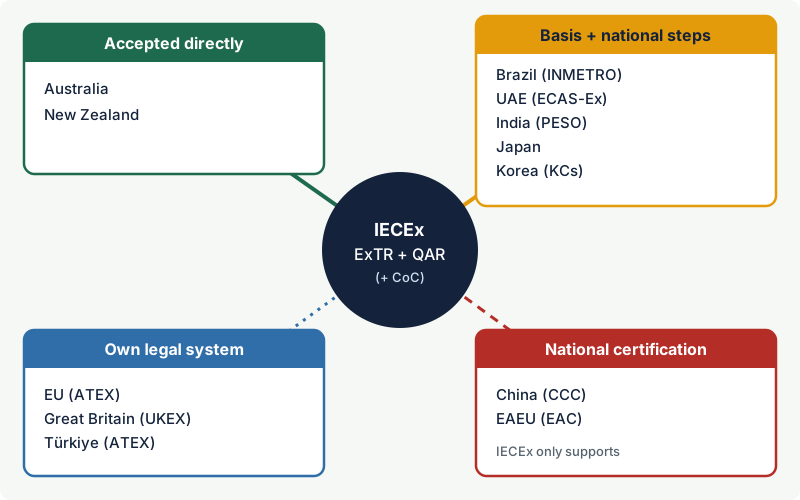
| How IECEx is used | Typical examples | What the manufacturer still has to do |
|---|---|---|
| IECEx certificate accepted directly | Australia, New Zealand | Usually nothing beyond the IECEx certificate; national alternatives also exist |
| National certificate based on IECEx ExTR and often the QAR | Brazil, UAE, India, Japan, Korea | Apply to the national body, possibly add tests for national deviations, accept national audits, labels and representatives |
| Separate national certification | China (CCC), Eurasian Economic Union (EAC) | Testing and assessment under the national scheme; IECEx documents may help but do not replace it |
| Own legal system, IEC-based standards | EU (ATEX), Great Britain (UKEX), Türkiye (ATEX) | Meet the legal requirements of that system; IECEx reports can reduce testing |
Great Britain and Northern Ireland: UKEX and UKCA
After leaving the EU, Great Britain kept the ATEX product rules as the Equipment and Protective Systems Intended for Use in Potentially Explosive Atmospheres Regulations 2016 (UK SI 2016/1107), usually called UKEX. The requirements, categories and conformity assessment modules mirror ATEX; the differences are in who assesses and which marking is used.
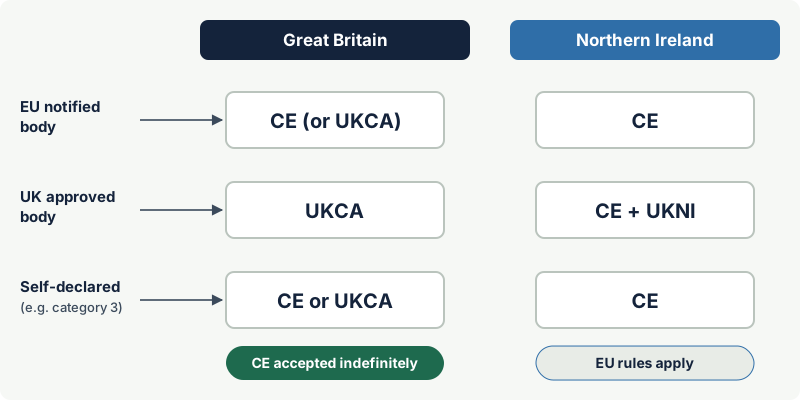
- Marking. The Product Safety and Metrology etc. (Amendment) Regulations 2024 extended recognition of the CE marking in Great Britain indefinitely. Manufacturers can therefore place Ex equipment on the GB market with either the CE marking (based on an EU notified body) or the UKCA marking (based on a UK approved body), plus the Ex hexagon with group and category as before. Since 1 October 2024, a product whose assessment was completed by an EU notified body may also be UKCA marked if it meets the GB requirements.
- Approved bodies. Where third-party assessment is needed for UKCA, it is done by a UK approved body: established in the UK, approved by the Secretary of State and identified by a four-digit number. Certificates from these bodies are commonly called UKEX certificates and use UKEX in the certificate number, for example
ABC 26UKEX0123X. - Label placement. Until 31 December 2027, the UKCA marking may be placed on a label or accompanying document instead of on the equipment itself.
- Northern Ireland. Under the Windsor Framework, EU rules apply: CE marking is required, and where mandatory third-party assessment was done by a UK body the product carries CE plus the UKNI marking. Qualifying Northern Ireland goods with CE marking may also be sold in Great Britain.
A product already on the market with CE marking cannot later simply be re-marked UKCA; that requires full conformity assessment by a UK approved body. Products for both markets can carry both markings when both sets of procedures are complete.
Eurasian Economic Union: EAC under TR CU 012/2011
Armenia, Belarus, Kazakhstan, Kyrgyzstan and Russia apply a common technical regulation, TR CU 012/2011 "On safety of equipment for work in explosive atmospheres". It was adopted by Decision No. 825 of the Customs Union Commission on 18 October 2011 and has applied since 15 February 2013. It covers electrical and non-electrical equipment and Ex components, and conformity must be confirmed by certification, not by declaration.
Certificates are issued by certification bodies accredited in the union and listed in its registers, to an applicant registered in a member state, normally the manufacturer's local entity or an authorised representative. The standards are interstate adoptions of the IEC 60079 series, and the lists of standards linked to the regulation are amended from time to time by the Eurasian Economic Commission. Certified equipment carries the EAC conformity mark and the special Ex sign required by the regulation, in addition to the Ex marking.
There is no formal recognition of IECEx certificates. IECEx test reports can support an application, but the decision rests with the union's certification body, and the usual certification schemes for serial production include an assessment of production at the manufacturing site. Amendments to the regulation have been under discussion for several years, so check the current text before relying on details.
Brazil: INMETRO
Ex certification has been compulsory in Brazil since 1991. The current requirements (RAC) are set by Inmetro Portaria No. 115 of 21 March 2022, covering electrical, electronic, instrumentation and telecommunication equipment for gas and dust atmospheres, Zones 0 to 2 and 20 to 22. Mechanical equipment was not included in that revision.
| Feature | Brazilian requirement |
|---|---|
| Who certifies | A third-party Ex certification body (OCP) accredited by Inmetro |
| Usual model | Type testing plus audit of the factory quality system (based on ISO 9001 with additional Ex requirements in an annex of the RAC) and periodic surveillance |
| Use of IECEx | National certificate can be based on an IECEx test report from an IECEx-recognised laboratory without repeating Ex tests |
| IECEx QAR | Not accepted in place of the factory audit, as Inmetro restated in a 2025 technical note |
| Validity and surveillance | Certificates valid six years; maintenance audits and tests every 18 months |
| Small quantities | A simplified route for imports of small quantities, limited in number per half-year |
The certificate carries a standard note that installation, inspection, maintenance and repair are the user's responsibility under the applicable standards. Inmetro consulted on amendments to Portaria 115 in 2025 (on test report age, updated standards, traceability plates and the durability of the conformity seal), so check for a newer consolidated text.
China: CCC
Explosion-proof electrical products were added to the China Compulsory Certification (CCC) catalogue in 2019, and since 1 October 2020 listed products without CCC may not be sold, imported or used in China. The scope includes product types such as motors, switches and control devices, actuators and solenoid valves, sensors and instruments, and safety barriers; electrical products for explosive atmospheres that do not match the listed descriptions fall outside CCC.
Assessment is against the Chinese standards for explosive atmospheres, the GB 3836 series (some parts mandatory GB, others recommended GB/T), which are based on the IEC 60079 series but are not always the latest IEC edition. Certification is carried out by bodies designated by the national certification authority under implementation rules for explosion-proof products, and includes product testing and assessment of the factory, followed by surveillance. An IECEx certificate is not a substitute for CCC.
India: PESO
In India, equipment for hazardous areas in petroleum installations needs approval from the Petroleum and Explosives Safety Organisation (PESO), headed by the Chief Controller of Explosives, under the Petroleum Rules 2002. The approval is often called a CCOE or PESO approval.
A typical approval letter for imported equipment shows how the scheme works:
- it is based on test reports and the certificate from a recognised testing body, often an IECEx certificate with its test report and QAR;
- it states the zone, gas group and standards, and requires the product to match the tested drawings;
- it names an Indian representative responsible for after-sales service;
- it requires the approval reference to be marked on each unit, and may require periodic field performance reports;
- it is valid until a stated date and must be renewed.
Equipment for mines falls under a separate regime for mining safety, so check the applicable authority for underground use.
Other markets
| Market | Scheme | How IECEx is used | Notes |
|---|---|---|---|
| Australia and New Zealand | IECEx, or the national ANZEx scheme; installation to AS/NZS 60079.14 | IECEx certificates accepted; a state mines safety regulator has stated that IECEx-certified equipment can be used almost without exception | Other approvals, for example North American listings alone, need a separate conformity assessment |
| Japan | Type examination under the Industrial Safety and Health Act by bodies registered by the Ministry of Health, Labour and Welfare, including foreign registered bodies | IECEx test reports used as the basis, with additional work where Japanese standards differ in edition or content | Separate certificates per type and rating; certificates time-limited; Japanese-language documentation |
| Republic of Korea | KCs safety certification under the occupational safety and health legislation | Existing IECEx or ATEX certification can reduce testing but does not replace KCs | The national safety agency is itself an IECEx certification body and test laboratory |
| United Arab Emirates | ECAS-Ex under the Ministry of Industry and Advanced Technology (Cabinet Resolution No. 23 of 2016) | Certificate of conformity based on IECEx certificate, test report and QAR | Certificates issued for limited periods |
| Türkiye | ATEX regulation transposing Directive 2014/34/EU under the EU-Türkiye Customs Union | As in the EU | CE marking; Turkish notified bodies listed in NANDO |
| USA and Canada | NEC and CEC hazardous location approvals | IECEx reports help but do not replace listing | See North American hazardous location approvals |
Türkiye is not in the EU but needs no separate Ex certificate, because it applies the ATEX directives through national regulations. The product directive is transposed as the Muhtemel Patlayıcı Ortamda Kullanılan Teçhizat ve Koruyucu Sistemler ile İlgili Yönetmelik (2014/34/AB), published in the Official Gazette on 30 June 2016 (No. 29758); the workplace directive 1999/92/EC has its counterpart in a separate regulation of the Ministry of Labour and Social Security, published on 30 April 2013 (No. 28633). Equipment is CE marked under the same categories and modules as in the EU, with instructions in Turkish, and Turkish conformity assessment bodies are notified through the European Commission's NANDO system (now part of the Commission's Single Market Compliance Space). See ATEX explained and the Turkish regulations.
Practical case: one product, five markets
A manufacturer of a flameproof gas detector, marked Ex db IIC T4 Gb, plans sales in the EU, Great Britain, Brazil, the UAE and India.
- One test programme. Choose a body that is an ATEX notified body and an IECEx certification body with a laboratory, and test once to the current IEC 60079-0 and IEC 60079-1 editions plus any EN deviations. The output is an ExTR, an EU-type examination certificate and an IECEx certificate of conformity.
- One factory audit, several reports. An audit to ISO/IEC 80079-34 produces the QAN for ATEX and the QAR for IECEx; see quality assurance for Ex manufacturers.
- Great Britain. CE marking is accepted, so no additional certificate is needed unless a customer asks for UKCA.
- UAE. The ECAS-Ex application uses the IECEx certificate, ExTR and QAR.
- Brazil. An Inmetro-accredited body issues a national certificate based on the ExTR, but performs its own factory audit and surveillance every 18 months.
- India. PESO approval is applied for through the Indian representative with the IECEx documents; the approval has an end date that must be tracked.
The order matters: national certificates refer to a specific ExTR and certificate issue. When the product changes, every national certificate based on the old issue needs updating too, so the change control plan must list them all.
Common mistakes
- "IECEx is accepted everywhere." IECEx is a voluntary scheme with 36 member countries; several members, including China and Russia, require national certification regardless.
- "UKCA is mandatory in Great Britain." Since the 2024 amendment, CE marking remains accepted in Great Britain indefinitely; UKCA is an option, mandatory only where a UK approved body did the assessment and no EU body was involved.
- Assuming the QAR replaces local factory audits. Brazil explicitly does not accept it in place of its own audit, and other schemes run their own surveillance.
- Forgetting renewal dates. IECEx and ATEX certificates have no expiry date, but many national approvals do. A lapsed national approval blocks shipments even when the IECEx certificate is current.
- Using the wrong edition. National standards often lag the IEC editions or add deviations. A report to the newest IEC edition may still need comparison against the national edition.
- Ignoring the local applicant. EAEU, Indian and other approvals need a locally registered applicant or representative, which takes time to arrange.
Frequently asked questions
Is ATEX accepted in the UK after Brexit?
Yes. Great Britain implemented the ATEX product rules as the 2016 UKEX Regulations, and the UK government has extended recognition of the CE marking indefinitely, so CE-marked ATEX equipment can be placed on the GB market. The UKCA marking, based on a UK approved body, is an alternative. In Northern Ireland, CE marking is required.
What is EAC Ex certification?
It is certification under the Eurasian Economic Union's technical regulation TR CU 012/2011 on the safety of equipment for explosive atmospheres, applicable in Armenia, Belarus, Kazakhstan, Kyrgyzstan and Russia. Certificates are issued by accredited bodies in the union to a locally registered applicant, and products carry the EAC mark and a special Ex sign.
Does INMETRO accept IECEx certificates?
Not directly. An Inmetro-accredited certification body can base a Brazilian certificate on an IECEx test report from a recognised laboratory without repeating the Ex tests, but it must carry out its own factory audit, and the IECEx QAR is not accepted in its place. Brazilian certificates are valid for six years with surveillance every 18 months.
Is CCC required for Ex equipment in China?
Yes, for listed explosion-proof electrical products. Since 1 October 2020 such products without CCC may not be sold, imported or used in China. Assessment is to the Chinese GB 3836 series by designated certification bodies.
What is PESO approval?
It is the approval of equipment for hazardous areas issued by India's Petroleum and Explosives Safety Organisation under the Petroleum Rules 2002, also called CCOE approval. For imported equipment it is usually based on IECEx or ATEX test reports, names an Indian representative and is valid until a stated date.
Which countries accept IECEx certificates directly?
Australia and New Zealand are the clearest examples: IECEx certificates are accepted there for hazardous area equipment. Most other IECEx member countries use IECEx test reports and quality reports as the basis for a national certificate rather than accepting the IECEx certificate alone.
Related on excodex
- ATEX vs IECEx: differences, similarities and which one you need
- The IECEx scheme explained: CoC, ExTR, QAR and the online certificate database
- North American hazardous location approvals: NEC 500/505/506, UL, CSA and FM
- Quality assurance for Ex manufacturers: QAN, QAR and ISO/IEC 80079-34
- How to verify that an Ex certificate is genuine
- Standards spaces: UKEX, TR CU 012/2011, GB 3836, IECEx, Turkish ATEX regulation
Standards and further reading
- UK Government, statutory guidance on the Equipment and Protective Systems Intended for Use in Potentially Explosive Atmospheres Regulations 2016 (Great Britain): gov.uk
- The Equipment and Protective Systems Intended for Use in Potentially Explosive Atmospheres Regulations 2016 (SI 2016/1107): legislation.gov.uk
- Technical Regulation of the Customs Union TR CU 012/2011, on safety of equipment for work in explosive atmospheres (Customs Union Commission Decision No. 825 of 18 October 2011), with the lists of standards maintained by the Eurasian Economic Commission.
- Inmetro Portaria No. 115 of 21 March 2022, conformity assessment requirements for equipment for explosive atmospheres, and Inmetro technical note 2/2025 on its amendment: gov.br (PDF)
- GB 3836 series, Chinese standards for explosive atmospheres (based on IEC 60079).
- IECEx member countries: iecex.com; IECEx certified equipment scheme FAQ (acceptance of test results by ExCBs): iecex.com
- IEC 60079-0, explosive atmospheres: general requirements for equipment; ISO/IEC 80079-34, quality management systems for Ex product manufacture.
This article is general technical information prepared by the excodex editorial team. It does not replace the applicable standards, the equipment certificates and instructions, national regulations or the assessment of a competent person.