North American hazardous location approvals: NEC 500/505/506, UL, CSA and FM
Abstract
In the US, hazardous location equipment is certified by an OSHA-recognised NRTL and installed under NEC Articles 500 to 506; in Canada, by an SCC-accredited body under CEC Section 18. Standards, markings (Class/Division, AEx, Ex) and how IECEx and ATEX products fit in.
In the United States, equipment for hazardous (classified) locations is installed under the National Electrical Code (NEC, NFPA 70), Articles 500 to 506, and in workplaces OSHA requires it to be approved, which in practice means tested and certified by a Nationally Recognized Testing Laboratory (NRTL) to a US standard. In Canada, the Canadian Electrical Code (CEC) Part I, Section 18, governs installation, and the equipment must be certified by a certification body accredited by the Standards Council of Canada (SCC). Both countries recognise the Class and Division system and the IEC-based zone system, but for onshore installations neither accepts ATEX or IECEx certificates on their own: a European or international product needs a North American certification and marking.
This article explains who approves what, which standards sit behind the familiar names UL, CSA and FM, how North American markings differ from IEC and ATEX markings, and how an IECEx-certified product gets to a North American site.
Key points
- US hazardous location equipment is normally listed or labelled by an NRTL recognised by OSHA for the specific test standards involved; OSHA itself does not test or approve products. OSHA's list showed 21 NRTLs in October 2026.
- Canada requires electrical equipment to be approved, in practice certified by an SCC-accredited certification body or accepted by the provincial authority after a special inspection.
- "UL", "CSA" and "FM" in a specification usually refer to families of standards and to certification marks; what matters legally is certification by a recognised or accredited body to the standard that applies.
- Division-system equipment is tested to standards such as UL 1203 (explosionproof and dust-ignitionproof), UL 913 (intrinsic safety) and UL 121201 / CSA C22.2 No. 213 (nonincendive); zone-system equipment to the UL 60079 and CSA C22.2 No. 60079 series, which are national versions of the IEC standards.
- US zone equipment is marked with the prefix
AExplus the zone (Class I, Zone 1, AEx db IIC T4 Gb); Canadian zone equipment is markedExlike IEC equipment. - The CEC has used zones for new Class I installations since 1998; Section 18 now classifies gas and dust locations in Zones 0, 1, 2 and 20, 21, 22, with the Division rules kept in an appendix for existing facilities.
- IECEx test reports can shorten North American certification, because both countries are IECEx members, but an IECEx certificate is not a North American approval.
Three layers: installation code, workplace law and certification
The North American system has three layers that are easy to confuse.
- Installation codes. In the US this is NFPA 70, the NEC, which is published by the National Fire Protection Association and becomes law only when a state, county or city adopts it, often a few years after publication. The person who enforces it locally is the authority having jurisdiction (AHJ). In Canada it is the CEC Part I, published as CSA C22.1 (the 2024 edition is current) and adopted, sometimes with amendments, by each province and territory.
- Workplace safety law. In the US, the federal OSHA electrical regulations (29 CFR 1910 Subpart S) apply to employers. They have their own hazardous location section, 1910.307, which allows both Divisions and Zones and requires equipment to be approved for the class, the specific gas, vapour, dust or fibre, and the operating temperature.
- Certification. In the US, OSHA recognises private laboratories as NRTLs; in Canada, the SCC accredits certification bodies. These bodies test products to standards and authorise the manufacturer to apply their mark.
Underground mines and offshore units have their own regimes. Electrical equipment for US underground mines is approved by the Mine Safety and Health Administration (MSHA) under 30 CFR Part 18, and the US Coast Guard sets requirements for vessels and outer continental shelf units, including a list of independent laboratories it accepts. The US Coast Guard states that it does not accept ATEX equipment on the basis of self-certification, but its electrical rules for vessels (46 CFR 111.105) do accept apparatus tested to the IEC 60079 standards and certified under the IECEx System, alongside equipment listed to the NEC-based standards.
Classification: Divisions and Zones in both countries
| Material | US (NEC) | Canada (CEC Part I) |
|---|---|---|
| Gases, vapours | Class I, Division 1 or 2 (Article 500/501), or Class I, Zone 0, 1 or 2 (Article 505) | Zone 0, 1 or 2 (Section 18); Class I Divisions only for existing facilities (appendix) |
| Combustible dusts | Class II, Division 1 or 2 (Article 500/502), or Zone 20, 21 or 22 (Article 506) | Zone 20, 21 or 22 (Section 18); Class II Divisions in the appendix |
| Fibres and flyings | Class III, Division 1 or 2 (Article 500/503), or Zone 20, 21 or 22 (Article 506) | Zone 20, 21 or 22 (Section 18); Class III Divisions in the appendix |
The two systems, their groups (A to G against IIA to IIIC) and their temperature codes are compared in detail in zones vs divisions. For certification, one point from that comparison matters most: a product certified for a Zone 1 location is not automatically acceptable in a Division 1 location, because Division 1 also covers Zone 0 conditions.
Who certifies: NRTLs and SCC-accredited bodies
United States
An NRTL is a private organisation that OSHA has recognised, under 29 CFR 1910.7, as competent to test and certify products to specific test standards. Recognition is per standard: a laboratory recognised for UL 913 may certify intrinsically safe apparatus, but that does not make it competent for explosionproof motors unless UL 1203 or UL 674 is also in its recognised scope. OSHA publishes the current list of NRTLs and the scope of each, and the NRTL authorises the manufacturer to use its registered certification mark. OSHA itself does not test or approve products.
For workplaces, OSHA's electrical rules define "approved" as acceptable to OSHA, which in turn means accepted, certified, listed or labelled by an NRTL, with narrow alternatives for equipment no NRTL covers and for custom-made equipment. The NEC is slightly broader: it accepts listing or labelling, evaluation by a qualified testing laboratory or inspection agency, or other evidence acceptable to the AHJ, such as a manufacturer's self-evaluation or an owner's engineering judgment. On a US industrial site both apply, so in practice the hazardous location equipment carries an NRTL mark.
| Term (OSHA and NEC usage) | Meaning in practice |
|---|---|
| Listed | Appears in a list published by a recognised laboratory that inspects production periodically |
| Labelled | Carries the laboratory's label or mark, with periodic production inspection |
| Certified | Tested and found by a recognised laboratory to meet the standard, of a kind whose production it inspects periodically, and marked accordingly |
| Identified (NEC) | Recognisable as suitable for the specific purpose, location or environment, usually through listing and marking |
Canada
The CEC requires electrical equipment in installations under an inspection department to be approved. Approved normally means certified by a certification body accredited by the SCC to a CSA standard or another recognised document, with the body's mark on the product. Where no certification exists, a provincial authority may accept equipment after a special inspection (a field evaluation) by an SCC-accredited inspection body. Provincial regulators, such as Technical Safety BC, publish the certification marks they accept and point to the SCC for the current list of accredited bodies.
One mark, two countries
Many certification marks carry small indicators that define their territory. A mark with both "C" and "US" indicators means the product is certified for Canada and the US, "US" alone means the US only and "C" alone Canada only. What a mark without any indicator means depends on the certifier's own convention (for some marks it means the home country only), so check the certificate or the certifier's mark guide rather than the logo.
What "UL", "CSA" and "FM" mean in a specification
Project specifications often say "UL, CSA or FM approved". Three organisations gave their names to families of hazardous location standards, and the same names appear on certification marks, so the phrase mixes two things. Legally, the question is always: certified by a recognised (US) or accredited (Canada) body, to which standard? Any NRTL whose scope includes a UL standard can certify to that UL standard, and the standards themselves are increasingly harmonised between the two countries.
| Protection method | US standard (Division system) | Canadian standard (Division system) | Zone system, US and Canada |
|---|---|---|---|
| General requirements | FM 3600 | CSA C22.2 No. 0 (general requirements for certified equipment) | UL 60079-0; CSA C22.2 No. 60079-0 |
| Explosionproof (Class I) | UL 1203, FM 3615 | CSA C22.2 No. 30 | flameproof "d": UL 60079-1; CSA C22.2 No. 60079-1 |
| Dust-ignitionproof (Class II) | UL 1203 | CSA C22.2 No. 25 | enclosure "t": UL 60079-31; CSA C22.2 No. 60079-31 |
| Intrinsic safety | UL 913, FM 3610 | CSA C22.2 No. 157 | "i": UL 60079-11; CSA C22.2 No. 60079-11 |
| Nonincendive (Division 2) | UL 121201, FM 3611 | CSA C22.2 No. 213 (binational with UL 121201) | type "n": UL 60079-15; CSA C22.2 No. 60079-15 |
| Purged and pressurised | NFPA 496, FM 3620 | check the CEC appendix and the AHJ | "p": UL 60079-2; CSA C22.2 No. 60079-2 |
| Increased safety | not used in Divisions | not used in Divisions | "e": UL 60079-7; CSA C22.2 No. 60079-7 |
A few product standards add requirements for specific equipment, for example UL 674 for motors and generators, UL 844 for luminaires and UL 823 for heaters in hazardous locations. Older certificates may cite ISA numbers: ISA 60079 parts for zone equipment and ISA 12.12.01 for nonincendive equipment, which has since been superseded by the binational UL 121201 / CSA C22.2 No. 213.
The zone-system standards are the IEC 60079 texts adopted with national differences. That is why a product already tested to IEC 60079-1 can often be certified to UL 60079-1 and CSA C22.2 No. 60079-1 largely on the basis of its existing test report, plus an assessment of the national differences and any extra tests they require.
How North American markings differ
| Where and which system | Example marking | Notes |
|---|---|---|
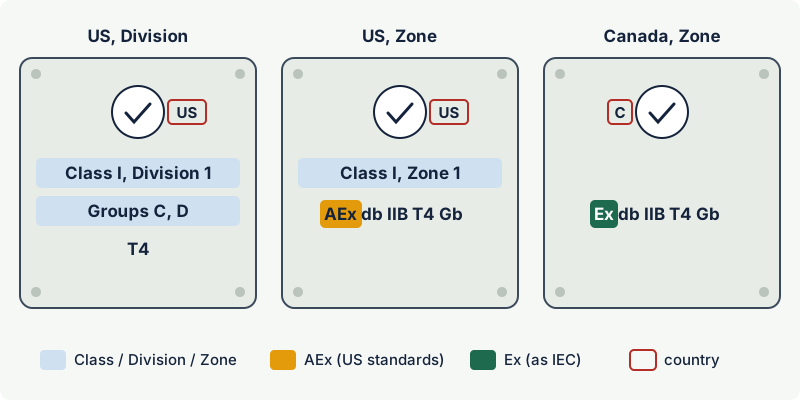
| US, Division | Class I, Division 1, Groups C and D, T4 | No type of protection required; a Division 2 only product says Division 2 |
| Canada, Division | Class I, Division 1, Groups C and D, T4 | Same style, used under the CEC appendix for existing facilities |
| US, Zone (gas) | Class I, Zone 1, AEx db IIB T4 Gb | Class, Zone, AEx, type of protection, group, T class; in the 2017 NEC the EPL is permitted but not required, and from 2020 "Class I" may be omitted |
| US, Zone (dust) | Zone 21, AEx tb IIIC T135°C Db | Article 506 marking |
| Canada, Zone | Ex db IIB T4 Gb | Same structure as the IEC marking |
| IEC and ATEX, for comparison | II 2 G Ex db IIB T4 Gb | Neither is accepted on its own in North America |
AEx is the marking prefix the NEC requires for zone equipment that meets the US (ANSI-approved) versions of the IEC standards. It tells an inspector that the protection has been assessed to US standards, not only to IEC ones. A product certified for both countries often carries two zone strings, AEx for the US and Ex for Canada, and frequently a Division marking as well, because a Zone 1 flameproof product may also be certified for Class I, Division 2.
Two further differences catch buyers. In the 2017 NEC, Article 500 treats -25 °C to +40 °C as the normal ambient range that needs no marking, while Article 505 and IEC 60079-0 use -20 °C to +40 °C; check the wording of the edition your AHJ enforces. And Division-system temperature codes include sub-codes such as T3C (160 °C), which have no direct IEC equivalent; see temperature classes T1 to T6.
CEC Section 18 in brief
Section 18 of the CEC classifies hazardous locations by zone and sets the installation rules. Its main features for anyone buying or approving equipment:
- Zones for new work. Since the 1998 edition, Class I locations are classified in Zones 0, 1 and 2; current editions also classify dust locations in Zones 20, 21 and 22. The Division rules survive in an appendix for additions and modifications to existing facilities classified in Divisions.
- Certified for the specific atmosphere. Equipment must be designed, tested and certified for the explosive atmosphere actually present, and marked accordingly.
- Table of permitted protection. A table lists, for each zone and division, the types of protection and the EPLs (equipment protection levels) that are acceptable. Its notes state that the EPL takes precedence over the type of protection and that zone equipment can be used in some Division locations and vice versa.
- Group equivalents. A companion table maps zone groups to Division groups: IIC equipment suits Groups A, B, C and D, IIB suits C and D, IIA suits D, and IIB+H2 suits B, C and D, though not with complete equivalence. On the dust side, IIIC corresponds to Group E, IIIB to Groups F and G, and IIIA to Class III.
- Temperature. Equipment must not reach the ignition temperature of the gas; the 2018 edition treats equipment with no temperature marking as reaching 100 °C. For dust zones, the marked surface temperature must stay below the lower of the dust cloud and dust layer ignition temperatures.
- Zone 1 equipment and Division 1. As in the US, equipment certified only for Zone 1 is not accepted in a Class I Division 1 location: the table lists Zone 0 equipment, but not Zone 1 equipment, for Division 1.
Provinces and territories may amend the CEC, so always confirm with the local inspection authority.
Bringing IECEx or ATEX equipment to North America
Neither the ATEX directive nor the IECEx scheme is recognised as an approval for onshore installations in the US or Canada (the US Coast Guard rules for vessels, mentioned above, are the main exception for IECEx). The United States and Canada are, however, both IECEx member countries, and the IECEx rules require every IECEx certification body to accept test reports from other bodies in the scheme when issuing national certification. Many North American certifiers are also IECEx certification bodies. In practice the route looks like this:
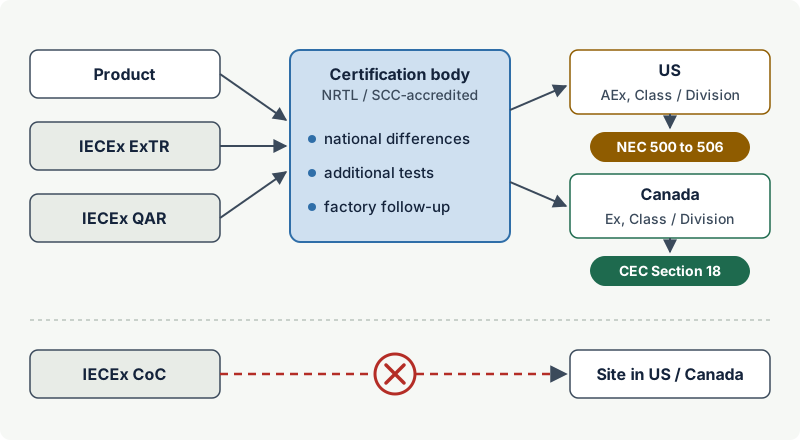
- Choose a certification body that is an NRTL for the relevant UL standards and SCC-accredited for the CSA standards, and ideally also an IECEx certification body.
- Provide the IECEx test report (ExTR) and quality assessment report. The body reviews them against the national differences of UL 60079 and CSA C22.2 No. 60079 and runs any additional tests.
- Decide whether the product also needs Division ratings. Many US sites are classified in Divisions; a Zone 1 product can often be certified for Class I Division 2 in addition, but a Division 1 rating usually requires assessment as explosionproof or intrinsically safe to the Division standards.
- Accept factory follow-up. North American marks require periodic production inspection by the certifier, independent of the IECEx surveillance.
- Update the nameplate and instructions with the
AEx,Exand Division markings, the certification mark and the North American ambient range.
Example: A flameproof gas detector certified under IECEx as Ex db IIC T4 Gb is specified for two projects: a Texas gas plant classified Class I, Division 1, Group D, and an Alberta plant classified Zone 1, IIA. For Alberta, certification to the CSA C22.2 No. 60079 series gives Ex db IIC T4 Gb with a Canadian mark, and the CEC table of permitted protection accepts EPL Gb in Zone 1. For Texas, a US zone listing (Class I, Zone 1, AEx db IIC T4 Gb) is not enough, because Zone 1 equipment may not be installed in Division 1. The manufacturer either obtains a Division 1 explosionproof rating to UL 1203, or the Texas owner reclassifies the area under Article 505, which needs a qualified engineer and covers all the space around that source. Gas detector performance approvals are a separate subject; see fixed gas detection systems.
Common mistakes and misconceptions
- "It has ATEX and IECEx, so it is approved worldwide." Neither is accepted on its own for onshore installations in the US or Canada. The product needs certification by an NRTL and an SCC-accredited body, with North American markings.
- "UL listed" means approved for the hazardous location. A general-purpose listing says nothing about hazardous locations. Check that the listing names the class, division or zone, groups and temperature code.
- Reading the logo but not the indicators. A mark without the "US" indicator is not necessarily a US listing, and one without the "C" indicator not necessarily a Canadian certification; check the certificate.
- Installing
AExZone 1 equipment in Division 1. It is permitted in Division 2 and in Zones 1 and 2, but not in Division 1. - Assuming one country's approval covers the other. The US and Canadian codes, standards and marks are separate, even when one certifier issues both.
- Copying old standard numbers into new specifications. ISA 12.12.01 has been superseded by UL 121201 / CSA C22.2 No. 213; check the current number and edition of every standard named in a specification.
Frequently asked questions
What is an NRTL?
A Nationally Recognized Testing Laboratory is a private organisation recognised by OSHA to test and certify products to specific standards. US workplace rules require hazardous location equipment to be approved, which normally means certified, listed or labelled by an NRTL whose recognised scope covers the applicable standard.
Is ATEX or IECEx certification accepted in the US?
Not on its own for onshore installations (US Coast Guard rules for vessels accept IECEx-certified apparatus). US installations need equipment listed for the class and division or zone, normally by an NRTL to US standards. IECEx test reports can be reused by the certifier to speed up US certification, and zone-system equipment is then marked with the AEx prefix.
What does AEx mean on a nameplate?
AEx is the prefix the NEC requires for zone-system equipment that meets the US versions of the IEC 60079 standards. It appears in markings such as Class I, Zone 1, AEx db IIB T4 Gb. Canadian zone equipment uses Ex instead.
What is the difference between UL, CSA and FM approval?
They are three families of standards whose names also appear on certification marks. For legal purposes, the question is whether the product is certified by a body recognised in the US (an NRTL) or accredited in Canada (by the SCC) to the applicable standard; any such body may certify within its recognised scope.
What is CEC Section 18?
Section 18 of the Canadian Electrical Code Part I covers hazardous locations. It classifies new installations in Zones 0, 1 and 2 for gases and Zones 20, 21 and 22 for dusts and fibres, lists the protection types and EPLs permitted in each zone, and keeps the Division rules in an appendix for existing facilities.
Can one certification cover both the US and Canada?
One certifier can issue both, often in a single project, and the mark then carries both "C" and "US" indicators. Technically these are two certifications to two sets of standards, and the markings usually differ (AEx for the US, Ex for Canada).
Related on excodex
- Zones vs Divisions: IEC and ATEX zones compared with NEC Class I Division 1 and 2
- ATEX vs IECEx: differences, similarities and which one you need
- The IECEx scheme explained: CoC, ExTR, QAR and the online certificate database
- Ex certification in other markets: UKEX, EAC, INMETRO, CCC, PESO and others
- How to read an Ex marking
- Standards spaces: NEC Articles 500 to 506, IECEx; tool: Ex marking check
Standards and further reading
- NFPA 70, National Electrical Code, Articles 500 to 506 (hazardous classified locations, Divisions and Zones)
- CSA C22.1, Canadian Electrical Code Part I, Section 18 (hazardous locations) and its appendix for Division installations
- UL 1203, explosion-proof and dust-ignition-proof electrical equipment for hazardous locations; UL 913, intrinsically safe apparatus and associated apparatus; UL 121201 / CSA C22.2 No. 213, nonincendive equipment for Division 2 (and Class III) locations
- CSA C22.2 No. 30, explosion-proof enclosures for Class I locations; CSA C22.2 No. 25, enclosures for Class II Groups E, F and G; CSA C22.2 No. 157, intrinsically safe and non-incendive equipment
- FM 3600 (general requirements), FM 3610 (intrinsic safety), FM 3611 (Division 2 and Class III equipment), FM 3615 (explosionproof), FM 3620 (purged and pressurised equipment)
- UL 60079 and CSA C22.2 No. 60079 series, national adoptions of the IEC 60079 equipment standards
- OSHA Nationally Recognized Testing Laboratory programme and current list of NRTLs: osha.gov
- OSHA 29 CFR 1910.307 (hazardous locations) and 1910.399 (definitions of approved, listed, labelled, certified): 1910.307, 1910.399
- 46 CFR 111.105-3, US Coast Guard rules on approval of electrical equipment in hazardous locations on vessels: law.cornell.edu
- Technical Safety BC, approved certification marks for electrical products: technicalsafetybc.ca
- US Coast Guard OCS National Center of Expertise, hazardous location markings and applicable standards: dco.uscg.mil
- IECEx certified equipment scheme FAQ (acceptance of test reports, national certification): iecex.com
This article is general technical information prepared by the excodex editorial team. It does not replace the applicable standards, the equipment certificates and instructions, national regulations or the assessment of a competent person.