How to read an Ex marking: decoding II 2 G Ex db IIC T4 Gb step by step
Abstract
II 2 G Ex db IIC T4 Gb means group II, category 2, gas, flameproof level b, gas group IIC, 135 °C maximum surface temperature and EPL Gb. This guide decodes every element of ATEX and IEC markings, dust and old EEx markings, with worked examples.
II 2 G Ex db IIC T4 Gb describes equipment of group II (surface industries, not mines), ATEX category 2 for gas atmospheres, protected by a flameproof enclosure at level "b", tested for the most demanding gas group IIC, with a maximum surface temperature of 135 °C (T4) and equipment protection level Gb. In plain terms: it may be installed in Zone 1 or Zone 2 for any flammable gas or vapour whose autoignition temperature is above 135 °C, provided the ambient temperature and any special conditions on the certificate are respected. The first half (II 2 G) comes from the EU ATEX directive, the second half (Ex db IIC T4 Gb) from the IEC 60079 series of standards.
This guide decodes every element of the marking in order, then covers dust markings, the extra information on the plate, older markings such as EEx d IIC T4, and a step-by-step check of a marking against a real site.
Key points
- A European Ex marking has two parts: the ATEX part (Ex hexagon, equipment group, category, G or D) required by Directive 2014/34/EU, and the standards part (
Ex, type of protection, group, temperature, EPL) defined by IEC 60079-0 and the related standards. - The category (1, 2, 3) and the equipment protection level (a, b, c in Ga, Gb, Gc) express the same idea: how many faults the equipment tolerates before it could ignite an atmosphere. Category 2 and EPL Gb are suitable for Zone 1 and Zone 2.
- Gas group IIC equipment may be used for IIB and IIA gases, IIB for IIA, but never the other way round. For dust, IIIC covers IIIB and IIIA.
- The temperature class (T1 to T6) or the marked surface temperature must be below the ignition temperature of the substances present. T4 means the surface stays at or below 135 °C.
- An
Xafter the certificate number means specific conditions of use that the installer must read; aUmeans an Ex component that is not complete equipment. EExis the old CENELEC prefix used before EN 60079-0:2006; equipment marked that way is not automatically unsafe, but its marking reflects older rules.- Since IEC 60079-0 edition 8 (2026), the rated ambient temperature range must always appear in the marking; under earlier editions it was marked only when it differed from -20 °C to +40 °C.
Two halves: the ATEX part and the IEC part
The marking you see on equipment sold in the European Union is a combination of two systems that grew up separately.
The ATEX part is a legal requirement. Annex II of Directive 2014/34/EU lists the minimum marking: manufacturer name and address, CE marking, series or type, serial or batch number, year of construction, and the specific marking of explosion protection (the letters Ex inside a hexagon) followed by the equipment group and category symbol, plus the letter G for gases, vapours and mists and/or D for dust. Anything essential for safe use must also be marked.
The IEC part comes from the standards. The directive does not itself require Ex db IIC T4 Gb; that string is required by the harmonised European versions of IEC 60079-0 and the protection-type standards, which manufacturers apply to demonstrate conformity. Outside Europe, under the IECEx scheme or national systems based on IEC standards, the IEC part normally appears without the ATEX part.
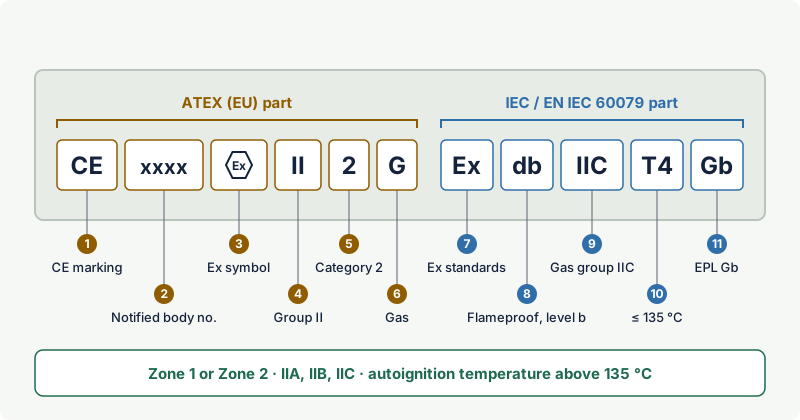
Decoding II 2 G Ex db IIC T4 Gb element by element
| No. | Element | Meaning | What you check on site |
|---|---|---|---|
| 1 | CE | Conformity with all applicable EU directives | Present on equipment placed on the EU market |
| 2 | xxxx (four digits) | Identification number of the notified body involved in production control | Matches the quality assurance notification |
| 3 | Ex in hexagon | Specific marking of explosion protection | Present |
| 4 | II | Equipment group II: places other than mines | Not group I (mines) |
| 5 | 2 | Category 2: high level of protection | Zone 1 or Zone 2 (gas) |
| 6 | G | Gas, vapour or mist | D needed for dust zones |
| 7 | Ex | Complies with the Ex standards | Present |
| 8 | db | Flameproof enclosure, level of protection b | Maintenance rules for flamepaths apply |
| 9 | IIC | Gas group IIC | Equal to or higher than the gas group on site |
| 10 | T4 | Maximum surface temperature 135 °C | Below autoignition temperature of site gases |
| 11 | Gb | Equipment protection level Gb | Gb or better required for Zone 1 |
CE marking and notified body number
The CE marking says the manufacturer declares conformity with all EU legislation that applies to the product. Under Article 16 of Directive 2014/34/EU, the CE marking is followed by the four-digit number of a notified body when that body is involved in the production control phase, for example by auditing the manufacturer's quality system. Equipment that the manufacturer assesses alone under internal production control, which covers most category 3 equipment, therefore carries CE without a number. The number identifies the body that supervises production, which is not necessarily the body that issued the type examination certificate. See EU-Type Examination Certificates and Notified Bodies explained.
The Ex hexagon, group, category and G or D
The hexagon is the European symbol for explosion protection. After it comes the equipment group: I for underground mines and their surface installations endangered by firedamp and/or combustible dust, II for all other places with explosive atmospheres. Note that ATEX group II covers both gas and dust; the IEC system instead uses a separate Group III for dust (more on this below and in Equipment groups I, II and III).
The category expresses the level of protection. Category 1 is very high (safe even with rare faults, usually by two independent means of protection), category 2 is high (safe with frequently occurring disturbances or faults normally expected), category 3 is normal (safe in normal operation). For mines the categories are M1 and M2. Finally G or D (or both) say which kind of atmosphere the category applies to. The full story is in ATEX equipment categories 1, 2 and 3.
Ex and the type of protection
Ex opens the standards part. Then comes the code of the type of protection, now normally with a lower-case letter for the level of protection (a, b or c) appended. db is a flameproof enclosure designed for EPL Gb. The most common codes are:
| Code | Type of protection | Levels and typical EPL |
|---|---|---|
d | Flameproof enclosure | db (Gb), dc (Gc); da (Ga) only for catalytic sensors of portable gas detectors |
e | Increased safety | eb (Gb), ec (Gc) |
i | Intrinsic safety | ia (Ga/Da), ib (Gb/Db), ic (Gc/Dc) |
p | Pressurisation | pxb, pyb (Gb), pzc (Gc) |
m | Encapsulation | ma, mb, mc |
o | Liquid immersion | ob, oc |
q | Powder filling | q (Gb), no level letter |
n | Type n (Zone 2 only) | nR, nC (Gc); nA now replaced by ec |
t | Dust protection by enclosure | ta (Da), tb (Db), tc (Dc) |
op | Optical radiation | op is, op pr, op sh |
h | Non-electrical equipment (ISO 80079-36/37) | No level letter; EPL at the end |
Equipment can combine several types: Ex db eb is a flameproof motor with an increased-safety terminal box. Each concept is explained in Ex protection concepts at a glance and combined markings in Combined protection concepts.
Gas group IIC
Group II is subdivided by how easily a gas ignites and how readily its flame passes through narrow gaps. IIA gases (for example propane) are the least demanding, IIB (for example ethylene) in the middle, IIC (hydrogen, acetylene, carbon disulphide) the most demanding. Equipment marked IIC is also suitable for IIB and IIA. A marking IIB + H2 means IIB equipment additionally suitable for hydrogen only (see IIB+H2 explained).
Temperature class T4
The temperature class is the maximum surface temperature the equipment can reach anywhere an explosive atmosphere can touch it, at the maximum rated ambient temperature:
| Class | Maximum surface temperature |
|---|---|
| T1 | 450 °C |
| T2 | 300 °C |
| T3 | 200 °C |
| T4 | 135 °C |
| T5 | 100 °C |
| T6 | 85 °C |
A lower temperature (higher T number) is always acceptable where a higher one is. T4 suits, for example, methane (autoignition about 600 °C, T1) and diethyl ether (autoignition 175 °C, T4), but not carbon disulphide (90 °C, T6). Details: Temperature classes T1 to T6.
Equipment protection level Gb
The last element is the EPL. Gb means a high level of protection for gas atmospheres: the equipment is not a source of ignition in normal operation or during expected malfunctions. Ga adds rare malfunctions; Gc covers normal operation with some extra protection against regularly expected events. For mines the EPLs are Ma and Mb, for dust Da, Db and Dc. The EPL tells you directly which zones the equipment can serve: Ga for Zone 0, 1 and 2, Gb for Zone 1 and 2, Gc for Zone 2. See Equipment Protection Levels (EPL).
The rest of the plate: Ta, certificates, X and U
The Ex string is only part of the label. Read the rest before installing.
- Ambient temperature range. Equipment is designed for -20 °C to +40 °C unless another range is marked, usually as
TaorTamb, for example-40 °C ≤ Ta ≤ +60 °C. The temperature class is only valid inside this range. IEC 60079-0 edition 8 (published in 2026) requires the rated ambient range to be marked in all cases, because the assumed +40 °C maximum is no longer realistic in many regions; equipment certified to earlier editions shows Ta only when it is non-standard. See Ambient temperature range Ta. - Certificate numbers. An EU-type examination certificate typically reads like
ABC 24 ATEX 1234 X(issuing body code, year, ATEX, serial number); an IECEx certificate likeIECEx ABC 24.0001X. Both can be looked up; see How to verify that an Ex certificate is genuine. - X suffix. Specific conditions of use apply. They are listed on the certificate and in the instructions and may restrict ambient temperature, impact risk, cleaning, cable entries or fasteners.
- U suffix. An Ex component, such as an empty enclosure or a terminal, certified only for use inside other equipment. It does not carry a full Ex marking and cannot be installed on its own. See The X and U suffixes.
- Electrical ratings, IP rating and warnings, such as a warning not to open the enclosure when an explosive atmosphere may be present, or a waiting time after switching off.
- Year of construction and serial number, required by the ATEX directive.
Dust markings
Dust equipment follows the same logic, with three differences: the ATEX part uses D, the IEC part uses Group III subgroups, and the temperature is stated in degrees rather than as a T-class, because dust ignition temperatures depend on whether the dust forms a cloud or a layer.
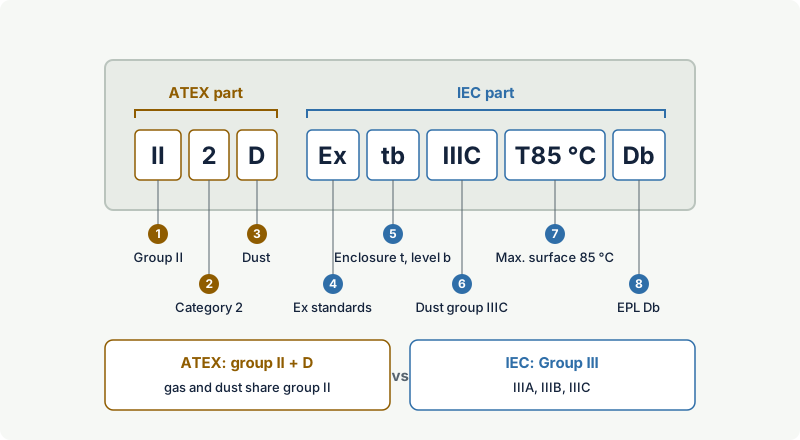
II 2 D Ex tb IIIC T85 °C Db reads: group II, category 2, dust; protection by enclosure level b; suitable for dust group IIIC (conductive dust), and therefore also for IIIB non-conductive dust and IIIA combustible flyings; maximum surface temperature 85 °C; EPL Db, suitable for Zone 21 and Zone 22.
Where the surface temperature was determined under a thick layer of dust, the marking gives the layer depth as a subscript in millimetres, written for example T500 320 °C: a maximum surface temperature of 320 °C under a 500 mm layer. The site engineer compares the marked temperature with the limits derived from the dust's cloud and layer ignition temperatures, explained in Surface temperature limits for dust.
Equipment for both atmospheres carries both strings, for example II 2 G D with Ex db IIC T6 Gb and Ex tb IIIC T85 °C Db.
More worked examples
| Marking | How to read it | Typical use |
|---|---|---|
II 1 G Ex ia IIC T4 Ga | Category 1 gas, intrinsically safe level ia, IIC, 135 °C, EPL Ga | Level transmitter in a tank (Zone 0) |
II (1) G [Ex ia Ga] IIC | Associated apparatus: installed in the safe area, feeds intrinsically safe circuits that may enter Zone 0 | Isolator or barrier in a control cabinet |
II 2 G Ex db eb IIC T4 Gb | Flameproof motor with increased-safety terminal box | Pump motor in Zone 1 |
II 3 G Ex ec IIC T4 Gc | Category 3, increased safety level c, EPL Gc | Luminaire in Zone 2 only |
II 2 G Ex h IIB T4 Gb | Non-electrical equipment to ISO 80079-36/37, IIB | Gearbox or pump in Zone 1 |
I M2 Ex db I Mb | Mining group I, category M2, flameproof, EPL Mb | Equipment de-energised on firedamp alarm |
II 1/2 G Ex ia/db IIC T4 Ga/Gb | Part in Zone 0, part in Zone 1 (boundary wall mounting) | Sensor through a tank roof |
Square brackets mark associated apparatus: the equipment itself is not protected for a hazardous area but contains circuits that are. The ATEX category in round brackets, (1), refers to those circuits, not to the location of the apparatus. Associated apparatus carries no temperature class unless it is itself built for a hazardous area, as in II 3 (1) G Ex ec [ia Ga] IIC T4 Gc. In North America, Zone-system equipment is marked in a similar way with the prefix AEx for equipment certified to US standards; see Zones vs Divisions.
Old markings: EEx, Ex d and Ex tD
Equipment stays in service for decades, so inspectors meet markings from several generations. The same flameproof IIC T4 product would have been marked differently in each period.
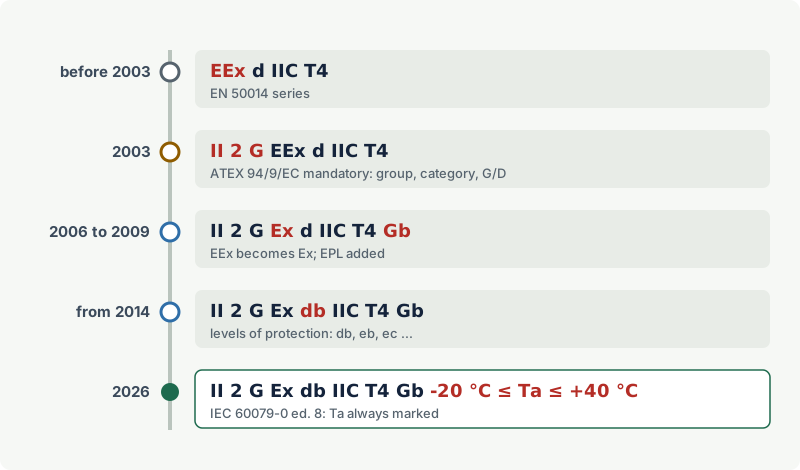
- EEx was the prefix of the CENELEC EN 50014 series. The extra E stood for compliance with the European standards. EN 60079-0:2006 changed the prefix to plain
Ex, and the EN 50014 series was withdrawn in 2008. - No group, category or G/D in front of the Ex code points to equipment certified before ATEX Directive 94/9/EC became mandatory on 1 July 2003, or to equipment certified only for markets outside the EU (for example IECEx only).
- No EPL at the end indicates certification before EPLs entered the standards (IEC 60079-0 in 2007, the European edition EN 60079-0 in 2009).
- Plain II without A, B or C was common for types such as increased safety; IEC 60079-0:2007 (adopted in Europe as EN 60079-0:2009) replaced it with IIA, IIB or IIC because many enclosure requirements now depend on the subgroup.
- Ex d or Ex e without a level letter dates from before about 2015, when levels such as
db,ebandecwere introduced (IEC 60079-7:2015 for increased safety). - Ex tD A21 and Ex tD A22 are dust markings from IEC 61241-1 (practice A, zone 21 or 22), replaced by IEC 60079-31 and the levels
tbandtc.
| Old marking | Closest current form (subgroup as certified) |
|---|---|
EEx d IIC T4 | Ex db IIC T4 Gb |
EEx e II T3 | Ex eb IIC T3 Gb (subgroup now shown) |
EEx ia IIC T6 | Ex ia IIC T6 Ga |
EEx m II T4 | Ex mb IIC T4 Gb |
Ex nA II T3 | Ex ec IIC T3 Gc |
Ex nL IIC T4 | Ex ic IIC T4 Gc |
Ex tD A21 IP65 T80°C | Ex tb IIIC T80 °C Db (group depends on the test) |
The right-hand column is a reading aid, not an equivalence certificate: the newer standards changed some requirements, so an old certificate cannot be re-marked. Old equipment that was lawfully placed on the market may usually remain in service where the site risk assessment, inspection and maintenance confirm it is still suitable; national rules decide the details.
Checking a marking against your site: worked example
A buyer needs a junction box for an outdoor Zone 1 area at a propane compressor. From the area classification and the gas library: propane is gas group IIA, autoignition temperature 450 °C (T2). Site ambient ranges from -15 °C to +45 °C in summer sun.
Candidate A: II 2 G Ex db IIC T4 Gb, no Ta marked.
- Group and category: II 2 G, gas. Zone 1 requires category 2 or 1. Pass.
- EPL: Gb is acceptable in Zone 1. Pass.
- Gas group: IIC covers IIA. Pass.
- Temperature: 135 °C is well below 450 °C. Pass.
- Ambient: no Ta marked on this older-edition label means -20 °C to +40 °C. The site reaches +45 °C. Fail.
Candidate B: II 2 G Ex eb IIC T4 Gb, -40 °C ≤ Ta ≤ +60 °C, certificate ending in X.
Steps 1 to 5 pass. Step 6 is to read the specific conditions of use behind the X: for example a requirement to use certified cable glands of a stated type, or a limit on the number of terminals loaded. Only after that is the box confirmed.
The same sequence works in reverse during inspection: an Ex ec IIB T4 Gc luminaire found in a Zone 2 around a hydrogen electrolyser fails at step 3, because hydrogen is IIC. The Ex marking check tool at /tools/ex runs these steps automatically when you paste a marking.
Common mistakes
- Reading the category as a zone number. Category 2 is not "Zone 2". Category 2 equipment is designed for Zone 1 and is also allowed in Zone 2; Zone 2 alone only requires category 3.
- Ignoring the ambient range. A T-class is valid only up to the maximum marked ambient (or +40 °C if none is marked). Sun, nearby hot equipment and enclosed housings can push the real ambient higher.
- Treating IIA as the "best" group. The order is the reverse: IIC equipment is the most widely usable, IIA the most restricted.
- Assuming a dust zone is covered by a G marking. Gas-only equipment (
G, Group II) has not been assessed for dust ingress or dust layers. Dust zones needDand a Group III marking. - Installing an Ex component (U) as if it were equipment. A certified empty enclosure becomes equipment only after the complete assembly is assessed and marked.
- Skipping the X conditions. Many installation defects found during inspection are breaches of conditions printed only on the certificate.
Frequently asked questions
What does II 2 G mean on an Ex label?
It is the ATEX part of the marking: equipment group II (not mining), category 2 (high level of protection), for gas, vapour or mist atmospheres. Category 2 G equipment is suitable for Zone 1 and Zone 2.
What is the difference between Ex d and Ex db?
Both are flameproof enclosures. db adds the level of protection "b", which links the type of protection directly to EPL Gb. The letter was added in newer editions of the flameproof standard; an older Ex d ... Gb marking means essentially the same level, certified under earlier rules.
Is equipment marked EEx still allowed?
The EEx prefix belongs to the EN 50014 standards used before 2006. Such equipment cannot be newly certified today, but equipment already in service is not automatically illegal. Its continued use depends on the site risk assessment, its condition and national regulations.
What does T4 mean on Ex equipment?
T4 means the maximum surface temperature of the equipment does not exceed 135 °C at its maximum rated ambient temperature. It is suitable for flammable gases and vapours whose autoignition temperature is higher than 135 °C.
Does the Ex marking have to show the ambient temperature?
Under IEC 60079-0 edition 8 (2026) the rated ambient temperature range must always be marked. Under earlier editions it was marked only when it differed from the normal range of -20 °C to +40 °C, so an unmarked older label means that normal range.
What does an X after the certificate number mean?
It means the certificate contains specific conditions of use. These are safety-relevant limitations that the user and installer must follow, and they are found on the certificate and in the manufacturer's instructions, not always on the label.
Related on excodex
- Equipment Protection Levels (EPL): Ga, Gb, Gc, Da, Db, Dc and how they match zones
- ATEX equipment categories 1, 2 and 3 and how they relate to EPLs
- Gas groups IIA, IIB and IIC explained with typical gases
- Temperature classes T1 to T6
- The ATEX Declaration of Conformity and the CE and Ex marking
- Ex marking check tool: /tools/ex, gas and solvent library: /gas, standards spaces: IEC 60079-0, ATEX 2014/34/EU
Standards and further reading
- IEC 60079-0, Explosive atmospheres, Part 0: Equipment, general requirements (edition 8, 2026, replaces the 2017 edition)
- IEC 60079-1, flameproof enclosures "d"; IEC 60079-7, increased safety "e"; IEC 60079-11, intrinsic safety "i"; IEC 60079-31, dust ignition protection by enclosure "t"
- ISO 80079-36 and ISO 80079-37, non-electrical equipment for explosive atmospheres
- Directive 2014/34/EU (ATEX equipment directive), full text on EUR-Lex: https://eur-lex.europa.eu/legal-content/EN/TXT/HTML/?uri=CELEX:32014L0034
- Directive 2014/34/EU annex structure (modules), legislation.gov.uk: https://www.legislation.gov.uk/eudr/2014/34/contents
- IEC 60079-7:2015 publication page (levels of protection eb and ec): https://webstore.iec.ch/publication/22791
- IECEx ExTAG draft decision sheet on marking of Ex t equipment with dust layers: https://iecex.com/dmsdocument/1178
- US Coast Guard Drill Down 28, equipment protection level in hazardous location markings: https://www.dco.uscg.mil/OCSNCOE/Drill-Down/DD-028/
- NSW TestSafe, dust ignition protection by enclosure Ex t: https://www.nsw.gov.au/testsafe/electrical/explosive-atmosphere/dust-ignition
This article is general technical information prepared by the excodex editorial team. It does not replace the applicable standards, the equipment certificates and instructions, national regulations or the assessment of a competent person.