The ATEX Declaration of Conformity and the CE and Ex marking: what must be on the label
Abstract
What Directive 2014/34/EU requires on an ATEX label (CE, notified body number, Ex hexagon, group, category, manufacturer, type, serial number, year), what the EU declaration of conformity must contain, and the rules for instructions and languages.
Under the ATEX directive 2014/34/EU, every piece of equipment and every protective system must carry, legibly and indelibly, at least: the manufacturer's name and address, the CE marking, the type or series designation, the batch or serial number if there is one, the year of construction, and the Ex hexagon followed by the equipment group, the category and, for group II, the letter G (gas) and/or D (dust). Where a notified body supervises production, its four-digit number follows the CE marking. Each product must also be accompanied by a copy of the EU declaration of conformity, the manufacturer's signed statement with the content set out in Annex X of the directive, and by instructions in a language that end-users in the country of sale can easily understand.
This article goes through the label line by line, explains what the EU declaration of conformity (DoC) must contain and how to check it, and summarises the rules for instructions and languages.
Key points
- The minimum ATEX marking is set by Annex II, point 1.0.5, of Directive 2014/34/EU: manufacturer and address, CE marking, series or type, batch or serial number (if any), year of construction, Ex hexagon with group and category, and G and/or D for group II.
- The CE marking is followed by a notified body number only when that body is involved in the production control phase; self-declared category 3 equipment carries CE without a number.
- The standard marking such as
Ex db IIC T4 Gb, the certificate number and the ambient range come from the harmonised standards (EN IEC 60079-0 and others), not from the directive text, but in practice they sit on the same plate. - The EU declaration of conformity follows the model structure of Annex X: product, manufacturer, sole responsibility statement, object, legislation, standards, notified body and certificate, additional information, signature.
- Each product must be accompanied by a copy of the DoC (one copy may cover a batch delivered to a single user), and the DoC must be translated into the language or languages required by the Member State where the product is sold.
- Instructions must accompany every product in a language easily understood by end-users, as determined by the Member State, and must repeat the marking (except the serial number).
- Components are not CE marked: they come with a written attestation of conformity instead of a DoC.
Why three things belong together: label, declaration and instructions
The directive treats the product, its marking, its declaration and its instructions as one package. The manufacturer completes the conformity assessment procedure for the equipment category, draws up the technical documentation, signs the EU declaration of conformity and only then affixes the CE marking. By signing, the manufacturer takes legal responsibility for compliance; the CE marking is the visible sign of that declaration, not an approval by an authority. The background is in ATEX explained, and the role of notified bodies in EU-type examination certificates and notified bodies.
For the user, the three documents answer three questions. The label says what the product is and where it may be used. The declaration says who takes responsibility and on what basis. The instructions say how to install, use and maintain it safely. An inspector checking an installation under IEC 60079-17 compares all three, and a mismatch between them is a finding in its own right.
What must be on the label
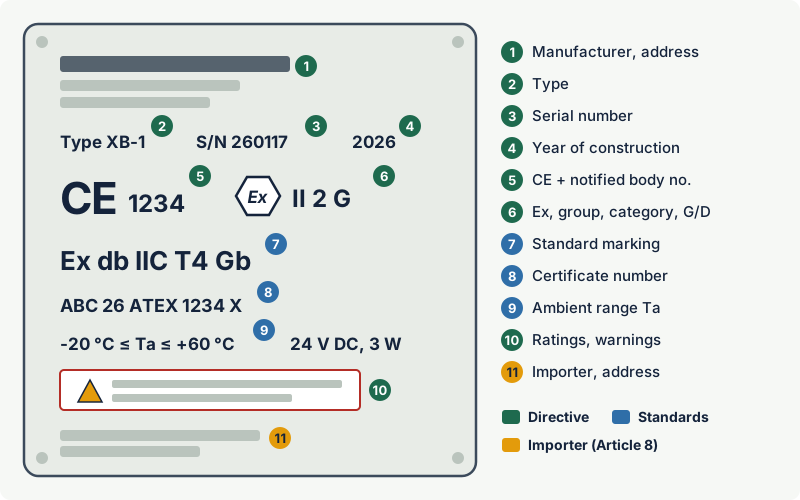
| Element | Where the requirement comes from | Notes |
|---|---|---|
| Manufacturer's name, registered trade name or trade mark, and postal address | Annex II 1.0.5; Article 6 | One address where the manufacturer can be contacted |
| CE marking | Annex II 1.0.5; Article 16; Regulation (EC) No 765/2008 | At least 5 mm high (the minimum may be waived for small-scale products); original proportions |
| Notified body identification number after CE | Article 16 | Only if a notified body is involved in production control (for example under a QAN) |
| Ex hexagon, then equipment group and category | Annex II 1.0.5; Article 16 | For example II 2, I M2 |
| G and/or D (group II only) | Annex II 1.0.5 | G for gas, vapour or mist; D for dust |
| Designation of series or type | Annex II 1.0.5 | Must match the DoC and certificate |
| Batch or serial number, if any | Annex II 1.0.5; Article 6 | Identifies the individual unit |
| Year of construction | Annex II 1.0.5 | Required by the directive even where the standard does not ask for it |
| Information essential to safe use | Annex II 1.0.5 ("where necessary") | Ratings, warnings, ambient range, special conditions |
| Importer's name and postal address | Article 8 | For products made outside the EU; on the product or, if impossible, packaging or document |
| Standard marking, certificate number, Ta | Harmonised standards (EN IEC 60079-0, EN ISO 80079-36) | For example Ex db IIC T4 Gb, ABC 26 ATEX 1234 X |
CE and the notified body number
The CE marking must be affixed visibly, legibly and indelibly to the product or its data plate before the product is placed on the market. Only where that is impossible or unjustified because of the nature of the product may it go on the packaging and accompanying documents instead. It may be affixed only by the manufacturer or its authorised representative, and markings that could be confused with it are prohibited.
The four-digit number after CE belongs to the notified body that takes part in the production control phase: the body that issued the quality assurance notification under Module D or E, that verifies or tests products under Module F or C1, or that carried out a unit verification (Module G). It is not necessarily the body that issued the EU-type examination certificate. For category 3 equipment (internal production control) and for non-electrical category 2 equipment, where the notified body only holds the technical documentation, no number follows CE. A number after CE on a self-declared category 3 product is a warning sign: no notified body supervises its production, and the Commission's ATEX Guidelines say such products, like those covered only by a voluntary certificate, should not carry a notified body number.
The Ex hexagon, group, category and G or D
The "specific marking of explosion protection", the letters Ex in a hexagon, is followed by the equipment group (I for mines, II for other places) and the category (M1 or M2 in group I; 1, 2 or 3 in group II), then G and/or D. II 2 G therefore reads: surface industry, category 2 (high level of protection, suitable for Zone 1 and Zone 2), gas atmospheres. The relationship between categories and zones is explained in ATEX equipment categories.
Equipment installed outside the hazardous area but needed for the safety of equipment inside it, such as an intrinsically safe barrier or a protective device, shows the category in brackets, for example II (2) G. The European Commission's ATEX Guidelines explain that the bracketed figure is the category of the equipment it protects. For brackets in the standard marking, such as [Ex ia Ga] IIC, see how to read an Ex marking.
The standard marking and the certificate number
The directive's own marking ends with G or D. The string that engineers read first, for example Ex db IIC T4 Gb (type of protection, gas group, temperature class, equipment protection level), comes from EN IEC 60079-0 and the standard for each type of protection, or from EN ISO 80079-36 for non-electrical equipment. Because applying harmonised standards is the usual way to show conformity, this marking is on practically every ATEX product. The same standards ask for the certificate number (with X for specific conditions of use, or U for an Ex component), and IEC 60079-0 edition 8 (2026) requires the ambient temperature range to be marked in every case. For the full decoding, use the Ex marking check.
Small products, packaging and accompanying documents
The directive allows a few items to move off the product when its size or nature makes marking impossible: the type, batch or serial number, the manufacturer's and importer's address, and, in the circumstances described above, the CE marking itself, which then goes on the packaging and accompanying documents. The Commission's ATEX Guidelines contain a section on marking small products: the marking may not be reduced or moved to the packaging for aesthetic reasons, and even on very small products the CE marking, the Ex hexagon and the manufacturer's name or registered trade mark should stay on the product, with at least a simplified postal address where possible.
The EU economic operator
Regulation (EU) 2019/1020 on market surveillance adds a requirement that applies to ATEX products: a product may be placed on the EU market only if there is an economic operator established in the Union responsible for it (the manufacturer, an importer, an authorised representative or a fulfilment service provider), and that operator's name and contact details, including a postal address, must be shown on the product, its packaging, the parcel or an accompanying document. For a manufacturer outside the EU selling through an importer, the importer's address on the product usually fulfils this.
The EU declaration of conformity
The EU declaration of conformity is a short document, usually one or two pages, in which the manufacturer declares that the product meets the essential health and safety requirements of Annex II. Its structure is fixed by Annex X of the directive, and it must contain the elements required by the conformity assessment module used. It must be kept up to date.
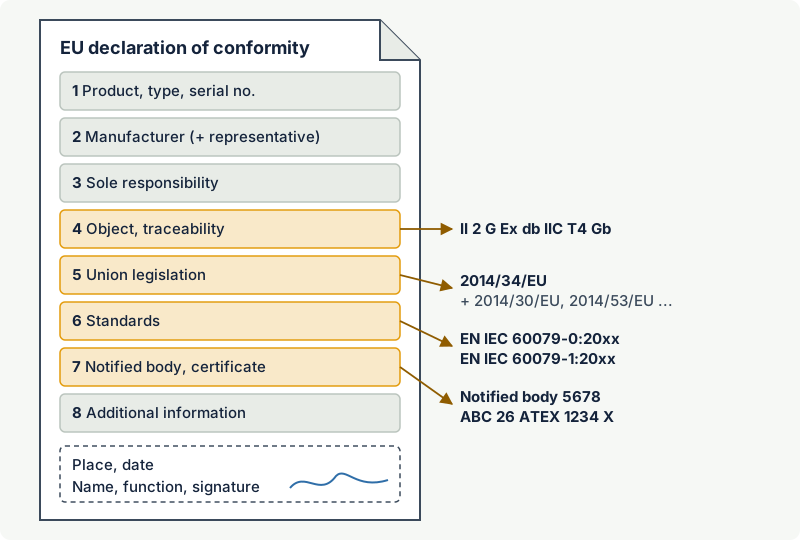
| Annex X item | What to write | What to check as a buyer |
|---|---|---|
| 1. Product model or product | Product, type, batch or serial number | Same type designation as on the plate |
| 2. Manufacturer (and authorised representative) | Name and address | Same name as on the plate |
| 3. Sole responsibility | The declaration is issued under the manufacturer's sole responsibility | Present; not signed "on behalf of" an unrelated trader |
| 4. Object of the declaration | Identification allowing traceability; may include an image | Model range, and in practice the Ex marking |
| 5. Union legislation | Directive 2014/34/EU and other applicable Union acts | Correct directives; see below |
| 6. Standards | References of harmonised standards or other specifications used | Editions given; current or justified |
| 7. Notified body | Name and number of the body, what it did, the certificate issued | EU-type examination certificate number; QAN body if applicable |
| 8. Additional information | Anything else relevant | Often specific conditions of use, ambient range |
| Signature | Place and date of issue, name, function, signature | A real person with a function in the company |
One declaration for several directives
Where a product falls under more than one EU act requiring a DoC, the manufacturer must draw up a single declaration covering all of them, with their publication references. A gas detector with a radio module may, for example, be declared under 2014/34/EU and the Radio Equipment Directive 2014/53/EU, and many electrical products also under the EMC Directive 2014/30/EU and the RoHS Directive 2011/65/EU. The Low Voltage Directive 2014/35/EU, on the other hand, excludes electrical equipment for use in an explosive atmosphere from its scope, so it should not normally appear on the DoC of equipment installed in the hazardous area; ATEX itself covers electrical hazards through its essential requirements (Annex II, 1.2.7), and the Commission's ATEX Guidelines note that low-voltage standards may still be cited on the DoC to show conformity with that requirement. The exception is a safety, controlling or regulating device installed outside the hazardous area, such as an intrinsically safe barrier marked II (1) G: the Guidelines state that both directives apply to it, so the Low Voltage Directive correctly appears on its DoC. For equipment that goes into the hazardous area itself, a DoC that lists the Low Voltage Directive deserves a question to the manufacturer.
DoC, certificate and attestation are different documents
| Document | Who issues it | Purpose |
|---|---|---|
| EU declaration of conformity | Manufacturer | Legal statement of conformity; condition for CE marking |
| EU-type examination certificate | Notified body | Confirms the design (Module B) for categories M1 and 1, for electrical equipment and internal combustion engines of categories M2 and 2, and for protective systems |
| Quality assurance notification (QAN) | Notified body | Approves the manufacturer's quality system (Module D or E) |
| Written attestation of conformity | Manufacturer | Replaces the DoC for components, which are not CE marked |
An EU-type examination certificate is not a declaration of conformity, and a buyer who receives only the certificate has not received the document the directive requires to accompany the product.
Delivery and retention
Manufacturers must ensure that each product is accompanied by a copy of the DoC or, for a component, of the attestation of conformity; where many products go to a single user, one copy may cover the whole batch. The DoC must be translated into the language or languages required by the Member State where the product is placed or made available on the market. The manufacturer and the importer each keep the DoC (and the manufacturer the technical documentation) for 10 years after the product has been placed on the market. Importers must check, before placing a product on the market, that it carries the CE marking and is accompanied by the DoC and the required documents.
Instructions and languages
Annex II, point 1.0.6, requires every item of equipment and protective system to be accompanied by instructions that include at least:
- a recapitulation of the marking, except the batch or serial number, plus information that makes maintenance easier (for example the address of the repairer);
- instructions for safe putting into service, use, assembly and dismantling, maintenance (servicing and emergency repair), installation and adjustment;
- where necessary, the danger areas in front of pressure-relief devices, and training instructions;
- details that allow a decision "beyond any doubt" on whether equipment of a given category, or a protective system, can be used safely in the intended area and conditions;
- electrical and pressure parameters, maximum surface temperatures and other limit values;
- where necessary, special conditions of use, including foreseeable misuse, and the essential characteristics of tools that may be fitted.
The instructions must also contain the drawings and diagrams needed for putting into service, maintenance, inspection, checking of correct operation and, where appropriate, repair. Sales literature must not contradict the instructions on safety aspects.
On language, the directive does not name languages. It requires instructions and safety information in a language that end-users can easily understand, as determined by the Member State concerned, and the manufacturer's contact details in a language easily understood by end-users and market surveillance authorities. In practice, a product sold in several Member States needs instructions in several languages, and the importer and distributor must check that the right ones are supplied. Specific conditions of use from an X certificate belong in the instructions, see the X and U suffixes.
Practical case: checking a delivery
A maintenance contractor receives a batch of increased-safety junction boxes for a Zone 1 area with IIB gases and T3 required. The plate reads, in part, CE 1234, the Ex hexagon, II 2 G, Ex eb IIC T6 Gb, ABC 26 ATEX 5678 X, -40 °C ≤ Ta ≤ +60 °C, a type designation, serial numbers and the year 2026.
- Label against site. Category 2 G suits Zone 1; IIC covers IIB; T6 is cooler than T3; the ambient range covers the site. The equipment is suitable.
- Declaration. One copy of the DoC came with the batch, which is allowed for a delivery to one user. It names the same type, lists 2014/34/EU, gives EN IEC 60079-0 and EN IEC 60079-7 with editions, and names a notified body as issuer of the EU-type examination certificate
ABC 26 ATEX 5678 X. - Number after CE. The DoC names the type examination body; 1234 is the body that issued the QAN. The two may differ, and both can be checked in the Commission's notified body database.
- X. The certificate number ends in X, so the instructions must state the specific conditions of use. Here they restrict the cable glands to certified types with a stated IP rating; the installer is told before work starts.
- Language. The site is in a Member State whose official language is not English; the instructions supplied are in English only. The contractor asks the supplier for the required language version before installation, as the directive requires it to accompany the product.
Every step uses only documents that must be supplied with the product, so the check can be done at goods receipt, before anything is installed.
Common mistakes and misconceptions
- "The EU-type examination certificate is the declaration." It is the notified body's statement about the design. The manufacturer's EU declaration of conformity is a separate document and must accompany the product.
- Expecting a notified body number on every ATEX product. Category 3 and non-electrical category 2 equipment usually carry CE without a number, because no notified body supervises their production.
- Reading the number after CE as the certificate issuer. It identifies the body involved in production control, which may differ from the body that examined the type.
- Listing the Low Voltage Directive on the DoC of equipment for the hazardous area. That directive excludes electrical equipment for use in explosive atmospheres; ATEX covers those hazards itself. Associated apparatus installed outside the hazardous area, such as barriers, is the exception: both directives apply.
- Supplying instructions only in English. The Member State decides which language end-users can easily understand; English alone is often not enough.
- CE marking components. Components, as defined in the directive, receive a written attestation of conformity and no CE marking.
Frequently asked questions
What must be on an ATEX label?
At minimum: the manufacturer's name and address, the CE marking, the series or type designation, the batch or serial number if any, the year of construction, and the Ex hexagon followed by the equipment group, category and G and/or D. In practice the plate also carries the standard marking, the certificate number, the ambient range and electrical ratings.
Does the ATEX declaration of conformity have to be supplied with the product?
Yes. Directive 2014/34/EU requires each product to be accompanied by a copy of the EU declaration of conformity; one copy may cover a batch delivered to a single user. It must be in the language or languages required by the Member State of sale.
What is the number after the CE mark on ATEX equipment?
It is the four-digit identification number of the notified body involved in the production control phase, for example the body that approved the manufacturer's quality system. Self-declared equipment, such as most category 3 products, has no number after CE.
What is the difference between the CE marking and the Ex marking?
The CE marking shows that the manufacturer declares conformity with all applicable EU legislation. The Ex hexagon with group and category is the specific ATEX marking of explosion protection, and it tells the user in which kind of hazardous area the product may be used.
In which language must ATEX instructions be?
In a language that end-users can easily understand, as determined by each Member State. A product sold across the EU therefore often needs instructions in several languages, and the DoC must be translated into the languages the Member State requires.
Do ATEX components need CE marking?
No. Components intended to be incorporated into ATEX equipment are not CE marked. The manufacturer issues a written attestation of conformity stating their characteristics and how they must be incorporated.
Related on excodex
- How to read an Ex marking: decoding II 2 G Ex db IIC T4 Gb step by step
- EU-Type Examination Certificates and Notified Bodies explained
- ATEX equipment categories 1, 2 and 3 and how they relate to EPLs
- How to verify that an Ex certificate is genuine
- ATEX vs IECEx: differences, similarities and which one you need
- Standards spaces: ATEX 2014/34/EU, IEC 60079-0; tool: Ex marking check
Standards and further reading
- Directive 2014/34/EU, equipment and protective systems for potentially explosive atmospheres: Articles 6, 8, 13, 14 and 16, Annex II (points 1.0.5 and 1.0.6) and Annex X: legislation.gov.uk (EU text as adopted)
- Regulation (EC) No 765/2008, Article 30 and Annex II (CE marking): EUR-Lex
- Regulation (EU) 2019/1020 on market surveillance, Article 4: EUR-Lex
- Directive 2014/35/EU (Low Voltage Directive), Annex II exclusions: legislation.gov.uk
- European Commission, ATEX page and ATEX 2014/34/EU Guidelines, 6th edition (January 2026): single-market-economy.ec.europa.eu
- European Commission, CE marking: single-market-economy.ec.europa.eu
- EN IEC 60079-0, explosive atmospheres, general requirements for equipment (marking clause)
- EN ISO 80079-36, non-electrical equipment for explosive atmospheres, basic method and requirements
This article is general technical information prepared by the excodex editorial team. It does not replace the applicable standards, the equipment certificates and instructions, national regulations or the assessment of a competent person.