Inspection of Ex installations under IEC 60079-17: initial, periodic, visual, close and detailed
Abstract
IEC 60079-17 sets how electrical installations in hazardous areas are inspected in service: visual, close and detailed grades, initial, periodic and sample inspections, continuous supervision, the 3-year interval limit, checklists, records and inspector competence.
IEC 60079-17 is the international standard for inspecting and maintaining electrical installations in hazardous areas once they are in service. It defines three grades of inspection (visual, close and detailed) and four ways of organising inspections (initial, periodic, sample and continuous supervision). The interval between periodic inspections is set from the factors that make the equipment deteriorate, but it should not exceed three years without expert advice. Results go into the verification dossier, and only competent persons may carry out the work.
This article explains the grades and types, how to set and justify intervals, what the inspection checklists cover, how to keep records, and what competence the standard expects.
Key points
- A visual inspection finds defects visible to the eye without tools, such as missing bolts; a close inspection adds defects found with access equipment and tools, such as loose bolts; a detailed inspection adds defects found only by opening the enclosure or using test equipment, such as loose terminations.
- Visual and close inspections can normally be done with the equipment energised; detailed inspections generally require it to be isolated.
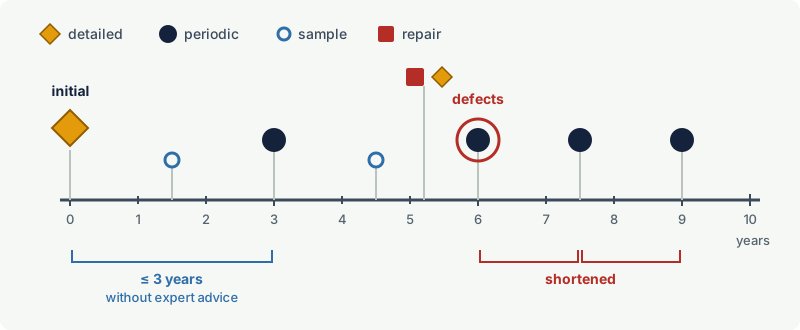
- Every installation gets an initial inspection at detailed grade before it is put into service (the requirements are in IEC 60079-14), and is then kept safe by periodic inspections or by continuous supervision by skilled personnel.
- IEC 60079-17 states that the interval between periodic inspections of fixed installations should not exceed three years without seeking expert advice; the reasoning behind each chosen interval should be recorded so that it can be reviewed.
- Movable equipment (hand-held, portable, transportable) is more prone to damage; the standard calls for a close inspection at least every 12 months and a visual check by the user before each use.
- The current edition is IEC 60079-17:2023 (edition 6), adopted in Europe as EN IEC 60079-17:2024.
What IEC 60079-17 covers
The standard applies to users of electrical installations in areas where explosive gas or dust atmospheres, or combustible dust layers, may be present. It covers only the inspection and maintenance aspects specific to explosion protection and supplements the general verification rules of IEC 60364-6. It does not cover underground mining, explosives dusts, pyrophoric substances, gas detection systems, ventilation of rooms, or repair and overhaul of Ex equipment, which is the subject of IEC 60079-19.
The sixth edition was published in December 2023 and replaced the 2013 edition; EN IEC 60079-17:2024 replaced EN 60079-17:2014, with conflicting national standards to be withdrawn by 5 January 2027. The changes are mostly clarifications: aligned maintenance definitions, a new subclause on using the manufacturer's documentation, more guidance on deterioration factors, the term "Specific Conditions of Use" replacing the older "special conditions of safe use", more requirements for liquid immersion "o", clarification of how to use the inspection tables, alignment of continuous supervision roles, and a typical fitness-for-purpose assessment report.
Grades of inspection: visual, close and detailed
The three grades are nested. Each one includes everything in the grade below it and adds more.
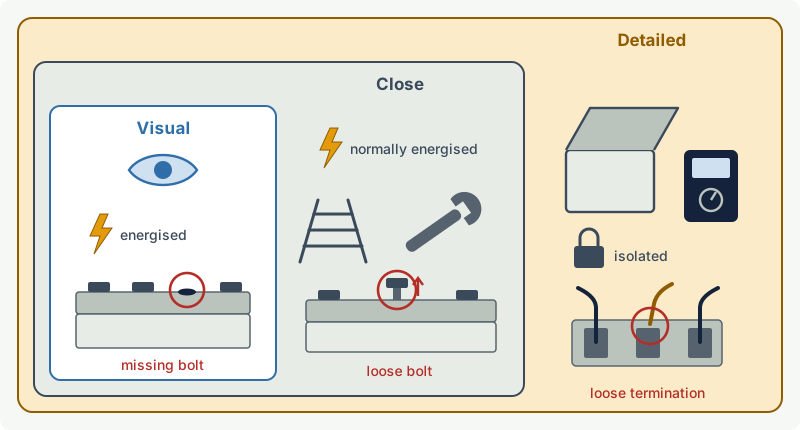
| Grade | Method | Equipment state | Typical defects found |
|---|---|---|---|
| Visual | Eyes only, without access equipment or tools | Energised | Missing bolts or blanking elements, broken glass, obvious damage, missing labels, corrosion, wrong equipment for the zone (from the marking) |
| Close | Visual plus access equipment (steps) and hand tools | Normally energised, enclosure not opened | Loose bolts and glands, damaged seals visible from outside, unsuitable gland or plug types, earthing and bonding connections not tight |
| Detailed | Close plus opening the enclosure and test equipment | Generally isolated | Loose terminations, damaged flamepaths and gaps, internal damage or contamination, wrong lamp rating, water or dust ingress, insulation resistance, earth loop impedance, protection settings |
For equipment that combines types of protection, such as an Ex d motor with an Ex e terminal box, the inspection combines the checks for each type.
Note: A detailed inspection is not a close inspection done more carefully. It needs isolation, a work permit and usually a gas-free certificate, so it disturbs the plant and is itself a source of risk: every time a flameproof cover is removed, the flamepath can be damaged and a bolt can be lost. Plan detailed inspections where they add information.
Types of inspection
Initial inspection
Before an installation or a new item of equipment is put into service, it receives an initial inspection to check that the type of protection and the installation are appropriate. The initial inspection is done at detailed grade, and since 2013 its requirements are in IEC 60079-14 rather than IEC 60079-17. See Ex installation basics.
Periodic inspection
A periodic inspection is a routine inspection of all the equipment, systems and installations. It can be visual, close or detailed, and the grade and interval are chosen together. Many plants combine grades, for example a close inspection of all items with a detailed inspection of a proportion of them.
Sample inspection
A sample inspection covers a representative proportion of the equipment. The standard is clear about what sampling can and cannot do: it will not reliably reveal random faults such as a loose connection, but it is the right tool for monitoring the effects of the environment, vibration and inherent design weaknesses. Samples are also used between periodic inspections to confirm or adjust the chosen interval and grade.
Continuous supervision
Instead of periodic inspections, an installation may be kept under continuous supervision: frequent attendance, inspection, service, care and maintenance by skilled personnel who know the specific installation and its environment. This needs a defined organisation, with a technical person with executive function who manages the skilled personnel and has overall responsibility for the inspection system, documented frequencies and training. Where an installation falls outside what continuous supervision can cover, it must be inspected periodically.
Inspection after work and after changes
After any adjustment, maintenance, repair, reclamation, modification or replacement, the equipment or the affected parts must be inspected to the relevant detailed checks. If the area classification or the EPL requirements change, or equipment is moved to another location, its type of protection, group and temperature class must be checked again for the new conditions.
Setting and justifying the interval
IEC 60079-17 does not give a fixed interval for fixed installations. The grade and interval are determined from:
- the type of equipment and the manufacturer's guidance;
- the factors that cause deterioration: corrosion, exposure to chemicals or solvents, dust and dirt, water ingress, high ambient temperature, mechanical damage and vibration;
- service factors such as the training and experience of personnel, the likelihood of unauthorised modifications and of inappropriate maintenance;
- the zone or EPL requirement;
- the results of previous inspections, and experience with similar equipment in similar environments.
The standard sets one ceiling: the interval between periodic inspections should not exceed three years without seeking expert advice. A longer interval therefore needs an assessment by someone with the relevant expertise, and recording the basis of every interval lets later reviewers check it. Once an interval is fixed, interim sample inspections are used to support or modify it, and the results are reviewed continuously.
National adoptions can differ. Guidance from WorkSafe Victoria, which refers to AS/NZS 60079.17:2017, says that fixed equipment should not go more than four years between inspections without expert advice and a risk assessment, and recommends upgrading visual or close inspections to detailed grade when major defects are found. Check the edition and national version that applies to your site.
Movable equipment
Hand-held, portable and transportable equipment is particularly prone to damage and misuse. The standard calls for a close inspection at least every 12 months and for the user to check the equipment visually before use. Enclosures that are opened frequently, such as battery compartments, also need detailed inspection. See portable electronics in hazardous areas.
Worked example: building a programme
A tank farm has 600 Ex items: 380 increased safety junction boxes and luminaires, 150 flameproof motors and control stations, and 70 intrinsically safe instruments. The site is coastal and the equipment is 12 years old.
- Group the items by type of protection, environment (exposed jetty, sheltered pump house) and history.
- Set the base programme: a close inspection of every item every two years, rather than three, because of salt exposure; a detailed inspection of a 10 % sample of each group in between.
- Use the results: if the sample in the jetty group finds water ingress in four of fifteen junction boxes, inspect all jetty junction boxes in detail and shorten that group's interval. If the pump house sample is clean three times running, the documented results can support a longer interval there, with expert advice if it would exceed three years.
- Record the reasoning in the inspection strategy, so a later reviewer can see why each group has its interval.
The sample size of 10 % in this example is a planning choice, not a figure from the standard.
What the checklists cover
IEC 60079-17 provides inspection schedules (tables) for each type of protection: one for Ex d, e, n and t, one for intrinsic safety, one for pressurisation and one for liquid immersion. For each check, the tables show at which grade it applies. In outline the items fall into three groups:
| Group | Typical checks |
|---|---|
| Equipment | Suitable for the EPL, zone, group and temperature class; correct circuit identification; enclosure, glass and seals undamaged; no unauthorised modifications; bolts, cable entries and blanking elements of the correct type, complete and tight; flamepaths clean and undamaged with gaps within limits; lamps of the correct rating and type; terminations tight; no water or dust inside |
| Installation | Cable type suitable and undamaged; sealing of trunking, ducts and conduits; earthing and bonding connections; fault loop impedance or earth resistance; insulation resistance; protective device settings; specific conditions of use met; unused cores correctly terminated; obstructions near flameproof flanges |
| Environment | Protection against corrosion, weather, vibration and other adverse factors; no undue accumulation of dust and dirt; insulation clean and dry |
The intrinsic safety schedule adds checks of the documentation, labelling, safety interfaces such as barriers and isolators, cable screens, earthing integrity, and separation between intrinsically safe and other circuits. The pressurisation schedule adds protective gas supply, pressure and flow, purge and alarm or trip functions. The 2024 edition of IEC 60079-14 also contains initial inspection tables aligned with these schedules, which many sites use as a starting point for their own checklists.
Test equipment in the hazardous area
Insulation resistance testers and loop impedance testers are not normally Ex certified and can produce sparks. Testing in the hazardous area is done only under a work permit, typically after a gas-free test. Insulation tests on intrinsically safe circuits are done only as the system documentation allows, because they can damage the protective components.
Records
The results of every inspection are recorded and retained. For the purposes of inspection and maintenance, IEC 60079-17 requires an up-to-date verification dossier containing:
- the zone classification and, where used, the EPL required at each location;
- for gases, the equipment group and temperature class required; for dusts, the equipment group and maximum surface temperature;
- the equipment characteristics, such as temperature rating, type of protection, IP rating and corrosion resistance;
- records sufficient to maintain each item according to its type of protection, such as an equipment list with locations, spares, certificates and technical information;
- copies of previous inspection records, and the initial inspection records.
Two practical points come from the standard. Where a marking plate is missing or illegible, the item can still be traced to its certificate through tag numbers, serial numbers or the installation database, provided any added label does not reduce the protection. And for old equipment that was never certified, a fitness-for-purpose assessment (an informative annex gives a procedure) is needed before it can be kept in service and given an inspection regime.
A good inspection record names the item and its tag, the grade and date, the inspector, each defect with its location and severity, the action taken or raised, and the date it was closed out. Defects found must be corrected as soon as practicable; equipment that cannot be made safe must be taken out of service.
Who may inspect
Inspection and maintenance must be carried out by competent personnel. The standard expects their training to cover the types of protection and installation practices, the requirements of the standard, the relevant national regulations and company rules, and the general principles of area classification, with regular refresher training and documented evidence. For periodic inspection the inspector must understand the area classification and EPL of the location, the theory and practice of the equipment, and what visual, close and detailed inspections require.
The inspection must be sufficiently independent of the immediate demands of maintenance so that the findings are reliable. It does not have to be done by an external organisation. The 2023 edition describes the roles of responsible persons, technical persons with executive function and skilled personnel in a normative annex.
Competence can be demonstrated through national schemes or the IECEx Certificate of Personnel Competence: unit Ex 007 covers visual and close inspection, Ex 008 detailed inspection and Ex 010 audit inspection. See competence of people working in hazardous areas.
Common mistakes
- Using three years as a fixed interval. It is a ceiling without expert advice, not a target. A corrosive, vibrating or frequently modified installation may need much shorter intervals.
- Sampling to find loose connections. Random faults are not found by sampling. Use sampling to monitor deterioration trends, and full inspections where random faults matter.
- Inspecting without the dossier. An inspector who does not know the zone, gas group and temperature class cannot judge suitability, only condition.
- Recording defects but not closing them out. Regulators such as WorkSafe Victoria have taken action where defects were identified but damaged equipment was not repaired or replaced.
- Opening equipment that does not need it. Unnecessary detailed inspections damage flamepaths, lose bolts and create risk. Match the grade to the purpose.
- Forgetting to re-check after changes. A new process fluid or a revised zone drawing can make installed equipment unsuitable even though nothing on it has changed.
Frequently asked questions
What are the three grades of Ex inspection?
Visual, close and detailed. A visual inspection finds defects visible to the eye without tools; a close inspection also uses access equipment and hand tools, for example to find loose bolts; a detailed inspection also opens the enclosure and uses test equipment, for example to find loose terminations. Each grade includes the checks of the grade below.
How often should Ex equipment be inspected?
IEC 60079-17 does not fix a single interval. The interval is set from the deterioration factors, the zone and the results of previous inspections, and for fixed installations it should not exceed three years without expert advice. Movable equipment needs a close inspection at least every 12 months and a visual check before each use.
Is the initial inspection part of IEC 60079-17?
The initial inspection is a type of inspection named in IEC 60079-17, but its requirements are in IEC 60079-14. It is carried out at detailed grade before the installation is put into service, and its records become part of the verification dossier.
What is continuous supervision?
Continuous supervision is an alternative to periodic inspection in which skilled personnel who know the installation attend it frequently, inspecting, servicing and maintaining it as part of their normal work. It requires a defined organisation, a technical person with executive function, documented frequencies and training. Parts of the installation that it cannot cover still need periodic inspection.
Can visual and close inspections be done with the equipment live?
Yes, they are normally done with the equipment energised, because they do not require opening the enclosure. Detailed inspections generally require isolation, and any test equipment used in the hazardous area needs a permit and usually a gas-free test.
Does the inspector have to be from an independent company?
No. IEC 60079-17 requires the inspection to be sufficiently independent of the immediate demands of maintenance so that it reports reliably, but it states that inspectors do not need to belong to an external organisation. They do need documented competence.
Related on excodex
- Ex installation basics under IEC 60079-14
- Common Ex inspection findings and how to fix them
- Repair, overhaul and modification of Ex equipment (IEC 60079-19)
- Competence of people working in hazardous areas: IECEx CoPC and other schemes
- How to verify that an Ex certificate is genuine and the Ex marking check tool
- Standards space: IEC 60079-17, IEC 60079-19, and the forum
Standards and further reading
- IEC 60079-17:2023, Explosive atmospheres, Part 17: electrical installations inspection and maintenance (edition 6). Sample pages with scope and definitions: IEC 60079-17:2023 preview
- EN IEC 60079-17:2024, European adoption: catalogue entry with dates and scope
- IEC 60079-14, design, selection, installation and initial inspection
- IEC 60079-19, equipment repair, overhaul and reclamation
- IEC 60364-6, low-voltage electrical installations, verification
- WorkSafe Victoria, "Management of electrical equipment in hazardous areas at major hazard facilities" (2020): guidance PDF
- Australian offshore safety regulator (issued by NOPSA, now NOPSEMA), Safety Alert 33, hazardous area electrical equipment: alert PDF
- IECEx Certified Persons scheme, units of competence: IECEx CoPC overview
This article is general technical information prepared by the excodex editorial team. It does not replace the applicable standards, the equipment certificates and instructions, national regulations or the assessment of a competent person.