Common Ex inspection findings and how to fix them
Abstract
The defects Ex inspectors find most often, why each one matters and how to fix it properly: missing or wrong bolts, wrong or loose cable glands, open or plugged unused entries, damaged flamepaths, paint, corrosion, ingress and unsuitable equipment.
The defects found most often in Ex inspections are simple and visible: bolts missing from flameproof covers, the wrong or a loose cable gland, unused entries left open or closed with plastic caps, flamepaths that are scratched, corroded, painted or sealed with silicone, and enclosures let down by corrosion and water. Most are caused by maintenance work and the environment, not by the manufacturer. The fix is always to restore the certified condition with certified parts and the manufacturer's instructions, never to improvise.
This article goes through the common findings one by one: what the inspector sees, why it matters for explosion protection, and how to put it right. Diagrams replace photographs so that the details are clear.
Key points
- One missing bolt on a flameproof cover can compromise the enclosure; replacements must match the specified size, length and strength class, and every fastener must be fitted and tight.
- A cable gland must be certified for the enclosure's type of protection, match the entry thread and the cable diameter, and be tight; tape or sleeves to build up a cable are not allowed.
- Unused entries must be closed with blanking elements certified for the type of protection; plastic transit caps provide neither flameproof nor IP protection.
- Damaged flamepaths must not be filled, re-machined on site or sealed with gaskets or silicone; light staining can be cleaned as instructed, and real damage needs repair to the manufacturer's data under IEC 60079-19 or replacement.
- Paint must never cover flamepaths, labels, breathers or drains, and thick coatings can create an electrostatic hazard unless they meet the equipment standard.
- Every repair is followed by an inspection of the affected parts to the detailed grade, and the finding, the fix and the re-inspection are recorded in the verification dossier.
Why the same findings keep appearing
Regulators list the same problems again and again. The Australian offshore safety regulator (then NOPSA, now NOPSEMA), in its Safety Alert 33 on hazardous area electrical equipment, reported equipment not rated for its zone, corrosion of motors, instruments and junction boxes, non-rated portable equipment in hazardous areas, damaged glands and seals, broken conduit, missing labels, exposed wiring, wiring not properly terminated and in some cases still live, and poorly maintained dossiers and registers with expired certification. WorkSafe Victoria notes that one missing bolt on the cover of a flameproof enclosure can compromise the protection and put the whole site at risk.
The causes are rarely mysterious:
- Maintenance disturbance. Every time a cover is opened, a bolt can be lost, a flamepath scratched, or a gland loosened.
- Spares and stores. The right bolt, plug or gland is not in stock, so something that fits is used instead.
- Environment. Salt, rain, heat, UV and chemicals attack seals, coatings and fasteners.
- Competence and supervision. Contractors without Ex training treat Ex equipment like industrial equipment.
- Changes. New process fluids, new pipework or a revised zone drawing make installed equipment unsuitable.
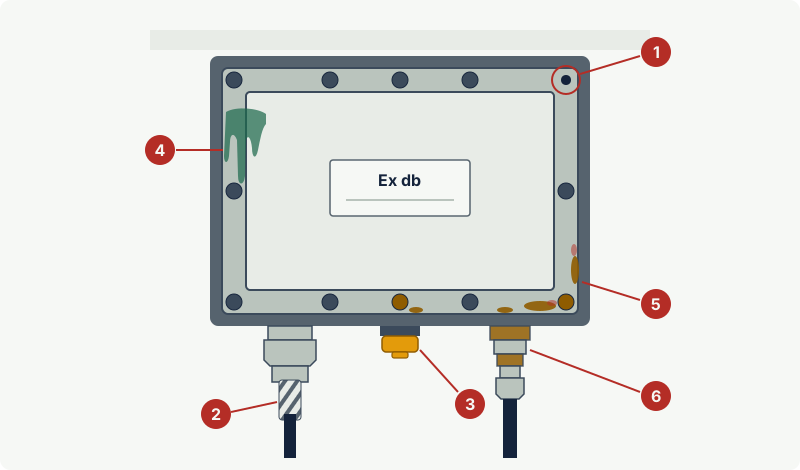
The findings at a glance
| Finding | Why it matters | Correct fix | Usually found at |
|---|---|---|---|
| Missing, loose or wrong bolts | Cover may not withstand the internal explosion; gap opens | Fit all bolts of the specified size, length and class; tighten as instructed | Visual (missing), close (loose) |
| Wrong, loose or damaged gland | Flameproof or IP protection lost at the entry | Certified gland for the protection type, thread and cable size | Visual to close |
| Unused entry open or with plastic cap | Direct path for flame, water and dust | Certified blanking element, correct thread, IP maintained | Visual |
| Damaged, corroded or sealed flamepath | Gap or width no longer as certified | Clean as instructed, assess, repair under IEC 60079-19 or replace | Detailed |
| Paint over joints, labels, breathers | Holds joints open, hides marking, blocks breathing devices, static charge | Remove paint from critical surfaces; mask before painting | Visual to detailed |
| Corrosion | Weakens enclosures, fasteners, earths and flamepaths | Clean, assess, replace parts, improve protection, shorten interval | Visual to detailed |
| Water or dust inside | Tracking, short circuits, hot spots, corrosion | Find the leak (gasket, gland, entry), dry, replace seals | Detailed |
| Equipment unsuitable for the location | Not protected for the zone, gas group or temperature class | Replace with suitable equipment | Visual (from marking and dossier) |
Bolts, glands and entries
Missing, loose and wrong bolts
What the inspector sees. An empty bolt hole on a flameproof cover, bolts that turn by hand, bolts of different lengths or materials on the same cover, or a bolt that is too long and has bottomed in a blind hole.
Why it matters. The cover bolts of a flameproof (Ex d) enclosure carry the force of an internal explosion and hold the flamepath gap within its certified maximum. A missing or loose bolt lets the cover lift under pressure, so the gap can open beyond the value that quenches the flame. On increased safety (Ex e) and dust (Ex t) enclosures, the cover screws compress the gasket that provides the IP rating.
How to fix it.
- Find the specified fastener in the manufacturer's instructions or on the label: thread size, length, material and strength class. Some enclosures use special or captive fasteners.
- Replace every missing or damaged bolt with an identical one. A bolt of lower strength class, or a stainless steel bolt where a higher strength carbon steel bolt is specified, may not meet the design.
- Check that the bolt engages fully and does not bottom in a blind hole; a bottoming bolt feels tight but leaves the cover loose.
- Tighten all bolts evenly to the torque in the instructions, if given.
- Check the flamepath gap where the instructions give a method and a maximum value.
If a threaded hole is stripped, the enclosure needs repair under IEC 60079-19 by a competent workshop; it must not be re-tapped oversize or fitted with an insert on site unless the manufacturer's documentation allows it.
Wrong, loose and damaged cable glands
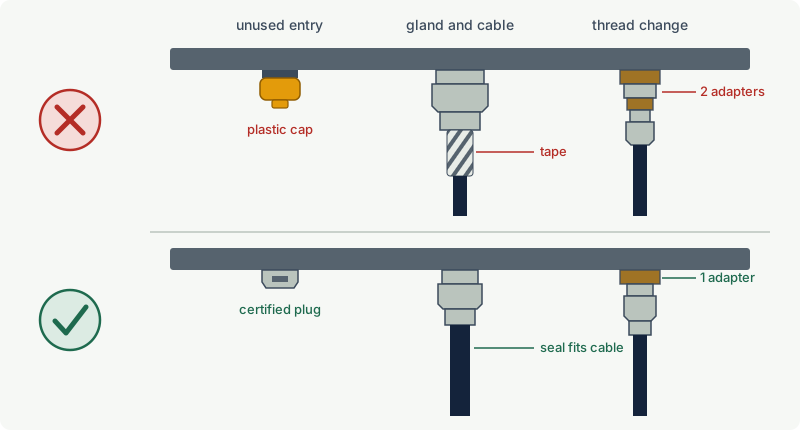
What the inspector sees. An increased safety or industrial gland in a flameproof enclosure; a gland that is too large for the cable, with tape or heat-shrink wrapped round the cable to make it fit; a loose gland locknut or a cable that can be pulled through the seal; armour not terminated in the gland; a cracked plastic gland; or a cable pulled partly out of its gland.
Why it matters. The gland is part of the enclosure's protection. A wrong gland type does not maintain a flameproof joint; a gland that does not grip the cable lets water in and lets pull on the cable reach the terminals; unterminated armour can float at a different potential and spark.
How to fix it.
- Identify the enclosure's type of protection and the entry thread, and fit a gland certified for that protection type, with the correct thread and a seal range that covers the measured cable diameter.
- Never build up a cable with tape or sleeves; use the correct gland or seal size.
- Terminate armour or braid in the gland's clamp and, on non-metallic enclosures, connect it to the bonding system as designed.
- On flameproof enclosures, check whether a barrier gland was required (see cable glands for hazardous areas). Re-terminating a cable in a barrier gland means making a new barrier with new compound, as instructed.
- Support the cable so that its weight and movement are not carried by the gland.
Unused entries left open or plugged wrongly
What the inspector sees. A plastic dust cap from the factory still in an unused entry, an uncertified metal plug, a plug with the wrong thread, or an adapter with a blanking plug screwed into it on a flameproof enclosure.
Why it matters. An open or wrongly closed entry is a direct path for flame out of a flameproof enclosure and for water and dust into any enclosure. Plastic transit caps are designed only to keep threads clean during transport.
How to fix it. Fit a blanking element certified for the enclosure's type of protection, with the correct thread type and size, removable only with a tool, giving at least IP54 or the IP rating the location requires. On a flameproof enclosure use a certified flameproof stopping plug screwed directly into the entry: IEC 60079-14 does not allow an adapter to be combined with a blanking element on Ex d equipment. If many entries are unused, record them so that stores hold the right plugs.
Flamepaths, paint and corrosion
Damaged flamepaths
What the inspector sees (at a detailed inspection, with the cover removed): scratches or dents across the joint faces, pitting from corrosion, a layer of hardened paint or sealant, a gasket that is not part of the design, or a gap larger than the maximum given in the documentation.
Why it matters. A flamepath works because the gap is narrow and the path is long enough to cool the escaping gases. A scratch running across the face from inside to outside shortens the effective width and creates a channel with a wider gap. Corrosion pits do the same. A sealant, extra gasket or layer of paint can hold the cover away from the body and increase the gap. See flameproof enclosures.
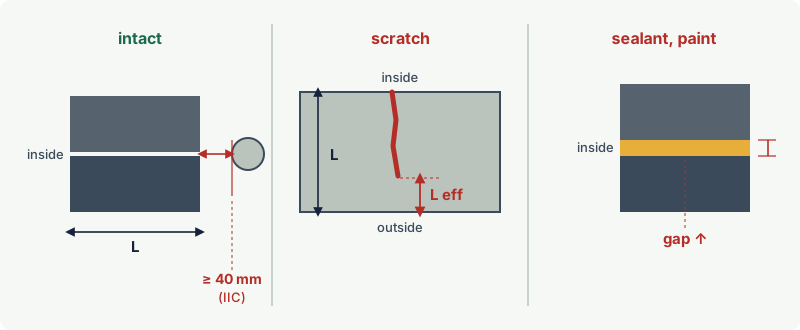
How to fix it.
- Isolate under the site permit and remove the cover without levering on the joint faces.
- Clean the faces with the method and agent the instructions allow; never with abrasive paper, a wire brush or a power tool.
- Assess the damage against the manufacturer's data. Light surface staining that cleans off without pitting can usually be accepted. Scratches or pits across the width, or a measured gap above the maximum, cannot.
- Never fill damage with compound, weld or re-machine faces on site. Repair to the manufacturer's dimensions is work under IEC 60079-19 for a competent repair facility; often replacement of the cover or enclosure is the practical answer. See repair, overhaul and modification.
- Remove any sealant or gasket that is not part of the certified design. Protect the faces with non-setting grease or the agent named by the manufacturer.
- Refit with all bolts, and check that no obstacle sits closer to the joint outlet than the minimum: 10 mm for IIA, 30 mm for IIB and 40 mm for IIC, unless the certificate allows less.
Warning: Tape around flanged joints is restricted. Installation codes allow non-hardening grease-impregnated tape around the outside of a flanged joint only in limited cases: at most a single layer, generally only in IIA atmospheres (some codes allow IIB only with very small gaps), and never in IIC. Tests have shown that tape can reduce the safe gap significantly for IIB and IIC gases. Follow the manufacturer's instructions and the installation standard, and do not add layers.
Paint and coatings
What the inspector sees. Paint run into or over a flamepath, labels painted over during plant repainting, painted breathers, drains, gland seals or glass, or very thick coating layers built up over years.
Why it matters.
- Paint on a flamepath can hold the joint open, and paint in the gap is not part of the certified design.
- A painted-over label makes the equipment untraceable: the inspector can no longer confirm the type of protection, group or temperature class.
- Breathing and draining devices that are painted shut stop working, so condensation collects inside.
- Non-metallic coatings can store electrostatic charge. Equipment standards control this by requiring antistatic coatings or limiting the coating thickness; repainting by the user can exceed the limit the manufacturer designed for.
How to fix it. Remove paint from flamepaths and joint faces with the method allowed by the manufacturer. Restore or replace labels; where a plate is missing or illegible, IEC 60079-17 allows traceability by tag numbers, serial numbers or the installation database, as long as any added label does not reduce the protection. Free or replace breathers and drains. Before future painting campaigns, mask flamepaths, labels, breathers, drains, gland seals and windows, and follow the manufacturer's guidance on coatings.
Corrosion
What the inspector sees. Rust on steel enclosures, bolts and flanges; white corrosion products on aluminium; green deposits on brass glands; pitting on joint faces; corroded earth and bonding connections; swollen paint with rust underneath.
Why it matters. Corrosion weakens the enclosure and the fasteners that must resist the explosion pressure, damages flamepaths, seizes covers so that maintenance teams force them, and increases the resistance of earth and bonding connections. Dissimilar metals in contact, for example plain brass glands in aluminium enclosures in a wet, salty environment, corrode faster.
How to fix it.
- Assess how far the corrosion goes: surface, fasteners, joint faces, or the enclosure wall itself.
- Replace corroded fasteners with the specified type; clean and protect flamepaths as described above; remake earth and bonding connections with clean contact surfaces and protection against corrosion.
- Where the enclosure wall, a threaded entry or a flamepath is attacked, the item needs repair under IEC 60079-19 or replacement.
- Remove the cause: improve drainage, fit gland shrouds where suitable, choose compatible materials (stainless steel, nickel-plated glands, marine grade coatings) at replacement.
- Record the finding and shorten the inspection interval for that environment until results show the measures work. Corrosion is one of the deterioration factors IEC 60079-17 lists for setting intervals.
Other frequent findings
- Water or dust inside the enclosure. Usually a perished or missing gasket, a loose cover, a wrong gland or an open entry. Dry the equipment, replace seals with the manufacturer's parts, find the entry point, and check insulation resistance before re-energising.
- Wrong lamp or lamp rating in a luminaire. A higher wattage lamp can push the surface temperature above the temperature class. Fit only the lamp type and rating marked on the luminaire. See hot surfaces in hazardous areas.
- Equipment unsuitable for the location. Often discovered when the inspector compares the marking with the zone drawing: a Gc item in Zone 1, IIB equipment where hydrogen is handled, or a temperature class too high for the substance. Replace it; do not "accept" it.
- Unauthorised modifications. Extra holes drilled in an enclosure, added components inside a flameproof enclosure, or bypassed pressurisation alarms. The certificate no longer applies; restore the original configuration or replace.
- Intrinsic safety errors. IS and non-IS cables mixed in one cable or junction box without segregation, missing identification, interface earths disconnected, or replaced field devices whose parameters no longer match the loop documentation. See IS loop verification.
- Unused cores cut and taped. They must be earthed or insulated with suitable terminations; tape alone is not acceptable.
- Non-Ex portable equipment such as drills, lamps and phones in the hazardous area without a permit. See portable electronics in hazardous areas.
From finding to close-out
A finding is only closed when the equipment is back in its certified condition and the record shows it. A practical sequence:
- Grade the severity. Many sites use three categories: immediate danger (isolate or make safe now), significant (fix within a short, defined time), and minor (fix at the next opportunity). These categories are site practice, not part of the standard, but they make priorities clear.
- Make safe. Where protection is lost on live equipment in a hazardous area, isolate it or apply other controls until it is fixed.
- Fix with certified parts and the manufacturer's instructions. Repairs that change certified dimensions or parts belong in a competent repair facility under IEC 60079-19.
- Re-inspect. IEC 60079-17 requires equipment that has been adjusted, maintained, repaired, modified or replaced to be inspected to the relevant detailed checks.
- Record and learn. Enter the finding, the fix and the re-inspection in the dossier. If the same finding appears on many items, treat it as a systematic problem: wrong stores items, an untrained contractor, a corrosive location or a weak design, and adjust the inspection interval and procedures. See inspection under IEC 60079-17.
Common mistakes when fixing findings
- Adding silicone or a gasket to stop water. It can hold a flameproof joint open. Use the design's own seal and non-setting grease, and fix the source of water.
- Taking bolts from stores "because they fit". The thread may match while the length or strength class does not. Use the specified fastener.
- Replacing a plastic cap with any metal plug. It must be certified for the type of protection and have the right thread.
- Filling or dressing damaged flamepaths on site. This changes certified dimensions. Repair under IEC 60079-19 or replace.
- Closing a finding without re-inspection. The repair itself may introduce a new defect; inspect the affected parts in detail afterwards.
Frequently asked questions
What is the most common finding in Ex inspections?
Missing or loose bolts on flameproof covers, unsuitable or loose cable glands, and unused entries closed with plastic caps or uncertified plugs are among the most frequent findings, together with corrosion and water ingress. They are easy to see and usually result from maintenance work or the environment.
Can I replace a missing flameproof cover bolt with any bolt that fits?
No. The bolt must match the specified thread, length, material and strength class, because the fasteners carry the explosion pressure and hold the joint gap. A bolt that is too long can bottom in a blind hole and leave the cover loose even though it feels tight.
Is it allowed to paint Ex equipment?
Painting the outside of an enclosure is generally possible if it follows the manufacturer's guidance, but flamepaths, joint faces, labels, breathers, drains, gland seals and windows must not be painted. Thick or non-antistatic coatings can create an electrostatic hazard, so check the instructions before repainting.
Can a damaged flamepath be repaired on site?
Only cleaning and protection as described in the manufacturer's instructions should be done on site. Repair of damaged joint faces, such as re-machining, belongs to a competent repair facility working under IEC 60079-19 with the manufacturer's data; often the cover or enclosure is replaced instead.
What should be used to close an unused cable entry?
A blanking element certified for the enclosure's type of protection, with the correct thread, removable only with a tool, and maintaining at least IP54 or the IP rating the location requires. On flameproof enclosures this is a certified flameproof stopping plug fitted directly in the entry, not combined with an adapter.
Related on excodex
- Inspection of Ex installations under IEC 60079-17
- Cable glands for hazardous areas: barrier glands, compound glands and selection
- Flameproof enclosures (Ex d): how flamepaths stop an internal explosion
- Repair, overhaul and modification of Ex equipment (IEC 60079-19)
- Ex installation basics under IEC 60079-14 and the Ex marking check tool
- Standards space: IEC 60079-17, IEC 60079-19, and the forum
Standards and further reading
- IEC 60079-17, electrical installations inspection and maintenance (inspection schedules for each type of protection)
- IEC 60079-14, design, selection, installation and initial inspection (cable entries, blanking elements, obstruction distances)
- IEC 60079-19, equipment repair, overhaul and reclamation
- IEC 60079-1, flameproof enclosures; IEC 60079-0, general requirements (including electrostatic requirements for coatings)
- Australian offshore safety regulator (issued by NOPSA, now NOPSEMA), Safety Alert 33, hazardous area electrical equipment: alert PDF
- WorkSafe Victoria, "Management of electrical equipment in hazardous areas at major hazard facilities" (2020): guidance PDF
- A. Wallace, "Exd weatherproofing alert", technical note on tape around flameproof joints and the test results behind the restrictions, hosted by the Engineering Institute of Technology: Ex d weatherproofing alert
This article is general technical information prepared by the excodex editorial team. It does not replace the applicable standards, the equipment certificates and instructions, national regulations or the assessment of a competent person.