Hot surfaces in hazardous areas: luminaires, motors, heat tracing and process heat
Abstract
A temperature class is only valid under the conditions it was certified for. How heat tracing gets its T-class (stabilised or controlled design), why motors on variable speed drives need converter-rated certificates, safe lamp changes, and hot process surfaces.
Any surface hotter than the autoignition temperature (AIT) of the gas or vapour around it can ignite it, whether the surface belongs to Ex equipment or to the process. The temperature class (T1 to T6) of Ex equipment only holds under the conditions it was certified for: the specified lamp, the rated supply, the rated ambient temperature and no extra heat from the process. Electrical trace heating earns its temperature class either by a stabilised design, where the sheath temperature stays below the limit even under worst-case conditions without any control, or by a controlled design, where a temperature controller and, in Zone 1, an independent high-temperature limiter keep it there. Motors on variable speed drives, luminaires after a lamp change, and instruments on hot process lines are the most common places where those conditions are quietly broken.
This article goes through the four main sources of hot surfaces in a plant, explains what decides their temperature and what to check, and ends with a walk-down of a typical pump skid.
Key points
- A temperature class is a statement about equipment under defined conditions. A different lamp, a converter supply, a higher ambient or heat from the process can each make the marked class invalid.
- Trace heating gets its temperature class by stabilised design (calculated or tested worst case without control) or by controlled design (in long-established practice, a controller plus, for Zone 1 and Division 1, an independent high-temperature limiter that needs a manual reset; the 2025 edition rewrote the detailed rules). IEC/IEEE 60079-30-1 does not cover EPL Ga, so trace heating to this standard is not suitable for Zone 0.
- Self-regulating heaters can carry a temperature class that is independent of the application; constant wattage and power-limiting heaters get their class from the design of each circuit.
- A motor on a variable speed drive is hotter at low speed and with converter harmonics. Its temperature class is valid only if the certificate covers converter supply; flameproof motors usually rely on embedded winding sensors connected to a trip, and increased safety motors need certification together with the converter type.
- Ex luminaires are classified with a specific lamp type and maximum power. Fitting a different lamp, or an LED retrofit tube not covered by the certificate, invalidates the temperature class.
- Equipment mounted on hot pipes or vessels must be used within the process temperature limits in its documentation. Hot process surfaces themselves must stay below the AIT; the German technical rule TRGS 723 limits them to 80 % of the ignition temperature in Zone 0 and, with exceptions, in Zone 1.
Why hot surfaces deserve their own checklist
A hot surface ignites a gas without any spark or flame. The safe limit is the AIT of the most easily ignited substance in the zone, and equipment is selected by temperature class so that its hottest accessible surface stays below that limit (see temperature classes T1 to T6).
In practice the temperature class on the label is only half of the story. The Australian offshore regulator NOPSEMA reported in 2021 that it had received multiple notifications of surface temperatures exceeding commitments or standards, involving turbines, steam systems and boilers, and that most were found during checks with handheld instruments. Degraded insulation was a common cause. Hot surfaces change with operating conditions, maintenance and modifications, so they need to be checked in operation and not only on the data sheet.
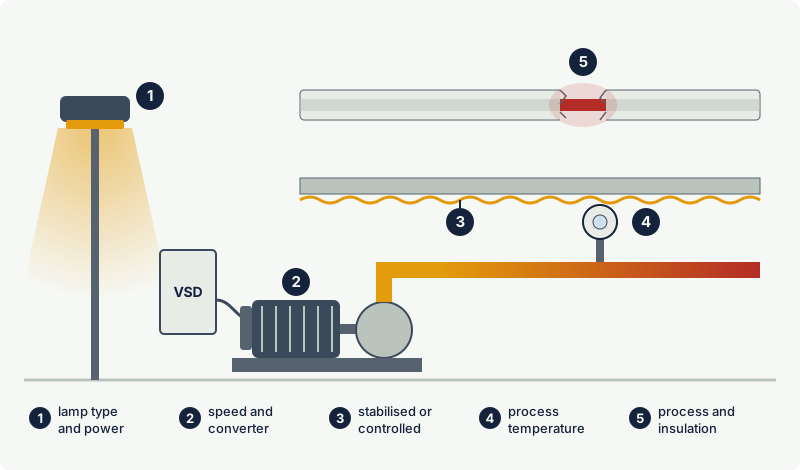
Heat tracing
Electrical trace heating keeps pipes, valves and vessels warm to prevent freezing, keep products fluid or avoid condensation. In a hazardous area the trace heater is Ex equipment, built and tested to IEC/IEEE 60079-30-1 (edition 2.0, September 2025, replacing the 2015 edition), with design and installation guidance in IEC/IEEE 60079-30-2 (also edition 2.0, 2025). The standard covers equipment for EPL Gb, Gc, Db and Dc and excludes EPL Ga, Da, Ma and Mb, so trace heating to this standard is not suitable for Zone 0 or Zone 20.
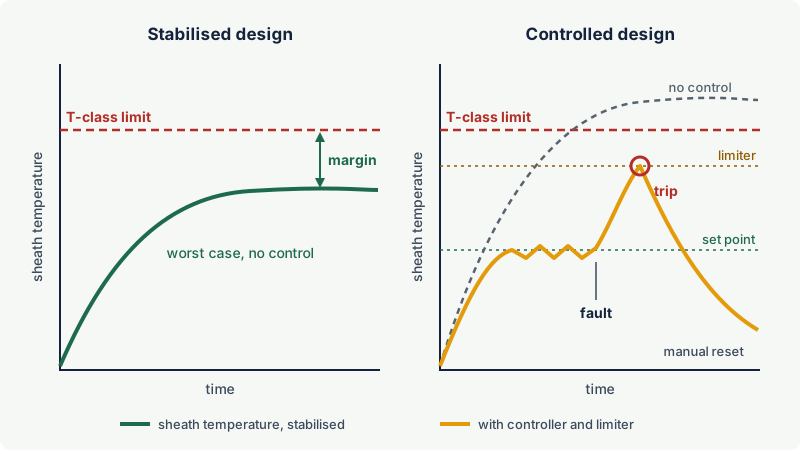
The key quantity is the maximum sheath temperature: the highest temperature of the outer covering of the heater. It must not exceed the temperature class limit (or the maximum surface temperature allowed for the area). There are two ways to guarantee that.
Stabilised design
In a stabilised design, the heater by its own design and use stabilises below the limit under the most unfavourable conditions, without relying on any thermostat or limiter. The calculation or test assumes, in essence:
- no control at all, so the pipe reaches the temperature where heat input and heat loss balance;
- the highest ambient temperature and still air (no wind cooling);
- the heater at the upper end of its output tolerance and at overvoltage (a supply above nominal);
- no safety factor on heat loss that would make the result look cooler.
If the resulting maximum sheath temperature is below the class limit, the circuit is stabilised and its temperature class does not depend on any control device. Control may still be fitted for energy saving or process reasons.
Controlled design
Where the uncontrolled equilibrium would be too hot, the circuit relies on control. IEC/IEEE 60079-30-1 calls this a controlled design, in which a temperature controller and/or a high-temperature limiter are used to establish or limit the maximum sheath temperature. The 2025 edition rewrote these requirements for controllers and limiters used for the different EPLs, so check the current edition for details. The long-established principles, also found in IEEE 515, are:
- Zone 1 and Division 1: a temperature controller plus a separate high-temperature limiter that works independently of the controller. The limiter trips before the sheath can exceed the limit, it stays tripped until it is manually reset, and its set point is locked against unauthorised change.
- Zone 2 and Division 2: a temperature controller has traditionally been sufficient, subject to the standard's conditions.
- Sensor placement matters. A limiter protects only the point it measures. It is placed where the sheath will be hottest, or its set point is reduced to allow for the difference, as the design documents state.
Self-regulating, constant wattage and power-limiting heaters
Self-regulating heaters have a conductive polymer core whose output falls as its temperature rises. Many are tested by the manufacturer so that the temperature class is a property of the product, independent of the application: the cable cannot exceed its class however it is installed, within the stated conditions. Constant wattage (series and parallel) and power-limiting heaters keep producing heat as the pipe warms, so their temperature class is a property of each circuit design and must be shown by calculation or by control.
Practical points for heat tracing
- Process temperature versus exposure temperature. A pipe that is steam-cleaned or carries a hot product can heat the trace heater from the inside. Its maximum exposure temperature (withstand temperature) must be above the highest pipe temperature, and the pipe itself must remain below the class limit for the area.
- Insulation is part of the design. Wet, damaged or missing insulation changes heat loss and therefore temperatures; thicker insulation than designed can make an unstabilised circuit hotter.
- Earth-fault protection. Trace heating circuits need protection against earth faults. IEEE 515 calls for a nominal 30 mA trip, with an adjustable setting above the inherent capacitive leakage of long circuits.
- Documentation. The design documents state the maximum sheath temperature and how it is guaranteed. Without them, an inspector cannot confirm the temperature class of the installation.
Motors and variable speed drives
An Ex motor's temperature class is established for a defined supply, normally a sinusoidal supply at rated voltage and frequency. A variable speed drive (VSD, also called a frequency converter or inverter) changes three things:
- Cooling falls at low speed. A self-cooled motor's shaft-mounted fan moves less air when the motor runs slower, so the same torque produces a higher temperature. Motors for converter duty come with a torque-speed limit curve.
- Extra losses. The converter's switched output adds harmonic losses in windings and rotor.
- New electrical stresses. Fast voltage edges stress the winding insulation, and currents through the bearings can cause sparking and damage. Insulated bearings or output filters are the usual remedies.
IEC 60079-14 therefore requires motors supplied at varying frequency and voltage to be suitable for that duty, and its 2024 edition adds an informative annex on machines operated from converters. The usual routes depend on the type of protection:
| Type of protection | Usual route to a valid temperature class on a VSD |
|---|---|
Flameproof Ex db (also Ex tb, Ex pxb) | type test with the converter, or thermal protection by sensors embedded in the windings (often PTC thermistors) connected to a protective device that trips the drive |
Increased safety Ex eb | certification for converter supply, with the converter type or its parameters (frequency range, switching frequency, current limits) stated on the certificate |
Ex ec (Zone 2) | test of the motor with converter, or assessment by calculation as allowed by the certificate |
Whatever the route, the installation must match the certificate: the frequency range, the minimum speed, the torque limit, the converter settings and the connection of the thermal protection. A thermistor that is not wired, or wired to a relay that only raises an alarm when the certificate requires a trip, leaves the motor without a valid temperature class. The selection between flameproof and increased safety motors is discussed in Ex d or Ex e.
Luminaires and lamp changes
Lamps are the hottest components in many Ex installations, and lamp changes are the most frequent intervention on Ex equipment by people who are not Ex specialists.
- The lamp is part of the certificate. A luminaire's temperature class is determined with a specific lamp type and maximum power, which are marked on the luminaire. A higher-power lamp, a different lamp technology, or a lamp with a different base or geometry can raise surface temperatures above the class limit.
- Where the hot surface is depends on the type of protection. In a flameproof (Ex d) luminaire, the temperature class applies to the outer surface; the lamp inside can be much hotter because any gas reaching it is contained. In increased safety (Ex e) and Zone 2 luminaires the gas can reach the lamp, so the lamp surface itself counts.
- LED retrofits. Replacing a fluorescent or discharge lamp with an LED retrofit lamp, or fitting a different LED module or driver, is a modification unless the luminaire's certificate covers it. LED luminaires are cooler overall, but their temperature class still depends on the driver and the module they were tested with. See repair, overhaul and modification.
- Opening and cooling. Many Ex luminaires carry a warning to isolate before opening and to wait a stated time after switching off, so that lamps and internal parts can cool. The lamp change procedure should include isolation, gas-free confirmation where required, the waiting time, the correct replacement lamp, and checking seals and flamepaths before closing.
Inspections under IEC 60079-17 include lamps and luminaires, and checking that the fitted lamp matches the marking is a quick, high-value item (see inspection of Ex installations).
Process heat: hot equipment and hot pipes
Equipment mounted on hot processes
Instruments, valves, pump motors and junction boxes mounted on or close to hot pipes and vessels receive heat that the certificate's ambient rating does not include. IEC 60079-0 has a specific clause for equipment intended to be connected to an external source of heating or cooling, under which the manufacturer states how the process temperature influences the equipment. Transmitters, for example, often come with a table of permissible process temperature for each temperature class and ambient range. Those limits are part of the conditions of use, and an instrument fitted on a line hotter than its table allows has no valid temperature class.
Non-electrical equipment is treated the same way. For pumps, mixers and other equipment with type of protection Ex h (ISO 80079-36 and ISO 80079-37), the maximum surface temperature usually depends on the temperature of the product, and the instructions state the class for a given process temperature. See non-electrical equipment.
Hot pipes, vessels and machines
Steam lines, hot oil systems, heat exchangers, compressor discharge lines, engine exhausts and dryers are not Ex equipment and carry no temperature class, but they are ignition sources if their surfaces exceed the AIT of the gas present. The basic rule is the same: keep surfaces the atmosphere can reach below the AIT, for example by insulation and cladding, by relocating the hot surface, or by choosing a lower process temperature.
National guidance adds margins. The German technical rule TRGS 723, for example, requires that in Zone 0 surface temperatures stay at or below 80 % of the ignition temperature even during rare malfunctions; that in Zone 1 they only rarely exceed 80 % of the ignition temperature (permanent operation above it, up to the ignition temperature, is accepted only if the temperature is reliably limited); and that in Zone 2 they do not exceed the ignition temperature in normal operation.
Two traps are worth knowing:
- Very low AITs. Substances such as carbon disulphide (AIT 90 °C) can be ignited by ordinary steam pipes; the US NOAA datasheet notes ignition on contact with steam pipes, especially rusted ones. In such plants, steam heating is usually replaced by tempered water.
- Lagging fires. Liquids that soak into insulation around a hot pipe can self-heat and ignite inside the insulation at pipe temperatures where their vapour would not ignite on a clean surface. Leaks onto insulated hot lines need prompt clean-up and replacement of the soaked insulation.
Worked example: walking down a pump skid
A pump skid handles n-hexane (AIT 225 °C, so the zone needs T3, maximum 200 °C) in Zone 1. The product is pumped at up to 120 °C. The skid has five hot-surface items.
- Pump motor on a VSD. The motor is
Ex db IIB T4 Gb. Its certificate covers converter supply with embedded PTC thermistors and a minimum frequency of 15 Hz. Check: the thermistors are wired to a certified tripping device that stops the drive, the drive's minimum frequency is set to 15 Hz or more, and the drive type matches the instructions. Result: valid T4 if all three are confirmed. - Luminaire.
Ex db eb IIC T4 GbLED floodlight. The marking lists the LED module; maintenance records show the original module. Result: valid. - Trace heating on the suction line. A self-regulating heater whose certificate gives T4 independent of application, with a maximum exposure temperature of 150 °C when energised. The line carries product at up to 120 °C, so the exposure limit is respected. Result: stabilised, valid T4.
- Pressure transmitter on the discharge line. The certificate's table allows a process temperature up to 140 °C for T4 at the site's maximum ambient. At 120 °C the transmitter is inside its limits. Result: valid T4.
- Pump casing and mechanical seal. The casing surface follows the product temperature (120 °C, well below 200 °C). The seal manufacturer's Ex h instructions give T3 for product temperatures up to 150 °C, provided the seal flush is running. Result: acceptable, with seal flush monitoring added to the inspection plan.
The walk-down shows that none of the five items could be accepted on its label alone: each one depended on drive settings, process conditions or maintenance history.
Common mistakes
- Assuming a T-class is unconditional. It is valid only for the certified lamp, supply, ambient and process conditions. Correction: check the certificate's conditions against the actual installation.
- Putting a mains-rated Ex motor on a VSD. Without converter-duty certification the temperature class is not proven. Correction: use a motor certified for converter supply and install it exactly as the certificate requires.
- Leaving thermistors unconnected or alarm-only. Correction: connect embedded sensors to a protective device that trips, as the certificate specifies.
- Fitting "equivalent" lamps or LED retrofit tubes. Correction: fit only the lamp type and power marked on the luminaire, or a modification covered by the certificate.
- Relying on a single thermostat for a non-stabilised trace heating circuit in Zone 1. Correction: add an independent, manually reset high-temperature limiter with its sensor at the hottest point, or redesign as stabilised.
- Forgetting process heat. Instruments on hot lines and hot pipes themselves are outside the equipment ambient rating. Correction: check process temperature limits and survey hot surfaces in operation.
Frequently asked questions
How is the temperature class of heat tracing determined?
Either by stabilised design, where the maximum sheath temperature under worst-case conditions without any control stays below the class limit, or by controlled design, where a controller and, in Zone 1, an independent high-temperature limiter keep it below the limit. Self-regulating heaters often carry a product temperature class that is independent of the application. The rules are in IEC/IEEE 60079-30-1.
Can an Ex motor be used with a variable speed drive?
Only if its certificate covers converter supply. Low speed reduces cooling and the converter adds losses, so the temperature class proven on a sinusoidal supply does not automatically apply. Flameproof motors are usually protected by embedded thermistors connected to a trip; increased safety motors need certification together with the converter type or its parameters.
Can I put an LED tube in an Ex fluorescent luminaire?
Not unless the luminaire's certificate covers that lamp. The temperature class and the type of protection were assessed with the original lamp type and power. An uncovered retrofit is a modification that invalidates the certification; use a luminaire certified for LED or a retrofit kit certified for that luminaire.
Do hot pipes in a hazardous area need a temperature class?
Pipes and vessels are not Ex equipment and are not marked, but their surfaces must still stay below the autoignition temperature of the gases that can reach them. National guidance often adds a margin, such as 80 % of the ignition temperature in Zone 0 in the German TRGS 723. Insulation, relocation or lower process temperatures are the usual measures.
Why does an Ex transmitter have a process temperature limit?
Because heat from the process flows into the transmitter and can raise its surface temperature above the class limit. IEC 60079-0 requires the manufacturer to state the influence of an external heat source, and the certificate or manual gives the permissible process temperature for each temperature class.
Related on excodex
- Temperature classes T1 to T6
- Ambient temperature range Ta: what -20 °C to +40 °C really means
- Ex d or Ex e? Choosing between flameproof and increased safety for motors
- Ignition sources in hazardous areas
- Surface temperature limits for dust
- Tools: Ex marking check, gas and solvent library, standards spaces IEC 60079-14, IEC 60079-0 and IEC 60079-17
Standards and further reading
- IEC/IEEE 60079-30-1, electrical resistance trace heating: general and testing requirements (edition 2.0, 2025).
- IEC/IEEE 60079-30-2, electrical resistance trace heating: application guide for design, installation and maintenance (edition 2.0, 2025).
- IEC 60079-0, general requirements for Ex equipment (temperature classes, external sources of heating or cooling).
- IEC 60079-14, design, selection and erection of electrical installations (edition 6.0, 2024; machines with converter supply, electric heating systems, luminaires).
- IEC 60079-17, inspection and maintenance of electrical installations (edition 6.0, 2023).
- ISO 80079-36 and ISO 80079-37, non-electrical equipment for explosive atmospheres.
- IEEE 515, testing, design, installation and maintenance of electrical resistance trace heating for industrial applications (the 2017 edition is now listed by IEEE as superseded by IEEE/IEC 62395-1:2024): standards.ieee.org
- IEC/IEEE 60079-30-1:2025 catalogue entry: webstore.iec.ch
- NOPSEMA information paper, Management of hot surfaces, 2021: nopsema.gov.au
- TRGS 723, avoidance of ignition sources, section on hot surfaces (German): bgn-branchenwissen.de
- J. Brindley et al., Criteria for autoignition of combustible fluids in insulation materials, IChemE Symposium Series 144: icheme.org
- IEC/IEEE 60079-30-2:2025 catalogue entry (application guide for design, installation and maintenance of trace heating; edition 2, 15 September 2025): store.sfs.fi
This article is general technical information prepared by the excodex editorial team. It does not replace the applicable standards, the equipment certificates and instructions, national regulations or the assessment of a competent person.