Surface temperature limits for dust: the two-thirds cloud rule and the 75 K layer margin
Abstract
In dust areas the maximum surface temperature of equipment must not exceed two thirds of the dust cloud ignition temperature or the 5 mm layer ignition temperature minus 75 K, whichever is lower. How the IEC 60079-14 rules work, thicker layers and worked examples.
In an explosive dust atmosphere, the maximum surface temperature of equipment must stay below two limits at the same time: no more than two thirds of the minimum ignition temperature of the dust cloud, and, where dust layers up to 5 mm thick can form, no more than the minimum ignition temperature of a 5 mm layer minus 75 K. The lower of the two values is the permitted maximum surface temperature, and it is compared with the temperature marked on the equipment, such as T135 °C. Where thicker layers can form, IEC 60079-14 requires a further reduction, and for layers above 50 mm, for easily ignited layers or for equipment that can be buried in dust, the limit must be established by laboratory tests.
This article explains where the two rules come from, how to apply them step by step, how thicker layers change the result, and gives worked examples with published data for maize starch, beech wood dust, lignite and beet sugar.
Key points
- Dust ignites on hot surfaces in two ways: as a cloud that touches a hot surface, and as a layer that heats up, smoulders and ignites. Each has its own test and its own limit.
- Cloud limit: Tmax ≤ 2/3 × T_cloud, where T_cloud is the minimum ignition temperature of the dust cloud in °C.
- Layer limit (layers up to 5 mm): Tmax ≤ T_5mm - 75 K, where T_5mm is the minimum ignition temperature of a 5 mm layer.
- The permitted maximum surface temperature is the lower of the two. For many organic dusts the layer limit governs.
- Layers thicker than 5 mm ignite at lower temperatures. IEC 60079-14 gives a graph for reducing the limit for layers from 5 to 50 mm, valid for dusts whose 5 mm layer ignition temperature is at least 250 °C; outside that range, laboratory testing is required.
- Group III equipment is marked with its maximum surface temperature in °C (for example
T135 °C). For EPL Db and Dc it is normally determined without a dust layer; equipment tested under a dust layer carries the layer depth in mm as a subscript after the T, in the formT500 320 °Cused as the example in IECEx guidance. - Gas temperature classes T1 to T6 do not apply to dust. A gas-only
T4marking says nothing about dust ignition protection.
Why dust needs its own temperature rule
For flammable gases the rule is simple: the equipment temperature class must be below the autoignition temperature of the gas (see Temperature classes T1 to T6). Dust behaves differently in two ways.
First, a dust cloud in contact with a hot surface ignites at a temperature measured in a furnace test, typically several hundred °C for organic dusts. The test conditions are idealised, and real clouds, surfaces and exposure times vary, so a margin is applied.
Second, dust settles. A layer on top of a motor, a luminaire or an enclosure insulates the surface, traps heat and can begin to oxidise and self-heat. The temperature at which a layer ignites is usually much lower than the cloud value and falls as the layer gets thicker. A smouldering layer is then an ignition source for any cloud that forms around it.
Both values are measured by standard test methods (ISO/IEC 80079-20-2 in the IEC system, ASTM E1491 and E2021 in the US) and explained in Dust explosion parameters explained. For dust equipment, the IEC system therefore does not use temperature classes. Group III equipment is marked with its actual maximum surface temperature in °C, for example Ex tb IIIC T85 °C Db, and the installer checks that this value is below the limit calculated for the dust.
The cloud limit: two thirds of the cloud ignition temperature
IEC 60079-14, the installation standard, requires the maximum surface temperature of equipment not to exceed two thirds of the minimum ignition temperature of the dust cloud:
Tmax ≤ 2/3 × T_cloud
The calculation is done with temperatures in °C, as in the standard and in published worked examples. For a dust with a cloud ignition temperature of 430 °C, the cloud limit is 2/3 × 430 = 286.7 °C, rounded down to 286 °C.
The two-thirds factor is a safety margin against the differences between the laboratory furnace and the plant: dust concentration, particle size, surface shape, flow and the time the dust spends in contact with the hot surface. The cloud limit applies to the whole equipment surface that the cloud can reach, whether or not dust layers are present.
The layer limit: 5 mm layer ignition temperature minus 75 K
Where a dust layer up to 5 mm thick can form on the equipment, the standard requires the maximum surface temperature to be at least 75 K below the minimum ignition temperature of a 5 mm layer:
Tmax ≤ T_5mm - 75 K
A difference of 75 K is the same as 75 °C, so for a layer ignition temperature of 310 °C the layer limit is 310 - 75 = 235 °C.
The 5 mm figure matches the hot plate test, which uses a 5 mm layer, and the assumption behind ordinary equipment selection that housekeeping keeps layers thin. HSE guidance notes that the electrical standards assume dust deposits will never be more than 5 mm thick. The 75 K margin covers the uncertainty of the test and the fact that the layer on real equipment is heated from one side and cooled differently from the test layer.
Some dusts melt or decompose on the hot plate instead of igniting, and test reports then say "melts" or give no value up to the highest test temperature. In that case the layer limit cannot be calculated from the test, and the cloud limit together with an assessment of what the molten or decomposing material can do on the surface decides the result.
Putting the two together
The permitted maximum surface temperature is the lower of the two limits:
Tmax permitted = lower of (2/3 × T_cloud) and (T_5mm - 75 K)
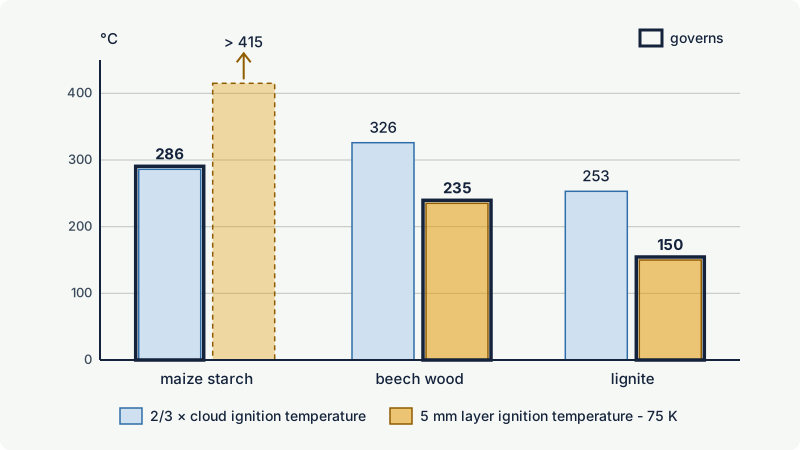
Worked example 1: beech wood dust in a joinery workshop
A dust extraction room in a joinery is classified Zone 22 because of leaks at the filter and settled dust between cleaning rounds. A beech wood dust sample in the GESTIS-DUST-EX database (median particle size 61 µm) has a cloud ignition temperature of 490 °C (Godbert-Greenwald furnace) and a 5 mm layer ignition temperature of 310 °C.
- Cloud limit: 2/3 × 490 = 326.7, so 326 °C.
- Layer limit: 310 - 75 = 235 °C.
- Permitted maximum surface temperature: the lower value, 235 °C.
- Check the equipment: a motor marked
Ex tc IIIB T135 °C Dc(Ex t means protection by enclosure, see Dust ignition protection by enclosure (Ex t)) is suitable, with a wide margin. A luminaire markedT250 °Cis not suitable, even though 250 °C is below the cloud limit.
Worked example 2: maize starch, where the cloud governs
A maize starch sample in the database (median 11 µm) has a cloud ignition temperature of 430 °C and showed no glowing of a 5 mm layer up to 490 °C.
- Cloud limit: 2/3 × 430 = 286.7, so 286 °C.
- Layer limit: at least 490 - 75 = 415 °C (the real value is higher, since no ignition was found).
- Permitted maximum surface temperature: 286 °C, set by the cloud.
Worked example 3: lignite, where thick layers need testing
A lignite sample (median 32 µm) has a cloud ignition temperature of 380 °C and a 5 mm layer ignition temperature of 225 °C.
- Cloud limit: 2/3 × 380 = 253.3, so 253 °C.
- Layer limit: 225 - 75 = 150 °C.
- Permitted maximum surface temperature: 150 °C. A motor marked
T135 °Cis acceptable. - Because the 5 mm layer ignition temperature is below 250 °C, the graph for thicker layers in IEC 60079-14 may not be used. If layers thicker than 5 mm can form, the ignition temperature of the actual layer thickness must be determined by test.
Worked example 4: beet sugar, a melting dust
A beet sugar sample (median 29 µm) has a cloud ignition temperature of 470 °C, and the 5 mm layer melts on the hot plate.
- Cloud limit: 2/3 × 470 = 313.3, so 313 °C.
- Layer limit: not available from the test, because the layer melts instead of igniting.
- The cloud limit gives 313 °C, but a competent assessment should consider what a melted, caramelising deposit on a hot surface can do, and a lower limit may be appropriate.
| Sample (GESTIS-DUST-EX) | Cloud ignition | 5 mm layer ignition | Cloud limit | Layer limit | Permitted Tmax |
|---|---|---|---|---|---|
| Maize starch | 430 °C | no glowing up to 490 °C | 286 °C | above 415 °C | 286 °C (cloud) |
| Beech wood dust | 490 °C | 310 °C | 326 °C | 235 °C | 235 °C (layer) |
| Lignite | 380 °C | 225 °C | 253 °C | 150 °C | 150 °C (layer) |
| Beet sugar | 470 °C | melts | 313 °C | not applicable | 313 °C, plus assessment of melting |
Note: These values describe single tested samples. Another grade, a finer fraction or a different moisture content can give different results. For a real installation, use test data for the dust actually present, including the fines that collect on equipment.
Thicker layers: the 5 to 50 mm rule and beyond
A thicker layer insulates better, so the heat produced by slow oxidation inside it escapes less easily, and the layer ignites at a lower hot surface temperature. The effect is large. ASTM E2021 cites data for a pulverised bituminous coal whose hot-surface ignition temperature fell from 300 °C at 6.4 mm to 260 °C at 9.4 mm, 240 °C at 12.7 mm and 210 °C at 25.4 mm. A published study on wood dusts found 5 mm layer values of 330 to 350 °C and 12.5 mm values of 300 °C for the same samples, and concluded that equipment in wood workshops should not exceed 225 °C where 12.5 mm layers occur.
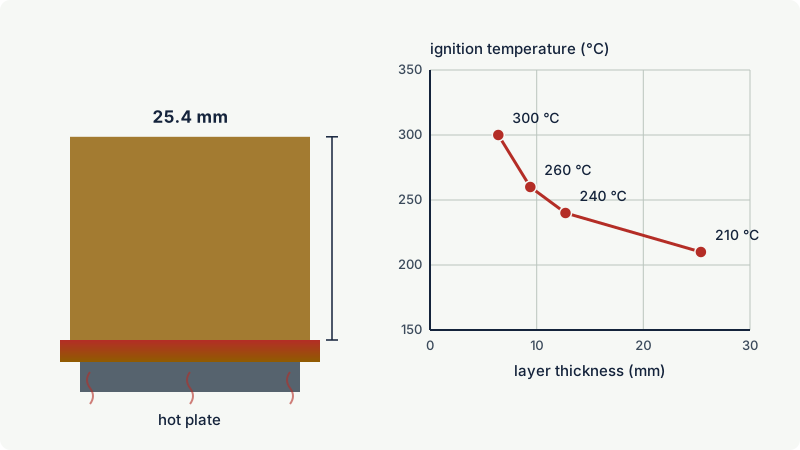
IEC 60079-14 handles this in three steps:
- Layers up to 5 mm: the 75 K rule above applies.
- Layers from 5 mm up to 50 mm: the standard contains a graph that reduces the permitted maximum surface temperature as the layer thickness increases, with a family of curves for different 5 mm layer ignition temperatures. The graph may only be used for dusts with a 5 mm layer ignition temperature of 250 °C or more.
- Laboratory investigation is needed for layers thicker than 50 mm, for dusts whose 5 mm layer ignites below 250 °C when thicker layers are possible, and where equipment can be completely surrounded or buried by dust, for example inside a silo or a hopper.
The better answer is often to prevent the thick layer: good housekeeping, sloped tops on enclosures and equipment mounted where dust does not accumulate (see Dust layers and housekeeping). Where thick layers are part of the process, the equipment itself can be certified for them.
Equipment marked for a layer thickness
For EPL Db and Dc the maximum surface temperature of Group III equipment is normally determined without a dust layer. Where equipment is tested under a specified dust layer, the result is marked together with the layer depth in mm, written as a T with the depth as a subscript, followed by the temperature. IECEx guidance on this marking uses T500 320 °C as its example: a maximum surface temperature of 320 °C with the equipment under a 500 mm layer. Equipment with level of protection ta (EPL Da) is always tested under a layer and so always carries this form. The installer compares the marked temperature with the ignition temperature of a layer of the same depth, determined by test, again with a 75 K margin.
Applying the result in practice
- Compare like with like. The permitted value calculated for the dust is compared with the maximum surface temperature marked on the equipment, which already includes the rated ambient temperature range. If the equipment is used outside its marked ambient range, the marking no longer applies (see Ambient temperature range Ta).
- Read gas and dust markings separately. Equipment certified for both gas and dust carries two markings, for example
Ex db IIC T4 GbandEx tb IIIC T135 °C Db. Only the Group III marking is relevant for the dust. A gas-only T4 rating means 135 °C for gas, but gives no information about dust ingress protection or dust layers. - Use the same limits for hot surfaces of the process. Steam pipes, dryers, heaters and bearings are ignition sources too. The ignition hazard assessment for non-electrical equipment and process surfaces normally compares them with the same two limits; see Hot surfaces in hazardous areas.
- Check both the dust and the zone. Surface temperature is only one selection criterion. The equipment protection level (Da, Db or Dc) must match the zone and the dust group (IIIA, IIIB or IIIC) must match the dust; see Equipment Protection Levels.
North American practice in brief
In the NEC Class II (Division) system, equipment temperature markings must be below the ignition temperature of the specific dust, and for organic dusts that may dehydrate or carbonise the marked temperature must not exceed the lower of that ignition temperature and 165 °C (329 °F). The two-thirds and 75 K rules described here belong to the IEC system; see North American hazardous location approvals.
Common mistakes and misconceptions
- Using only the cloud ignition temperature. For most organic dusts the layer limit is lower and governs. Always calculate both.
- Using gas temperature classes for dust. T1 to T6 relate to gas autoignition temperatures. Dust equipment is marked with a temperature in °C, and that value must be compared with the dust limits.
- Forgetting thicker layers. The 75 K rule covers layers up to 5 mm. Where thicker layers can build up, the limit is lower, and below 250 °C or above 50 mm it must be tested.
- Taking database values for a different dust. One sample's ignition temperatures do not describe a finer grade, a different moisture content or the fines on top of a motor. Test the dust actually present when the result is close to the equipment rating.
- Ignoring melting dusts. A "melts" result does not mean there is no layer hazard. It means the 75 K rule cannot be applied directly and the assessment needs more care.
- Assuming a marked temperature includes a dust layer. Under the IEC system, a plain Group III temperature such as
T135 °Cis determined without a layer. Only a marking with a layer depth subscript, in the formT500 320 °C, covers a specified layer.
Frequently asked questions
How do you calculate the maximum surface temperature for dust?
Take two thirds of the minimum ignition temperature of the dust cloud, and take the minimum ignition temperature of a 5 mm layer minus 75 K. The lower of the two values is the highest surface temperature the equipment may have. For example, a cloud value of 490 °C and a layer value of 310 °C give 326 °C and 235 °C, so equipment must not exceed 235 °C.
Why is the dust layer margin 75 K?
The layer ignition temperature is measured on a 5 mm layer on a hot plate under controlled conditions. Real layers on equipment differ in thickness, heating and cooling, and the test has its own uncertainty. The fixed margin of 75 K, which equals 75 °C, gives a safety distance for layers up to 5 mm; thicker layers need a larger reduction.
Is the two-thirds rule applied in °C or in kelvin?
In °C. The installation standard expresses the ignition temperatures in °C, and published worked examples multiply the cloud ignition temperature in °C by two thirds. Converting to kelvin first gives a different number that is not what the rule means.
What if the dust layer is thicker than 5 mm?
For layers from 5 mm up to 50 mm, IEC 60079-14 provides a graph that lowers the permitted surface temperature as the layer gets thicker, for dusts whose 5 mm layer ignition temperature is at least 250 °C. For thicker layers, for dusts that ignite below 250 °C as a 5 mm layer, or where equipment can be buried in dust, the ignition temperature must be determined by laboratory tests.
Can I use a T4 gas-rated device in a dust area?
Not on that basis alone. A T4 marking relates to gases and does not show that the enclosure keeps dust out or how hot the surface becomes under dust. The device needs a Group III marking with a suitable EPL, dust group and maximum surface temperature in °C that is below the limit calculated for the dust.
What does T135 °C mean on dust equipment?
It is the maximum surface temperature of the equipment in service under the most adverse conditions within its ratings, measured without a dust layer (a layer test would be shown with a layer depth subscript after the T). It must be lower than the permitted temperature calculated for the dust: for example, it is acceptable for a dust whose limit is 150 °C, and not acceptable for one whose limit is 130 °C.
Related on excodex
- Dust explosion parameters explained: Kst, Pmax, St classes, MIE and minimum ignition temperatures
- Dust layers and housekeeping: how thick is too thick?
- Dust ignition protection by enclosure (Ex t): ta, tb and tc
- Temperature classes T1 to T6: matching surface temperature to autoignition temperature
- How to read an Ex marking
- Tools and standards spaces: Ex marking check, IEC 60079-14, IEC 60079-31, IEC 60079-0; questions in the forum
Standards and further reading
- IEC 60079-14:2024 (edition 6.0), electrical installations design, selection and installation, including the selection of equipment by dust ignition temperatures and the correlation between dust layer thickness and maximum permissible surface temperature: catalogue entry and preview
- IEC 60079-0, general requirements for Ex equipment, including the determination and marking of the maximum surface temperature for Group III.
- IEC 60079-31:2022, dust ignition protection by enclosure
t. - IECEx ExTAG draft decision sheet on the marking of Ex t equipment with and without dust layers (layer depth subscript, example
T500 320 °C): iecex.com - ISO/IEC 80079-20-2, test methods for combustible dusts, including the cloud and 5 mm layer ignition temperatures.
- ASTM E2021, hot-surface ignition temperature of dust layers (with data on the effect of layer thickness): astm.org
- IEV 426-01-04, definition of maximum surface temperature: electropedia.org
- IFA, GESTIS-DUST-EX database of combustion and explosion characteristics of dusts (source of the sample values used here): staubex.ifa.dguv.de
- M. Pastier and others, Minimum ignition temperature of wood dust layers, Research Papers of the Faculty of Materials Science and Technology in Trnava, 2013: reference-global.com (PDF)
- HSE, HSG103 Safe handling of combustible dusts (surface temperatures and dust deposits): hse.gov.uk (free PDF)
This article is general technical information prepared by the excodex editorial team. It does not replace the applicable standards, the equipment certificates and instructions, national regulations or the assessment of a competent person.