Ambient temperature range Ta: what -20 °C to +40 °C really means
Abstract
Ex equipment is certified for an ambient range, by default -20 °C to +40 °C. Its temperature class and protection hold only inside it. How Ta is marked, what extended ranges require, and what it means for cable entries, cold climates and process heat.
The ambient temperature range (Ta or Tamb) is the band of surrounding air temperatures in which Ex equipment is certified to work safely. Unless another range is stated, it is -20 °C to +40 °C. The temperature class, the materials and the type of protection are proven only inside that band: above the upper limit the surfaces get hotter than the class allows, and below the lower limit seals, plastics and enclosures may no longer behave as tested. IEC 60079-0 edition 8 (2026) requires the range to be marked on all equipment certified to it, even when it is the default.
This article explains where the default comes from, how Ta is marked, what an extended range demands from the manufacturer, and what it means for temperature class, cable entries, cold climates and equipment heated by the process.
Key points
- The normal ambient range for Ex equipment is -20 °C to +40 °C, unless another range is specified and marked. This is narrower than the -20 °C to +60 °C "standard atmospheric conditions" in the scope of IEC 60079-0.
- Under earlier editions of IEC 60079-0, the range was marked only when it differed from the default, as
TaorTambwith both limits, or by the symbolX. IEC 60079-0 edition 8 (2026) requires the ambient range to be marked in all cases. - The temperature class is determined at the maximum rated ambient. As a working approximation, for equipment without a temperature-limiting device, every degree of ambient above the rating adds about a degree to the hottest surface, so a T4 rating proven at +40 °C is not proven at +50 °C.
- Ambient, service temperature and process temperature are different things. Service temperature includes the heating or cooling from the process and from the equipment itself.
- If the temperature under rated conditions exceeds 70 °C at the cable entry point or 80 °C at the branching point of the conductors, the equipment must be marked with information for selecting suitable cables and glands.
- Cable glands, seals and other Ex Components have their own temperature ratings. The whole installation, not just the main equipment, must suit the site's coldest and hottest conditions.
Three temperatures that are often confused
| Term | What it is | Where you find it |
|---|---|---|
| Ambient temperature (Ta, Tamb) | Temperature of the air or surroundings near the equipment, without the equipment's own heating | Marking and certificate: the rated range |
| Service temperature (Ts) | Maximum or minimum temperature reached at a specific point of the equipment in rated operation, including ambient and any external heating or cooling | Certificate, instructions; used to rate seals, plastics and cable entries |
| Process temperature | Temperature of the medium in a pipe, vessel or pump that the equipment is mounted on or in contact with | Instructions or certificate tables, where the process affects the equipment |
| Maximum surface temperature | Hottest surface the explosive atmosphere can reach | Temperature class or value in °C in the marking |
The ambient range describes the environment the equipment can tolerate. The surface temperature describes what the equipment does to the environment. Both are linked: the surface temperature is measured at, or corrected to, the maximum rated ambient.
Where -20 °C to +40 °C comes from
The scope of IEC 60079-0 defines standard atmospheric conditions for the explosion behaviour of the atmosphere: -20 °C to +60 °C, 80 kPa to 110 kPa, and air with normal oxygen content. A note then says that the normal ambient range for the equipment is -20 °C to +40 °C unless otherwise specified and marked. ISO 80079-36, the standard for non-electrical equipment, carries the same note and gives the reason: -20 °C to +40 °C suits most equipment, and designing everything for +60 °C would impose unnecessary constraints.
The European Commission's ATEX guidelines say the same thing from the legal side. The directive does not define atmospheric conditions, but -20 °C to +60 °C and 0.8 bar to 1.1 bar may be a basis for design, while electrical products are normally designed and tested for -20 °C to +40 °C under the harmonised standards. Products for other ranges need additional marking and testing, normally agreed between manufacturer and user.
North American codes use similar defaults with one difference: NFPA 70 Article 500 (Class and Division) requires no ambient marking for -25 °C to +40 °C, while Article 505 (Zones) uses -20 °C to +40 °C. Equipment rated outside these ranges must be marked with its range.
How the ambient range is marked
| Marking | Meaning |
|---|---|
| No Ta on a label certified to an edition before 2026 | Default range, -20 °C to +40 °C |
-40 °C ≤ Ta ≤ +60 °C or Tamb -40 °C to +60 °C | Extended range, both limits stated |
0 °C ≤ Ta ≤ +40 °C | Restricted range: the equipment may not be used below 0 °C |
-20 °C ≤ Ta ≤ +40 °C | Default range, marked explicitly (required from IEC 60079-0 edition 8) |
Certificate number ending in X | Specific conditions of use; the certificate may state the range or a table of ranges |
Ranges can be restricted as well as extended. A device with a liquid crystal display or a battery may be certified only from 0 °C or -10 °C upwards, which is easy to overlook if one assumes "no marking means -20 °C".
Many certificates for heat-producing equipment, such as luminaires, heaters and transmitters, give a table of temperature classes against ambient ranges, for example T6 up to +40 °C and T5 up to +55 °C. The user picks the line that matches both the gas and the site.
Ambient and the temperature class
The temperature class is proven by measuring the hottest surface at the most unfavourable rated conditions. If the test is not carried out at the maximum rated ambient, the result is normally corrected by adding the difference between the rated maximum ambient and the test ambient (equipment with a temperature-limiting device is treated differently). Put simply, the surface temperature is the maximum ambient plus the equipment's own temperature rise.
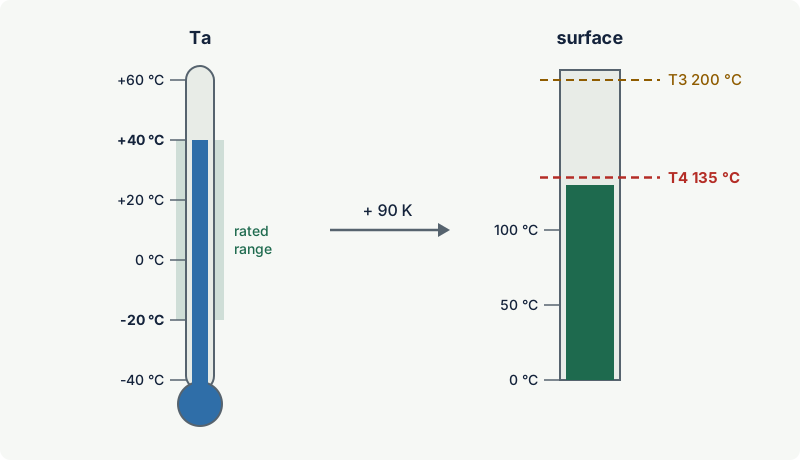
That has two consequences:
- Above the rated maximum, the temperature class is no longer proven. A junction box rated T6 (85 °C) whose hottest surface runs 40 K above ambient reaches about 80 °C at +40 °C but about 95 °C at +55 °C, which is T5, not T6. For the gas in question, that may or may not matter, but it is not what the label says.
- Extended ambient often costs a temperature class. The same product is frequently offered as T6 up to +40 °C and T5 or T4 up to +60 °C. Choosing the hotter range is safe only if the gas allows the lower class. See temperature classes T1 to T6.
For flameproof equipment, the class refers to the outer surface; for increased safety and most other concepts it covers internal parts the gas can reach too. Either way, the reference point is the maximum rated ambient.
Ambient and cable entries
Cables and glands are rated for a maximum temperature, and the hottest point of a cable is often where it enters the equipment. IEC 60079-0 therefore requires that, when the temperature under rated conditions exceeds 70 °C at the entry point or 80 °C at the branching point of the conductors, information is marked on the equipment to guide the user in selecting cable and gland (or conductors in conduit). The branching point is where the cores leave the cable sheath inside the enclosure.
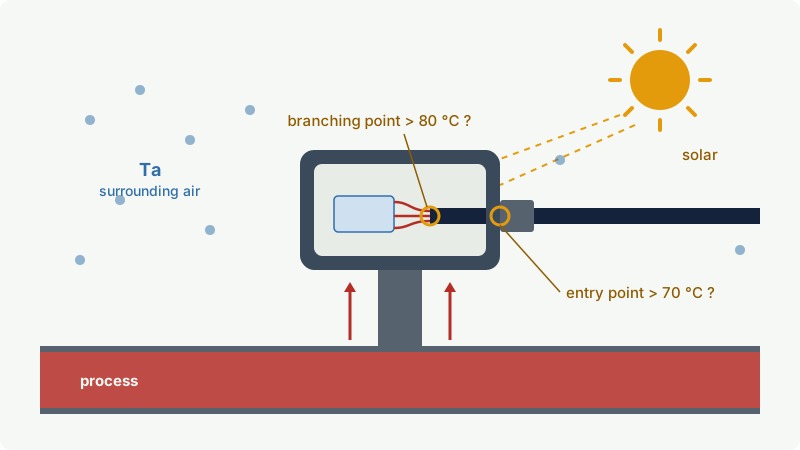
These limits are measured at the maximum rated ambient. An IECEx ExTAG decision sheet on cable entries of electrical machines (DS 2013/001, with a draft revision circulated in 2018) accepts that the internal air temperature of the terminal box may be used to represent the entry point, branching point and terminal box lid gasket temperatures, because machines are not tested with the site's own glands and cables.
What the installer should do:
- Read any cable-temperature marking or instruction and choose cables whose rated temperature covers it.
- Check the gland's own rating. Cable glands are Ex Components or Ex equipment with a service temperature range set by their seals and materials. From IEC 60079-0 edition 8, the temperature range of an Ex Component must be stated in its schedule of limitations.
- Check the cold end too. Many cable sheaths and gland seals have a minimum installation temperature below which they crack when bent, and a lower minimum for fixed service.
Cold climates
Below -20 °C, the risks change from "too hot" to "too brittle, too stiff, too strong an explosion":
- Plastics and glass. Non-metallic enclosures, windows and light-transmitting parts lose impact strength in the cold. The general requirements include tests of thermal endurance to cold and impact tests linked to the minimum service temperature, so a rating to -50 °C means these were done at the low end.
- Seals. Elastomer gaskets and gland seals stiffen and shrink. A seal that keeps IP66 at +20 °C can leak at -45 °C, and for increased safety equipment the ingress protection is part of the protection concept.
- Flameproof enclosures. A cold gas mixture is denser, and an internal explosion starting from a lower temperature produces a higher pressure. Flameproof equipment rated below -20 °C is therefore subject to additional pressure testing that reflects the low temperature; research on enclosures at -40 °C and below continues because the effect matters for arctic designs.
- Lubricants, batteries and displays. Grease thickens, cells lose capacity, displays slow down or stop. These rarely affect Ex safety directly, but they limit the rated range, which is why some equipment is marked only down to -10 °C or 0 °C.
- Ice and condensation. Rapid cooling draws moist air in; ice can block breathing devices and drains or jam moving parts. IEC 60079-14 (2024) includes an informative annex on adverse environmental conditions that covers low temperatures, icing and winterisation, rapid cooling, solar radiation and salt atmospheres.
Heating the equipment, for example with anti-condensation heaters or heated cabinets, can keep it within its range, but the heater becomes part of the Ex equipment. It must be covered by the certificate, and it changes the internal temperatures that the temperature class is based on.
Hot climates and process-heated equipment
The ambient in the Ex sense is the local air around the equipment, not the weather report. Several effects push it above the meteorological value:
- Solar radiation. A dark enclosure in direct sun can be far hotter than the shade temperature. IEC 60079-14 addresses UV and solar radiation for cables and, in its annex on adverse environmental conditions, for equipment.
- Enclosed spaces. Equipment inside a cabinet, shelter, analyser house or another enclosure sees the air inside, which is heated by everything in it.
- Neighbouring hot equipment. Motors, transformers, steam lines and furnaces raise the local air temperature.
Process heat is a separate problem. Equipment mounted on or in contact with a hot pipe, vessel or pump receives heat by conduction, not only from the air. IEC 60079-0 has a clause on external sources of heating or cooling: where equipment is intended to be heated or cooled by an external source, such as a process connection, the manufacturer has to state the conditions in the documentation. Typical results are:
- Instruments (transmitters, level gauges, valve positioners) with a certificate table of temperature class against process temperature, often with a required minimum neck length or standoff.
- Pumps and agitators whose surface temperature is set by the liquid. Non-electrical equipment to ISO 80079-36 may then be marked with a temperature range such as
T6…T4, with the instructions linking each class to the process temperature. See non-electrical equipment (Ex h). - Motors and junction boxes close to hot equipment, where the designer must use the local ambient, not the site average.
The ATEX guidelines list "the effect of additional sources of heat or cooling (such as mounting on a heated process vessel)" among the surrounding-area conditions that the manufacturer and user should communicate about. In practice, the area classification and equipment list should record the design ambient and any process temperatures for each item, so that the selection can be checked. See hot surfaces in hazardous areas.
Worked example: a luminaire under a canopy in a hot region
A loading canopy is classified Zone 1. The products handled are hexane (autoignition temperature 225 °C, T3) and, at one bay, diethyl ether (175 °C, T4). The design ambient under the roof, including the effect of sun on the roof sheeting, is +48 °C; the coldest night is -5 °C.
A candidate luminaire carries two marking lines (illustrative values): Ex db eb IIC T4 Gb for -40 °C ≤ Ta ≤ +40 °C, and Ex db eb IIC T3 Gb for -40 °C ≤ Ta ≤ +55 °C.
- Hexane bays: at +48 °C the luminaire falls in the +55 °C line, which gives T3 (200 °C). Hexane needs T3. Pass.
- Diethyl ether bay: T4 is needed, and the luminaire is T4 only up to +40 °C. The design ambient is +48 °C. Fail. Options: a luminaire rated T4 up to at least +50 °C, or a better-ventilated mounting position whose ambient is demonstrably below +40 °C.
- Cold end: -5 °C is within -40 °C. Pass.
- Cables: the luminaire's instructions call for cables rated for at least 80 °C at the entry (illustrative). The cable schedule is updated accordingly, and the glands' own range is checked against -5 °C to +48 °C.
Common mistakes
- Assuming the weather station value is the ambient. Sun, enclosures and nearby hot equipment raise the local air temperature; the design ambient must reflect the actual mounting position.
- Reading "no marking" as "any temperature". On older equipment it means -20 °C to +40 °C. On some equipment the range is restricted (for example 0 °C to +40 °C) and is marked; read it.
- Checking only the main equipment. Glands, plugs, breathers and cables have their own temperature limits, and in the cold they are often the weak point.
- Mixing up Ta and process temperature. A transmitter rated for Ta +60 °C may still have a lower limit for the process temperature at its connection, given in a separate table.
- Adding heaters, sunshades or insulation without thinking about temperature. Heaters and thermal insulation change internal temperatures; a heater must be part of the certified equipment, and insulation around a hot enclosure raises its surface temperature.
- Choosing the widest Ta line without checking the T-class it brings. Extended ranges often come with a lower temperature class.
Frequently asked questions
What does -20 °C ≤ Ta ≤ +40 °C mean on an Ex label?
It is the range of surrounding air temperatures in which the equipment is certified. Inside it, the marked temperature class and type of protection are valid. It is the default range of the IEC 60079 series; equipment certified to IEC 60079-0 edition 8 (2026) shows it explicitly instead of leaving it implied.
What if no ambient temperature is marked on Ex equipment?
On equipment certified to editions of IEC 60079-0 before 2026, no marking means the default range of -20 °C to +40 °C. If the certificate number ends in X, the range may be given in the certificate's specific conditions of use, so read the certificate before assuming the default.
Can I use Ex equipment above +40 °C?
Only if it is rated and marked for a higher maximum ambient. Above its rated maximum, its surfaces get hotter than when the temperature class was proven, and seals and plastics may be stressed beyond their rating. Choose equipment with a suitable Ta range or reduce the local ambient.
Is the ambient temperature the same as the process temperature?
No. Ambient is the surrounding air; process temperature is the temperature of the medium in a pipe, vessel or pump that the equipment is connected to. Equipment mounted on a hot process is heated by conduction too, so its certificate often gives separate limits or a table of temperature classes against process temperature.
Why do some cables need a higher temperature rating near Ex equipment?
If the temperature at the cable entry point exceeds 70 °C, or at the conductor branching point exceeds 80 °C, under rated conditions, IEC 60079-0 requires the equipment to be marked with information for cable and gland selection. A cable rated too low can degrade at the entry and compromise the gland seal or the terminals.
What changes for Ex equipment in arctic climates?
Below -20 °C, plastics become brittle, seals stiffen, cold gas mixtures explode with higher pressure inside flameproof enclosures, and batteries and displays degrade. Equipment for these sites must be certified for the lower limit, which involves cold-specific tests, and glands, cables and heaters must be selected for the same range.
Related on excodex
- Temperature classes T1 to T6: matching surface temperature to autoignition temperature
- How to read an Ex marking: decoding II 2 G Ex db IIC T4 Gb step by step
- Hot surfaces in hazardous areas: luminaires, motors, heat tracing and process heat
- Cable glands for hazardous areas: barrier glands, compound glands and selection
- The X and U suffixes on Ex certificates
- Tools and spaces: Ex marking check, gas library, standards spaces IEC 60079-0, IEC 60079-14, NEC 500-506, forum
Standards and further reading
- IEC 60079-0, general requirements, including ambient temperature, service temperature, external heating and cooling, and marking (edition 8, 2026).
- IEC 60079-14, design, selection and installation (edition 6, 2024), including selection by temperature range and an informative annex on adverse environmental conditions.
- ISO 80079-36, non-electrical equipment: basic method and requirements (same ambient rules for Ex h equipment).
- IEC 60079-1, flameproof enclosures, for the additional tests at low ambient temperature.
- NFPA 70 (National Electrical Code), Articles 500 and 505, for North American ambient marking.
- IEC 60079-0:2026 overview with the scope note on standard atmospheric conditions and normal ambient range: certifico.com
- IECEx ExTAG draft revision (2018) of decision sheet DS 2013/001, temperature measurement of cable entries on electrical machines (entry point and branching point): iecex.com
- US Coast Guard Outer Continental Shelf National Center of Expertise, Drill Down 27: temperature class and ambient marking under NEC and IEC: dco.uscg.mil
- European Commission, ATEX 2014/34/EU Guidelines, 6th edition (January 2026), on atmospheric conditions and surrounding-area conditions: single-market-economy.ec.europa.eu
- J. C. Munro, Impact of extremely cold temperatures on the safety of flameproof motors, PhD thesis, The University of Sydney, 2017: ses.library.usyd.edu.au
This article is general technical information prepared by the excodex editorial team. It does not replace the applicable standards, the equipment certificates and instructions, national regulations or the assessment of a competent person.