Temperature classes T1 to T6: matching surface temperature to autoignition temperature
Abstract
Temperature classes T1 to T6 cap the hottest surface of Ex equipment at 450, 300, 200, 135, 100 or 85 °C. Choose a class whose limit is below the autoignition temperature of every gas present. Table, rule, examples and margin practice.
A temperature class (T1 to T6) states the highest surface temperature that a piece of Ex equipment can reach in service: 450 °C for T1, 300 °C for T2, 200 °C for T3, 135 °C for T4, 100 °C for T5 and 85 °C for T6. To be safe, the class limit must be below the autoignition temperature (AIT) of every flammable gas or vapour that can be present, so a gas with an AIT of 175 °C needs T4, T5 or T6 equipment. The higher the T-number, the cooler the equipment and the wider the range of gases it can be used with.
This article gives the full table, explains how gases and equipment are assigned to classes, works through examples with values from the excodex gas library, and describes the margins that careful engineers add on top of the bare rule.
Key points
- The six temperature classes and their maximum surface temperatures are: T1 450 °C, T2 300 °C, T3 200 °C, T4 135 °C, T5 100 °C and T6 85 °C.
- A gas belongs to the class whose band contains its AIT: for example an AIT between 135 °C and 200 °C makes it a T4 gas.
- Equipment of the same class or of a higher T-number is acceptable: a T3 gas can be served by T3, T4, T5 or T6 equipment.
- The marked class is valid only within the rated ambient temperature range; the standard range is -20 °C to +40 °C, and IEC 60079-0:2026 requires the range to be marked on the equipment.
- The temperature class is independent of the gas group: hydrogen is IIC but only needs T1, carbon disulphide is IIC and needs T6.
- The margin between the class limit and the AIT is not fixed: it can be nearly zero at the bottom of a band and over 100 K at the top, which is why many specifications ask for one class better than strictly required.
The rule: maximum surface temperature below the autoignition temperature
The autoignition temperature is the lowest temperature of a hot surface at which a flammable gas or vapour mixed with air ignites under specified test conditions. The test method is in ISO/IEC 80079-20-1. Any surface hotter than this, whether a lamp, a motor frame, a resistor or a heated pipe, can ignite the mixture without a spark or flame.
Ex equipment is therefore assigned a maximum surface temperature: the highest temperature reached by any part of the equipment that the surrounding atmosphere can touch, in service, under the most adverse conditions the equipment is rated for. To keep the number of variants manageable, IEC 60079-0 groups maximum surface temperatures for Group II equipment into six classes.
| Temperature class | Maximum surface temperature of equipment | AIT of gases in this class | Typical gases (excodex library) |
|---|---|---|---|
| T1 | 450 °C | above 450 °C | methane about 600 °C, hydrogen 560 °C, ammonia 630 °C, toluene 530 °C, acetone 539 °C |
| T2 | 300 °C | above 300 up to 450 °C | propane 450 °C, ethylene 440 °C, methanol 440 °C, butane 372 °C, acetylene 305 °C |
| T3 | 200 °C | above 200 up to 300 °C | hydrogen sulphide 260 °C, cyclohexane 244 °C, hexane 225 °C, kerosene 210 °C, n-heptane 204 °C |
| T4 | 135 °C | above 135 up to 200 °C | diethyl ether 175 °C, acetaldehyde 155 °C |
| T5 | 100 °C | above 100 up to 135 °C | few common substances |
| T6 | 85 °C | above 85 up to 100 °C | carbon disulphide 90 °C, ethyl nitrite 95 °C |
The rule for selection follows directly. Find the lowest AIT of all flammable substances that can be present in the zone, find the class whose band contains it, and use equipment of that class or a higher T-number. IEC 60079-14 makes this a selection requirement for installations; in North America, NFPA 70 Article 505 states the same principle for zone installations.
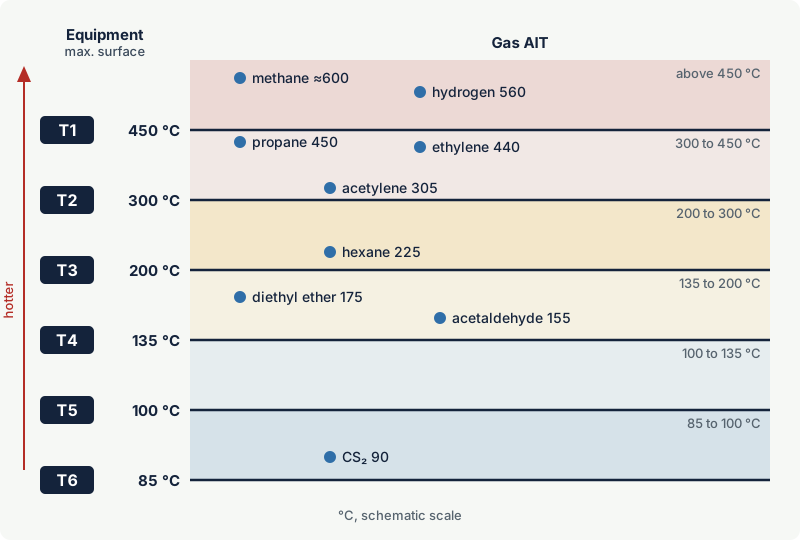
Reading the class from both sides
The same label is used for two different things, which causes confusion:
- A T3 gas is a gas whose AIT lies above 200 °C and up to 300 °C.
- T3 equipment never exceeds 200 °C on any surface the atmosphere can reach.
T3 equipment is safe in a T3 gas because 200 °C is at or below the lowest AIT in that band. It is also safe for T2 and T1 gases, which ignite only at higher temperatures. It is not safe for a T4 gas such as diethyl ether (AIT 175 °C), because a surface at 200 °C is above that AIT.
A higher T-number never makes equipment less suitable. A T6 junction box can be used wherever a T1 box can, as far as surface temperature is concerned.
What the marked class actually covers
Which surfaces count
The maximum surface temperature applies to surfaces that the explosive atmosphere can reach. For a flameproof enclosure (Ex d) that is the outside of the enclosure, because any gas that reaches the hot inside is assumed to ignite and the explosion is contained. For types of protection where the gas can reach the inside of the equipment, such as increased safety (Ex e), internal surfaces count as well. Some types of protection, such as restricted breathing enclosures (Ex nR), are classified by their external surface under the conditions of their own standard; the certificate shows what applies. Pressurised equipment (Ex p) may have hot internal parts, which is why its instructions often require a cooling time after switch-off before the enclosure is opened.
Under which conditions
The class is determined by the manufacturer and the certification body with the equipment at its maximum rated ambient temperature, at rated load and with the least favourable supply conditions the equipment is rated for. Hot spots such as lamp caps, resistors, motor bearings and terminal points are measured. For very small components, IEC 60079-0 contains special assessment rules, because a small hot component is less able to ignite a gas than a large surface at the same temperature.
Ambient temperature
The standard ambient range for Ex equipment is -20 °C to +40 °C. Under earlier editions of IEC 60079-0 the standard range did not have to be marked; IEC 60079-0:2026 requires the rated ambient range to appear in every Ex marking. If equipment is used at a higher ambient, every surface gets hotter and the marked class is no longer proven. Equipment for hotter locations is marked with its range (for example Ta -40 °C to +60 °C), and some certificates give a table of temperature classes for different ambient ranges. See ambient temperature range Ta.
Equipment marked with an actual temperature
Equipment may be marked with its maximum surface temperature in degrees Celsius instead of, or as well as, the class. This is useful when the real value is well below the class limit, for example a T1 device that never exceeds 350 °C. For dusts, temperature classes are not used at all: equipment is marked with a maximum surface temperature in °C, such as T135 °C, and the limits are calculated differently (see surface temperature limits for dust).
Why heavier hydrocarbons need cooler equipment
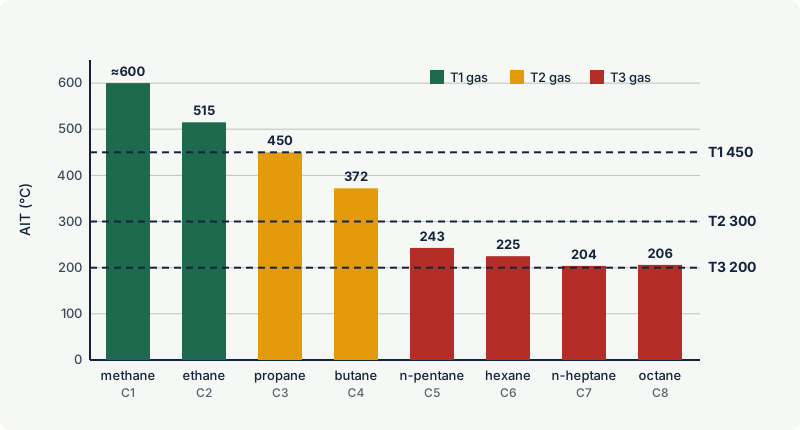
For simple hydrocarbons the AIT falls as the molecule gets longer. Methane needs only T1, propane and butane T2, but n-pentane, hexane, n-heptane, octane and kerosene all need T3. This is why gas plants often run on T1 or T2 equipment while oil terminals, refineries and diesel installations standardise on T3 or better.
Worked examples
Example: A solvent recovery unit handles diethyl ether, AIT 175 °C. The AIT lies between 135 °C and 200 °C, so the gas is T4. Motors, luminaires and instruments must be T4, T5 or T6. A T3 motor would be allowed to reach 200 °C, which is 25 K above the AIT, and is not acceptable.
Example: A tank farm stores kerosene (AIT 210 °C, T3) next to a hydrogen buffer (AIT 560 °C, T1) whose release zone overlaps the kerosene zone. The lowest AIT governs, so equipment in the overlap must be T3 or better. For the gas group, hydrogen governs (IIC). The final requirement is IIC T3, which shows how group and class are chosen independently.
Example: A viscose fibre plant uses carbon disulphide, AIT 90 °C. Only T6 equipment (85 °C) is acceptable, and the margin is only 5 K. Few products are available as IIC T6, so designers often move electrical equipment out of the zone, use intrinsically safe instruments, or pressurise a room rather than search for T6 motors.
Example: A gas has an AIT of 185 °C. Under IEC rules it is a T4 gas and needs equipment of 135 °C or cooler. The North American Division system (NFPA 70 Article 500) has intermediate codes, and a T3A device (180 °C) would satisfy the bare rule there. The margin would be only 5 K, so many users still choose T4.
Safety margins in practice
The bare rule (class limit at or below the AIT) is the minimum. The real margin depends on where the gas sits in its band, and experienced engineers add margin deliberately.
The margin built into the bands is uneven
Because every class limit sits at the bottom edge of its band, the margin varies. Acetylene (AIT 305 °C) with T2 equipment (300 °C) has 5 K. Ethylene (440 °C) with the same T2 equipment has 140 K. Hexane (225 °C) with T3 equipment has 25 K. Gases near the bottom of a band deserve a second look.
Published AIT values differ
The AIT depends on the test method, vessel size and how ignition is judged, so handbooks and safety data sheets often disagree by tens of degrees for the same substance. Use a traceable source that follows ISO/IEC 80079-20-1, use the lowest credible value when sources differ, and record the reference in the area classification. See how to find the gas group and temperature class.
Common practices that add margin
- One class better: many owner specifications ask for one T-class better than the strict requirement where the AIT sits close to a class limit, or set a site minimum such as T3 for refineries.
- Real ambient, not nominal: design with the hottest credible local air temperature, including enclosed rooms, solar heating and nearby hot equipment, and check it against the marked Ta.
- Process heat counts: equipment mounted on hot pipes, vessels or heaters picks up heat from the process. Its surface temperature must include that heat, and the manufacturer's limits for process connections apply. See hot surfaces in hazardous areas.
- Conditions outside the standard atmosphere: temperature classes and AIT values apply to atmospheric conditions (roughly 80 to 110 kPa, normal oxygen content). At elevated pressure or with oxygen enrichment, ignition temperatures can be lower and the class alone is not a sufficient basis.
What is not a margin
Field experience and some petroleum industry guidance (API RP 2216) note that, in open air, hot surfaces usually have to be considerably hotter than the published AIT to ignite hydrocarbon vapours. This explains why many hot-surface incidents do not happen, but it is not a design allowance and does not relax the rule for Ex equipment. In North America, the NEC uses a fixed fraction of the AIT for some Division 2 equipment without a T-code; this is a code-specific rule and should not be transferred to IEC or ATEX installations.
North American temperature codes
NFPA 70 Article 500 uses the same six classes plus intermediate codes, while Article 505 and the IEC system use only T1 to T6.
| Code | Maximum surface temperature |
|---|---|
| T2A, T2B, T2C, T2D | 280 °C, 260 °C, 230 °C, 215 °C |
| T3A, T3B, T3C | 180 °C, 165 °C, 160 °C |
| T4A | 120 °C |
A device marked T3C (160 °C) is cooler than T3 but hotter than T4. When it is used in an IEC or ATEX installation, treat it as T3 unless the certificate states the actual maximum surface temperature.
Common mistakes
- Reading T1 as "the best". T1 is the hottest class. For surface temperature, T6 is the most widely usable.
- Matching the T-number of the gas without checking the value. A T4 gas needs T4, T5 or T6 equipment; T3 equipment is not "close enough".
- Ignoring ambient temperature. A T4 rating proven at +40 °C is not proven at +55 °C inside a sun-heated cabinet.
- Forgetting process heat. Instruments on hot lines, motors driving hot pumps and heat-traced pipework can exceed the limit even if the equipment itself is correctly classed.
- Choosing the class from the gas group. Gas group and temperature class are independent; check both from the substance data.
- Applying the gas rule to dust. Dust areas use a maximum surface temperature in °C with explicit margins for clouds and layers, not T1 to T6.
Frequently asked questions
What does T4 mean on Ex equipment?
T4 means the equipment's maximum surface temperature does not exceed 135 °C within its rated ambient range. It is suitable for gases and vapours with an autoignition temperature above 135 °C, which covers the T4, T3, T2 and T1 gases. It is not suitable for T5 or T6 gases such as carbon disulphide.
Which temperature class is safest?
T6 equipment has the lowest maximum surface temperature (85 °C) and, as far as surface temperature is concerned, can be used with any gas or vapour that has been assigned a temperature class. That does not make it safer in other respects: gas group, equipment protection level and installation still have to be right. T6 equipment is often more expensive or less powerful, so the usual choice is the class the substances actually require, sometimes with one class of extra margin.
Can I use T3 equipment where T4 is required?
No. A T4 requirement means at least one substance can ignite at a temperature below 200 °C, and T3 equipment may legitimately reach 200 °C. Only T4, T5 or T6 equipment, or equipment certified with an actual maximum surface temperature below the lowest AIT, is acceptable.
What temperature class is hydrogen?
Hydrogen has an autoignition temperature of 560 °C in the excodex library (other compilations give roughly 500 to 585 °C), so it is a T1 gas. Any temperature class is acceptable for hydrogen from the surface temperature point of view, but the gas group must be IIC or IIB + H2.
Is the temperature class the same as the ambient temperature rating?
No. The temperature class limits the hottest surface of the equipment; the ambient rating (Ta) is the range of air temperatures in which the equipment may operate and in which its temperature class is valid. Both appear in the marking and both must suit the installation.
How is the temperature class of a gas mixture chosen?
Use the lowest autoignition temperature of all components that can be present in a flammable concentration. The AIT of a mixture can lie below that of its main component, so when a minor component has a low AIT, it can set the class. See mixtures of gases and vapours.
Related on excodex
- Flash point, autoignition temperature and minimum ignition energy
- Gas groups IIA, IIB and IIC explained with typical gases
- Hot surfaces in hazardous areas: luminaires, motors, heat tracing and process heat
- Ambient temperature range Ta
- How to read an Ex marking
- Tools: Ex marking check, gas and solvent library, standards space IEC 60079-0
Standards and further reading
- IEC 60079-0, Explosive atmospheres: general requirements for equipment (temperature classification and marking); edition 8 was published in 2026.
- ISO/IEC 80079-20-1, material characteristics for gas and vapour classification, including the autoignition temperature test method (replaced IEC 60079-20-1).
- IEC 60079-14, design, selection and installation of electrical installations in explosive atmospheres.
- NFPA 70 (National Electrical Code), Articles 500 and 505; API RP 2216 on ignition risk of hydrocarbons by hot surfaces in open air.
- IEC Electropedia, definition of auto-ignition temperature (IEV 426-02-01): electropedia.org
- US Coast Guard, Hazardous locations drill-down on temperature class, with NEC and IEC tables: dco.uscg.mil
- HSE (UK), Hazardous area classification and control of ignition sources: hse.gov.uk
- ISO/IEC 80079-20-1 catalogue entry with the temperature class table in the preview: standards.iteh.ai
This article is general technical information prepared by the excodex editorial team. It does not replace the applicable standards, the equipment certificates and instructions, national regulations or the assessment of a competent person.