How to find the gas group and temperature class of a substance
Abstract
Find a substance's gas group (from MESG or MIC ratio) and temperature class (from its autoignition temperature) in ISO/IEC 80079-20-1, NFPA 497, safety data sheets or the excodex gas library. Step-by-step lookup, worked example, and what to do when data are missing.
The gas group and the temperature class of a flammable gas or vapour are not calculated from its formula; they come from tests. The gas group (IIA, IIB or IIC) follows from the maximum experimental safe gap (MESG) or the minimum igniting current (MIC) ratio, and the temperature class (T1 to T6) follows from the autoignition temperature (AIT). The reference source for IEC and ATEX work is the data table of ISO/IEC 80079-20-1; NFPA 497 gives the North American groups, and safety data sheets give the AIT but rarely the group. When no tested value exists, the group may be inferred provisionally from neighbouring members of a homologous series; otherwise the substance must be tested or treated conservatively.
This article explains which sources to use and in what order, walks through a lookup step by step with values from the excodex gas library, and sets out what to do when the data are missing or disagree.
Key points
- The gas group comes from the MESG or the MIC ratio (IIA: MESG 0.90 mm or more; IIB: between 0.50 and 0.90 mm; IIC: 0.50 mm or less). The temperature class comes from the AIT band (T1 above 450 °C down to T6 above 85 °C).
- ISO/IEC 80079-20-1 contains the internationally used table of substance data: equipment group, temperature class, explosive limits, flash point, MESG, MIC ratio and AIT. A revised edition is at draft stage.
- Safety data sheets list the AIT, flash point and explosive limits in section 9 but normally not the MESG or the gas group.
- Identify the substance by its CAS number, not by name or formula: nitroethane and ethyl nitrite share the formula C2H5NO2, yet one is IIB T2 and the other IIA T6.
- Published AIT values for the same substance often differ by tens of degrees. Use the lowest credible value from a traceable source and record where it came from.
- Where no group is listed, ISO/IEC 80079-20-1 allows a provisional classification from neighbouring members of a homologous series, but not when one neighbour was classified by MESG and the other by MIC ratio.
What you are looking for
Two independent properties decide which Ex equipment may be used with a substance. Both are explained in detail in gas groups IIA, IIB and IIC and temperature classes T1 to T6; the lookup tables are repeated here for convenience.
| Gas group | MESG | MIC ratio |
|---|---|---|
| IIA | 0.90 mm or more | above 0.80 |
| IIB | above 0.50 mm and below 0.90 mm | 0.45 to 0.80 |
| IIC | 0.50 mm or less | below 0.45 |
| Temperature class of the substance | AIT range | Equipment limit |
|---|---|---|
| T1 | above 450 °C | 450 °C |
| T2 | above 300 °C up to 450 °C | 300 °C |
| T3 | above 200 °C up to 300 °C | 200 °C |
| T4 | above 135 °C up to 200 °C | 135 °C |
| T5 | above 100 °C up to 135 °C | 100 °C |
| T6 | above 85 °C up to 100 °C | 85 °C |
Near the group boundaries one test value is not enough: ISO/IEC 80079-20-1 requires both MESG and MIC ratio when the MIC ratio lies between 0.70 and 0.90 (and in the other boundary ranges set out in the standard), and it says which value then decides. The test methods are described in MESG and MIC.
Where the data come from
ISO/IEC 80079-20-1 (formerly IEC 60079-20-1)
ISO/IEC 80079-20-1:2017 is the standard behind the gas groups and temperature classes used in IEC 60079-14 and under ATEX. It describes the test methods for MESG and AIT, sets the classification rules, and contains a large table of material data with, for each substance, the equipment group, temperature class, explosive limits, flash point, MESG, MIC ratio and AIT where they are known. The European adoption is EN ISO/IEC 80079-20-1, and a revised edition has reached the draft international standard (DIS) stage, so check for a newer edition before relying on a value in a new project.
Three details of the table are worth knowing:
- Not every group is tested. Where no MESG or MIC value is given, the group in the table is based on chemical similarity to tested substances.
- AIT values come from a defined test, a heated vessel into which the substance is injected, where ignition must occur within 5 minutes. If no result from the standard apparatus exists, the standard accepts results from similar apparatus (such as ASTM E659), and where no such result exists either it lists the lowest value from other methods.
- Some entries carry notes. Examples are methane with a limited hydrogen content and coke oven gas, which are classified by composition (see mixtures of gases and vapours), and carbon monoxide, whose group refers to air saturated with moisture.
NFPA 497 and NFPA 70 (North America)
NFPA 497, the US recommended practice for classifying flammable liquids, gases and vapours in chemical process areas, lists selected chemicals with their National Electrical Code group (A, B, C or D) and, among other properties, their autoignition temperature. Two cautions apply:
- The Division groups use different boundaries. Group B covers MESG of 0.45 mm or less, Group C above 0.45 up to 0.75 mm and Group D above 0.75 mm. A substance with an MESG of 0.80 mm is therefore IIB under ISO/IEC 80079-20-1 but Group D under NFPA 70 Article 500. Article 505 (the zone system in the US) uses IIA, IIB and IIC.
- Values differ between data sets. The excodex library gives hydrogen an AIT of 560 °C and a US Department of Energy supported hydrogen data site gives 500 °C; other compilations give roughly 500 to 585 °C. All of them put hydrogen in T1, but the example shows why the source must be recorded.
Use the table that belongs to the code you are applying, and never transfer a group letter (A to D) into an IEC marking or the other way round.
Safety data sheets
The safety data sheet (SDS) is often the only document on site, and section 9 (physical and chemical properties) is required to include the flash point, the upper and lower flammability or explosive limits, the vapour density and the auto-ignition temperature, among others. It is a useful cross-check for the AIT. Its limitations:
- The gas group and MESG are rarely given, because they are not required SDS content. Some suppliers add an explosion group or temperature class under other information; treat it as a pointer and confirm it in the standard table.
- Values may come from different test methods, and "no data available" is common, especially for mixtures.
- For mixtures the SDS describes the product, not the vapour that is actually released. The vapour composition can be very different from the liquid composition.
Chemical safety databases
Public databases are good for cross-checking AIT, flash point, explosive limits and vapour density:
- International Chemical Safety Cards (ICSC), published by the ILO and WHO, give auto-ignition temperature, flash point, explosive limits and relative vapour density for each card.
- NOAA CAMEO Chemicals (US) collects properties and fire hazard notes from several sources and states which source each value comes from.
- GESTIS Substance Database (German Social Accident Insurance) covers about 8,800 substances with physical and chemical properties and regulatory information.
These databases seldom give the gas group, and none replaces the standard table for classification.
The excodex gas library
The excodex gas and solvent library holds about 1,870 substances with CAS number, explosive limits, flash point, AIT, temperature class, gas group and vapour density where known. About 660 entries carry an AIT and temperature class and about 330 carry a gas group; where a field is empty, no reliable value was available. Each card (for example tetrahydrofuran) can be linked from area classification notes so that the whole team works from the same values.
Step by step: looking up one substance
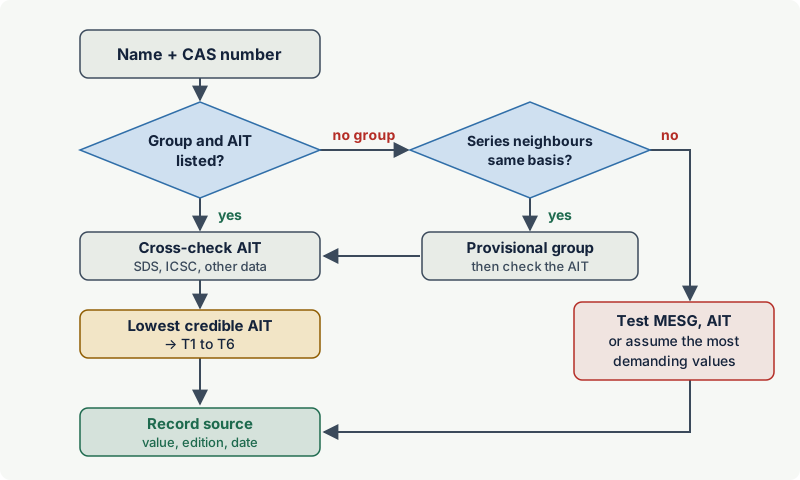
- Identify the substance exactly. Use the CAS number and the full chemical name. Isomers and similar names can differ completely: nitroethane and ethyl nitrite both have the formula C2H5NO2, but nitroethane is IIB with an AIT of 412 °C (T2) while ethyl nitrite is IIA with an AIT of 95 °C (T6). Trade names and abbreviations ("thinners", "IPA", "white spirit") are not identifications.
- Look up group and AIT in ISO/IEC 80079-20-1 or the excodex library card. Note whether the group is based on a test or on similarity.
- Cross-check the AIT against the supplier's SDS and at least one other source. If values differ, use the lowest credible value, unless there is a documented reason to reject it (for example a clearly different test method or an obvious typing error).
- Convert the AIT to a temperature class using the bands above. Note how close the AIT is to the class limit; a margin of only a few kelvin is a reason to consider the next class.
- Check the conditions. The data apply to the substance mixed with air at atmospheric pressure and normal temperatures. Elevated pressure, elevated temperature or oxygen enrichment can make ignition easier, and the tables then do not apply directly (see oxygen enrichment and inerting).
- Record the result with the source, edition and date in the area classification documentation, together with the other data used for zoning (flash point, LEL, vapour density). Under ATEX this belongs in the explosion protection document.
When several substances can be present in the same zone, the most demanding group and the lowest AIT of all of them set the requirement, unless a specific assessment of the mixture shows otherwise.
Worked example: a solvent recovery unit
A solvent recovery unit handles three substances. The engineer looks each one up in the excodex library and cross-checks the AIT on the suppliers' safety data sheets.
| Substance | CAS | Gas group | AIT | Temperature class |
|---|---|---|---|---|
| Tetrahydrofuran | 109-99-9 | IIB | 230 °C | T3 |
| Hexane | 110-54-3 | IIA | 225 °C | T3 |
| Ethyl propionate | 105-37-3 | not listed in the library | 440 °C | T2 |
Tetrahydrofuran and hexane are straightforward: both have a listed group and an AIT in the T3 band.
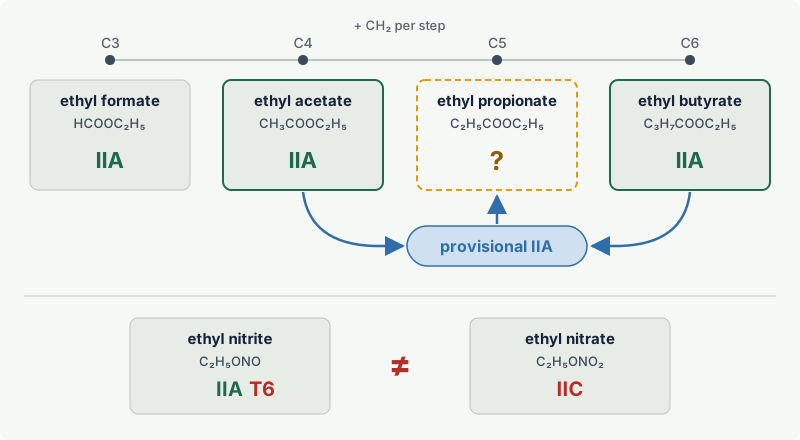
Ethyl propionate has no gas group in the library. The engineer first checks the table of ISO/IEC 80079-20-1; if the substance is listed there, that classification is used. If it is not, the homologous series of ethyl esters gives a provisional answer: its neighbours ethyl acetate and ethyl butyrate are both IIA, and so is ethyl formate. Provided the neighbours were classified on the same basis (both by MESG or both by MIC ratio), ethyl propionate can provisionally be treated as IIA. Even if that inference were wrong by one group, it would not change the answer for this unit, because tetrahydrofuran already requires IIB.
Result for the zone: gas group IIB (from tetrahydrofuran) and temperature class T3 (from the lowest AIT, hexane at 225 °C). Equipment marked IIB or IIC with T3, T4, T5 or T6 is acceptable. The margin between hexane's AIT and the T3 limit is 25 K; the owner's specification asks for T4 where the margin is below 50 K, so T4 equipment is chosen. The table, the sources and the provisional classification of ethyl propionate are recorded in the area classification report.
When the data are missing
Search further first
Many substances that are missing from one source are listed in another. Check the ISO/IEC 80079-20-1 table, NFPA 497, the ICSC card and the supplier's SDS before concluding that no data exist. For the AIT, published test results in the peer-reviewed literature can also be used if the test method is stated.
Use the homologous series rule, with its limits
ISO/IEC 80079-20-1 allows the group of a member of a homologous series (a family of compounds that differ by one CH2 group, such as the alkanes, the straight-chain alcohols or the ethyl esters) to be inferred provisionally from its neighbours. The rule does not apply when one neighbour was classified by MESG and the other by MIC ratio. It also does not cover substances that only look similar: ethyl nitrite is IIA and T6, while ethyl nitrate is IIC. Nitrates, nitrites, peroxides, unsaturated and oxygen-rich compounds deserve particular care.
Do not estimate the temperature class
There is no accepted similarity rule for the AIT. Within a homologous series it can change sharply: methane has an AIT of about 600 °C and hexane 225 °C. Predictive methods exist in the research literature, but they are not a basis for selecting equipment. Without a measured AIT, either test it or assume a low value.
Commission tests
MESG and AIT can be measured by specialist test laboratories using the methods of ISO/IEC 80079-20-1. Testing is worthwhile when a large amount of equipment depends on the result (for example the difference between IIB and IIC flameproof motors) or when the substance will be handled for many years. The test report then becomes the reference for the area classification.
Assume conservatively, and say so
Where testing is not practical, choose the most demanding group and the lowest temperature class that are chemically plausible, and record that the values are assumptions. In practice that often means IIC and T4 or better for an unknown organic vapour, and T6 if there is any indication of a very low ignition temperature. A conservative assumption costs money but is always defensible; an optimistic guess is not.
Common mistakes
- Identifying the substance by name or formula only. Isomers and similar names can have different groups and temperature classes. Correction: always use the CAS number and full name.
- Reading the temperature class from the flash point. The flash point decides whether a liquid forms vapour; it says nothing about ignition by hot surfaces. Correction: use the AIT (see flash point, autoignition temperature and MIE).
- Taking the highest AIT from several sources. That removes the margin the variation between sources represents. Correction: use the lowest credible value and record the source.
- Mixing NEC group letters and IEC groups. Group D is not IIA in every case, and Group A is acetylene, not the least severe group. Correction: use the table that belongs to the code you apply.
- Guessing the group from a "similar" chemical. Ethyl nitrite and ethyl nitrate differ by two groups. Correction: apply the homologous series rule only within a true series, otherwise test or assume conservatively.
- Using the product SDS for a mixture as if it described the vapour. The vapour released may be dominated by the most volatile component. Correction: classify by the components that can be present in the vapour.
Frequently asked questions
Where can I find the gas group of a chemical?
The authoritative source is the data table in ISO/IEC 80079-20-1. The excodex gas library gives the group for about 330 substances, and NFPA 497 gives the North American Groups A to D. Safety data sheets usually do not state the gas group.
Does the safety data sheet show the temperature class?
Not usually. Section 9 of a safety data sheet gives the auto-ignition temperature, from which the temperature class can be read: above 450 °C is T1, above 300 °C T2, above 200 °C T3, above 135 °C T4, above 100 °C T5 and above 85 °C T6. Some suppliers add a temperature class under other information, which should be confirmed.
What should I do if two sources give different autoignition temperatures?
Use the lowest credible value, unless there is a documented reason to reject it, and record the source. Differences of tens of degrees are common because the test vessel, method and ignition criterion affect the result. If the two values fall in different temperature classes, the lower value decides.
What temperature class should I use if the autoignition temperature is unknown?
Do not estimate it from similar substances. Either have the AIT measured or assume a low value, for example T4 for an ordinary organic vapour and T6 where a very low ignition temperature is possible. Record the assumption in the area classification documents.
Can the gas group be calculated?
Not for a pure substance: the group comes from a measured MESG or MIC ratio, or provisionally from neighbouring members of a homologous series. For mixtures, ISO/IEC 80079-20-1 gives an estimation formula for the MESG, with exclusions such as mixtures containing acetylene. See the article on mixtures.
Is the gas group the same under IEC and the NEC?
The zone system of NFPA 70 Article 505 uses IIA, IIB and IIC with practically the same boundaries as ISO/IEC 80079-20-1. The Division system of Article 500 uses Groups A to D with different MESG boundaries, so a substance can be IIB in IEC terms and Group D in the Division system.
Related on excodex
- Gas groups IIA, IIB and IIC explained with typical gases
- Temperature classes T1 to T6
- MESG and MIC: the two test values behind gas groups
- Mixtures of flammable gases and vapours: choosing gas group and temperature class
- How to carry out a gas hazardous area classification step by step
- Tools: gas and solvent library, Ex marking check, forum, standards spaces ISO/IEC 80079-20-1, IEC 60079-14 and NEC 500 to 506
Standards and further reading
- ISO/IEC 80079-20-1, material characteristics for gas and vapour classification: test methods and data (adopted in Europe as EN ISO/IEC 80079-20-1).
- IEC 60079-14, design, selection and erection of electrical installations (selection by gas group and ignition temperature).
- NFPA 497, recommended practice for the classification of flammable liquids, gases or vapours and of hazardous locations in chemical process areas.
- NFPA 70 (National Electrical Code), Articles 500 and 505.
- ASTM E659, test method for autoignition temperature of chemicals.
- ISO/IEC 80079-20-1:2017 catalogue entry with preview: standards.iteh.ai
- REACH Annex II, section 9.1, required physical and chemical properties in a safety data sheet: reachonline.eu
- International Chemical Safety Cards, example card 0022 (carbon disulfide): inchem.org
- NOAA CAMEO Chemicals, example datasheet: cameochemicals.noaa.gov
- GESTIS Substance Database information page: dguv.de
- Basic hydrogen properties (Hydrogen Tools, US DOE-supported), source of the 500 °C value: h2tools.org
This article is general technical information prepared by the excodex editorial team. It does not replace the applicable standards, the equipment certificates and instructions, national regulations or the assessment of a competent person.