Gas groups IIA, IIB and IIC explained with typical gases
Abstract
Gas groups IIA, IIB and IIC rank flammable gases by how easily an explosion passes a narrow gap and how little current ignites them. Propane is IIA, ethylene IIB, hydrogen and acetylene IIC. IIC equipment covers all three groups.
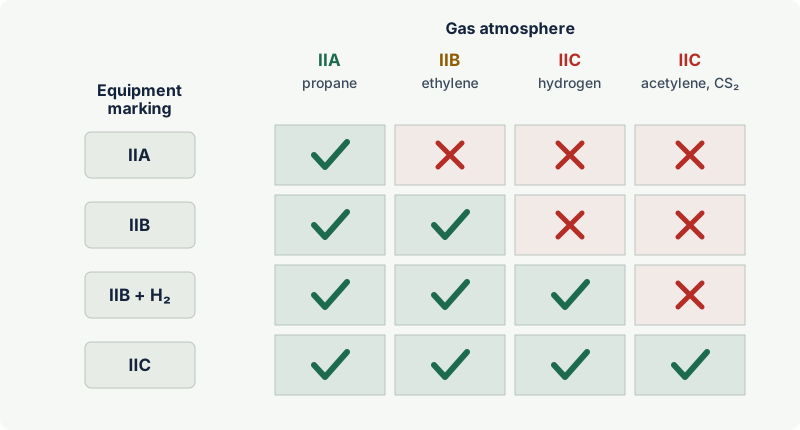
Gas groups IIA, IIB and IIC divide the flammable gases and vapours of surface industry (equipment Group II) by how dangerous they are for Ex equipment: how easily a flame passes through a narrow gap, measured as the maximum experimental safe gap (MESG), and how little electrical current ignites them, measured as the minimum igniting current (MIC) ratio. IIA is the least demanding group (typical gas: propane), IIB is in the middle (typical gas: ethylene) and IIC is the most demanding (typical gases: hydrogen and acetylene). Equipment marked IIC may be used in IIC, IIB and IIA atmospheres, IIB equipment in IIB and IIA, and IIA equipment only in IIA.
This article explains where the groups come from, lists typical gases in each group with links to the excodex gas library, shows how the hierarchy works in equipment selection, and compares the IEC groups with the North American Groups A to D.
Key points
- Group II (non-mining gases and vapours) is subdivided into IIA, IIB and IIC; Group I is reserved for mines with firedamp (methane) and Group III for combustible dusts.
- A substance is placed in a group by its MESG (IIA: 0.90 mm or more, IIB: above 0.50 mm and below 0.90 mm, IIC: 0.50 mm or less) or its MIC ratio (IIA: above 0.80, IIB: 0.45 to 0.80, IIC: below 0.45).
- Representative gases are propane for IIA, ethylene for IIB and hydrogen for IIC; acetylene and carbon disulphide are also IIC.
- The hierarchy runs one way: IIC equipment is suitable for IIB and IIA, IIB equipment for IIA, but never the other way round.
- The gas group says nothing about ignition temperature: hydrogen is IIC but only needs T1, while diethyl ether is IIB and needs T4. Gas group and temperature class are chosen separately.
- North American Groups run in the opposite direction of letters: Group A (acetylene) is the most severe and Group D (propane) the least.
Where gas groups sit in the Ex system
IEC 60079-0 sorts Ex equipment into three groups. Group I is equipment for underground mines where firedamp (mainly methane) can occur. Group II is equipment for explosive gas atmospheres everywhere else. Group III is equipment for explosive dust atmospheres, subdivided into IIIA, IIIB and IIIC (see dust groups).
Group II is subdivided because gases differ strongly in two properties that matter for equipment design. Hydrogen flames squeeze through gaps that would stop a propane flame, and hydrogen is ignited by a spark carrying a small fraction of the energy that propane needs. Designing every enclosure and every intrinsically safe circuit for hydrogen would make most equipment heavier and more expensive than necessary, so the subdivision lets equipment be designed for the gases it will actually meet.
Since the 2007 edition of IEC 60079-0, Group II equipment is marked IIA, IIB or IIC rather than plain "II", because more and more construction requirements (for example the limits on electrostatic charging of non-metallic surfaces) depend on the subgroup.
What decides the group: MESG and MIC ratio
Two laboratory values decide the group. The test methods are in ISO/IEC 80079-20-1, which replaced IEC 60079-20-1 and is now the standard for gas and vapour classification data.
- MESG (maximum experimental safe gap): the largest gap of a 25 mm wide joint that stops an internal explosion from igniting the surrounding mixture, over all concentrations of the gas in air. It describes flame transmission and is the basis for flameproof enclosures (Ex d).
- MIC ratio (minimum igniting current ratio): the minimum current that ignites the gas in a standard spark test apparatus, divided by the value for laboratory methane. It describes spark ignition sensitivity and is the basis for intrinsic safety (Ex i).
| Group | MESG | MIC ratio | Representative gas |
|---|---|---|---|
| IIA | 0.90 mm or more | above 0.80 | propane |
| IIB | above 0.50 mm and below 0.90 mm | 0.45 to 0.80 | ethylene |
| IIC | 0.50 mm or less | below 0.45 | hydrogen |
For most substances one value is enough. Near the boundaries ISO/IEC 80079-20-1 asks for both values and says which one decides: when the MESG is between 0.50 and 0.55 mm, the MIC ratio decides; when the MIC ratio lies close to a boundary (between 0.70 and 0.90, or between 0.40 and 0.50), the MESG decides. The detailed test procedures are explained in MESG and MIC.
Note that IIC has no lower limit. Hydrogen, acetylene and carbon disulphide all fall in IIC, but their behaviour is not identical, which is why some construction rules add restrictions for acetylene and carbon disulphide (see the special cases of IIC).
Typical gases in each group
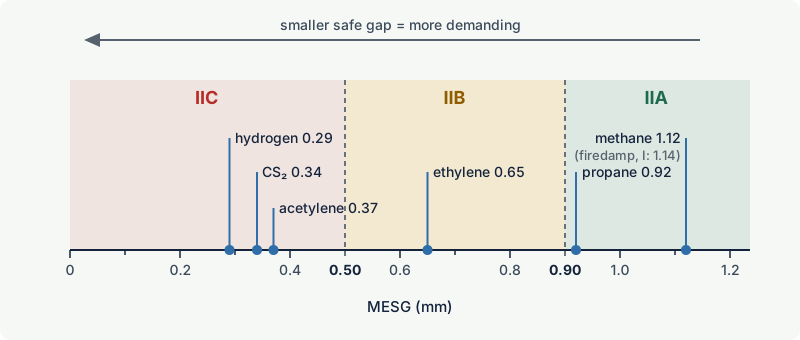
The figure places the representative gases on the MESG scale. The values are those reported in the HSE comparison of MESG test methods, in IEC committee documents and in the NSW TestSafe classification table; individual laboratories report slightly different numbers, so they are shown as typical values.
| Gas | Group | Typical MESG | Autoignition temperature | Temperature class |
|---|---|---|---|---|
| Methane | IIA (surface); firedamp is Group I (mines) | 1.12 mm (firedamp: 1.14 mm) | about 600 °C | T1 |
| Propane | IIA | 0.92 mm | 450 °C | T2 |
| Ethylene | IIB | 0.65 mm | 440 °C | T2 |
| Acetylene | IIC | 0.37 mm | 305 °C | T2 |
| Carbon disulphide | IIC | 0.34 mm | 90 °C | T6 |
| Hydrogen | IIC | 0.29 mm | 560 °C | T1 |
Most hydrocarbon fuels and common solvents fall in IIA. IIB contains many oxygen-containing compounds (ethers, epoxides, some alcohols and aldehydes), unsaturated compounds such as ethylene and butadiene, and some toxic gases. IIC is a short list.
| Group | Typical substances (excodex library) |
|---|---|
| IIA | methane, ethane, propane, butane, n-pentane, hexane, n-heptane, octane, kerosene, benzene, toluene, o-xylene, acetone, methanol, ethyl acetate, ammonia, propylene |
| IIB | ethylene, 1,3-butadiene, ethylene oxide, propylene oxide, diethyl ether, dimethyl ether, tetrahydrofuran, acrylonitrile, formaldehyde, carbon monoxide, hydrogen sulphide, hydrogen cyanide, ethanol |
| IIC | hydrogen, acetylene, carbon disulphide, ethyl nitrate |
Note: Published tables do not always agree. Ethanol, for example, is IIB in the excodex library but still appears as IIA in some older charts. Always take the group from a current, traceable data source and keep the reference in the area classification documents. See how to find the gas group.
The hierarchy: which equipment can go where
The groups form a ladder. Equipment that has been designed and tested for a more demanding group is also safe in a less demanding one, because an enclosure that stops a hydrogen explosion will certainly stop a propane explosion, and a circuit too weak to ignite hydrogen cannot ignite propane.
| Gas group of the area | Equipment marking that is acceptable |
|---|---|
| IIA | IIA, IIB or IIC |
| IIB | IIB or IIC |
| IIC | IIC only (or a marking for the specific gas, see below) |
Two special markings sit between the main groups:
- IIB + H2: equipment, usually flameproof, that meets IIB and has also been tested for hydrogen. It may be used for IIA, IIB and hydrogen, but not for acetylene or carbon disulphide. See IIB+H2 explained.
- A named gas: equipment can be certified for one particular gas, marked with its name or chemical formula next to the group. It is then suitable only for that gas, plus the gases of any group it is also marked for.
Group I equipment and Group II equipment are not interchangeable by default. Mining equipment is built for methane and coal dust and for rough mechanical conditions, but its marking does not confirm suitability for other surface-industry gases. Equipment certified for both groups carries both markings (for example Ex db I Mb and Ex db IIB T4 Gb) and has been assessed against both.
Which types of protection depend on the gas group
The group matters most where the protection principle relies on a gas property:
- Flameproof enclosures (Ex d): the permitted gaps and widths of flamepaths are smaller for IIB and much more restricted for IIC, and the type tests use more severe test mixtures. A IIC flameproof enclosure is usually heavier and has tighter machining tolerances. See flameproof enclosures.
- Intrinsic safety (Ex i): the permitted voltage, current, capacitance and inductance of a circuit are lowest for IIC. Cable parameters (Co, Lo) printed on associated apparatus differ by group. See intrinsic safety.
- Other types of protection such as increased safety (Ex e), encapsulation (Ex m) or pressurisation (Ex p) do not rely on stopping a flame or limiting spark energy, so the main design rules are the same for all groups. The equipment still carries IIA, IIB or IIC because secondary requirements, such as electrostatic limits for plastic enclosures and some component restrictions, depend on it. Many such products are marked IIC for that reason.
Gas group and temperature class are independent
The gas group describes flame transmission and spark sensitivity. The temperature class describes how hot a surface may become. The two are unrelated, so both must be checked. A few examples from the excodex library make this clear:
| Substance | Gas group | Autoignition temperature | Temperature class |
|---|---|---|---|
| Hydrogen | IIC | 560 °C | T1 |
| Carbon disulphide | IIC | 90 °C | T6 |
| Diethyl ether | IIB | 175 °C | T4 |
| Hexane | IIA | 225 °C | T3 |
| Acetaldehyde | IIA | 155 °C | T4 |
An IIC T1 lamp is suitable for hydrogen but would be a dangerous choice for diethyl ether, even though IIC is "higher" than IIB. The temperature side is covered in temperature classes T1 to T6.
Worked example: choosing the gas group for a process unit
A unit contains three areas: a propane storage and pump area, an ethylene compressor house, and a small hydrogen buffer vessel.
- Propane area: propane is IIA, AIT 450 °C, T2. Any equipment marked IIA, IIB or IIC with T2 or better (T3 to T6) is acceptable.
- Ethylene compressor house: ethylene is IIB, AIT 440 °C, T2. Equipment must be IIB or IIC. A IIA motor is not acceptable here even though the temperature class would be fine.
- Hydrogen buffer vessel: hydrogen is IIC, T1. Equipment must be IIC or IIB + H2.
- Where zones overlap (for example a pipe rack carrying both ethylene and hydrogen), the most demanding gas sets the requirement: IIC (or IIB + H2, if no acetylene or carbon disulphide is present) and the lowest temperature class of the substances present.
A common commercial decision is to buy IIC equipment for the whole unit to keep one spare-parts list. That is technically allowed, because IIC covers all lower groups. It is often more expensive for flameproof items, and the temperature class still has to be checked area by area. For mixtures of several gases in the same release, see mixtures of gases and vapours.
IEC groups compared with North American Groups A to D
Under the US National Electrical Code (NFPA 70) Article 500 (Class I, Divisions), gases are placed in Groups A, B, C and D, also on the basis of MESG and MIC ratio. Article 505 (Class I, Zones) uses the IEC groups IIA, IIB and IIC with practically the same MESG boundaries as ISO/IEC 80079-20-1; the only difference is a substance with an MESG of exactly 0.90 mm, which Article 505 places in IIB rather than IIA. The Division groups A to D have different boundaries, so their correspondence with the IEC groups is approximate.
| NEC Article 500 group | Criterion (paraphrased) | Typical gas | Nearest IEC group |
|---|---|---|---|
| A | acetylene | acetylene | IIC |
| B | MESG 0.45 mm or less, or MIC ratio 0.40 or less | hydrogen | IIC |
| C | MESG above 0.45 up to 0.75 mm, or MIC ratio above 0.40 up to 0.80 | ethylene | IIB |
| D | MESG above 0.75 mm, or MIC ratio above 0.80 | propane | IIA |
Because the letters run in the opposite direction (Group A is the most severe, IIA the least), engineers working with both systems should write the full designation ("Class I Group D" or "IIA") and never just "A" or "D". A substance near a boundary can fall into a different group in each system, so take the group from the table that belongs to the code you are applying. The two systems are compared in zones vs divisions.
Common mistakes
- Reading IIC as "more flammable". The group says nothing about how easily a gas forms a flammable mixture or how hot a surface may be. Carbon disulphide and hydrogen are both IIC but need T6 and T1 respectively.
- Using IIB equipment for hydrogen. Plain IIB is not enough for hydrogen. Use IIC, or IIB + H2 where acetylene and carbon disulphide are absent.
- Assuming IIB + H2 covers all IIC gases. It does not cover acetylene or carbon disulphide.
- Confusing IEC IIA with NEC Group A. IIA is the least severe IEC group; Group A (acetylene) is the most severe NEC group.
- Treating Group I mining equipment as suitable for surface plants without checking. Unless it is also marked for Group II, it has not been assessed for Group II gases.
- Taking the group from an old chart. Classifications are revised as new test data become available; use a current, traceable source.
Frequently asked questions
What gas group is hydrogen?
Hydrogen is in gas group IIC, the most demanding group, with a typical MESG of about 0.29 mm. Equipment for hydrogen must be marked IIC or IIB + H2. Its autoignition temperature of 560 °C in the excodex library (other compilations give roughly 500 to 585 °C) means temperature class T1 is sufficient from the ignition temperature point of view.
Can IIC equipment be used in a IIA or IIB area?
Yes. Equipment marked IIC has been designed and tested for the most demanding group and is suitable for IIB and IIA gases as well. The temperature class, the equipment protection level and any specific conditions of use on the certificate must still match the area.
What gas group is natural gas or methane?
In surface industry, methane and methane-rich natural gas are treated as IIA. Methane is also the reference gas of Group I, which is reserved for underground mines with firedamp. Natural gas with a high content of heavier hydrocarbons, or blended with hydrogen, should be checked against its actual composition.
What gas group is propane or LPG?
Propane is the representative gas of IIA, with a typical MESG of about 0.92 mm, and butane is also IIA. Equipment marked IIA, IIB or IIC is suitable. Propane needs temperature class T2 or better on the basis of its 450 °C autoignition temperature.
What is the difference between IIA, IIB and IIC?
They are three levels of severity for flammable gases, decided by MESG and MIC ratio. IIA gases (such as propane) are the least able to pass a flame through a narrow gap and need the most ignition energy; IIC gases (such as hydrogen and acetylene) pass flames through very small gaps and ignite with very little energy. Equipment for a higher group can be used for a lower one.
Is ethylene IIB?
Yes. Ethylene is the representative gas of IIB, with a typical MESG of about 0.65 mm. Equipment for ethylene must be marked IIB or IIC.
Related on excodex
- MESG and MIC: the two test values behind gas groups IIA, IIB and IIC
- IIB+H2 explained: when is it enough for hydrogen?
- Acetylene, carbon disulphide and hydrogen: the special cases of gas group IIC
- How to find the gas group and temperature class of a substance
- How to read an Ex marking
- Tools: Ex marking check, gas and solvent library, standards space ISO/IEC 80079-20-1
Standards and further reading
- ISO/IEC 80079-20-1, Explosive atmospheres: material characteristics for gas and vapour classification, test methods and data.
- IEC 60079-0, Explosive atmospheres: general requirements for equipment (equipment groups and marking).
- IEC 60079-1, flameproof enclosures "d"; IEC 60079-11, intrinsic safety "i".
- IEC 60079-14, design, selection and installation of electrical installations in explosive atmospheres.
- NFPA 70 (National Electrical Code), Articles 500 and 505.
- ISO/IEC 80079-20-1 catalogue entry with group boundaries in the preview: standards.iteh.ai
- IEC Electropedia, definition of maximum experimental safe gap (IEV 426-02-11): electropedia.org
- H. Phillips (HSE), A comparison of standard methods for the determination of MESG, NMAB-447, 1987: stacks.cdc.gov
- NSW TestSafe (New South Wales Government), gas classification table with MESG, MIC ratio and autoignition data, including industrial methane (IIA) and firedamp (Group I): nsw.gov.au
- US Fire Administration training bulletin on classified locations and NEC groups (2011): dps.alaska.gov
- IEC 60079-0 current edition page: webstore.iec.ch
This article is general technical information prepared by the excodex editorial team. It does not replace the applicable standards, the equipment certificates and instructions, national regulations or the assessment of a competent person.