Mixtures of flammable gases and vapours: choosing gas group and temperature class
Abstract
For a gas or vapour mixture, take the most severe gas group and the lowest autoignition temperature of its components, or estimate the MESG and LEL with Le Chatelier-type formulas. Rules, exclusions, hydrogen blends, worked examples and when to test.
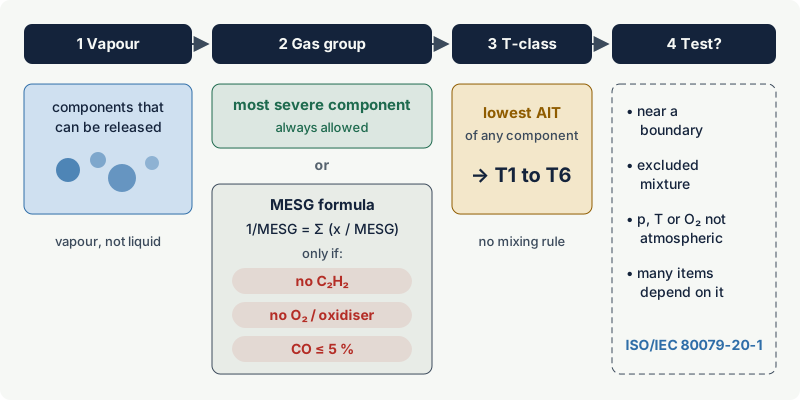
For a mixture of flammable gases or vapours, the simple and always conservative rule is to take the most demanding gas group and the lowest autoignition temperature (AIT) of any component that can be present in the released vapour. Where that rule is too costly, ISO/IEC 80079-20-1 gives a Le Chatelier-type formula to estimate the maximum experimental safe gap (MESG) of a mixture, with exclusions for acetylene, oxidisers and more than 5 % carbon monoxide, and it classifies methane with up to 25 % hydrogen as IIA. The lower explosive limit (LEL) of a mixture can be estimated with Le Chatelier's rule; for the AIT there is no accepted mixing rule, so the lowest component value applies unless the mixture is tested.
This article explains the conservative rules, the estimation formulas and their limits, works through examples (natural gas, a hydrogen blend, a solvent blend) and lists the situations in which a laboratory test is the better answer.
Key points
- The most demanding gas group and the lowest AIT among the components that can be present in a flammable concentration always give a safe classification of a mixture.
- ISO/IEC 80079-20-1 allows the MESG of a mixture to be estimated as the reciprocal of the sum of each component's volume fraction divided by its MESG. It must not be used for mixtures with acetylene or other self-decomposing gases, with oxygen or another strong oxidiser, or with more than 5 % carbon monoxide.
- Inert components count in the formula: below 5 % by volume they are given an infinite MESG, at 5 % or more an MESG of 2 mm.
- ISO/IEC 80079-20-1 classifies methane containing no more than 25 % hydrogen by volume as IIA, and recommends IIB flameproof equipment for coke oven gas when hydrogen plus carbon monoxide is below 75 %, otherwise IIC.
- Le Chatelier's rule estimates the LEL of a fuel mixture well; it is less reliable at the upper limit.
- There is no accepted rule for the AIT of a mixture. A simple weighted average can overestimate it, which is unsafe, so use the lowest component AIT or test the mixture.
- Classify the vapour that is actually released, not the liquid: volatile components dominate the vapour even when they are a small part of the liquid.
The conservative rule
Gas group and temperature class are properties of a substance, but area classification deals with real releases: natural gas, refinery off-gas, solvent blends, fuel and process streams. The straightforward approach is:
- Gas group: the most demanding group of any component that can be present in the flammable mixture. A stream containing propane (IIA), ethylene (IIB) and hydrogen (IIC) is treated as IIC.
- Temperature class: the class set by the lowest AIT of any component that can be present. A blend of toluene (530 °C) and n-heptane (204 °C) is treated as T3.
This is the generally accepted conservative basis: for ordinary fuel mixtures the MESG of the mixture lies between those of its components, and the lowest component AIT is the safe starting point for surface temperatures. Reactive or unusual mixtures are the exception and should be tested. The obvious weakness is that a trace of one component can drive the whole classification. A natural gas stream with a fraction of a percent of hydrogen would become IIC, which no one does in practice.
The practical question is therefore what "can be present" means. Components that are present only as traces, far below the concentration at which they influence ignition, are normally disregarded, but there is no universal threshold. As one example, a gas turbine standard (ISO 21789) quoted in a 2021 information paper of the Australian offshore regulator NOPSEMA takes the lowest AIT of any component present above 3 % by volume. Such thresholds are conventions of a particular standard, not a general rule, and the reasoning should be recorded.
Where hydrogen is the only IIC component, equipment marked IIB+H2 is an alternative to IIC (see IIB+H2 explained). Where acetylene or carbon disulphide is present, it is not.
Gas group of a mixture: the MESG estimation formula
The formula
ISO/IEC 80079-20-1, the standard behind the gas groups, accepts an estimate of the MESG of a mixture based on Le Chatelier's principle:
1 / MESG_mix = x1 / MESG1 + x2 / MESG2 + x3 / MESG3 + ...
Here x1, x2, ... are the volume fractions of the components in the gas stream (adding up to 1) and MESG1, MESG2, ... are their MESG values. The result is compared with the group boundaries: 0.90 mm or more is IIA, above 0.50 and below 0.90 mm is IIB, and 0.50 mm or less is IIC.
Inert components such as nitrogen are part of the stream. The standard warns that a two-component mixture in which one component is an inert can produce unrealistically high MESG estimates, and sets a rule: an inert below 5 % by volume is given an infinite MESG (its term drops out), and an inert at 5 % or more is given an MESG of 2 mm. The standard also points to a more detailed method in the literature that takes stoichiometric ratios into account.
Where the formula must not be used
The standard excludes three kinds of mixture:
- mixtures containing acetylene or another gas with an equivalent hazard, such as the ability to decompose on its own;
- mixtures containing oxygen or another strong oxidiser as a component;
- mixtures with more than 5 % carbon monoxide by volume.
For these, use the most severe component rule or have the mixture tested. The formula is also an estimate: near a group boundary, a test is the better basis.
Specific statements in the standard
For two important mixtures ISO/IEC 80079-20-1 gives a direct classification, which takes precedence over the formula:
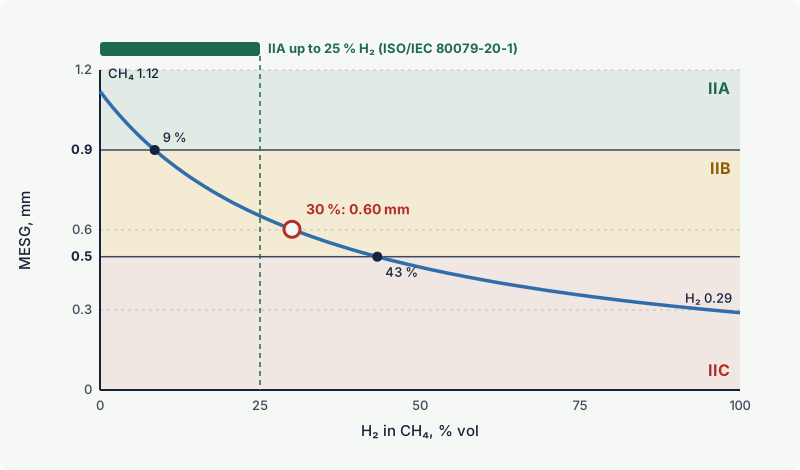
- Methane with hydrogen: methane containing no more than 25 % hydrogen by volume is classified as IIA.
- Coke oven gas (a mixture of hydrogen, carbon monoxide and methane): IIB flameproof equipment is recommended when hydrogen plus carbon monoxide is below 75 % by volume; otherwise IIC.
The methane case shows how cautious the formula is. With typical MESG values of 1.12 mm for industrial methane (IIA; the 1.14 mm often quoted belongs to firedamp in Group I) and 0.29 mm for hydrogen, the formula predicts IIB from about 9 % hydrogen onwards, while test data allow IIA up to 25 %. Above 25 % the formula is the usual basis: it predicts IIB up to about 43 % hydrogen and IIC above.
LEL of a mixture: Le Chatelier's rule
For detector settings and for estimating zone extents, the LEL of the mixture matters. Le Chatelier's mixing rule estimates it from the LELs of the combustible components:
LEL_mix = 100 / (C1 / LEL1 + C2 / LEL2 + C3 / LEL3 + ...)
Here C1, C2, ... are the percentages of each component in the combustible part of the gas (adding up to 100) and LEL1, LEL2, ... are their LELs in % by volume. Mashuga and Crowl showed in 2000 that the assumptions behind the rule are reasonably valid at the lower flammable limit and less so at the upper limit. It works well for mixtures of similar hydrocarbons and is widely used in industry; for unusual mixtures, or for the upper limit, a measured value is better. Explosion limits are measured by standard methods such as EN 1839.
If the gas also contains inert components, apply the rule to the combustible part and divide the result by the combustible fraction to obtain the LEL of the whole gas in air. This treats the inert as pure diluent, which is a reasonable approximation at the low concentrations around the LEL.
Example: A natural gas contains 90 % methane (LEL 4.4 %), 6 % ethane (2.4 %) and 4 % propane (1.7 %). LEL_mix = 100 / (90/4.4 + 6/2.4 + 4/1.7) = 100 / (20.45 + 2.50 + 2.35) = 100 / 25.30 = 3.95 % by volume, lower than the 4.4 % of pure methane. Gas detectors also respond differently to each component, so a detector calibrated on methane does not read the %LEL of this mixture exactly; see LEL and UEL explained.
Temperature class of a mixture
There is no accepted mixing rule for the autoignition temperature, and ISO/IEC 80079-20-1 does not give one. The AIT of a mixture depends strongly on its composition, mixture data are scarce, and predictive models are still a research topic. A 2019 study of prediction methods noted, for example, that a simple weighting formula proposed for one group of mixtures gave values about 20 K higher than the measured AITs. An average of the component AITs can therefore overstate the safe surface temperature.
The practical rule is to take the lowest AIT of any component that can be present in the flammable vapour and select the temperature class from it. If that gives an impractical result (for example T4 or T5 equipment for a whole plant because of one minor component), the options are to show by assessment that the component cannot reach a significant concentration in a release, or to have the AIT of the actual mixture measured by the method of ISO/IEC 80079-20-1.
Classify the vapour, not the liquid
For liquid mixtures, what reaches the explosive atmosphere is the vapour, and its composition differs from the liquid. Each component contributes to the vapour roughly in proportion to its mole fraction in the liquid multiplied by its vapour pressure (Raoult's law for ideal mixtures). Volatile components are therefore strongly enriched in the vapour:
- A heavy oil or fuel with a few percent of dissolved light hydrocarbons can release a vapour that consists mostly of those light components. The flash point and the vapour LEL then follow the light ends, not the bulk liquid.
- As a solvent blend evaporates from an open surface or a spill, the vapour composition changes with time: the most volatile component dominates at first, the least volatile at the end. Every component that can dominate at some stage must be considered.
- Heating a liquid changes the proportions again, because vapour pressures rise at different rates.
The product safety data sheet describes the liquid as supplied. For classification, list the components that can appear in the vapour and use their data. Data sources and lookup are covered in how to find the gas group and temperature class.
Worked examples
Natural gas blended with 30 % hydrogen
A pilot project blends 30 % hydrogen into methane-rich natural gas.
- Group, conservative rule: hydrogen is IIC, so IIC (or IIB+H2, since hydrogen is the only IIC component).
- Group, specific statement: not applicable, because the hydrogen content is above 25 %.
- Group, formula: 1 / MESG = 0.70 / 1.12 + 0.30 / 0.29 = 0.625 + 1.034 = 1.659, so MESG is about 0.60 mm, which is IIB. None of the exclusions applies (no acetylene, no oxidiser, no carbon monoxide). The estimate lies well inside the IIB band.
- Temperature class: methane about 600 °C and hydrogen 560 °C (other compilations give roughly 500 to 585 °C for hydrogen), all above 450 °C, so T1.
- LEL: 100 / (70/4.4 + 30/4.0) = 100 / (15.91 + 7.50) = about 4.3 % by volume.
Result: IIB T1 on the basis of the estimate. Because many flameproof items are involved, the project team weighs this against buying IIB+H2 or IIC equipment, which removes any dependence on the estimate and allows higher hydrogen fractions later. Either way the reasoning is recorded.
A solvent blend in a paint mixing room
A thinner contains toluene, ethyl acetate and n-heptane.
| Component | Gas group | AIT | Temperature class |
|---|---|---|---|
| Toluene | IIA | 530 °C | T1 |
| Ethyl acetate | IIA | 470 °C | T1 |
| n-Heptane | IIA | 204 °C | T3 |
All three are IIA, so the mixture is IIA. The lowest AIT is 204 °C (n-heptane), so the mixture is T3. n-Heptane is also one of the more volatile components, so it is certainly present in the vapour. The margin between 204 °C and the T3 limit of 200 °C is only 4 K, so many engineers would specify T4 equipment in this room.
A process stream with acetylene
A cracker off-gas contains mainly methane, ethylene and hydrogen with some acetylene. The MESG formula may not be used because acetylene is present. Unless a documented assessment shows that acetylene cannot reach a significant concentration, the stream is IIC, with the acetylene-specific restrictions for flameproof equipment, and IIB+H2 is not acceptable. See the special cases of IIC.
When a test is needed
Calculation and conservative rules cover most cases. A laboratory test of the actual mixture, using the MESG and AIT methods of ISO/IEC 80079-20-1, is the better basis when:
- the formula result lies close to a group boundary, or the lowest-AIT component sits close to a temperature class limit;
- the mixture is excluded from the formula (acetylene or other decomposing gases, oxidisers, more than 5 % carbon monoxide);
- the conditions are not atmospheric: elevated pressure or temperature, or oxygen-enriched atmospheres, change MESG, AIT and limits (see oxygen enrichment and inerting);
- the mixture contains reactive or unusual compounds for which component data are incomplete;
- a large amount of equipment depends on the answer, for example IIB versus IIC for all flameproof motors of a unit, or T3 versus T4 for a plant's lighting.
A test applies to the composition tested. Record the composition range, and repeat or extend the test if the process changes.
Common mistakes
- Averaging AITs. A weighted average of component AITs can be higher than the real AIT of the mixture. Correction: use the lowest component AIT or a measured mixture value.
- Applying the MESG formula to an excluded mixture. Acetylene, oxidisers and more than 5 % carbon monoxide invalidate it. Correction: use the most severe component rule or test.
- Ignoring inerts, or ignoring their rule. Leaving out 20 % nitrogen, or counting it as air, changes the estimate. Correction: include inerts with an MESG of 2 mm when they are 5 % or more, and as infinite below 5 %.
- Classifying by the liquid composition. A minor volatile component can dominate the vapour. Correction: identify the components that can be present in the released vapour.
- Letting a trace component drive the classification without thinking. It is safe, but it can be very expensive. Correction: assess and document whether the component can reach a significant concentration.
- Forgetting that process changes change the classification. A new feedstock or a hydrogen blend can move the group. Correction: put the mixture basis into the management of change checklist.
Frequently asked questions
How do I find the gas group of a gas mixture?
The safe rule is the most demanding gas group of any component that can be present. To avoid unnecessary severity, ISO/IEC 80079-20-1 allows the MESG of the mixture to be estimated with a Le Chatelier-type formula and compared with the group boundaries, except for mixtures containing acetylene, oxidisers or more than 5 % carbon monoxide. Near a boundary, a test is better.
What temperature class applies to a mixture of solvents?
Use the temperature class set by the lowest autoignition temperature of any component that can be present in the vapour. There is no accepted mixing rule for AIT, and averages can be unsafe. If the result is impractical, the AIT of the actual mixture can be measured.
Is natural gas with hydrogen still IIA?
ISO/IEC 80079-20-1 classifies methane with no more than 25 % hydrogen by volume as IIA. Above that, the mixture formula or a test decides; a methane blend with 30 % hydrogen is estimated as IIB, and higher fractions eventually reach IIC. Natural gas with heavier hydrocarbons or other components should be assessed on its actual composition.
How is the LEL of a gas mixture calculated?
With Le Chatelier's rule: divide 100 by the sum of each component's share of the combustible gas (in %) divided by its LEL. For 90 % methane, 6 % ethane and 4 % propane this gives about 3.95 % by volume. The rule is reliable for similar hydrocarbons at the lower limit and less so at the upper limit.
When must a gas mixture be tested?
When an estimate lies near a group or temperature class boundary, when the mixture is excluded from the MESG formula, when conditions are not atmospheric, when component data are incomplete, or when a lot of equipment cost depends on the result. The test applies only to the composition tested.
Related on excodex
- How to find the gas group and temperature class of a substance
- MESG and MIC: the two test values behind gas groups IIA, IIB and IIC
- LEL and UEL explained
- Temperature classes T1 to T6
- Hybrid mixtures: when flammable gas and combustible dust are present together
- Tools: gas and solvent library, forum, standards spaces ISO/IEC 80079-20-1 and IEC 60079-10-1
Standards and further reading
- ISO/IEC 80079-20-1, material characteristics for gas and vapour classification: test methods and data (classification of mixtures, MESG and AIT tests).
- IEC 60079-10-1, classification of areas for explosive gas atmospheres.
- IEC 60079-14, design, selection and erection of electrical installations.
- EN 1839, determination of explosion limits and limiting oxygen concentration of gases and vapours.
- ISO/IEC 80079-20-1:2017 catalogue entry and preview: standards.iteh.ai
- NSW TestSafe (New South Wales Government), gas classification table with MESG values, including industrial methane (1.12 mm, IIA) and firedamp (1.14 mm, Group I): nsw.gov.au
- C. V. Mashuga and D. A. Crowl, Derivation of Le Chatelier's mixing rule for flammable limits, Process Safety Progress, 2000: digitalcommons.mtu.edu
- I. A. Zlochower and G. M. Green (NIOSH), The limiting oxygen concentration and flammability limits of gases and gas mixtures, 2009: stacks.cdc.gov
- S. Shen et al., Prediction of the auto-ignition temperatures of binary miscible liquid mixtures from molecular structures, Int. J. Mol. Sci., 2019: PDF
- NOPSEMA information paper, Management of hot surfaces, 2021: nopsema.gov.au
This article is general technical information prepared by the excodex editorial team. It does not replace the applicable standards, the equipment certificates and instructions, national regulations or the assessment of a competent person.