Hybrid mixtures: when flammable gas and combustible dust are present together
Abstract
A hybrid mixture of combustible dust with flammable gas or vapour can explode when each is below its own lower limit, and ignites more easily. Why, where it happens (solvent drying, coal mines, fumigated grain) and what it means for zoning and Ex marking.
A hybrid mixture is a mixture with air of a combustible dust and a flammable gas or vapour (or a mist) present at the same time. Hybrid mixtures matter because they can explode when both the gas and the dust are below their own lower explosion limits: the two fuels add up. The mixture also tends to ignite more easily and burn more violently than the dust alone. In practice this means a dryer with solvent vapour well below its LEL and a dust cloud below its minimum explosible concentration can still contain an explosive atmosphere.
This article explains why the limits fall, how they are estimated, where hybrid mixtures occur (solvent drying, coal mines, fumigated grain, polymer powders), and what they mean for area classification, Ex equipment selection, marking, explosion protection and gas detection.
Key points
- A hybrid mixture can be explosive even when the gas concentration is below its lower explosive limit (LEL) and the dust concentration is below its minimum explosible concentration (MEC).
- Two simple models estimate the combined limit: a linear Le Chatelier-type rule and the more conservative quadratic Bartknecht relation. Tests show that neither is reliable for every mixture, so important cases need test data.
- NIOSH gives a coal mine example: with 2 % methane in the air, coal dust above about 60 g/m³ is flammable; with 3.5 % methane, above about 30 g/m³, against about 100 g/m³ for the dust alone.
- Hybrid mixtures typically have a lower minimum ignition energy and a higher maximum explosion pressure and rate of pressure rise than the dust alone.
- In area classification, both the gas zones and the dust zones are assessed, and the hybrid effect is considered when judging whether concentrations stay "below the limit".
- Equipment marked for gas and for dust (for example
II 2G 2D) is not automatically suitable for a hybrid mixture. European guidance states that it must be suitable for such use and tested where appropriate.
What counts as a hybrid mixture
The European standard on explosion prevention, EN 1127-1, describes a hybrid mixture as a mixture with air of flammable substances in different physical states, with methane, coal dust and air as the classic example. The flammable phase can be a gas (methane, hydrogen, phosphine), a vapour from a solvent (ethanol, acetone, n-heptane) or a mist of droplets. The European Commission's guide to the ATEX workplace directive warns that mixtures of mists or dusts with gases or vapours can form an explosive atmosphere when the individual fuels are still below their lower explosion limits.
| Setting | Combustible dust | Flammable gas or vapour | Where it occurs |
|---|---|---|---|
| Pharmaceutical and fine chemical production | Active ingredients, excipients, granules | Residual solvents such as ethanol, isopropanol, acetone, heptane | Fluid bed and vacuum dryers, filter dryers, milling of solvent-wet powder, charging powder into vessels that already contain solvent |
| Underground coal mining | Coal dust | Methane (firedamp) | Coal faces, return airways, conveyors |
| Grain storage and shipping | Grain dust | Phosphine from fumigant tablets | Silos, bins, ship holds during and after fumigation |
| Polymer production | Polyolefin and resin powders | Residual monomer and hydrocarbon solvents | Purge bins, silos, pneumatic conveying |
| Fuel-fired plants | Coal dust, fly ash | Natural gas or volatiles released from heated coal | Mills, burners, ash handling |
Why hybrid mixtures ignite below each component's limit
A flame survives in a mixture only if each burning layer releases enough heat to ignite the next. Below the LEL of a gas or the MEC of a dust there is not quite enough fuel to do that. Put both fuels into the same air and their heat releases add: a vapour at half its LEL and a dust at half its MEC together supply roughly as much fuel as either at its full limit. That is the reason for the effect, and also the reason the mixture can ignite more easily, because the gas phase carries the flame from the very first moment while the dust particles heat up.
US Bureau of Mines work summarised by Kuchta notes that the lower limits of carbonaceous dusts decrease greatly with increased methane content of the atmosphere. Reviews of published research report the same for many other mixtures: adding even a small amount of flammable gas lowers the explosion limit and the minimum ignition energy and raises the maximum explosion pressure and the rate of pressure rise.
Estimating the combined limit
Two simple relations are widely used:
- Le Chatelier-type linear rule. The fractions of each limit add up to one: (gas concentration / LEL) + (dust concentration / MEC) = 1. At 50 % of the gas LEL, half the MEC of dust is enough.
- Bartknecht relation. The dust limit falls with the square of the remaining gas margin: dust limit = MEC × (1 - gas concentration / LEL)². At 50 % of the gas LEL, only a quarter of the MEC is enough.
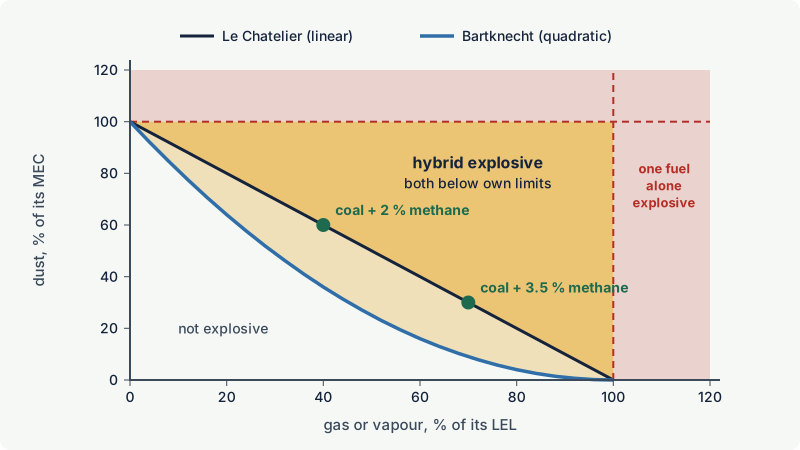
Experimental work shows the limits of both models. In 20 litre sphere tests at Magdeburg University (Addai, Gabel and Krause, 2016), explosions occurred with methane at 2 to 3 % (measured LEL 5.0 %), isopropanol at 1 % (LEL 2.1 %) and acetone at 1.5 % (LEL 2.5 %) when dust was added; lycopodium, for example, exploded at 50 g/m³ with methane instead of its MEC of 100 g/m³. The linear rule over-predicted the hybrid limit in most of those tests, which is the unsafe direction. The Bartknecht relation stayed on the safe side for most combinations, but not all: starch with 1 % isopropanol spray exploded at 35 g/m³, where the Bartknecht relation predicted about 90 g/m³. A study at Texas A&M University on niacin dust with methane found the opposite: both models predicted the mixture to be more explosive than it was. The practical conclusion is that the Bartknecht curve is the more cautious screening tool of the two but not a guaranteed lower bound, and that where the design depends on the hybrid limit, the actual mixture should be tested.
Ignition temperature and ignition energy
For hot surface ignition the picture is less dramatic. Tests in a Godbert-Greenwald furnace with starch or lycopodium and methane (Gabel and colleagues, 2022) found that adding methane did not noticeably lower the minimum ignition temperature below that of the pure dust, although ignition occurred over a wider range of conditions; the hybrid's ignition temperature was governed by whichever component ignites at the lower temperature. Ignition energy, by contrast, falls clearly with added gas, which makes static electricity, small sparks and mechanical friction more dangerous in hybrid atmospheres than in the dust alone.
Practical examples
Solvent drying in pharmaceutical production
Fluid bed dryers, vacuum dryers and filter dryers remove solvents such as ethanol or isopropanol from wet granules or crystals. As the product dries, the vapour concentration falls while the amount of fine, airborne dust rises, so for part of every batch both are present. Charging dry powder through a manway into a reactor that already contains solvent creates the same situation at the charging point, combined with strong static charging. These are some of the most frequent hybrid hazards in industry; the usual measures are inerting with nitrogen (see oxygen concentration, enrichment and inerting), closed charging systems, static control (see static electricity as an ignition source) and explosion protection of the dryer designed with hybrid test data.
Coal mines: methane and coal dust
Coal mining is the oldest and best documented hybrid hazard. NIOSH illustrates it with a coal dust whose limit alone is about 100 g/m³ (0.10 oz/ft³) and methane with a limit of 5 % (the US Bureau of Mines value; IEC-based data and the excodex methane card give 4.4 %, because the European test method uses a small vessel and a flame detachment criterion while the US value comes from flame propagation over a long distance in large vessels): with 2 % methane the dust becomes flammable above about 60 g/m³, and with 3.5 % methane above about 30 g/m³, so an ignition can occur at the face even when the methane is below its lower limit. US mining law reflects this: the incombustible content of the rock-dusted mine dust must be at least 80 %, increased by 0.4 percentage points for every 0.1 % of methane in the ventilating air (30 CFR 75.403).
The 2010 explosion at the Upper Big Branch mine in West Virginia, which killed 29 miners, shows the sequence. According to the US Mine Safety and Health Administration, a methane accumulation was ignited at the longwall shearer, and the resulting localised methane explosion met accumulations of float coal dust and coal dust that carried the explosion through the mine because rock dusting had been grossly inadequate. Group I mining equipment is designed with this combination in mind; see coal mine methane.
Grain, dust and fumigants
Grain is often fumigated with metal phosphide tablets that release phosphine on contact with moisture. Phosphine has a lower flammable limit of 1.6 % in the excodex library (1.8 % in fumigant safety literature) and may ignite spontaneously in air above that limit. Grain handling raises dust clouds at the same time and in the same spaces, so the hazard assessment must cover both fuels. Keeping dust-raising operations out of spaces where fumigant concentrations are high, and ventilating before handling resumes, keeps the two apart.
Polymer powders
Polyolefin powders leaving a reactor still contain dissolved hydrocarbons that desorb slowly in purge bins, silos and conveying lines. The vapour may stay well below its LEL on its own, but in the presence of the powder cloud the mixture is hybrid. Degassing with nitrogen and monitoring the hydrocarbon content of the vent gas are the usual controls.
Consequences for area classification
There is no separate "hybrid zone" in IEC or ATEX practice. Gas, vapour and mist are classified as Zones 0, 1 and 2 under IEC 60079-10-1, and dust as Zones 20, 21 and 22 under IEC 60079-10-2. Where both are present, both sets of zones are assigned, and the hybrid effect enters the assessment in several places:
- Below-the-limit arguments need care. A statement such as "the vapour never exceeds 25 % of the LEL, so no gas zone" or "the dust concentration in normal operation is below the MEC" does not hold if the other fuel is present at the same time. Use the combined limit, conservatively the Bartknecht relation, or test data.
- Ventilation and extraction dilute gas and vapour but may not remove dust in the same way; dust that settles is a separate source.
- Inside equipment such as dryers, mills, filters and silos the hybrid atmosphere is often present in normal operation, which drives the zones and the choice of explosion protection.
- Guidance. IEC 60079-10-1:2020 states that its principles may be used in the assessment of a hybrid mixture and contains an informative annex on hybrid mixtures, covering ventilation, concentration limits, chemical reactions, energy and temperature limits and zoning. IEC 60079-10-2 covers the dust side.
Record the hybrid considerations explicitly in the explosion protection document, so that a later reviewer can see why the zones are what they are; see the explosion protection document.
Consequences for equipment selection and marking
Equipment in a hybrid area must meet the gas requirements and the dust requirements at the same time:
- EPL or category for both: for example Gb (category 2G) for Zone 1 and Db (category 2D) for Zone 21.
- Gas group and temperature class for the gas or vapour, with the maximum surface temperature below its autoignition temperature.
- Dust group and maximum surface temperature for the dust, with the usual margins: no more than two thirds of the cloud ignition temperature, and the 5 mm layer ignition temperature minus 75 K where layers can form (see dust zones).
- The more severe of each requirement applies, and no credit can be taken for the hybrid igniting at a higher temperature.
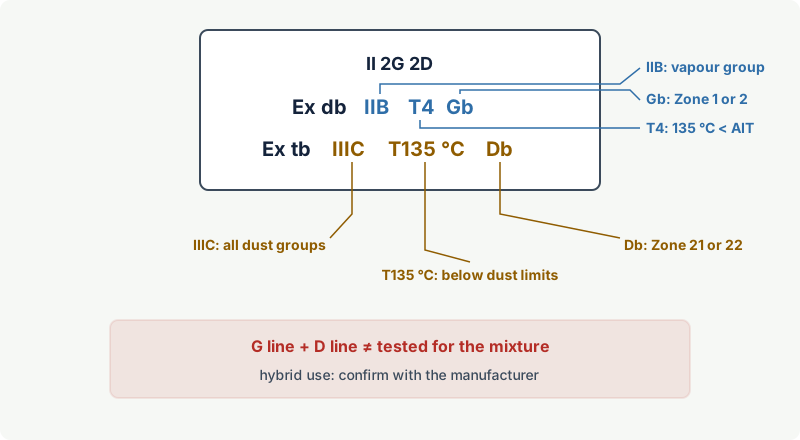
A typical dual marking reads II 2G 2D with Ex db IIB T4 Gb and Ex tb IIIC T135°C Db. It tells you that the product may be used in a gas area or in a dust area. It does not by itself tell you that it was assessed for both at once. The European Commission's non-binding guide to directive 1999/92/EC says this directly: equipment used in hybrid mixtures must be suitable for such use and tested where appropriate, and an item marked II 2 G/D is not necessarily suitable for hybrid mixtures. IEC 60079-0 likewise notes that the simultaneous presence of gas and dust often warrants additional protective measures and points to IEC 60079-14 for guidance on hybrid mixtures. In practice, ask the manufacturer to confirm suitability for the specific mixture and check the certificate's specific conditions of use. Read more in how to read an Ex marking.
Explosion protection and gas detection
Explosion venting, suppression and isolation must be designed with the explosion characteristics of the hybrid mixture, which can exceed those of the dust alone. Isolation needs particular thought: the EU guide notes that flame arresters for gases, vapours and mists cannot be used for dusts because they can block, and its checklist asks specifically about explosion decoupling for hybrid mixtures. Conversely, an isolation device tested only with dust should not be assumed to stop a gas or hybrid flame; check the scope of its tests.
Gas detection in hybrid atmospheres has its own pitfalls. The same guide says that where hybrid mixtures can arise, detectors must be suitable for both phases and calibrated for the possible mixtures, and that one phase can affect the detector, for example mists poisoning catalytic sensors. Dust can also block sinters and foul optics. A flammable gas reading in % LEL says nothing about the dust contribution, so alarm levels must be set lower than for gas alone if the detector is to warn before the hybrid limit is reached.
Worked example: a fluid bed dryer
A fluid bed dryer removes ethanol from pharmaceutical granules. Ethanol has an LEL of 3.1 % in the excodex library. The exhaust vapour concentration is controlled to stay below 25 % of the LEL. The fines that reach the dryer's filter section have a measured MEC of 60 g/m³ (an illustrative test value for this example).
- Single-component view. Vapour below 25 % LEL, so "not explosive"; dust below 60 g/m³ most of the time, so "only occasionally explosive".
- Hybrid view, linear rule. At 25 % of the LEL, the dust limit falls to 75 % of the MEC: 45 g/m³.
- Hybrid view, Bartknecht. The dust limit falls to (1 - 0.25)² = 56 % of the MEC: about 34 g/m³.
- Reality check. Dust concentrations in the expansion chamber and around the filter during drying and filter cleaning easily exceed 34 g/m³. The interior is therefore treated as containing an explosive hybrid atmosphere in normal operation, not occasionally.
- Decision. The team chooses nitrogen inerting with oxygen monitoring as the primary measure; the alternative would be an explosion-resistant or vented dryer designed with hybrid test data. Equipment inside and connected to the dryer is selected for both the gas and the dust zones, and its suitability for the hybrid mixture is confirmed with the manufacturer.
Common mistakes
- "Both are below their limits, so there is no explosive atmosphere." That is exactly the situation in which hybrid mixtures catch people out. Use a combined limit.
- Taking a dual G and D marking as proof of hybrid suitability. It shows suitability for gas or dust; hybrid use needs confirmation.
- Using the linear rule as if it were conservative. Tests have shown hybrid mixtures exploding below the linear prediction, and in one published case even below the Bartknecht prediction. Use the Bartknecht relation for screening and test data where the design depends on the limit.
- Designing venting or suppression with the dust's Kst only. The hybrid mixture can be more violent.
- Forgetting the gas side during dust work, or the reverse. Powder charging into a solvent vessel, cleaning out a solvent-wet filter and fumigating a dusty silo are all hybrid tasks.
Frequently asked questions
What is a hybrid mixture in explosion protection?
It is a mixture with air of a combustible dust (or mist) together with a flammable gas or vapour. The two fuels add their effects, so the mixture can explode even when each is below its own lower limit, and it usually ignites more easily than the dust alone.
How do you calculate the lower explosion limit of a hybrid mixture?
Two simple estimates are used. The linear rule assumes the fractions of the gas LEL and the dust MEC add up to one; the Bartknecht relation is more conservative and multiplies the MEC by the square of (1 - gas concentration / LEL). Neither is reliable for every mixture, so test the actual mixture where the design depends on it.
Do I need separate gas and dust zones for a hybrid mixture?
Yes. There is no separate hybrid zone. The gas or vapour is classified with Zones 0, 1 and 2 and the dust with Zones 20, 21 and 22, and the hybrid effect is considered when deciding where explosive atmospheres can occur and how often.
Is equipment marked II 2G 2D suitable for hybrid mixtures?
Not automatically. The marking confirms suitability for gas atmospheres and for dust atmospheres. European guidance states that equipment for hybrid mixtures must be suitable for such use and tested where appropriate, so ask the manufacturer to confirm suitability for the specific mixture.
Why are hybrid mixtures common in pharmaceutical plants?
Many active ingredients and excipients are crystallised, washed or granulated with flammable solvents and then dried and milled. During drying, discharge and powder charging into solvent-filled vessels, solvent vapour and fine powder are present together, which creates a hybrid mixture.
Related on excodex
- What makes a dust explosive: particle size, concentration and moisture
- Dust explosion parameters explained: Kst, Pmax, St classes, MIE
- LEL and UEL explained
- Dust explosion protection: venting, suppression and isolation
- Pharmaceutical and chemical plants: solvent handling and powders
- Tools: Ex marking check, gas and solvent library; standards spaces IEC 60079-10-1 and IEC 60079-10-2
Standards and further reading
- IEC 60079-10-1:2020, classification of areas, explosive gas atmospheres (scope note and informative annex on hybrid mixtures): IEC 60079-10-1:2020 catalogue entry
- IEC 60079-10-2, classification of areas, explosive dust atmospheres
- IEC 60079-0, equipment general requirements (scope note on gas and dust present together) and IEC 60079-14, design, selection and erection of electrical installations
- EN 1127-1, explosion prevention and protection, basic concepts and methodology (definition of hybrid mixtures)
- European Commission, non-binding guide to good practice for implementing directive 1999/92/EC (hybrid mixtures, equipment and detection): EU Publications Office
- Addai, Gabel and Krause, Models to estimate the lower explosion limits of dusts, gases and hybrid mixtures, Chemical Engineering Transactions 48, 2016: aidic.it (PDF)
- Jiang, Liu and Mannan, A correlation of the lower flammability limit for hybrid mixtures, IChemE Hazards XXIV: icheme.org (PDF)
- Gabel, Geoerg, Napetschnig and Krause, Minimum ignition temperature of hybrid mixtures, Chemical Engineering Transactions 90, 2022: cetjournal.it
- Cashdollar and Sapko, Explosion hazards of coal dust in the presence of methane, NIOSH Handbook for Methane Control in Mining, 2006: stacks.cdc.gov (PDF)
- 30 CFR 75.403, maintenance of incombustible content of rock dust: ecfr.gov
- US Mine Safety and Health Administration, Upper Big Branch mine explosion, executive summary: msha.gov (PDF)
- Zlochower and Green, The limiting oxygen concentration and flammability limits of gases and gas mixtures, NIOSH (why the methane lower limit is 5.0 % in US data and 4.4 % with the European method): cdc.gov (PDF)
This article is general technical information prepared by the excodex editorial team. It does not replace the applicable standards, the equipment certificates and instructions, national regulations or the assessment of a competent person.