Dust zones 20, 21 and 22 explained with practical examples
Abstract
Zones 20, 21 and 22 describe how often an explosive dust cloud is present. Definitions, typical zones inside silos, mills, cyclones and filters and around bagging points, the role of housekeeping and dust layers, and the matching EPL Da, Db and Dc.
Dust zones describe how often and for how long an explosive atmosphere in the form of a cloud of combustible dust in air is present at a place. Zone 20 is where such a cloud is present continuously, for long periods or frequently; Zone 21 is where it is likely to occur occasionally in normal operation; Zone 22 is where it is not likely in normal operation and, if it does occur, persists only for a short period. By default Zone 20 requires equipment with EPL Da (ATEX category 1D), Zone 21 requires Db (2D) or better, and Zone 22 accepts Dc (3D) or better.
This article explains the three definitions, shows how they are applied inside silos, mills, cyclones and filters and around bagging points, explains why housekeeping and dust layers are part of the classification, and ends with a worked example of a flour silo and packing line.
Key points
- Dust zones are defined by the frequency and duration of a combustible dust cloud. Dust layers, deposits and heaps are not a zone in themselves, but they are treated as sources that can form a cloud.
- Zone 20: cloud present continuously, for long periods or frequently. Zone 21: likely to occur occasionally in normal operation. Zone 22: not likely in normal operation, and short-lived if it occurs.
- In a well-designed plant, Zone 20 is found almost only inside equipment: silos, hoppers, mills, mixers, cyclones and the dirty side of filters.
- Zone 21 is typically a small volume around openings that release dust as part of normal work, such as bag tipping and sack filling points. Zone 22 covers the surrounding room where dust can escape or accumulate after faults.
- Classification assumes effective housekeeping. Where layers are allowed to build up and persist, they become a source of release and the area classification must account for clouds raised from them.
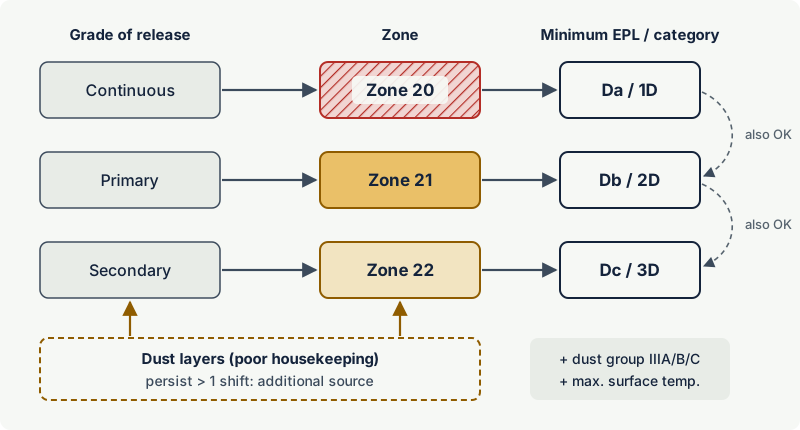
- Default equipment levels: Zone 20 needs EPL Da (category 1D), Zone 21 needs Da or Db (1D or 2D), Zone 22 accepts Da, Db or Dc (1D, 2D or 3D). The dust group (IIIA, IIIB, IIIC) and the maximum surface temperature must also match.
- The international method is IEC 60079-10-2; its third edition was published in June 2026 and replaces the 2015 edition. In the EU, Directive 1999/92/EC requires employers to classify places into these zones.
What a dust zone describes
An explosive dust atmosphere is a mixture of combustible dust with air, under atmospheric conditions, in which combustion spreads through the whole unburned mixture once it has been ignited. IEC 60079-10-2 defines combustible dust as finely divided solid particles of 500 µm or less in nominal size that can form an explosive mixture with air at normal pressure and temperature. Larger combustible particles, including fibres, are called combustible flyings. What makes a particular powder explosive is explained in What makes a dust explosive?.
A dust zone is a three-dimensional volume where such a cloud can be expected, graded by how often and how long it is present. The definitions in IEC 60079-10-2 and in Annex I of the ATEX workplace directive 1999/92/EC mirror the gas Zones 0, 1 and 2. Annex I adds an important note: layers, deposits and heaps of combustible dust must be considered like any other source that can form an explosive atmosphere.
Dust behaves very differently from gas, and the classification reflects that:
- A dust cloud does not dilute like gas. Particles settle out within minutes, so a release forms a dense local cloud and then a layer. General room ventilation does not dilute dust to a safe level as it does with gas, and dust classification does not rely on the dilution assessment used for gases. Local extraction at the source, however, can greatly reduce the release.
- An explosive dust cloud is very dense. Typical minimum explosible concentrations lie in the range of tens of grams per cubic metre. Clouds of this density outside equipment are rare and usually visible, which is why Zone 20 and Zone 21 outside equipment should be small.
- Layers store the fuel. A thin layer spread over a large floor, ledges and beams can produce an explosive cloud in the whole room if it is raised, for example by a small primary explosion. This mechanism, the secondary explosion, is often far more destructive than the primary event that triggered it.
Zone 20, Zone 21 and Zone 22 defined
| Zone | Explosive dust cloud is... | Usually created by | Typical places |
|---|---|---|---|
| Zone 20 | present continuously, for long periods or frequently | continuous grade of release, or the normal process inside equipment | inside silos and hoppers during filling and emptying, mills, mixers, cyclones, dust collector dirty sides, pneumatic conveying lines |
| Zone 21 | likely to occur occasionally in normal operation | primary grade releases | around bag tipping and sack filling points, open transfer points, filter element change, sampling points; sometimes inside equipment that is filled only occasionally |
| Zone 22 | not likely in normal operation; if it occurs, only for a short period | secondary grade releases, and layers that can be disturbed | the room around Zone 21 envelopes, around flexible connections and inspection doors that can leak, the clean side of filters |
Normal operation means the plant is used within its design parameters, including start-up, shut-down and routine activities such as cleaning and filter changes that are part of the job. Failures that need repair, such as a burst filter bag or a split flexible sleeve, are not normal operation; they are what Zone 22 is for.
Sources of release and how they set the zone
As with gases, the starting point is the source of release: a point or location from which combustible dust can escape into the atmosphere, or a place inside equipment where a cloud forms. Each source is given a grade:
- Continuous grade: a dust cloud is present continuously or for long periods, typically inside process equipment, or the release happens so frequently that the cloud is effectively always there.
- Primary grade: a release is expected periodically or occasionally during normal operation, for example each time a bag is emptied.
- Secondary grade: a release is not expected in normal operation and, if it happens, is infrequent and short, for example from a leaking flange of a pressurised conveying line.
By default continuous sources give Zone 20, primary sources Zone 21 and secondary sources Zone 22. The extent then depends on how much dust can be released, the particle size and density (fine light dust travels further), the release velocity, the local air movement and any enclosure or extraction. Distances should not be copied from one plant to another: HSE guidance for the rubber and plastics industries notes that direct observation of where clouds and deposits actually form is the best way to judge the extent around an open release point.
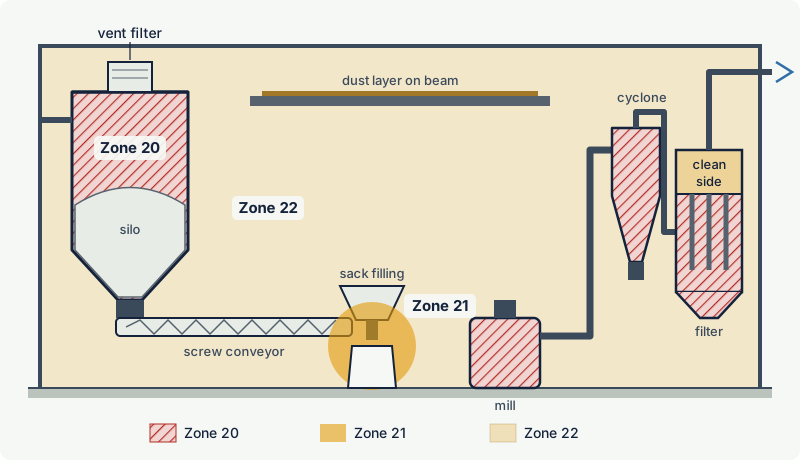
Practical examples
The examples below are typical outcomes, not a substitute for a site-specific assessment: the same equipment can be classified differently depending on the dust, the throughput and the operating pattern.
Silos, bins and hoppers
When a silo is filled pneumatically or by free fall, the falling product throws fine dust into the free space above the material. During filling and for a short time afterwards, the head space holds a dust cloud, so the inside of the silo is usually Zone 20. Some guidance links the zone to the operating pattern: an HSE guidance note for the rubber and plastics industries classifies the inside of an intermittently filled silo or hopper as Zone 20 if it is filled for more than about six hours a day and Zone 21 if less. This is a rule of thumb from that note, not a requirement of IEC 60079-10-2.
Outside the silo, the vent filter outlet, inspection hatches and the discharge point are possible sources. A well-sealed silo with a vent filter discharging clean air may need no zone outside except a small Zone 22 around hatches and the discharge connection.
Bagging, sack filling and bag emptying
Open handling of bags is the classic source of Zone 21. Each time a sack is cut and tipped into a hopper, or a valve sack is filled and removed from the spout, a dense local cloud forms. For places where dust is released regularly in this way, the HSE guidance gives a small Zone 21 where dense dust clouds are visible, which should rarely extend more than about 1 m from the source, and Zone 22 otherwise; it also expects local exhaust ventilation to be needed. Inside the receiving hopper the cloud is present whenever bags are tipped, which normally makes it Zone 20.
IEC 60079-10-2 includes informative examples of this situation, a bag emptying station in a building with and without exhaust ventilation. The design lever is the same in any plant: a well-designed extraction hood at the tipping point captures most of the dust, which shrinks the Zone 21 at the opening and the dust reaching the room.
Mills, grinders, mixers and blenders
Size reduction creates fine dust. The inside of a hammer mill, pin mill or classifier mill, and the inside of mixers and blenders handling dry powder, is normally Zone 20, because a cloud is present whenever the machine runs. Mills are also strong ignition sources (tramp metal, hot bearings, friction), so the zone inside the mill is usually combined with constructional protection such as explosion-resistant design, venting or suppression. Unenclosed grinding, buffing or sanding produces a local cloud at the work point and is classified locally, often as a small Zone 21 with Zone 22 around it.
Cyclones and dust collectors
The inside of a cyclone separating fine dust is Zone 20 whenever the plant runs. For bag and cartridge filters, the HSE guidance distinguishes:
| Part of the filter | Typical zone |
|---|---|
| Dirty side, heavy dust load, frequent pulse cleaning | Zone 20 |
| Dirty side, heavy load but infrequent cleaning, or light load (for example downstream of a cyclone) | Zone 21 |
| Clean side | Zone 22, to allow for a torn or displaced filter element |
Every pulse-jet cleaning cycle knocks dust off the elements and creates a cloud, which is why frequently cleaned filters are often Zone 20 on the dirty side. Collectors are covered in detail in Dust collectors, silos and bucket elevators: where dust explosions start.
Conveyors and transfer points
Enclosed conveying under suction normally leaks air inwards and does not need a zone outside, unless other sources exist. Conveying under positive pressure tends to leak dust at joints, flexible connections and rotary valves; unless maintenance is very good, these small leaks produce layers and justify Zone 22 around the line. Open belt transfer points and screw conveyor inspection covers that are opened in normal work behave like bag tipping: a small Zone 21 with Zone 22 around it.
Work rooms, ledges and adjacent rooms
The room around dust handling plant is the area most often under-classified. If dust regularly settles on floors, high ledges, beams, cable trays and light fittings, the whole room is typically classified Zone 22, because a disturbance can raise a cloud anywhere the dust lies. Adjacent offices and control rooms can stay unclassified if they are kept clean and separated by doors that are kept closed; otherwise they too may need Zone 22. Outdoors, zones are usually small, with exceptions such as tanker discharge points where equipment can be engulfed in dust.
Housekeeping, dust layers and the classification
IEC 60079-10-2 states that its examples assume effective housekeeping that prevents layers from accumulating. Where housekeeping is not effective, the classification must include the possible formation of clouds from layers. The standard's informative annex on dust layers describes three levels of housekeeping, summarised here in plain language:
| Housekeeping level | Condition of layers | Effect on classification |
|---|---|---|
| Good | Layers are kept to negligible thickness or do not exist, whatever the grade of release | Zones follow from the sources of release only |
| Fair | Layers are not negligible but short-lived: removed within one shift | Layers are a limited source; fire risk from hot surfaces under the layer must be considered |
| Poor | Layers are not negligible and persist for more than one shift | Layers become a source of release in their own right; fire and secondary explosion risk can be significant |
Two practical consequences follow:
- A zone drawing is only valid together with the housekeeping that it assumes. The cleaning method, frequency and responsibility belong in the explosion protection document. If cleaning stops, the classification is wrong.
- Thin layers are enough. A layer that looks harmless on a floor can produce an explosive cloud when it is spread through the height of a room. The calculation is shown in What makes a dust explosive?, and the thickness criteria used in practice are discussed in Dust layers and housekeeping: how thick is too thick?.
The 2008 sugar refinery explosion at Port Wentworth, Georgia, illustrates both points. The US Chemical Safety Board (CSB) found that the primary explosion most likely started inside a recently enclosed sugar conveyor below two large storage silos, where dust could accumulate to an explosive concentration. The blast then raised sugar dust and spilled sugar that had built up throughout the packing buildings, producing a cascade of secondary explosions that killed 14 workers. The CSB concluded that inadequate equipment design, maintenance and housekeeping led to the disaster.
Cleaning must not create the hazard it is meant to remove. Blowing dust off with compressed air raises exactly the cloud that the zone assumes will not occur; vacuum cleaning with equipment suitable for the zone, or careful wet methods where the dust allows it, are the usual alternatives.
Equipment for Zones 20, 21 and 22: EPL Da, Db and Dc
The zone sets the minimum equipment protection level (EPL). IEC 60079-14 gives the default relationship, and Directive 1999/92/EC sets the same rule in terms of ATEX equipment categories.
| Zone | Minimum EPL | Also acceptable | ATEX category | Typical protection by enclosure |
|---|---|---|---|---|
| Zone 20 | Da | none higher | 1D | ta |
| Zone 21 | Db | Da | 2D (or 1D) | tb (or ta) |
| Zone 22 | Dc | Da, Db | 3D (or 2D, 1D) | tc (or tb, ta) |
The EPL is only one of three dust-specific checks:
- Dust group. The equipment group must cover the dust: IIIA (combustible flyings), IIIB (non-conductive dust) or IIIC (conductive dust). IIIC equipment can be used for all three. For protection by enclosure the required dust tightness depends on both the level and the group:
tais always IP6X,tbis IP6X for IIIB and IIIC, and eventcmust be IP6X for conductive dust. See Dust groups IIIA, IIIB and IIIC. - Maximum surface temperature. Dust equipment is marked with a maximum surface temperature in °C, such as
T135 °C, rather than only a T-class. It must stay below two thirds of the minimum ignition temperature of the dust cloud and at least 75 K below the minimum ignition temperature of a 5 mm dust layer, with larger margins for thicker layers. See Surface temperature limits for dust. - Ambient and installation conditions, including any specific conditions of use on the certificate.
IEC 60079-14 also allows the required EPL to be set by a documented risk assessment instead of directly from the zone, for example to require a higher level where the consequences of ignition would be severe. More on this in Equipment Protection Levels (EPL).
Worked example: a flour silo and packing line
A bakery ingredients plant receives wheat flour by road tanker, blows it pneumatically into an indoor silo with a vent filter, discharges it through a rotary valve and screw conveyor to a packing machine that fills 25 kg valve sacks, and has a small manual station where bags of additives are tipped into a mixer.
Step 1: the dust. Wheat flour is combustible and normally non-conductive, so the dust group is IIIB. Ignition data should come from the actual product, because fineness and moisture change them. One wheat flour sample in the GESTIS-DUST-EX database of the German Social Accident Insurance (median particle size 57 µm) has a cloud minimum ignition temperature of 430 °C and showed no glowing of a 5 mm layer up to 450 °C. With these values the surface temperature limit is the lower of 2/3 × 430 = 287 °C and 450 - 75 = 375 °C, so about 287 °C.
Step 2: sources and zones.
| Location | Source and grade | Zone |
|---|---|---|
| Silo interior | Cloud during each pneumatic filling, several times a day | Zone 20 |
| Vent filter, dirty side | Cloud during filling and pulse cleaning | Zone 20 |
| Vent filter, clean side and outlet | Only if an element tears: secondary | Zone 22 locally |
| Rotary valve and screw conveyor interior | Product moving, little free space; assessed as primary | Zone 21 inside |
| Sack filling spout | Puff of dust each time a sack is removed: primary | Zone 21 within about 1 m, confirmed by observation |
| Bag tipping station with extraction hood | Primary, reduced by extraction | Small Zone 21 at the opening, Zone 20 inside the mixer |
| Packing room floor, ledges, cable trays | Leaks and settled dust, cleaned every shift (fair to good housekeeping) | Zone 22 |
Step 3: equipment. A level probe inside the silo needs EPL Da, for example Ex ia IIIC T135 °C Da or a probe certified as Ex ta. The packing machine motor near the spout needs Db, for example Ex tb IIIC T135 °C Db. Room lighting needs Dc; luminaires marked Ex tc IIIB T80 °C Dc would be acceptable for this flour, and IIIC equipment would also be acceptable. All maximum surface temperatures are well below the 287 °C limit.
Step 4: the conditions behind the drawing. The classification assumes that the vent filter is maintained, that dust escaping at the packing machine is cleaned up every shift by vacuum, and that the extraction hood at the tipping station is running whenever bags are tipped. These assumptions go into the explosion protection document with the zone drawing, see The Explosion Protection Document (EPD) and area classification drawings.
Common mistakes
- Classifying only the cloud and forgetting the layers. Dust on beams, ledges and cable trays is a source of release. If it persists, the room needs at least Zone 22 and the housekeeping must be fixed.
- Using gas logic for ventilation. General room ventilation does not dilute dust to a safe level the way it does for gas. Control dust at the source with enclosure and local extraction instead.
- Drawing Zone 21 everywhere "to be safe". Over-classification hides the real sources and drives costs. Zone 21 belongs around the points that release dust in normal operation, with Zone 22 for the rest.
- Forgetting the inside of equipment. Instruments, level probes, rotary valve motors with internal sensors and lamps in sight glasses can be inside Zone 20.
- Choosing equipment by EPL only. A
Dcluminaire for IIIB dust is not acceptable for aluminium powder (IIIC), and a correct EPL with a surface temperature above the dust's limits is still an ignition source.
Frequently asked questions
What is the difference between Zone 21 and Zone 22?
In Zone 21 an explosive dust cloud is likely to occur occasionally in normal operation, for example at a bag tipping point. In Zone 22 a cloud is not expected in normal operation and appears only after a fault or disturbance, such as a leaking flexible connection or settled dust being stirred up, and then only briefly. Zone 21 needs equipment with EPL Db or better; Zone 22 accepts Dc.
Is the inside of a silo Zone 20?
Usually yes, when fine dust is thrown into the head space during filling or emptying several times a day. Some guidance classifies an intermittently filled silo as Zone 21 when filling is short and infrequent. Granular products with very little fine dust, or silos kept inert, can justify a different classification, but this must be shown by data and documented.
Do dust layers make a zone?
A layer is not an explosive atmosphere by itself, but it is a source that can form one when disturbed, and it can ignite on a hot surface. Directive 1999/92/EC and IEC 60079-10-2 both require layers, deposits and heaps to be considered in the classification. Where layers persist for more than a shift, the area around them is classified accordingly, typically at least Zone 22.
Can a dust zone be removed by better housekeeping?
Housekeeping can remove layers as a source and so shrink or remove Zone 22 areas that exist only because of settled dust. It cannot remove zones created by the process itself, such as Zone 20 inside a mill or Zone 21 at a tipping point. Those are reduced by enclosing the process, capturing dust at the source and changing how material is handled.
Are Zones 20, 21 and 22 the same as Class II Divisions?
They cover the same hazard but are defined differently. North American practice uses either Class II, Division 1 and 2 under NEC Article 500 or Zones 20, 21 and 22 under NEC Article 506. The mapping is not one-to-one, so equipment and classification must follow the system that applies to the installation; see Zones vs Divisions.
Related on excodex
- What makes a dust explosive? Particle size, concentration and the dust explosion pentagon
- Dust layers and housekeeping: how thick is too thick?
- Hazardous area zones explained: Zone 0, Zone 1 and Zone 2
- Equipment Protection Levels (EPL): Ga, Gb, Gc, Da, Db, Dc and how they match zones
- Dust ignition protection by enclosure (Ex t): ta, tb and tc
- Hybrid mixtures: when flammable gas and combustible dust are present together
- Tools and spaces: Ex marking check, standards spaces IEC 60079-10-2, IEC 60079-14, ATEX 1999/92/EC, forum
Standards and further reading
- IEC 60079-10-2:2026 (edition 3.0, published June 2026, replacing the 2015 edition), Explosive atmospheres, Part 10-2: Classification of areas, explosive dust atmospheres. Contains the zone definitions, grades of release, informative examples (bag emptying stations, cyclone and filter, drum tipper) and an annex on dust layers and housekeeping. Preview of the 2026 edition (ANSI webstore)
- IEC 60079-14, design, selection and erection of electrical installations, including the zone and EPL relationship and dust surface temperature limits.
- IEC 60079-31, equipment dust ignition protection by enclosure "t".
- Directive 1999/92/EC (ATEX workplace directive), Annex I, zone definitions including the note on layers, deposits and heaps: legislation.gov.uk
- HSE, Hazardous area classification for explosible dusts in the rubber and plastics industries (guidance for inspectors with typical zones for silos, filters, mixers and bag handling): hse.gov.uk
- Health and Safety Authority (Ireland), ATEX delivery guide, combustible dust (definitions, zones, housekeeping levels): hsa.ie
- IEC Common Data Dictionary, housekeeping level "poor" (layers persisting for more than one shift): electropedia.org
- NSW TestSafe, dust ignition protection by enclosure, IP requirements by dust group and level: nsw.gov.au
- US Chemical Safety Board, final report on the 2008 sugar dust explosions: csb.gov
- OSHA, Safety and Health Information Bulletin on combustible dust in industry: osha.gov
- GESTIS-DUST-EX database of combustion and explosion characteristics of dusts (IFA, Germany): staubex.ifa.dguv.de
This article is general technical information prepared by the excodex editorial team. It does not replace the applicable standards, the equipment certificates and instructions, national regulations or the assessment of a competent person.