Hazardous area zones explained: Zone 0, Zone 1 and Zone 2
Abstract
Zone 0, 1 and 2 describe how likely an explosive gas atmosphere is and how long it lasts. Definitions, the often quoted hour guidance, typical examples, EPL and ATEX category mapping and a worked tank example.
Hazardous area zones describe how likely it is that an explosive gas atmosphere is present at a place, and for how long. Zone 0 is where it is present continuously, for long periods or frequently; Zone 1 is where it is likely to occur occasionally in normal operation; Zone 2 is where it is not likely to occur in normal operation and, if it does, persists only for a short period. The zone then sets the minimum protection level of the equipment installed there: EPL Ga (ATEX category 1G) in Zone 0, Gb (2G) in Zone 1 and Gc (3G) in Zone 2.
This article explains the three gas zones, the hour-based figures that are often quoted for them, typical examples, how zones map to equipment protection levels and categories, and walks through a fixed-roof storage tank as a worked example.
Key points
- Zones are defined by the frequency and duration of an explosive gas atmosphere, not by the quantity of gas or the consequences of an explosion.
- Zone 0: present continuously, for long periods or frequently. Zone 1: likely to occur occasionally in normal operation. Zone 2: not likely in normal operation, and short-lived if it occurs.
- Places outside Zone 0, 1 and 2 are non-hazardous for the purpose of equipment selection; flammable dusts use the separate Zones 20, 21 and 22.
- Often quoted industry guidance (not a requirement of IEC 60079-10-1 or the ATEX directives) puts Zone 0 above about 1000 hours per year, Zone 1 between about 10 and 1000 hours, and Zone 2 below about 10 hours.
- Minimum equipment protection: Zone 0 needs EPL Ga (category 1G), Zone 1 needs Gb (2G) or better, Zone 2 needs Gc (3G) or better.
- The zone type follows mainly from the grade of release (continuous, primary, secondary) combined with the degree of dilution and the availability of ventilation.
- Zones are three-dimensional volumes and must be shown in plan and elevation, together with the substances and assumptions behind them.
What a hazardous area zone is
An explosive gas atmosphere is a mixture of a flammable gas or vapour with air, at atmospheric conditions, in which a flame can propagate after ignition. A hazardous area is a place where such an atmosphere is present, or can be expected, in quantities that require special precautions for the construction, installation and use of equipment. Everything else is a non-hazardous area (often called a "safe area" in equipment catalogues, a term best avoided because it says nothing about other hazards).
Hazardous areas are divided into zones according to how often and for how long an explosive atmosphere is expected. This is the job of area classification, described internationally in IEC 60079-10-1 and required in the European Union by Directive 1999/92/EC, the ATEX workplace directive, which obliges the employer to classify places into zones and record them in the explosion protection document.
Two points are often misunderstood:
- Zones describe likelihood and duration, not consequence. A large release and a small one can both lead to Zone 2. The size of the release affects the extent of the zone, not its type. The UK Health and Safety Executive (HSE) makes the same point: the zone definitions take no account of the consequences of a release.
- Zones are volumes, not floor areas. A zone has a shape in three dimensions that depends on the release, the density of the gas or vapour and the air movement. A heavy vapour hugs the ground and fills pits and trenches; a light gas rises.
Zone 0, Zone 1 and Zone 2 defined
The definitions in IEC 60079-10-1 and Annex I of Directive 1999/92/EC say essentially the same thing. In plain language:
| Zone | Explosive gas atmosphere is... | Usually created by | Typical places |
|---|---|---|---|
| Zone 0 | present continuously, for long periods or frequently | continuous grade releases | vapour space inside tanks and process vessels; just above an open liquid surface |
| Zone 1 | likely to occur occasionally in normal operation | primary grade releases | around tank vents during filling; around sample points and drum filling openings; poorly ventilated pits close to such sources |
| Zone 2 | not likely in normal operation; if it occurs, only for a short period | secondary grade releases | around flanges, valves and pump seals; around Zone 1 envelopes; inside tank bunds |
Normal operation means operating within the design parameters, including start-up and shutdown. IEC terminology makes two useful clarifications: minor releases can be part of normal operation (for example from seals that rely on wetting by the pumped fluid), whereas failures that need repair or shutdown, such as a failed pump seal or flange gasket, are not.
Zone 0
Zone 0 is the most demanding zone and should be the smallest. In a well-designed plant it is usually limited to the inside of tanks, vessels and pipework where flammable vapour and air coexist, and to the immediate surroundings of permanently open liquid surfaces. Equipment installed inside a storage tank, such as a level transmitter or a submerged sensor, is in Zone 0 and needs EPL Ga.
IEC 60079-10-1 notes that "long" and "frequently" are meant to describe a very high likelihood and do not necessarily need to be quantified. "Frequently" matters: many short events that add up to a large fraction of the time can justify Zone 0 even if no single event lasts long.
Zone 1
Zone 1 covers places where an explosive atmosphere is expected from time to time during normal work. The 2020 edition of IEC 60079-10-1 describes it as likely to occur "occasionally" in normal operation, aligned with the ATEX directive wording. Typical sources are activities that open the process to air as part of the job: sampling, filling and emptying, draining water from a vessel, opening a filter, or a vent that discharges during each filling cycle.
Zone 2
Zone 2 is the most common zone in process plants. It surrounds equipment that is tight in normal operation but can leak if something goes wrong: flanged joints, valve stem packing, pump and compressor seals, instrument connections. The definition contains two conditions: the atmosphere is not expected in normal operation, and if it does occur it lasts only a short time. That second condition assumes that leaks are detected and repaired, and that ventilation disperses the gas. A leak that is tolerated for weeks no longer fits Zone 2.
How long is "long periods"? The hour-based guidance
Neither IEC 60079-10-1 nor Directive 1999/92/EC gives a number of hours for each zone. Several codes and guides have proposed figures, and the following values are widely quoted. HSE lists them as the most common values in use while noting that none has been officially adopted.
| Zone | Often quoted guidance (hours per year with an explosive atmosphere) | Approximate share of the year |
|---|---|---|
| Zone 0 | more than 1000 h | more than about 11 % |
| Zone 1 | more than 10 h and less than 1000 h | about 0.1 % to 11 % |
| Zone 2 | less than 10 h | less than about 0.1 % |
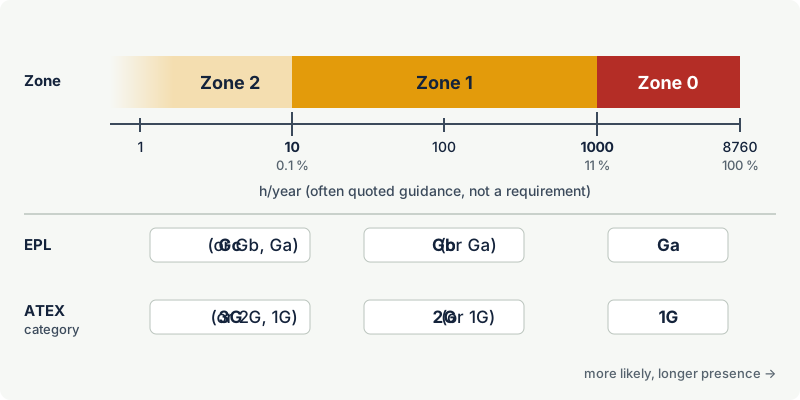
Use these figures with care:
- They are rules of thumb. They help a team agree on the meaning of "occasionally" or "for long periods", and they can support a quantitative risk assessment, but a classification is not wrong simply because it does not quote hours.
- They mix frequency and duration. Ten short sampling events a day, each producing a small explosive cloud for a few minutes, can add up to Zone 1 hours even though each event is brief.
- The lower boundary of Zone 2 is not defined by hours. Whether a very unlikely release needs a zone at all is decided by the grade of release, the ventilation and the concept of negligible extent, not by a time threshold.
For most installations a qualitative approach based on the grade of release and the ventilation is adequate. The hour figures are a cross-check, not the method.
Which equipment can be used in each zone
The zone sets the minimum level of protection. IEC 60079-14 expresses this as an Equipment Protection Level (EPL); the EU uses equipment categories under Directive 2014/34/EU, and Directive 1999/92/EC links them to zones.
| Zone | Minimum EPL | Also acceptable | ATEX category (gas) | Protection expected |
|---|---|---|---|---|
| Zone 0 | Ga | none higher | 1G | not an ignition source in normal operation, expected malfunctions or rare malfunctions |
| Zone 1 | Gb | Ga | 2G (or 1G) | not an ignition source in normal operation or expected malfunctions |
| Zone 2 | Gc | Gb, Ga | 3G (or 2G, 1G) | not an ignition source in normal operation, with some extra measures against regular expected occurrences |
The EPL is only part of the selection. The equipment must also suit the gas group (IIA, IIB or IIC) and the temperature class (T1 to T6) of the substances present, and the ambient temperature range. IEC 60079-14 also allows EPLs to be assigned through a risk assessment instead of directly from the zone, for example where the consequences of ignition are unusually high. Details are in the articles on EPLs and on Ex marking linked below.
Worked example: zones around a fixed-roof tank
Consider an outdoor fixed-roof tank storing toluene at ambient temperature, inside a bunded area, with a free vent on the roof and a filling line with a valve at the base. Toluene has a flash point of 4 °C, a lower explosive limit (LEL) of 1 % by volume, an upper limit of 7.8 % and a vapour density of 3.18 relative to air (excodex gas library values).
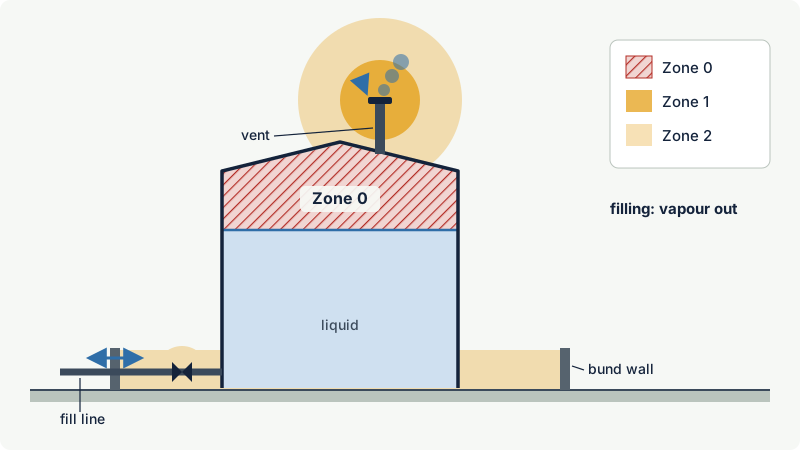
Inside the tank: Zone 0. At 20 °C the vapour pressure of toluene gives roughly 3 % by volume in the vapour space, which lies between the explosive limits. Air enters through the vent every time the tank is emptied, so an explosive atmosphere is present above the liquid for long periods. That is Zone 0.
At the vent: Zone 1, surrounded by Zone 2. Each time the tank is filled, the rising liquid pushes vapour out of the vent. This happens in normal operation, periodically, so the vent is a primary grade source and creates Zone 1 around the outlet. Beyond the Zone 1 envelope, higher filling rates, hot days and wind variations justify a surrounding Zone 2.
In the bund: Zone 2. A spill from overfilling or a leaking joint is not expected in normal operation, so it is a secondary grade source. Because toluene vapour is about three times heavier than air, the vapour from a spill collects at low level. The bund floor up to the height of the bund wall is typically Zone 2, together with a small volume around the valves and flanges of the filling line.
Extents. The distances are not given here on purpose. They depend on the vent size and filling rate, the ventilation, and the code or calculation used, and they must come from the assessment, see the articles on the step-by-step method and on estimating zone extent.
Two design choices change this picture. A floating roof or internal floating cover removes most of the vapour space and greatly reduces the Zone 0 volume. Routing the vent to a vapour recovery or treatment system can remove the Zone 1 at the roof, while creating new sources of release elsewhere that need their own assessment.
What makes a zone bigger, smaller, or a different type
The type and size of a zone come from a few physical factors. Most of them are covered in separate articles of this chapter.
| Factor | Effect on zone type | Effect on zone extent |
|---|---|---|
| Grade of release (continuous, primary, secondary) | main driver: tends towards Zone 0, 1 or 2 respectively | small |
| Degree of dilution (high, medium, low) | high dilution can reduce a zone to negligible extent; low dilution can raise the zone type | large |
| Availability of ventilation (good, fair, poor) | poor or fair availability can add or upgrade zones | indirect |
| Release rate (hole size, pressure, temperature) | none by itself | large |
| Volatility (flash point versus handling temperature) | decides whether a liquid release forms vapour at all | large |
| Vapour density | none | shape: heavy vapours spread at low level, light gases rise |
A liquid handled well below its flash point does not normally create an explosive atmosphere unless it can form a mist or spray, which is assessed separately. Some codes apply a safety margin between flash point and the maximum handling temperature.
Zones of negligible extent
IEC 60079-10-1 recognises that some releases are so small, or so well diluted, that an ignition would have negligible consequences. Such a zone is written Zone 0 NE, Zone 1 NE or Zone 2 NE ("negligible extent"), and for practical purposes the place can be treated as non-hazardous. The 2020 edition added a dedicated subclause on this concept. It is not a shortcut: the designation must be justified by the release and ventilation assessment and documented, and it is not appropriate where even a small ignition could cause harm, for example in a confined space where people work. National forewords, national guidance and industry codes can restrict its use further, so check them before relying on it.
Common mistakes and misconceptions
- "Zone 0 means the most gas." Zone type is about time, not quantity. A large but rare leak gives a large Zone 2, not Zone 0.
- Classifying everything as Zone 1 "to be safe". Over-classification forces more expensive equipment, makes maintenance harder and hides the real priorities. HSE guidance does not generally recommend drawing zones more conservatively as a substitute for a realistic assessment. Classify realistically and control the real sources.
- Drawing zones in plan only. A zone without an elevation view hides the shape: heavy vapours in pits and trenches, light gases under roofs.
- Treating the hour figures as legal limits. They are often quoted guidance. The definitions in IEC 60079-10-1 and Directive 1999/92/EC are qualitative.
- Forgetting the inside of equipment. The vapour space of a tank is a zone too, and instruments installed there need EPL Ga.
- Freezing the drawing. Zones change when the process, the substances, the ventilation or the layout change. Directive 1999/92/EC requires the explosion protection document to be revised after significant changes.
Frequently asked questions
What is the difference between Zone 1 and Zone 2?
In Zone 1 an explosive gas atmosphere is likely to occur occasionally during normal operation, for example during sampling or tank filling. In Zone 2 it is not expected in normal operation and occurs only after a fault such as a leaking flange, and then only briefly. Zone 1 therefore needs equipment with EPL Gb or better, while Zone 2 accepts EPL Gc.
How many hours per year is Zone 0, Zone 1 and Zone 2?
The figures most often quoted are more than 1000 hours per year for Zone 0, between 10 and 1000 hours for Zone 1, and less than 10 hours for Zone 2. They are industry guidance, not requirements of IEC 60079-10-1 or the ATEX directives, which define zones qualitatively.
Can Zone 1 equipment be used in Zone 2?
Yes. Equipment with a higher protection level can always be used in a less demanding zone: EPL Ga or Gb equipment (ATEX category 1G or 2G) is acceptable in Zone 2. The reverse is not allowed. Gas group, temperature class and ambient temperature range must still match the installation.
Who decides the zones of a plant?
The duty holder, usually the employer or plant operator, is responsible. In the EU, Directive 1999/92/EC requires the employer to classify places into zones and record them in the explosion protection document. The work itself is done by competent people who know the process, the substances and the method in IEC 60079-10-1 or the relevant industry code.
Is the inside of a tank Zone 0?
Usually yes, when the tank stores a liquid that gives off flammable vapour at the storage temperature and air can enter the vapour space, as in a fixed-roof tank with an open vent. If the vapour space is kept inert, or the liquid is stored well below its flash point, the classification can be different, but this must be justified and the inerting or temperature control must be reliable.
Are Zones 20, 21 and 22 the same as Zones 0, 1 and 2?
They follow the same logic of frequency and duration, but apply to clouds of combustible dust instead of gas, vapour or mist, and they are classified with IEC 60079-10-2. Dust layers are assessed as sources that can form a cloud. Where gas and dust can both be present, both classifications are needed.
Related on excodex
- How to carry out a gas hazardous area classification step by step
- Grades of release: continuous, primary and secondary
- Ventilation in area classification: degree of dilution and availability
- Equipment Protection Levels (EPL): Ga, Gb, Gc, Da, Db, Dc and how they match zones
- Zones vs Divisions: IEC and ATEX zones compared with NEC Class I Division 1 and 2
- Dust zones 20, 21 and 22 explained with practical examples
- Tools: gas and solvent library, Ex marking check, standards space IEC 60079-10-1, ATEX 1999/92/EC, forum
Standards and further reading
- IEC 60079-10-1:2020 (edition 3.0), Explosive atmospheres, Part 10-1: Classification of areas, explosive gas atmospheres. A fourth edition was circulated as a committee draft for vote in 2025; check the current edition before use. IEC webstore page
- IEC 60079-10-2, Classification of areas for combustible dust atmospheres.
- IEC 60079-14:2024, Electrical installations design, selection and erection, including the relationship between zones and EPLs.
- IEC 60079-0, General requirements for equipment, including the definitions of EPLs.
- Directive 1999/92/EC (ATEX workplace directive), Annex I zone definitions: legislation.gov.uk copy of Annex I
- Directive 1999/92/EC, Article 8 on the explosion protection document: legislation.gov.uk copy of Article 8
- HSE, Hazardous area classification and control of ignition sources: hse.gov.uk
- HSE, Area classification for laboratories and small quantities: hse.gov.uk
- HSE, L138 Dangerous substances and explosive atmospheres, Approved Code of Practice and guidance (free PDF): hse.gov.uk
- International Electrotechnical Vocabulary, entry 426-28-07 "normal operation" (non-electrical equipment), with notes on minor releases and failures: electropedia.org
This article is general technical information prepared by the excodex editorial team. It does not replace the applicable standards, the equipment certificates and instructions, national regulations or the assessment of a competent person.