Ventilation in area classification: degree of dilution and availability
Abstract
How IEC 60079-10-1 uses ventilation: natural and artificial ventilation, high, medium and low dilution, good, fair and poor availability, and how they combine with the grade of release to set the zone type, with an indoor example.
In IEC 60079-10-1, ventilation is judged on two separate questions. Degree of dilution (high, medium or low) asks how effectively the air movement dilutes a given release to below the lower flammable limit; it depends on the size of the release and the air velocity. Availability (good, fair or poor) asks how reliably that air movement is present. Together with the grade of release, these two answers set the zone type, and the degree of dilution also drives the zone extent: good ventilation can shrink a zone to negligible extent, while weak ventilation (low dilution) can turn a secondary release into Zone 1.
This article explains natural and artificial ventilation, the three degrees of dilution and three levels of availability as used in the 2020 edition of IEC 60079-10-1, how they change the zone type, and works through an indoor example.
Key points
- Ventilation in area classification is any air movement that replaces the air around a release with fresh air: wind and temperature differences (natural) or fans (artificial, general or local).
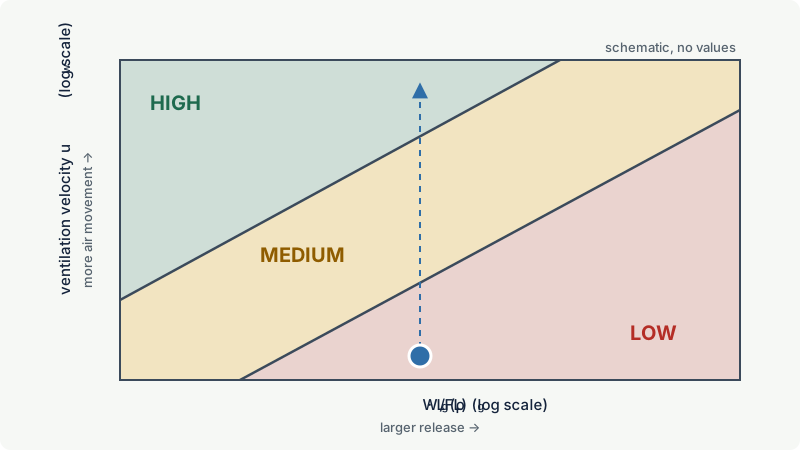
- Degree of dilution is high, medium or low. It is assessed by comparing the release characteristic, the release rate divided by the gas density and the lower flammable limit, with the ventilation velocity on a chart in the standard.
- Indoors, the background concentration of gas in the room is also checked against a critical value, commonly 25 % of the LFL: if it is exceeded, dilution is generally treated as low.
- Availability is good (ventilation present virtually continuously), fair (expected in normal operation, with only infrequent short interruptions) or poor (neither, but without long interruptions).
- Open outdoor locations usually give medium or high dilution with good availability; pits, trenches, congested areas and buildings need a specific assessment.
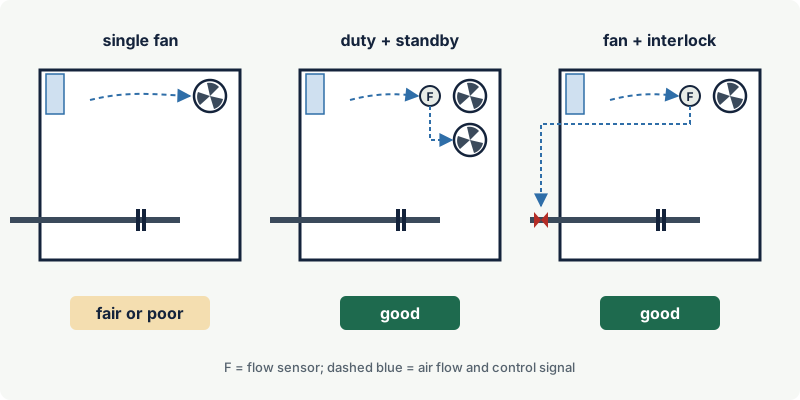
- Artificial ventilation can reach good availability through standby fans that start automatically, or through an interlock that stops the release when ventilation fails.
Why ventilation decides so much
A release of flammable gas creates an explosive atmosphere only where the concentration lies between the lower and upper flammable limits. Air movement carries the gas away and mixes it with fresh air, so the concentration falls with distance. The faster and more reliable this dilution is, the smaller the flammable cloud and the shorter it persists after the release stops.
Ventilation therefore affects both outputs of the classification:
- the zone type, because persistence after the release and the risk of ventilation failure change how often an explosive atmosphere is present;
- the zone extent, because stronger dilution reaches a safe concentration closer to the source.
Ventilation does not change the grade of release. A flange leak is still secondary in a well-ventilated area. What changes is what that leak can produce.
Natural and artificial ventilation
Natural ventilation
Natural ventilation is air movement driven by the wind and by temperature differences. Outdoors, it is the wind, slowed and redirected by structures. Indoors, air enters and leaves through openings, driven by wind pressure on the building and by buoyancy (the stack effect when the inside is warmer than the outside). The 2020 edition of IEC 60079-10-1 has guidance in an annex for wind-induced, buoyancy-induced and combined natural ventilation of buildings.
Natural ventilation has two weaknesses. It varies: calm weather, wind direction and small temperature differences can reduce it to very little, and wind can even oppose the buoyancy flow. And it can be blocked: new walls, cladding, closed doors or added equipment change it without anyone noticing. A building or shelter with large permanent openings on several sides can sometimes be treated as an open-air location, but this needs justification.
Artificial ventilation
Artificial ventilation uses fans. It comes in two forms:
| Type | How it works | Strengths | Limits |
|---|---|---|---|
| General ventilation | dilutes releases within the whole room by air changes | covers releases anywhere in the room | needs large air flows for large releases; mixing is rarely perfect |
| Local ventilation | captures the release at or close to the source with hoods or extraction points | very effective for known, fixed sources; small air flows | only covers the release it was designed for |
Fans and ducts that carry a flammable atmosphere become part of the explosion protection problem. The extraction fan must be suitable for the atmosphere it may handle (non-electrical aspects are covered by ISO 80079-36 and ISO 80079-37), and the exhaust discharge point is itself a source of release that needs a zone.
Degree of dilution: high, medium and low
IEC 60079-10-1 describes the three degrees roughly as follows:
| Degree of dilution | What it means in practice |
|---|---|
| High | gas is diluted close to the source within a short distance, and practically nothing remains once the release stops |
| Medium | while the release lasts, the flammable cloud keeps a steady, limited size; after it stops, the cloud clears without lingering |
| Low | a large flammable concentration builds up during the release, or the flammable atmosphere lingers long after it stops, or both |
How the degree of dilution is assessed
The assessment combines two numbers:
- The release characteristic,
Wg / (ρg · LFL)in m³/s, where Wg is the mass release rate (for a liquid, the rate at which it becomes vapour), ρg the gas or vapour density at ambient conditions, and LFL the lower flammable limit as a volume fraction. It is, in effect, the volume flow of air needed to dilute the release to its LFL. The 2020 edition removed the extra safety factor k that the 2015 edition applied to the LFL in this expression. - The ventilation velocity uw in m/s. Outdoors it is a wind velocity; the standard gives indicative conservative values in a table that depend on the type of location and release. Indoors it is derived from the ventilation flow and the cross-section of the room through which the air passes.
The two values are plotted on the standard's dilution chart, which is divided into high, medium and low dilution regions. A small release in strong air movement falls in the high region; a large release in still air falls in the low region.
Indoors: the background concentration check
In a room, the gas that is not carried out immediately mixes into the room air and raises its average concentration, the background concentration Xb. Approximately, Xb equals the volume flow of released gas divided by the ventilation air flow, multiplied by a factor f that accounts for imperfect mixing (f = 1 for ideal mixing, higher when mixing is poor, for example because of obstructions or badly placed inlets and outlets).
The background concentration is compared with a critical concentration chosen for the assessment as a fraction of the LFL; 25 % of the LFL is the value most commonly used. If the background concentration exceeds it, the dilution is generally treated as low whatever the chart shows: the room cannot cope with the release, and the flammable atmosphere would persist.
Outdoors: open air is not always well ventilated
In open, unobstructed outdoor areas, dilution is usually medium or high and availability is usually good. Low dilution outdoors is uncommon but real: in pits, trenches, sumps and below grade, in areas enclosed by tall structures, and in congested process modules where air hardly moves. Heavier-than-air vapours, such as propane (vapour density 1.52) or toluene (3.18), flow into such low points and stay there.
The choice of wind speed is a recurring discussion. The standard's indicative values are conservative. Site wind statistics can support a different value, but this needs justification; for wind-driven natural ventilation of enclosures, research from the UK Health and Safety Laboratory proposed the wind speed exceeded for 80 % of the time as a realistic worst case.
Availability: good, fair and poor
Availability is about reliability, not strength. A powerful fan that is often switched off can have poor availability; a modest natural draught that is always present can have good availability.
| Availability | Meaning | Typical examples |
|---|---|---|
| Good | ventilation is present virtually continuously | open-air natural ventilation; duty and standby fans with automatic start-up on failure; ventilation with an interlock that stops the release if it fails |
| Fair | ventilation is expected to be present during normal operation; interruptions are acceptable if infrequent and short | a single fan running in normal operation, preferably with flow monitoring and an alarm |
| Poor | does not meet fair or good, but long interruptions are not expected | ventilation that may be reduced or stopped unnoticed, such as natural ventilation of a building through doors or windows that can be closed |
Ventilation that does not even meet the poor level should not be counted as ventilation at all.
For artificial ventilation, good availability is normally achieved in one of two ways. Either a standby fan starts automatically when the flow drops, or the flow failure is interlocked with the process so that the release itself is stopped, for example by closing a gas supply valve. In the second case the classification determined with ventilation running can be kept, because no release can occur without ventilation.
How dilution and availability change the zone type
IEC 60079-10-1 combines the grade of release with the degree of dilution and the availability in a table. The summary below gives the zone type for each combination; "+" means "surrounded by".
| Dilution and availability | Continuous grade | Primary grade | Secondary grade |
|---|---|---|---|
| High, good | non-hazardous (Zone 0 NE) | non-hazardous (Zone 1 NE) | non-hazardous (Zone 2 NE) |
| High, fair | Zone 2 | Zone 2 | non-hazardous (Zone 2 NE) |
| High, poor | Zone 1 | Zone 2 | Zone 2 |
| Medium, good | Zone 0 | Zone 1 | Zone 2 |
| Medium, fair | Zone 0 + Zone 2 | Zone 1 + Zone 2 | Zone 2 |
| Medium, poor | Zone 0 + Zone 1 | Zone 1 + Zone 2 | Zone 2 |
| Low, any availability | Zone 0 | Zone 1 or Zone 0 | Zone 1 and even Zone 0 |
Notes on reading the table:
- NE (negligible extent) means a zone exists in theory near the source but is so small that ignition would have negligible consequences. The designation must be justified and documented. National forewords, national guidance and industry codes can add conditions on its use.
- The surrounding zone in combinations such as "Zone 1 + Zone 2" covers the periods when ventilation is reduced or absent.
- Under low dilution, Zone 0 instead of Zone 1 (for a primary or a secondary release) applies when the ventilation is so weak and the release such that an explosive atmosphere would in practice be present almost continuously.
- For secondary releases, availability matters most when dilution is high: it decides between non-hazardous and Zone 2. With medium dilution the result is Zone 2 whatever the availability.
- The Zone 2 from a large secondary release can be larger than the zone from a primary or continuous release at the same source; the larger extent is then used.
Always check the current edition of the standard for the exact table and its footnotes.
Worked example: a gas metering room
A metering room of 10 m × 8 m × 4 m (320 m³) contains natural gas pipework, treated here as methane (LFL 4.4 % by volume, vapour density 0.554). The room has general mechanical extraction at 6 air changes per hour, which is 1920 m³/h or about 0.53 m³/s, with high-level extraction because the gas is lighter than air.
Flange leak. The flange leak from the step-by-step example in this chapter (about 1.6 × 10⁻⁴ kg/s, or about 2.4 × 10⁻⁴ m³/s of gas) is a secondary release.
Example: Assume moderately poor mixing, f = 2. The background concentration is Xb ≈ 2 × 2.4 × 10⁻⁴ / 0.53 ≈ 0.09 % by volume, about 2 % of the LFL. This is far below the commonly used critical value of 25 % of the LFL, so the background check does not force low dilution. The ventilation velocity is about 0.53 / (8 × 4) ≈ 0.017 m/s, and the degree of dilution is then read from the chart with the release characteristic.
Larger release. How large a release could this room tolerate before the background concentration reaches 25 % of the LFL (1.1 % by volume)? With the same f = 2, the limit is a gas flow of about 0.011 × 0.53 / 2 ≈ 0.003 m³/s, roughly 2 g/s of methane. A failed seal or a sheared small-bore connection releasing more than that would give low dilution, and a secondary release with low dilution leads to Zone 1 or worse. The room ventilation, the hole sizes assumed for secondary releases and measures such as gas detection with automatic isolation have to be considered together.
Availability. With a single fan, availability is fair at best, and poor if a fan failure could go unnoticed. If the assessment finds medium dilution, the secondary releases give Zone 2 whatever the availability. If it finds high dilution, fair availability still allows the room to be treated as non-hazardous (Zone 2 NE at the sources), but poor availability gives Zone 2. Adding a flow switch that closes the gas inlet valve on loss of extraction, or a standby fan that starts automatically, brings availability to good and makes the non-hazardous case much easier to justify.
The example shows the typical design lever: ventilation and its reliability can decide whether a room needs Ex equipment at all.
How the approach has changed
| Edition | Ventilation approach |
|---|---|
| IEC 60079-10-1:2008 | "degree of ventilation" (high, medium, low) based on a calculated hypothetical volume Vz of flammable gas |
| IEC 60079-10-1:2015 | replaced by the "degree of dilution", assessed with the release characteristic, the ventilation velocity and a chart, plus the background concentration check indoors |
| IEC 60079-10-1:2020 | same principles; safety factor k removed from the release characteristic, ventilation equations revised, the table of outdoor velocities restructured and limits placed on the extent chart |
The 2008 method was criticised for overestimating flammable volumes in many cases, and research by the UK Health and Safety Laboratory and others fed into the changes. A fourth edition was circulated as a committee draft for vote in 2025. A new edition does not by itself invalidate an existing classification, but a review after a significant change should use the current method.
Common mistakes
- Writing "well ventilated" without numbers. Dilution and availability must be justified: air flows, wind assumptions, opening areas, fan arrangements and interlocks.
- Assuming outdoors means high dilution. Pits, trenches, enclosed corners and congested modules can give low dilution even in the open air, especially for heavy vapours.
- Ignoring the background concentration indoors. A small room with a low air change rate can pass the local check near the leak and still fill up with gas.
- Forgetting where the air goes. Extract points must suit the gas density: high level for light gases such as methane and hydrogen, low level for heavy vapours. The exhaust outlet needs its own zone.
- Rating a single fan as good availability. Without an automatic standby fan or an interlock that stops the release, availability is fair at best.
- Letting natural ventilation degrade. New walls, cladding, closed louvres or storage in front of openings change the classification. Include them in management of change.
Frequently asked questions
What is the difference between degree of dilution and availability of ventilation?
Degree of dilution describes how well the air movement dilutes a release when the ventilation is working: high, medium or low. Availability describes how reliably that ventilation is present: good, fair or poor. They are assessed separately and combined with the grade of release to find the zone type.
Can ventilation make a hazardous area non-hazardous?
Yes, within limits. With high dilution and good availability, IEC 60079-10-1 allows the zone around a release to be classed as negligible extent, so the place can be treated as non-hazardous. This needs a documented assessment of the release, the dilution and the reliability of the ventilation, and it is not appropriate for large releases or where even a small ignition could harm people.
What air change rate is needed for a hazardous area?
IEC 60079-10-1 does not set a single air change rate. The required ventilation depends on the release rate, the gas properties and the target dilution, and indoors the background concentration should stay below the critical value used in the assessment, commonly 25 % of the LFL. A fixed air change rate without reference to the release can be far too low or wastefully high.
Is outdoor ventilation always rated as good availability?
In open, unobstructed outdoor locations natural ventilation is usually treated as good availability, because some air movement is virtually always present. The degree of dilution is a separate question and depends on the release and the wind velocity assumed. Locations with restricted air movement, such as pits or areas enclosed by tall structures, need their own assessment.
Does gas detection count as ventilation?
No. Gas detection does not dilute anything. It can support the classification indirectly, for example by starting extra ventilation or isolating the release when gas is detected. Taking credit for such actions requires that they are reliable, tested and documented, and it should be justified carefully in the assessment.
Related on excodex
- Hazardous area zones explained: Zone 0, Zone 1 and Zone 2
- How to carry out a gas hazardous area classification step by step
- Grades of release: continuous, primary and secondary
- Estimating the extent of a hazardous zone: release rates and dilution
- Pressurised rooms and analyser houses: making an area non-hazardous by ventilation
- Battery rooms and charging areas: hydrogen ventilation and hazardous areas
- Tools: gas and solvent library, standards spaces IEC 60079-10-1, ISO 80079-36, forum
Standards and further reading
- IEC 60079-10-1:2020 (edition 3.0), Explosive atmospheres, Part 10-1: Classification of areas, explosive gas atmospheres, with annexes on ventilation guidance and estimation of hazardous areas. IEC webstore page
- ISO 80079-36 and ISO 80079-37, non-electrical equipment for explosive atmospheres, relevant to fans and other mechanical equipment in extract systems.
- Ineris, Principes de ventilation en zone ATEX (in French), 2022, practical guidance on dilution and availability: ineris.fr
- Santon, Ivings, Webber, Kelsey (Health and Safety Laboratory), New methods for hazardous area classification for explosive gas atmospheres, IChemE Hazards XXIII, 2012: icheme.org
- Mauri and van Wingerden, A closer look to some aspects of the methodology of hazardous area classification using CFD, IChemE Hazards 27, 2017: icheme.org
- HSE, Hazardous area classification and control of ignition sources, including the role of mechanical ventilation: hse.gov.uk
This article is general technical information prepared by the excodex editorial team. It does not replace the applicable standards, the equipment certificates and instructions, national regulations or the assessment of a competent person.