Grades of release: continuous, primary and secondary
Abstract
Continuous, primary and secondary grades of release explained: definitions from IEC 60079-10-1, examples for vents, sample points, seals and flanges, how grades lead to zones, and how to handle sources with more than one grade.
A grade of release describes how often and for how long a flammable substance is expected to escape from a source of release. IEC 60079-10-1 defines three grades: continuous (released continuously, frequently or for long periods), primary (released periodically or occasionally during normal operation) and secondary (not released in normal operation, and if it happens, only infrequently and for short periods). With ordinary ventilation the three grades typically lead to Zone 0, Zone 1 and Zone 2 respectively, but the final zone type also depends on the degree of dilution and the availability of ventilation.
This article explains the three grades, gives typical examples for vents, sample points, seals and flanges, shows how grades turn into zones, and how to handle sources that release at more than one grade.
Key points
- A source of release is any point from which a flammable gas, vapour, mist or liquid can escape and form an explosive gas atmosphere; every source is given a grade.
- Continuous grade: continuous, or expected frequently or for long periods. Primary grade: expected periodically or occasionally in normal operation. Secondary grade: not expected in normal operation, and if it occurs, infrequent and short.
- The grade is about the release, the zone is about the atmosphere: grade plus ventilation gives the zone type, and release rate plus dilution gives the zone extent.
- With medium dilution and good ventilation availability, continuous, primary and secondary grades give Zone 0, Zone 1 and Zone 2; better or worse ventilation shifts the result.
- One physical source can produce releases of more than one grade, for example a seal that weeps slightly in normal operation and leaks heavily when it fails; each release is assessed and the zones are combined.
- Design and operating choices, such as closed sampling, routed vents and better seals, can lower the grade of a source and remove a Zone 1.
Sources of release and grades: the basic idea
Area classification starts by listing every point where flammable material can leave its containment. IEC 60079-10-1 calls such a point a source of release. A source can be a flange, a seal, a vent, a sample point, a drain, a relief valve outlet or an open liquid surface. Leak-tight welded pipework in good condition is normally not a source.
For each source, the next question is: how often, and for how long, will it release? The answer is the grade of release. The grade does not describe the amount released. A pinhole that weeps all day is a continuous or primary release; a large gasket blow-out that may happen once in many years is a secondary release.
The grades are defined against normal operation, which means operation within the design parameters, including start-up and shutdown. IEC terminology adds two useful notes: minor releases can be part of normal operation, for example from seals that rely on wetting by the pumped fluid, whereas failures that require repair or shutdown, such as a broken pump seal or a failed flange gasket, are not.
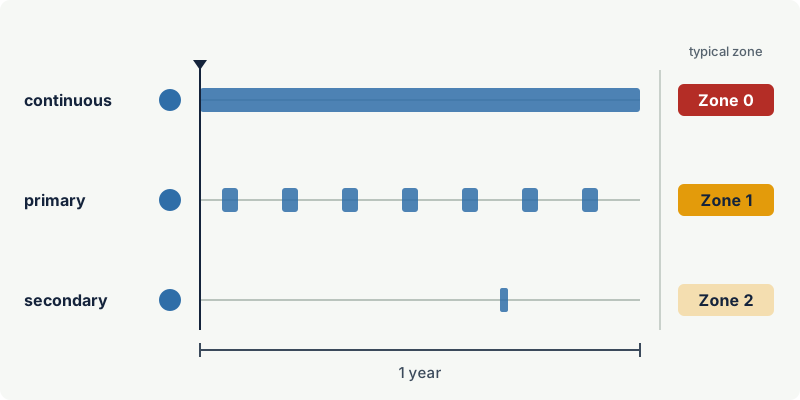
The three grades in detail
| Grade | What it means | Typical examples |
|---|---|---|
| Continuous | release is continuous, or expected frequently or for long periods | surface of a flammable liquid in a vented fixed-roof tank; open liquid surface of a separator or open vessel; a vent that discharges permanently |
| Primary | release expected periodically or occasionally during normal operation | sample points used routinely; drain points used to remove water from a vessel; vents and filling openings that release during filling or loading; seals that are expected to leak in normal operation |
| Secondary | release not expected in normal operation; if it occurs, only infrequently and for short periods | flanged joints, connections and fittings; seals and valve packings not expected to leak; relief valves that only lift on a fault; sample points not used in normal operation |
Continuous grade
A continuous release is the normal state, not an event. The classic example is the vapour space above a volatile liquid in a fixed-roof tank with a permanent vent: vapour is there whenever the tank holds liquid. An open separator, an open-topped mixing vessel or a permanently discharging process vent are other cases. Continuous grade releases should be rare in a well-designed plant and are usually confined to the inside of equipment or to the immediate vicinity of open surfaces.
Primary grade
A primary release is part of the job. Taking a sample, draining water from the bottom of a hydrocarbon vessel, opening a filter for cleaning, connecting a loading arm or filling a drum all release some flammable material, and they are expected to happen in normal operation. A tank vent is a primary source during filling: the liquid displaces vapour out of the vent every time the tank is filled.
The test is not whether the release is large, but whether it is expected during normal work. If operating procedures say "open the drain until water stops and hydrocarbon appears", that drain is a primary source.
Secondary grade
A secondary release is a fault. Gaskets, seals and packings are designed to be tight, but they can fail, and when they do the leak is expected to be found and stopped quickly. Most of the zones in a typical process plant are Zone 2 areas created by secondary releases from the large number of flanges, valves and seals.
The condition "only infrequently and for short periods" assumes a working maintenance regime. A flange that is known to weep and is left for months is not a secondary source any more; it is effectively primary or continuous, and it should be repaired rather than reclassified.
Examples by equipment item
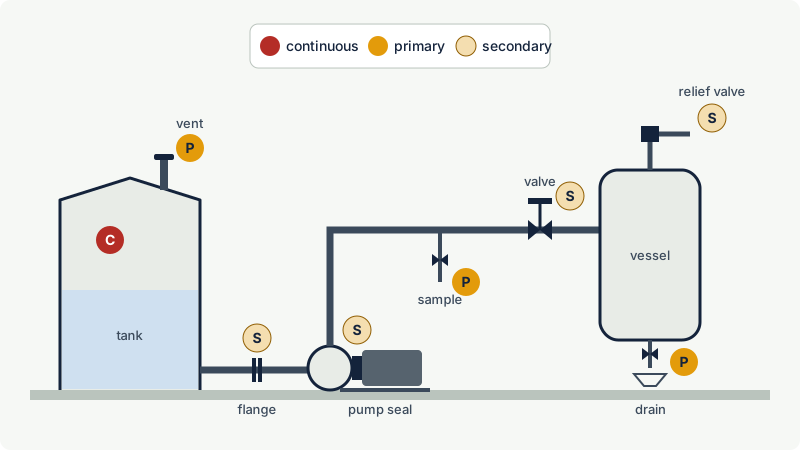
| Item | Usual grade | When the grade changes |
|---|---|---|
| Fixed-roof tank vapour space (vented) | continuous | lower if the vapour space is inerted, or if a floating roof removes it |
| Tank vent or breather | primary (during filling and breathing) | secondary or none if vapour is routed to a recovery or treatment system |
| Sample point | primary if used in normal operation | secondary if sampling is done with a closed system that does not release to atmosphere |
| Drain point on a vessel | primary if used routinely, for example to remove water | secondary if it is valved and capped and only opened after the vessel has been emptied to a closed system (planned start-up and shutdown count as normal operation) |
| Pump or compressor seal | secondary for seals not expected to leak | primary if the seal type is expected to release in normal operation |
| Flanged joint, threaded or small-bore connection | secondary | the hole size used for the release rate depends on gasket type and condition |
| Valve stem packing | secondary | primary if the valve is known to weep in normal service |
| Relief valve discharge | secondary if it only lifts on a fault | primary if it is expected to lift in normal operation; assessed at the outlet |
| Loading arm or hose connection | primary during connection and disconnection | lower with dry-break couplings, but the residual release still needs assessment |
| Open liquid surface (separator, open vessel) | continuous | lower if covered, or if the liquid is well below its flash point |
A liquid handled well below its flash point does not form a flammable vapour at the release point, so its leaks may not need a zone at all, unless the release can form a mist or spray, or the liquid can be heated above its flash point. Mists are assessed separately.
How grades become zones
The grade is the strongest single influence on the zone type, but not the only one. IEC 60079-10-1 combines the grade with the degree of dilution (high, medium or low) and the availability of ventilation (good, fair or poor) to give the zone type:
| Grade | High dilution, good availability | Medium dilution, good availability | Low dilution |
|---|---|---|---|
| Continuous | non-hazardous (Zone 0 NE) | Zone 0 | Zone 0 |
| Primary | non-hazardous (Zone 1 NE) | Zone 1 | Zone 1 or Zone 0 |
| Secondary | non-hazardous (Zone 2 NE) | Zone 2 | Zone 1 and even Zone 0 |
"NE" means negligible extent: the zone exists in theory but is so small that ignition would have negligible consequences. Low dilution can raise the zone above what the grade alone suggests, because gas lingers after the release stops. Fair or poor availability adds a surrounding Zone 2 or upgrades the result. The full table and its logic are explained in the article on ventilation.
The grade has little effect on the extent of the zone. The extent depends on the release rate, which is set by the hole size, the pressure and the substance, and on how quickly the air dilutes the release.
Sources with more than one grade
A single source can give rise to releases of more than one grade, and IEC 60079-10-1 expects each to be considered. Typical cases:
- A pump seal that weeps a little in normal operation (primary) and can fail with a much larger leak (secondary).
- A tank vent that releases during every filling (primary) and releases much more on overfilling or a blocked level instrument (secondary).
- A sample point used routinely (primary) whose valve can also be left open or fail (secondary, larger release).
Each release is assessed on its own: grade, release rate, dilution, zone type and extent. The zones are then combined. Usually the small primary release gives a Zone 1 close to the source and the larger secondary release gives a wider Zone 2 around it.
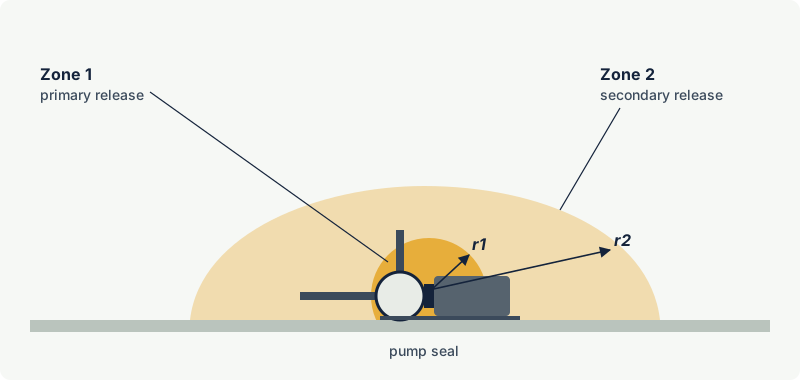
Two rules help when combining zones:
- The larger extent wins for each zone type. The Zone 2 created by a large secondary release can extend beyond the Zone 2 that surrounds a primary or continuous release. In that case the larger distance is used.
- Overlapping zones from neighbouring sources merge. Where several flanges and valves sit close together, their Zone 2 volumes are drawn as one envelope rather than as separate spheres.
Practical case: grading the sources on an ethanol transfer system
An outdoor ethanol day tank feeds a transfer pump. Ethanol has a flash point of 12 °C, an LEL of 3.1 % by volume and a vapour density of 1.59 (excodex gas library values), so at normal ambient temperatures it gives off flammable vapour that is heavier than air.
| Source | Grade | Justification |
|---|---|---|
| Inside the day tank vapour space | continuous | fixed roof with free vent; vapour above the liquid whenever there is liquid |
| Tank vent | primary | vapour displaced at every filling |
| Pump mechanical seal | secondary | seal type not expected to leak in normal operation; leaks are repaired promptly |
| Flanges on suction and discharge | secondary | leak only after gasket failure |
| Sample valve, used at every batch | primary | opened in normal operation, a small amount of liquid released to a container |
| Low-point drain, valved and capped | secondary | not opened to atmosphere in normal operation; the line is emptied to a closed system before the cap is removed for maintenance |
The only primary sources that create Zone 1 outside the equipment are the vent and the sample valve. Two changes would remove them: routing the vent to a vapour treatment unit, and replacing the open sample valve with a closed-loop sampler. Both sources would become secondary, the Zone 1 areas would disappear, and Zone 2 equipment would be enough around them. This is often cheaper than buying and maintaining Zone 1 equipment.
Common mistakes
- Grading by size instead of frequency. A large possible leak is not "primary" because it is large; it is secondary if it is not expected in normal operation. Size goes into the release rate and the extent.
- Ignoring routine operator tasks. Sampling, draining, filter changes and hose connections are often missing from the source list because they do not appear on drawings. These are typical primary sources.
- Calling a known leak secondary. A flange or seal that leaks persistently does not meet the "infrequently and for short periods" condition. Repair it, or grade it honestly.
- Treating the grade as the zone. Primary does not automatically mean Zone 1. High dilution can reduce the zone to negligible extent, and low dilution can raise it.
- Assessing only one grade per source. Seals, vents and sample points often need both a primary and a secondary release case.
- Including catastrophic failures. Vessel rupture or a full-bore pipe break is outside the scope of area classification. It belongs in the process hazard analysis and emergency planning, not in the zone drawing.
Frequently asked questions
What is the difference between a source of release and a grade of release?
A source of release is the physical point where flammable material can escape, such as a flange, a seal or a vent. The grade of release describes how often and how long that source releases: continuous, primary or secondary. Every source on the list receives at least one grade.
Is a pump seal a primary or a secondary source of release?
It depends on the seal and how it is expected to behave. A seal that is not expected to release in normal operation is a secondary source; a seal that is expected to weep in normal operation, for example because it relies on wetting by the pumped fluid, is a primary source. Many seals are assessed for both a small primary release and a larger secondary release.
Does a continuous grade of release always create Zone 0?
No. Combined with medium dilution it gives Zone 0, but with high dilution and good availability the zone can be of negligible extent. In practice continuous releases are mostly found inside equipment, where dilution is low, so Zone 0 is the usual result.
Are flanges always a secondary grade of release?
In most plants, yes: a flanged joint is not expected to leak in normal operation, and a leak would be repaired. The release rate used for the extent depends on the gasket type and condition, and IEC 60079-10-1 gives suggested hole sizes for typical cases. A flange known to leak repeatedly is a maintenance problem, not a secondary source.
Is a relief valve a source of release?
Yes, at its discharge point, not at the valve body. If it only lifts on a fault it is a secondary source; if it is expected to lift in normal operation it is primary. Relief valves that discharge to a flare or a closed system are not a release to atmosphere at that location.
Related on excodex
- Hazardous area zones explained: Zone 0, Zone 1 and Zone 2
- How to carry out a gas hazardous area classification step by step
- Ventilation in area classification: degree of dilution and availability
- Estimating the extent of a hazardous zone: release rates and dilution
- Typical hazardous area examples: tank vents, pumps, compressors and loading points
- Flammable mists and sprays: the overlooked explosion hazard
- Tools: gas and solvent library, standards space IEC 60079-10-1, EI 15, forum
Standards and further reading
- IEC 60079-10-1:2020 (edition 3.0), Explosive atmospheres, Part 10-1: Classification of areas, explosive gas atmospheres, including definitions of the three grades and an annex with examples of sources and suggested hole sizes. IEC webstore page
- Energy Institute, Model Code of Safe Practice Part 15, area classification code for installations handling flammable fluids (EI 15).
- International Electrotechnical Vocabulary, entry 426-28-07 "normal operation", with notes on minor releases and failures: electropedia.org
- HSE, Area classification for laboratories and small quantities, with primary and secondary sources explained in practical terms: hse.gov.uk
- HSE, Hazardous area classification and control of ignition sources: hse.gov.uk
- HSE, L138 Dangerous substances and explosive atmospheres, Approved Code of Practice and guidance (free PDF): hse.gov.uk
This article is general technical information prepared by the excodex editorial team. It does not replace the applicable standards, the equipment certificates and instructions, national regulations or the assessment of a competent person.