Flammable mists and sprays: the overlooked explosion hazard
Abstract
A fine spray of hydraulic oil, lube oil or fuel can explode even when the liquid is far below its flash point. How mists form and ignite, how IEC 60079-10-1 treats them, why gas detectors miss them and which measures work.
A flammable mist is a cloud of fine liquid droplets in air that can burn like a vapour. Because the droplets themselves are the fuel, a mist can form an explosive atmosphere from a liquid that is far below its flash point: a pinhole leak in a hydraulic line, a lube oil spray from a failed seal or an atomised fuel jet can all ignite at room temperature. Classification rules and gas detectors are built around vapour, so mist hazards are easy to miss and hard to measure.
This article explains why mists burn, how they form, which equipment produces them, how IEC 60079-10-1 and industry guidance deal with them, why ordinary gas detectors cannot see them, and which protective measures work in practice.
Key points
- A liquid handled below its flash point gives off too little vapour to burn, but if it is broken into fine droplets the droplets can carry a flame. Mists therefore ignite below the flash point.
- Mists with droplets smaller than about 10 µm behave much like vapour. US Bureau of Mines data put the spark ignition energy of fuel sprays and mists at the order of several millijoules, against 0.2 to 0.3 mJ for hydrocarbon vapours, falling towards the vapour value when the liquid is above its flash point.
- In joint industry tests by the UK HSE and Cardiff University, an aviation kerosene spray (flash point 38 °C) ignited at ambient temperature at every pressure tested, down to 1.7 barg, through a 1 mm hole.
- IEC 60079-10-1 states that its classification method and details do not apply where mists form from high flash point liquids released under pressure; it gives information on mists in an informative annex (Annex G) instead.
- Point gas detectors respond to vapour, not droplets. A dense mist of a heavy oil can be present with the detector reading close to zero.
- The most effective protection is preventive: fewer and better joints, spray shields, lower pressures, fire-resistant fluids and keeping hot surfaces insulated or away from possible spray paths.
Why a liquid below its flash point can still explode
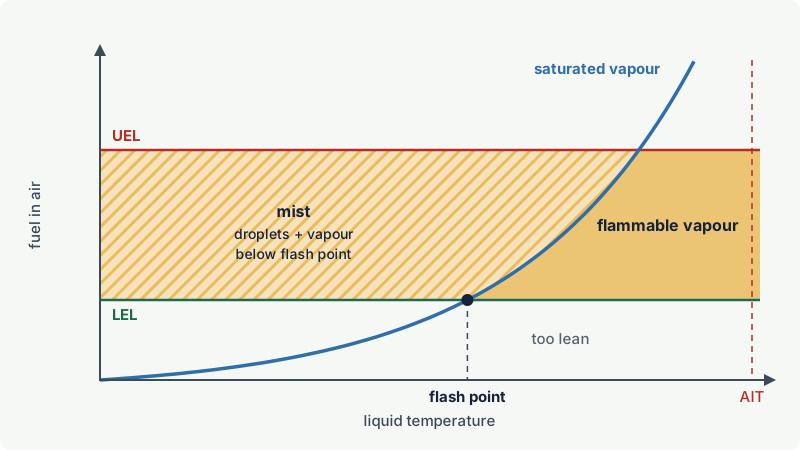
The flash point is the lowest liquid temperature at which the vapour above the surface reaches the lower explosive limit (LEL). Below it, the liquid simply cannot evaporate enough fuel into the air. That logic holds only while the liquid stays in bulk. Once it is atomised, the fuel is already in the air as droplets, and evaporation is no longer the limiting step.
When a flame front meets a fine droplet, the droplet heats up and evaporates within the flame itself, feeding it like a vapour would. US Bureau of Mines data summarised by Kuchta show that the flammability of mists approaches the behaviour of the vapour when the droplets are smaller than about 10 µm. Ignition is harder, though: for a fine spray or mist of fuel the minimum spark ignition energy tends to be of the order of several millijoules, depending on temperature, against about 0.2 to 0.3 mJ for the vapour-air mixture of most hydrocarbons. Above the flash point the spray ignition energy falls sharply towards the vapour value. Coarser droplets are harder to ignite still.
The lower limit of a mist is usually expressed as a mass concentration rather than a volume percentage. For hydrocarbon mists it is in the same region as the vapour LEL expressed in mass: the joint industry project (JIP) on mists measured concentrations close to about 50 g/m³ at the ignition boundary of a kerosene spray, and the spray model behind the hazard radii of the 2015 edition of EI 15 assumed 43 g/m³. A literature review in the same project found reports of quiescent mists ignited from below by a strong source at around 5 g/m³, so the true lower limit depends heavily on droplet size, motion and ignition source.
| Property | Vapour-air mixture | Fine mist (droplets under about 10 µm) | Coarse spray |
|---|---|---|---|
| Can form below the flash point | No | Yes | Yes |
| Typical lower limit, hydrocarbons | LEL in % vol (about 40 to 50 g/m³ in mass terms) | Similar mass concentration | Not well defined, depends on droplet size and motion |
| Spark ignition energy | About 0.2 to 0.3 mJ for most hydrocarbons | Of the order of several mJ below the flash point, nearer the vapour value above it | Higher still, rises with droplet size |
| Behaviour in still air | Mixes and disperses | Drifts with the air for a long time | Large drops rain out quickly |
| Seen by a point gas detector | Yes | Only the vapour fraction | Only the vapour fraction |
How flammable mists form
A review of the literature for the UK Health and Safety Executive (HSE, research report RR980) grouped mist generation into four mechanisms:
- Pressurised sprays. A liquid escaping through a small hole, crack or weeping joint under pressure breaks up into droplets. This is the most common accidental source: hydraulic lines, lube oil supplies, fuel injection lines and pump seals. The finer the hole and the higher the pressure, the smaller the droplets.
- Condensation aerosols. Hot vapour meets cooler air and condenses into very fine droplets, often only a few micrometres across. Overheated bearings in a crankcase or gearbox, hot oil vents and quench processes produce this type of mist, and it behaves almost exactly like a vapour.
- Agitation, splashing and sloshing. Liquid thrown against walls, dropped from height or stirred violently creates droplets, as in splash filling, gear trains and rotating machinery.
- Air stripping. Gas bubbling through a liquid bursts at the surface and throws up fine droplets, for example in sparged vessels or aerated tanks.
Deliberate sprays belong on the same list: spray painting and coating, spray drying, burner atomisers and oil-mist lubrication systems create mists by design, and they need the same assessment as a leak.
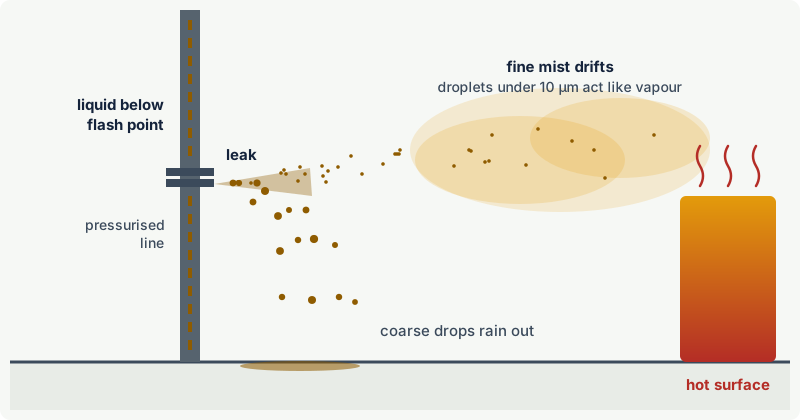
Large drops fall out within a short distance, while the fine fraction stays airborne and drifts with the air. Sprays that hit a surface (impingement) are a special case: the JIP found that impingement can make a spray easier to ignite, although it does not always do so. A spray in a confined space, such as a crankcase, machine enclosure or duct, can also build up a mist concentration far higher than in open air.
Typical sources: hydraulic oil, lube oil and fuels
Hydraulic systems
Hydraulic systems run at high pressures and use oils that most site assessments treat as non-hazardous because of their high flash points. A pinhole in a hose or a loose fitting turns that oil into a fine, fast-moving spray. In the JIP tests, a mineral hydraulic oil with a flash point of 223 °C did not sustain ignition by a 1 J spark in a free spray at pressures from 5 to 130 barg, although short flashes were seen at the highest pressures. That is reassuring for spark ignition only. The same sprays reaching a surface hotter than their autoignition temperature, a burner flame or molten metal are a well-known cause of serious fires in presses, die-casting, steel mills, mobile plant and engine rooms.
Lubricating oil and machinery
Lube oil systems on turbines, compressors and large engines combine pressurised oil supplies, hot casings and enclosed spaces. Two hazards stand out: spray from a failed joint onto a hot exhaust or casing, and condensation mist inside crankcases or gearboxes when a bearing overheats. A mist inside a closed crankcase can explode when the hot spot ignites it, and the subsequent inflow of air can cause a secondary explosion. This is why marine rules call for crankcase oil mist detection or bearing temperature monitoring on larger diesel engines, as interpreted by the IMO for engines of 2,250 kW and above or with cylinder bores over 300 mm.
Fuels, solvents and process liquids
Fuels with moderate flash points are the most easily ignited mists. In the JIP, sprays of Jet A1 kerosene (flash point 38 °C, matching the kerosene card in the excodex library) ignited at ambient temperature at all pressures tested, from 1.7 to 20 barg. A light fuel oil with a flash point of 81 °C did not ignite as a free spray at ambient temperature up to 20 barg, but ignited at 20 barg when the spray hit a plate, and ignited at all pressures from 5 to 20 barg once the oil was preheated to 70 °C.
| Fluid (JIP, 1 mm orifice, 1 J spark) | Flash point | Result |
|---|---|---|
| Jet A1 kerosene, ambient | 38 °C | Ignited at all pressures tested, 1.7 to 20 barg |
| Light fuel oil, ambient, free spray | 81 °C | No ignition up to 20 barg |
| Light fuel oil, ambient, spray hitting a plate | 81 °C | Ignited only at 20 barg with the plate at 0.4 m |
| Light fuel oil, preheated to 70 °C | 81 °C | Ignited at all pressures, 5 to 20 barg |
| Mineral hydraulic oil, free spray | 223 °C | No sustained ignition from 5 to 130 barg, brief flashes only |
Note: These are results for one orifice size, one spark energy and a few fluids. The 1 J spark was chosen as a reasonable upper limit for area classification purposes; hot surfaces, flames and more energetic sources can ignite sprays that a spark cannot. A preheated fluid behaves much more like a volatile one.
The autoignition temperature (AIT) also deserves attention. Middle distillates have low AITs: the excodex library gives 210 °C for kerosene and 254 °C for fuel oil No. 2, both temperature class T3. A spray reaching an uninsulated exhaust manifold can ignite without any spark at all.
How IEC 60079-10-1 and other guidance treat mists
IEC 60079-10-1
IEC 60079-10-1:2020 (edition 3) is the standard for classifying explosive gas atmospheres. Its handling of mists can be summarised in four points, paraphrased:
- A source of release can release mist. The standard's definition of a source of release includes gas, vapour, mist and liquid, and its section on forms of release has a subclause on flammable mists.
- The method is not built for mists. The scope warns that where mists form together with vapour, strict application of the standard's details may not be appropriate, and that where a high flash point liquid is released under pressure and forms a mist, the classifications and details of the standard do not apply.
- Guidance is informative. Information on mists is given in Annex G (informative), which was upgraded in the 2020 edition. The release rate and ventilation equations in the body of the standard are written for gases and vapours.
- Judgement is expected. In practice the assessor must decide whether a mist can form, whether it can be ignited, and how far it can travel, using the annex, industry codes and test data.
European practice
The ATEX workplace directive 1999/92/EC defines Zones 0, 1 and 2 for "gas, vapour or mist", so a mist zone is a gas zone, and the equipment categories 1G, 2G and 3G cover mists. The European Commission's non-binding guide to good practice for that directive lists the lower explosion limit of mists among the data an assessment needs, and warns that liquid dispersed into droplets can form an explosive atmosphere below the flash point, and that leaks from high-pressure systems such as hydraulics can do the same.
Industry codes and research
The Energy Institute's area classification code EI 15 (5th edition, 2024) is widely used in the oil and gas sector and includes guidance on liquids that can form mists; the 5th edition updated that guidance in the light of research published since the 2015 edition. The HSE and Cardiff University JIP, reported in HSE RR1107 and associated reports, proposed a tentative scheme that sorts liquids into four release classes by flash point (with boundaries at 32 °C and 125 °C) and by a dimensionless atomisation parameter based on the Ohnesorge number, both taken at the worst-case operating conditions. For the two classes that atomise most easily, whatever their flash point, it recommended treating a release like a flammable liquid release under EI 15, which in the 2015 edition gave hazard distances of about 2 to 2.5 m for a 1 mm hole. For the two classes that atomise less easily it suggested that no flammable zone may be needed for holes of 1 mm or larger at pressures below 20 bar, for the medium flash point class only where the spray cannot hit a surface. Outside those conditions, including any pressure of 20 bar or more, the behaviour was described as unknown and the release was to be treated like a flammable liquid release. The authors stressed that the guidance is tentative and only one input to professional judgement.
Warning: A "no zone" result for a high flash point liquid covers spark-type ignition of a free spray under the tested conditions. It does not remove the fire risk from sprays onto hot surfaces, nor the explosion risk from condensation mists in enclosures.
Protection measures that work
Because mist zones are hard to define, the emphasis shifts to preventing the mist and keeping it away from ignition sources.
- Design out the spray. Use welded joints, fewer flanges and fittings, rated hoses with correct bend radii and routing away from hot equipment, and replace hoses on a defined schedule.
- Shield joints. Spray shields or flange guards on joints in fuel, lube and hydraulic oil lines stop a leak from forming a fine jet. IMO guidance on preventing engine-room fires (MSC.1/Circ.1321) calls for them where a joint could spray onto an ignition source, together with jacketed high-pressure fuel lines.
- Insulate hot surfaces. The same IMO guidance treats surfaces above 220 °C as high-temperature surfaces to be insulated, with oil-impervious, non-combustible insulation.
- Lower the pressure or change the fluid. Fire-resistant hydraulic fluids (water-containing and synthetic types classified in ISO 6743-4) are standard in underground mining and hot metal processes for this reason.
- Control enclosures. Ventilate machine enclosures and fit mist eliminators to oil tank vents and crankcase breathers. Monitor crankcases with oil mist detectors or bearing temperature monitoring where the size and duty of the machine justify it.
- Select equipment for any zone assigned. Where a mist zone is assigned, the equipment needs the matching category or equipment protection level (EPL), and its temperature class must stay below the AIT of the liquid.
- Plan for the fire. Flame or heat detection with automatic isolation of the pump or pressure source limits a spray fire that prevention did not stop.
Detection: why gas detectors miss mists
Gas detectors measure molecules in the gas phase. A mist is mostly liquid, so the reading depends only on the small fraction that has evaporated. For a heavy oil at room temperature, that fraction can be close to zero even inside a mist dense enough to burn.
| Detection method | Response to a flammable mist | Practical consequence |
|---|---|---|
| Catalytic (pellistor) point detector | Measures vapour that diffuses through the sinter; droplets can coat and inhibit the sensing element | Can read near zero in an ignitable heavy-oil mist; sensor may be degraded |
| Infrared point detector | Measures vapour absorption; droplets can foul the optics | Same blind spot for low-volatility liquids; possible fault or drift |
| Open-path infrared | Droplets scatter and absorb light along the path | More likely to report a blocked or degraded beam than a flammable reading |
| Optical oil mist detector (light scattering or obscuration) | Responds to droplet concentration | Useful early warning in crankcases and enclosures; not calibrated in % LEL |
| Flame and heat detection | Responds once the mist burns | Limits the consequences, does not prevent ignition |
The European Commission's guide for directive 1999/92/EC explicitly warns that detection equipment can be adversely affected where mists are present, citing the poisoning of catalytic sensors as an example. Gas detector performance standards, now IEC 60079-29-0, are written for gases and vapours, and there is no standard way of calibrating a % LEL instrument for droplets. Gas detection is no substitute for preventing mists; see catalytic (pellistor) vs infrared flammable gas detectors.
Practical case: two pumps, two answers
A plant has two pump skids in the same building, each with flanged joints.
Skid A transfers kerosene (flash point 38 °C) at 6 barg at an ambient temperature of 20 °C. A vapour-only assessment might conclude that there is little hazard, since the liquid is about 18 K below its flash point. The JIP results show that a kerosene spray from a 1 mm hole ignites at ambient temperature at pressures well below 6 barg. The skid is therefore classified as a source of flammable liquid release, using EI 15 or an equivalent method, with a zone around the flanges and seals, Ex equipment selected for it (temperature class T3 or better for an AIT of 210 °C), and spray shields on the flanges.
Skid B is a lube oil unit for a compressor, supplying a mineral oil with a flash point of about 220 °C at 4 barg and a maximum oil temperature of 60 °C, next to the hot casing of a steam turbine. Under the JIP's tentative scheme an oil of this kind falls in the high flash point class that atomises less easily, for which no flammable zone was suggested for holes of 1 mm or larger below 20 bar; the assessor checks that the oil stays in that class at its highest operating temperature, and the oil never approaches its flash point in the room. On that basis, recorded as a judgement, no hazardous zone is assigned. The hazard that remains is a spray fire on the turbine casing or other hot surfaces. The measures are spray shields on flanges and fittings, insulation of the casing, routing of oil lines away from it, and a low-pressure switch that stops the pump if a line fails.
Same building, two different conclusions: one needs a zone, the other needs fire prevention. A high-pressure hydraulic unit at, say, 160 bar would not fit the second answer so easily, because the JIP scheme gives no basis for "no zone" at 20 bar or more. Record each decision and its reasoning in the explosion protection document.
Common mistakes
- "Below the flash point means no hazard." That applies to vapour only. Sprays, condensation mists and splashing can form explosive atmospheres well below the flash point.
- Relying on gas detectors to warn of oil mist. A point detector sees the vapour fraction only. For low-volatility oils it may never alarm.
- Treating a "no zone" mist result as "no risk". The tested ignition source is usually a spark. Hot surfaces, flames and preheated fluids change the answer completely.
- Ignoring enclosures. Crankcases, gearboxes, machine covers and ducts can accumulate condensation mist far above the levels seen in open air.
- Assessing the liquid at storage temperature only. A liquid heated in the process is closer to, or above, its flash point and atomises more easily.
Frequently asked questions
Can diesel or hydraulic oil explode?
Yes, if it is broken into a fine mist and meets a sufficient ignition source, or if it is heated above its flash point. At normal temperatures in bulk, diesel and hydraulic oil give off too little vapour to burn, but a fine spray from a pressurised leak or a condensation mist from an overheated bearing can ignite. Sprays of these oils are especially dangerous near hot surfaces.
Does a mist need a hazardous area classification?
Where a mist that can be ignited can form, it is an explosive atmosphere and the ATEX workplace rules treat it under the gas zones (Zones 0, 1 and 2). IEC 60079-10-1 states that its calculation method does not apply to mists from high flash point liquids under pressure, so the assessor uses its informative Annex G, industry codes such as EI 15 and research data to decide whether a zone is needed and how large it is.
What droplet size makes a mist explosive?
Droplets below about 10 µm behave much like a vapour and are the most hazardous. Larger droplets can still burn but need more ignition energy, and very large drops fall out of the air quickly. Real sprays contain a range of sizes, so a fine fraction is almost always present.
Can a gas detector detect oil mist?
Not reliably. Catalytic and infrared gas detectors measure vapour, and a heavy oil mist contains very little vapour. Optical oil mist detectors, which respond to droplets, are used in engine crankcases and machine enclosures, but they are not calibrated in % LEL.
What is the lower explosive limit of an oil mist?
There is no single value. For hydrocarbon mists, published work places it in the region of 40 to 50 g/m³, similar to the vapour limit expressed as mass. Under some conditions, such as quiescent mists with a strong ignition source, much lower values of around 5 g/m³ have been reported.
Related on excodex
- Flash point, autoignition temperature and minimum ignition energy
- What is an explosive atmosphere? Fire triangle, explosion pentagon and why ATEX exists
- Grades of release: continuous, primary and secondary
- How to carry out a gas hazardous area classification
- Hot surfaces in hazardous areas
- Gas and solvent library: kerosene, fuel oil No. 2, all substances; standards space IEC 60079-10-1
Standards and further reading
- IEC 60079-10-1:2020, Explosive atmospheres, classification of areas for explosive gas atmospheres (scope note on mists; informative Annex G on flammable mists): IEC 60079-10-1:2020 catalogue entry
- Directive 1999/92/EC and the European Commission's non-binding guide to good practice for its implementation: EU Publications Office
- Energy Institute, Model Code of Safe Practice Part 15, area classification for installations handling flammable fluids (EI 15, 5th edition, 2024): Energy Institute
- IEC 60079-29-0, gas detectors, performance requirements for detectors of flammable gases, toxic gases and oxygen
- ISO 6743-4, classification of hydraulic fluids, including fire-resistant types
- HSE RR980, generation of flammable mists from high flashpoint fluids, literature review: hse.gov.uk
- HSE RR1107, area classification for oil mists, final report of a joint industry project: hse.gov.uk
- Gant et al., Area classification of flammable mists: summary of joint industry project findings, IChemE Hazards 26: icheme.org (PDF)
- Engel and Armstrong, Flammability testing for heavy oil mists, IChemE Hazards 31, 2021: icheme.org (PDF)
- J. M. Kuchta, Investigation of fire and explosion accidents in the chemical, mining and fuel-related industries, US Bureau of Mines Bulletin 680, 1985 (mist flammability and ignition energy): stacks.cdc.gov (PDF)
- IMO MSC.1/Circ.1321, guidelines for measures to prevent fires in engine rooms and cargo pump rooms, reproduced in UK Maritime and Coastguard Agency MIN 579: gov.uk (PDF)
- IMO MSC.1/Circ.1345, unified interpretation on crankcase oil mist detectors: traficom.fi (PDF)
This article is general technical information prepared by the excodex editorial team. It does not replace the applicable standards, the equipment certificates and instructions, national regulations or the assessment of a competent person.