What is an explosive atmosphere? Fire triangle, explosion pentagon and why ATEX exists
Abstract
An explosive atmosphere is a mixture of flammable gas, vapour, mist or dust with air, at atmospheric conditions, in which a flame spreads through the whole mixture after ignition. The definition, fire triangle, explosion pentagon and why ATEX rules exist.
An explosive atmosphere is a mixture with air, under atmospheric conditions, of flammable substances in the form of gases, vapours, mists or dusts in which, after ignition, combustion spreads to the entire unburned mixture. That is the definition used in both EU ATEX directives. Turning such an atmosphere into an explosion needs three things at the same time: a fuel in the right concentration, oxygen from the air and an effective ignition source, the fire triangle. For a dust explosion two more conditions apply, dispersion into a cloud and confinement, which together with the triangle form the explosion pentagon.
This article takes the definition apart word by word, explains the flammable range, compares the fire triangle with the explosion pentagon, describes the four forms of fuel and summarises the accidents and logic behind ATEX regulation.
Key points
- An explosive atmosphere has four defining elements: a flammable substance (gas, vapour, mist or dust), mixed with air, under atmospheric conditions, and able to carry a flame through the whole mixture once ignited.
- The EU ATEX guidelines suggest -20 °C to +60 °C and 0.8 to 1.1 bar as an appropriate basis for "atmospheric conditions"; IEC 60079-0 uses the same range and adds air with normal oxygen content, typically 21 % by volume.
- A gas or vapour forms an explosive atmosphere only between its lower and upper explosive limits (LEL and UEL), for example 4.4 to 17 % by volume for methane and 4 to 77 % for hydrogen in the excodex gas library.
- The fire triangle (fuel, oxygen, ignition source) explains every fire; the explosion pentagon adds dispersion and confinement and is used mainly for dust explosions.
- Mists of fine droplets can form an explosive atmosphere even from liquids with a high flash point, and dust layers can be lifted into a cloud by a first, smaller explosion.
- A place is "hazardous" under the ATEX workplace directive only where an explosive atmosphere may occur in such quantities that special precautions are needed.
- Explosion protection follows a fixed order: prevent the explosive atmosphere, then avoid its ignition, then limit the effects of an explosion.
The definition, word by word
The same sentence appears in Directive 1999/92/EC (workplaces) and Directive 2014/34/EU (equipment). Each element has practical consequences.
| Element of the definition | What it means | Practical consequence |
|---|---|---|
| Flammable substances | Gases, vapours, mists or dusts that can burn | Every substance on site is a candidate until its properties show otherwise |
| Mixture with air | The oxidant is atmospheric oxygen | Mixtures with pure oxygen, chlorine or other oxidants are outside the definition and need special assessment |
| Under atmospheric conditions | Normal ambient temperature and pressure | Equipment certified for explosive atmospheres is designed for this range unless specifically assessed for other conditions |
| Combustion spreads to the entire unburned mixture | The flame propagates by itself once started | A mixture that only burns next to the ignition source is not an explosive atmosphere |
"Mixture with air"
The oxygen in an explosive atmosphere comes from the air. The ATEX guidelines name mixtures that are explosive without air, such as hydrogen with chlorine, and mixtures with other oxidants, as examples outside the scope. Oxygen enrichment changes everything: ignition becomes easier and flames hotter, so certified Ex equipment cannot simply be assumed safe there. See oxygen concentration, enrichment and inerting.
"Under atmospheric conditions"
Neither directive puts numbers on this phrase. The European Commission's ATEX guidelines state that a temperature range of -20 °C to +60 °C and a pressure range of 0.8 to 1.1 bar may be an appropriate basis. IEC 60079-0, whose eighth edition was published in 2026, uses the same range and adds air with normal oxygen content, typically 21 % by volume. Inside a reactor at 5 bar and 150 °C the mixture may well be explosive, but it is not an explosive atmosphere in the ATEX sense, and the equipment needs a separate design and risk assessment.
Do not confuse this with the ambient temperature range of equipment. Electrical Ex equipment is normally designed and tested for -20 °C to +40 °C ambient, and anything else is marked (the eighth edition of IEC 60079-0 requires the rated ambient range to be marked on every Ex marking, even when it is the normal range); see ambient temperature range Ta.
"Combustion spreads to the entire unburned mixture"
This is what separates an explosion from a local flame. If a spark in a mixture produces a small flame kernel that dies out, the mixture is not explosive. If the kernel grows into a flame front that travels through all the fuel-air mixture, it is. The ATEX guidelines add a realistic note for dusts: not always the whole quantity of material burns. What matters is self-sustaining propagation.
Explosive, potentially explosive, hazardous
Three related terms are often mixed up:
- An explosive atmosphere exists now: the mixture is within its explosive range.
- A potentially explosive atmosphere is one that could become explosive due to local and operational conditions. ATEX equipment is designed for this situation.
- A hazardous place, in the workplace directive, is one where an explosive atmosphere may occur in such quantities as to require special precautions. Where that is not expected, the place is non-hazardous. Hazardous places are then classified into zones; see hazardous area zones explained.
The workplace directive also sets a cautious default: flammable and combustible substances are treated as able to form an explosive atmosphere unless an investigation of their properties shows that, mixed with air, they cannot propagate an explosion on their own.
The flammable range: too lean, too rich, just right
A gas or vapour burns in air only between two concentrations. Below the lower explosive limit (LEL) there is too little fuel; a spark heats a small volume but the flame cannot sustain itself. Above the upper explosive limit (UEL) there is too little oxygen. Between the two, one ignition is enough to burn the whole mixture.
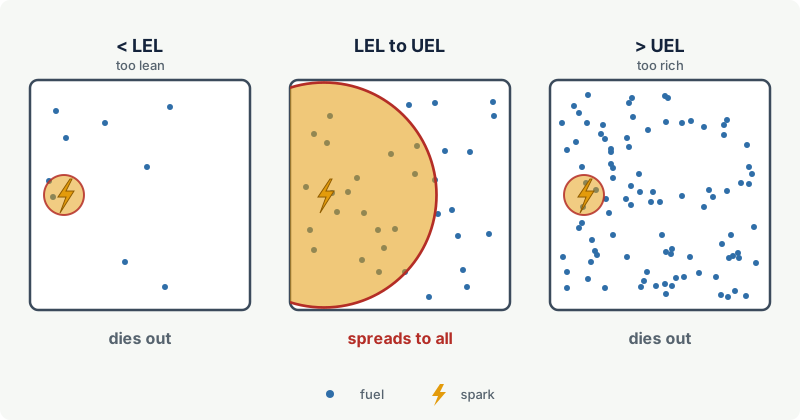
The width of the range differs greatly between substances, as the values from the excodex gas library show.
| Substance | LEL (% vol) | UEL (% vol) |
|---|---|---|
| Methane | 4.4 | 17 |
| Propane | 1.7 | 10.9 |
| Acetone | 2.5 | 14.3 |
| Toluene | 1 | 7.8 |
| Ammonia | 15 | 33.6 |
| Hydrogen | 4 | 77 |
| Acetylene | 2.3 | 100 |
Published limits vary slightly with the test method and source; the library values are used throughout excodex for consistency. The UEL of 100 % for acetylene reflects that it can decompose explosively even without air.
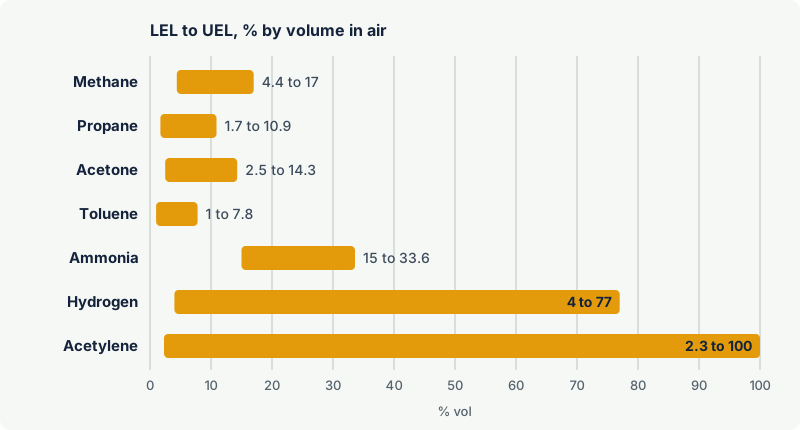
Two practical points follow. First, a "too rich" mixture is not safe: when it leaks or is vented, it mixes with air and passes through the flammable range on the way to dilution. Second, a low LEL means a small amount of fuel is enough. Our article on LEL and UEL explains how gas detectors use these limits.
Example: How much methane brings a 30 m³ room to its LEL if it mixed evenly? At 4.4 % by volume, 0.044 × 30 m³ = 1.32 m³ of methane, roughly 0.9 kg at 20 °C. Real leaks do not mix evenly. Methane is lighter than air (vapour density 0.554), so it collects under the ceiling, and a much smaller release can create a pocket within the flammable range near the leak or at roof level long before the room average approaches the LEL. This is why area classification looks at local concentrations, not room averages.
For liquids, the question is how much vapour they give off at the process temperature. The flash point is the lowest temperature at which a liquid gives off enough vapour to form an ignitable mixture above its surface under test conditions. Toluene, with a flash point of 4 °C, does this at any normal room temperature; kerosene, with a flash point of 38 °C, does not at 20 °C, but will if heated or sprayed. See flash point, autoignition temperature and minimum ignition energy.
Fire triangle and explosion pentagon
The fire triangle names the three things every fire needs: fuel, an oxidant (normally the oxygen in air) and an ignition source providing enough energy or heat. Take away any side and there is no fire. Every explosion prevention measure removes one side: ventilation and closed systems keep fuel below the LEL, inerting removes oxygen, and Ex equipment, bonding and permits control ignition sources.
The explosion pentagon adds two conditions. The US Occupational Safety and Health Administration (OSHA) describes it for combustible dust as fuel, ignition source and oxygen, plus dispersion of the dust particles in sufficient quantity and concentration, and confinement of the dust cloud.
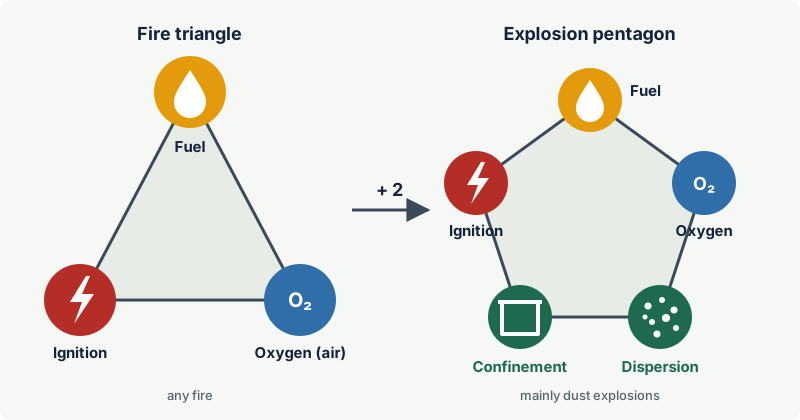
The pentagon matters most for dust. A dust layer on a beam burns slowly at worst; the same dust stirred into a cloud inside a silo, filter housing or building can explode. OSHA warns of the typical sequence: a first, often small, primary explosion shakes loose accumulated dust or damages equipment, and the dust thrown into the air can feed secondary explosions that are far more destructive than the first.
For gases and vapours the picture is slightly different. A gas mixture within its flammable range is already "dispersed", and it can ignite and burn without any enclosure. Confinement and obstacles decide how violent the event is: in open, uncongested space a gas cloud can burn as a flash fire with limited pressure, while in a building, vessel or a congested plant area the flame accelerates and the pressure rises sharply. Deflagration, detonation and overpressure explains the physics.
Gas, vapour, mist and dust: four forms of fuel
The definition lists four physical forms. They behave differently and are classified with different zone systems.
| Form | What it is | Typical examples | Zones |
|---|---|---|---|
| Gas | Substance that is gaseous at ambient conditions | Methane, hydrogen, propane released from a pressurised vessel | 0, 1, 2 |
| Vapour | Gaseous phase above a liquid; quantity depends on temperature | Acetone, toluene, petrol | 0, 1, 2 |
| Mist | Fine liquid droplets dispersed in air | Sprays, leaks from pressurised oil or fuel lines, condensing vapours | 0, 1, 2 |
| Dust | Finely divided combustible solids in a cloud; layers as a source | Flour, sugar, wood, coal, plastics, metal powders | 20, 21, 22 |
Gases spread quickly and either rise or sink depending on their density relative to air, which governs where they collect and where detectors go; see vapour density. Vapours come from liquids, so temperature controls the hazard: a solvent tank in summer sun may be a very different source from the same tank in winter.
Mists are the least understood form. Droplets fine enough can burn like a vapour, and the UK Health and Safety Executive (HSE) has published research on explosive mists from high flash point liquids, noting that guidance for classifying mist hazards is much less developed than for gases. A leaking hydraulic hose or a fuel line under pressure can therefore create an explosive atmosphere at temperatures where the liquid itself gives off almost no vapour; see flammable mists and sprays.
Dusts differ from gases in almost every respect: particle size, moisture and concentration govern ignitability, clouds settle into layers, and layers can smoulder or be raised again. They have their own zones (20, 21, 22), groups (IIIA, IIIB, IIIC) and test parameters; start with what makes a dust explosive. Where gas and dust are present together, the hybrid mixture can be more sensitive than either alone; see hybrid mixtures.
Why explosion protection is regulated: a short history
Explosion protection began underground. Methane (firedamp) and coal dust made coal mines the first workplaces where people systematically tried to prevent explosions, and mining equipment still forms its own group (Group I) in today's standards.
The scale of the danger was shown on 10 March 1906 at the Courrières mines in northern France, where an underground explosion killed 1,099 miners, one of the worst disasters in the history of mining. Disasters of this kind drove decades of research into flameproof electrical equipment, safer lamps, coal dust control and mine ventilation.
Industrial explosions continued above ground as well. Two well-documented modern cases show both main forms of fuel:
- Buncefield, Hertfordshire, United Kingdom, 11 December 2005. A storage tank at a fuel depot was overfilled with unleaded petrol after its level gauge stuck and its independent high-level switch did not work. Over 250,000 litres of petrol escaped, and a vapour cloud about 360 metres across formed in still conditions before it ignited and exploded. More than 40 people were injured, there were no fatalities, and the fire burned for five days. The official investigation report is titled "Buncefield: Why did it happen?".
- Port Wentworth, Georgia, United States, 7 February 2008. At a sugar refinery, massive accumulations of combustible sugar dust in the packaging building fuelled explosions and fire that killed 14 workers and injured 38. The US Chemical Safety Board concluded that inadequate equipment design, maintenance and housekeeping led to the explosions.
In Europe, regulation evolved from rules on electrical equipment (1976) and electrical equipment in mines (1982) to the two ATEX directives: Directive 94/9/EC, now 2014/34/EU, for equipment, and Directive 1999/92/EC for the protection of workers. The workplace directive states the reasoning plainly in its recitals: explosions endanger lives through the uncontrolled effects of flame and pressure, noxious reaction products and the consumption of the oxygen workers need to breathe. Our article on the two ATEX directives covers the legal framework.
From the definition to protection
The definition and the triangle lead directly to the order of priority in Article 3 of the workplace directive:
- Prevent the formation of explosive atmospheres. Substitute less flammable substances, keep processes closed, ventilate to stay well below the LEL, inert with nitrogen, and keep dust inside equipment and off surfaces.
- Avoid ignition where the atmosphere cannot be prevented. Classify the hazardous places into zones and use equipment of the right category, control hot surfaces, static electricity, mechanical sparks and hot work. See ignition sources in hazardous areas.
- Mitigate the effects of an explosion so that people stay safe: explosion venting, suppression, isolation, pressure-resistant design and keeping people away from the danger zone.
Note: The order matters. Ex equipment, the visible symbol of "ATEX", is the second line of defence. The first is not having an explosive atmosphere at all. Explosion protection strategy applies this hierarchy step by step.
Common mistakes and misconceptions
- "A rich mixture cannot explode." It cannot while it stays rich, but any leak or vent dilutes it through the flammable range.
- "Below the flash point there is no hazard." Sprays and mists from pressurised leaks can form an explosive atmosphere well below the flash point, and process heat can raise a liquid above its flash point.
- "Dust is a housekeeping issue, not an explosion hazard." Dust layers are a source of explosive atmospheres in the ATEX sense, and the secondary explosions they feed are often the most destructive part of an event.
- "Without an enclosure, a gas cloud cannot explode." An unconfined cloud still burns as a flash fire, and congestion from pipework and equipment can turn it into a damaging vapour cloud explosion.
- "ATEX equipment is safe in any flammable mixture." It is designed for mixtures with air under atmospheric conditions. Elevated pressure, high temperature or oxygen enrichment need a separate assessment.
- "Any flammable substance on site makes the whole area hazardous." Only places where an explosive atmosphere may occur in quantities requiring special precautions are hazardous, and the zone reflects how often and how long.
Frequently asked questions
What is the difference between an explosive atmosphere and a potentially explosive atmosphere?
An explosive atmosphere is a fuel-air mixture that is within its explosive range now. A potentially explosive atmosphere is one that could become explosive because of local or operational conditions, such as a leak, a process upset or dust being disturbed. ATEX equipment is designed for use in potentially explosive atmospheres.
What are "atmospheric conditions" in ATEX?
The directives do not define the term. The European Commission's ATEX guidelines suggest -20 °C to +60 °C and 0.8 to 1.1 bar as a basis, and IEC 60079-0 uses the same range with air of normal oxygen content, typically 21 % by volume.
Can a liquid below its flash point create an explosive atmosphere?
Yes. If it is sprayed or leaks under pressure, it can form a mist of fine droplets that ignites like a vapour. It can also be heated above its flash point by the process or by hot surfaces.
What is the explosion pentagon?
It is the fire triangle (fuel, oxygen, ignition source) plus two conditions needed for a dust explosion: the dust must be dispersed as a cloud in sufficient concentration, and the cloud must be confined. It explains why dust inside silos, filters and buildings is so dangerous.
Is a gas cloud in the open air an explosive atmosphere?
Yes, if the gas-air mixture is within its flammable range. It can ignite without any enclosure; the openness of the area mainly affects how much overpressure the combustion creates.
Why is it called ATEX?
ATEX comes from the French ATmosphères EXplosibles. It is the informal name for the two EU directives on equipment for explosive atmospheres and on the protection of workers.
Related on excodex
- ATEX explained: the two EU directives 2014/34/EU and 1999/92/EC
- LEL and UEL explained: explosive limits, %LEL and how gas detectors use them
- Explosion protection strategy: avoid the atmosphere, avoid ignition, limit the effects
- What makes a dust explosive? Particle size, concentration and the dust explosion pentagon
- Deflagration, detonation and overpressure
- Gas and solvent library: /gas; standards spaces: EN 1127-1, IEC 60079-0, IEC 60079-20-1
Standards and further reading
- EN 1127-1, explosive atmospheres: explosion prevention and protection, basic concepts and methodology
- IEC 60079-0, explosive atmospheres: general requirements for equipment (eighth edition 2026), including standard atmospheric conditions
- IEC 60079-10-1 and IEC 60079-10-2, classification of areas for explosive gas atmospheres and for combustible dust atmospheres
- ISO/IEC 80079-20-1 (which replaced IEC 60079-20-1), material characteristics for gas and vapour classification
- Directive 1999/92/EC, adopted text including Article 2 definition and Annex I: legislation.gov.uk
- European Commission, ATEX 2014/34/EU Guidelines, 6th edition January 2026 (explosive atmosphere and atmospheric conditions): single-market-economy.ec.europa.eu
- OSHA, Combustible dust in industry: preventing and mitigating the effects of fire and explosions (fire triangle and explosion pentagon): osha.gov
- HSE research report RR980, generation of flammable mists from high flashpoint fluids: hse.gov.uk
- HSE, Buncefield oil storage depot incident: hse.gov.uk
- US Chemical Safety Board, 2008 sugar dust explosion and fire, Port Wentworth: csb.gov
This article is general technical information prepared by the excodex editorial team. It does not replace the applicable standards, the equipment certificates and instructions, national regulations or the assessment of a competent person.