What makes a dust explosive? Particle size, concentration and the dust explosion pentagon
Abstract
A dust explodes when a fine combustible powder is dispersed in air above its minimum explosible concentration, inside a confined space, and meets an ignition source. How particle size, concentration and moisture decide the risk, with test data for common dusts.
A dust explodes when five conditions are met at the same time: a combustible dust (the fuel), oxygen from the air, an ignition source, dispersion of the dust into a cloud above its minimum explosible concentration, and confinement of that cloud. These five conditions form the dust explosion pentagon. Whether a powder can explode at all depends mainly on its chemistry and its particle size: the finer the particles, the more easily the cloud ignites and the more violently it burns, and most combustible materials only form explosible clouds when a significant fraction is finer than a few hundred micrometres.
This article explains the pentagon, why particle size and concentration matter so much, what moisture does and does not do, which materials are typical explosive dusts, and why a thin layer of settled dust can destroy a building.
Key points
- The dust explosion pentagon adds dispersion and confinement to the fire triangle of fuel, oxygen and ignition. Remove any one of the five and there is no explosion.
- Almost all natural and synthetic organic materials and many metals can form explosible dust: flour, sugar, starch, wood, coal, plastics, pharmaceuticals, aluminium, magnesium, titanium, iron and zinc are typical examples.
- IEC standards treat solid particles of 500 µm or less as combustible dust and larger ones as combustible flyings. Finer dust is generally the more dangerous: in the GESTIS-DUST-EX database, 11 of 14 aluminium samples with a median size below 35 µm are in the most severe explosion class St 3, while all aluminium grit samples of 150 µm and coarser did not explode in the test.
- A dust cloud only explodes above its minimum explosible concentration (MEC). For many organic dusts and metal powders, test data place it in the range of roughly 15 to 125 g/m³, thousands of times above typical occupational dust exposure limits.
- Settled dust is stored fuel. Spread through the height of a room, a layer well under 1 mm thick can be enough to exceed the MEC, which is why secondary explosions are so destructive.
- Moisture reduces explosibility, but published data show little effect below about 10 % water by weight. Dry powders, and powders leaving dryers, are the worst case.
- Whether a particular powder is explosible is decided by testing a representative, usually the finest and driest, sample, not by its name.
The dust explosion pentagon
The fire triangle describes what a fire needs: fuel, an oxidiser (usually the oxygen in air) and an ignition source. A heap of flour has all three and will only smoulder or burn slowly at its surface, because air cannot reach most of the fuel. For an explosion two more conditions are needed:
| Element | What it means for dust | Typical ways to remove it |
|---|---|---|
| Fuel | A combustible dust, fine enough to burn rapidly | Avoid generating fines; replace powders by granules or pellets; non-combustible alternatives |
| Oxygen | Air, or another oxidising atmosphere | Inerting with nitrogen or carbon dioxide inside equipment |
| Ignition | Hot surfaces, flames, mechanical sparks, electrical sparks, static discharges, smouldering nests | Ex equipment, earthing and bonding, tramp metal separation, hot work control |
| Dispersion | Particles suspended in air at a concentration within the explosible range | Enclosed handling, dense-phase conveying, extraction at the source, good housekeeping |
| Confinement | A vessel, duct, room or building that lets pressure build up | Cannot usually be avoided; consequences are limited by venting, suppression, isolation or containment |
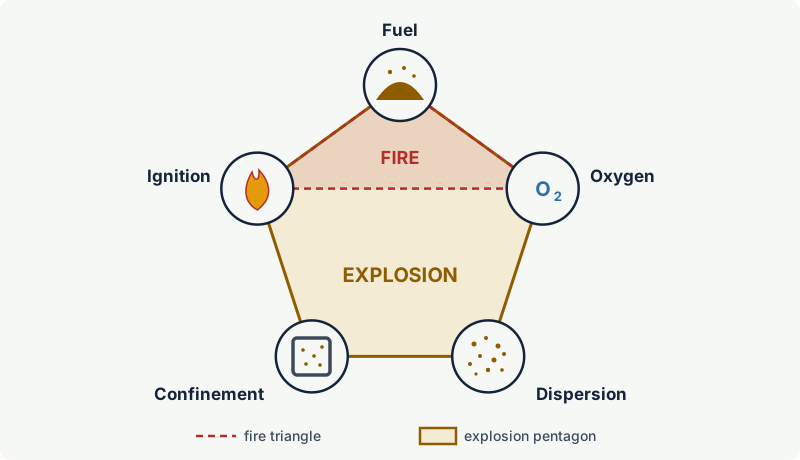
Dispersion turns a slow surface fire into a fast flame. When particles are suspended in air, each one is surrounded by oxygen and the flame can jump from particle to particle through the whole cloud. Confinement turns that fast flame into destructive pressure. In the open, an ignited dust cloud produces a flash fire, which can still kill and injure; inside a silo, a duct or a building, the expanding hot gases have nowhere to go and the pressure rises within fractions of a second. Closed-vessel tests on many organic dusts give maximum explosion pressures of around 7 to 10 bar above atmospheric, far more than ordinary buildings or process equipment can withstand.
The US Occupational Safety and Health Administration (OSHA) notes that oxygen and confinement are usually difficult to eliminate, so prevention concentrates on the other three: fuel, dispersion and ignition. Where an explosion cannot be excluded, the effects are limited by constructional measures, see Dust explosion protection: venting, suppression, isolation and containment.
Why particle size matters so much
Combustion happens at the surface of each particle. Dividing a solid into smaller particles increases its surface area for the same mass: a 1 cm cube has a surface of 6 cm²; cut into cubes of 10 µm, the same material has a surface 1000 times larger. Finer particles also heat up faster, give off volatile matter more quickly and stay suspended in air for longer. The result, confirmed by the German Social Accident Insurance (IFA) in its explanation of the GESTIS-DUST-EX database, is that finer dusts ignite more easily and react more violently.
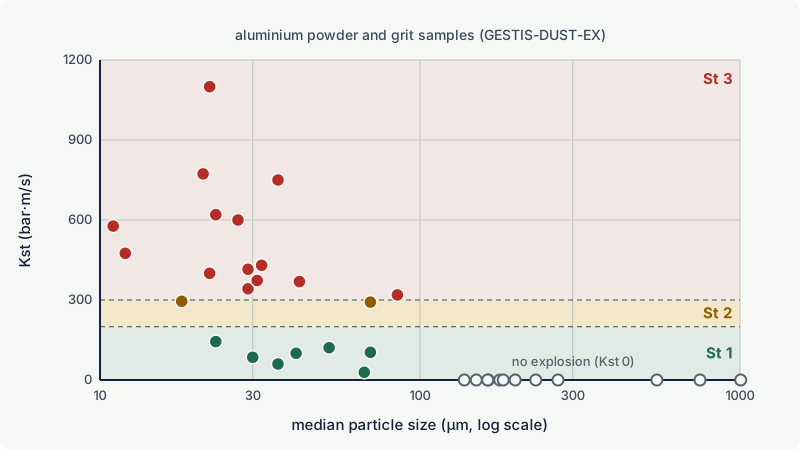
The figure shows the effect for one material, aluminium. Of 14 samples in the database with a median size below 35 µm, 11 are St 3, with Kst values from 342 to 1100 bar·m/s. Between 36 and 85 µm the results scatter from St 1 to St 3, and all 12 grit samples with a median of 150 µm or more did not explode in the test. The scatter is a reminder that the median alone does not decide: particle shape (flake or granular), the fine tail of the size distribution, oxide content and moisture also count. Wood shows the same trend: three beech wood samples in the same database have Kst values of 200, 188 and 48 bar·m/s at median sizes of 49, 90 and 170 µm, and a coarse sawdust sample with a median of 1500 µm did not explode at all in the test. Kst and the explosion classes are explained in Dust explosion parameters explained.
Is there a size limit?
Different documents draw the line in different places:
- IEC 60079-10-2 and IEC 60079-0 define combustible dust as particles of 500 µm or less in nominal size. Larger combustible particles, including fibres, are combustible flyings (group IIIA), which can also form explosive mixtures.
- US practice has long used a 420 µm criterion (material passing a US No. 40 sieve), as in the definition quoted by OSHA from NFPA 654. NFPA 652, the fundamentals standard, defines combustible dust by its fire and explosion hazard without a size limit, recognising that some larger particles, especially fibres and flakes, can still explode.
Both figures are screening criteria, not physical constants. The upper size at which a cloud stops propagating a flame depends on the material: work at the US National Institute for Occupational Safety and Health (NIOSH) found that narrow size fractions of a bituminous coal stopped igniting somewhere between 200 and 300 µm.
The bulk is not what explodes
A product specified as "coarse" can still be an explosion hazard because:
- Every powder has a size distribution. A product with a median of 300 µm may contain 10 or 20 % of particles below 75 µm.
- Handling creates fines. Attrition in conveyors, mixers and pneumatic transport grinds particles down.
- Fines separate. The dust that escapes from equipment, settles on beams and collects in filters is much finer than the bulk. That is the dust that will form the cloud.
For this reason the Irish Health and Safety Authority advises basing the assessment of ignition sensitivity on the finest fraction, usually obtained by sieving through 63 µm.
Concentration: the minimum explosible concentration
A dust cloud can only propagate a flame when there is enough fuel between the particles. The lowest concentration at which this happens is the minimum explosible concentration (MEC), also called the lower explosion limit (LEL) of the dust. It is measured in a closed test vessel by lowering the concentration until ignition fails repeatedly.
| Material | Test data range in published samples | Source |
|---|---|---|
| Organic dusts (flours, starch, sugar, wood, plastics) | mostly 15 to 125 g/m³ | GESTIS-DUST-EX samples |
| Bituminous coal (Pittsburgh coal) | about 80 g/m³ | NIOSH |
| Aluminium powders | 30 to 250 g/m³ depending on fineness | GESTIS-DUST-EX samples |
| Iron powders | about 220 to 500 g/m³ | NIOSH |
Three points help to put these numbers in perspective:
- They are similar to gases on a mass basis. Methane has a lower explosive limit of 4.4 % by volume (excodex library value), which corresponds to roughly 29 g of methane per cubic metre of mixture at 20 °C. NIOSH research notes that the lean limit of methane is similar to the MEC of polyethylene dust.
- They are enormous compared with exposure limits. In the UK, dust is treated as hazardous to health at 10 mg/m³ inhalable dust as an 8-hour average. An MEC of 30 g/m³ is 3000 times higher. A cloud at the MEC is so dense that it obscures vision at short distance, which is why explosible concentrations are normally found inside equipment and not in the working air.
- The upper limit is rarely useful. Dust clouds do have an upper explosible concentration, but it is poorly defined and very high, and real clouds are never uniform. Safety is never based on staying above it.
The concentration that gives the most violent explosion is usually several times the MEC, which is why test standards measure explosion pressure over a range of concentrations and report the maximum.
Worked example: how thin a layer can be dangerous
Consider a room 5 m high with a powder of bulk density 500 kg/m³ settled evenly on the floor, and an MEC of 60 g/m³ (a typical value for flour in the table above). If the layer is raised and spread through the full height of the room, the average concentration is:
concentration = bulk density × layer thickness / room height
To reach 60 g/m³ = 0.060 kg/m³:
layer thickness = 0.060 × 5 / 500 = 0.0006 m = 0.6 mm
A layer of less than a millimetre, about the thickness of a few sheets of paper, holds enough fuel to fill the whole room with an explosible cloud. In practice the dust is not spread perfectly evenly, but that makes things worse rather than better: the raised dust forms dense local clouds near the floor and along the beams, where the flame can travel. Layers on high ledges are particularly dangerous because they fall through the air when disturbed. Housekeeping criteria are covered in Dust layers and housekeeping: how thick is too thick?.
Secondary explosions: how a small event becomes a disaster
Most dust explosions that destroy buildings follow the same sequence. A primary explosion occurs inside a piece of equipment, such as a dust collector, an enclosed conveyor or a mill. Its pressure wave and the escaping flame shake ducts, floors and beams and blow open doors and covers. Dust lying on surfaces is thrown into the air ahead of the flame, forming a large cloud throughout the building, and the flame arriving behind it ignites a secondary explosion that is often far larger than the first. OSHA describes secondary explosions as potentially far more destructive than the primary one.
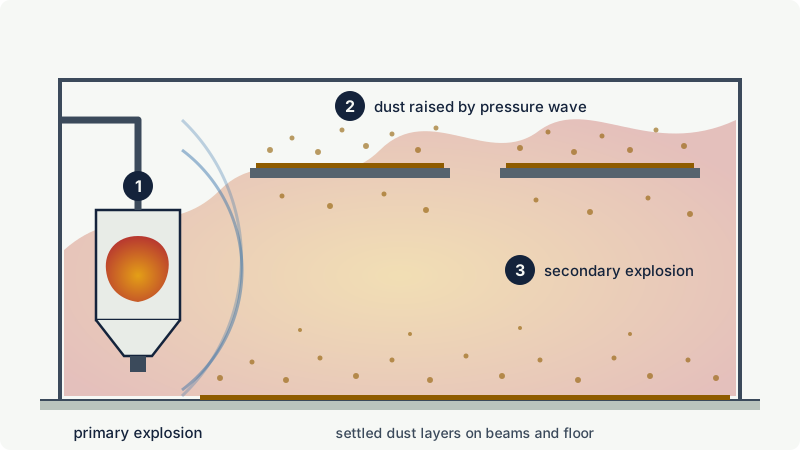
Investigations by the US Chemical Safety Board (CSB) show the pattern repeatedly:
- Port Wentworth, Georgia, 2008 (sugar refinery). A primary explosion most likely started in a recently enclosed sugar conveyor beneath two storage silos. It raised sugar dust that had accumulated throughout the packing buildings and caused a cascade of secondary explosions; 14 workers died.
- Kinston, North Carolina, 2003 (pharmaceutical rubber components plant). A fine plastic powder had accumulated above a suspended ceiling over a production area; its ignition killed six people.
- New Cumberland, West Virginia, 2010 (titanium processing plant). A dust explosion and fire involving titanium powder killed three workers.
The CSB's 2006 study of combustible dust hazards identified 281 dust incidents in the United States between 1980 and 2005, which killed 119 workers and injured 718.
Moisture and other factors
Moisture
Water in or on the particles absorbs heat, makes particles stick together and so reduces both ignitability and explosion violence. The effect is smaller than many people expect. According to the IFA's explanation of its dust database, the effect of moisture is negligible up to about 10 % by weight, and maximum pressure and Kst fall clearly only above about 20 to 30 %. The Irish Health and Safety Authority notes that dust with more than about 25 % moisture is unlikely to stay suspended. Practical consequences:
- A product that is "damp" when it arrives may become explosible after drying, grinding or long storage in a warm building.
- Dryers and the equipment just after them handle the driest, most sensitive form of the product.
- Some metal powders react with water and release hydrogen, which adds a flammable gas to the hazard. Water-based fire fighting and wet cleaning must be assessed specifically for combustible metals; after the 2010 titanium explosion the CSB recommended that the company prohibit sprinkler and deluge systems in its buildings processing or storing combustible metals.
Chemistry and inert content
Materials that are already fully oxidised, such as sand, limestone, cement, gypsum and most metal oxides, do not burn. Mixing a combustible dust with inert material reduces explosion pressure and violence and raises the ignition thresholds, but a mixture can still be explosible at surprisingly high inert contents. In the GESTIS database, for example, several hard coal samples with high ash content or low volatile content (anthracite) did not explode in the test, while other hard coals did.
Flammable gas or solvent vapour
A small amount of flammable gas or vapour in the air, even below its own lower explosive limit, can make a dust cloud easier to ignite and more violent. These hybrid mixtures are common in solvent drying, coal handling and some chemical processes, see Hybrid mixtures.
Typical explosive dusts
The table gives one tested sample per material from the GESTIS-DUST-EX database to show typical orders of magnitude. Other samples of the same material can differ considerably with particle size and moisture; never use these numbers for design.
| Material (one sample) | Median particle size | MEC | Pmax | Kst | Class |
|---|---|---|---|---|---|
| Wheat flour | 57 µm | 60 g/m³ | 8.3 bar | 87 bar·m/s | St 1 |
| Beet sugar | 29 µm | 60 g/m³ | 8.2 bar | 59 bar·m/s | St 1 |
| Maize starch | 15 µm | 60 g/m³ | 10.1 bar | 169 bar·m/s | St 1 |
| Beech wood flour | 49 µm | 30 g/m³ | 10.0 bar | 200 bar·m/s | St 1 |
| Lignite (brown coal) | 32 µm | 60 g/m³ | 10.0 bar | 151 bar·m/s | St 1 |
| Polyethylene | 52 µm | 30 g/m³ | 8.8 bar | 122 bar·m/s | St 1 |
| Aluminium powder | 29 µm | 30 g/m³ | 12.4 bar | 415 bar·m/s | St 3 |
Pmax is the maximum overpressure in a closed test vessel. Two observations stand out. Common food powders are not "weak" dusts: their maximum explosion pressures are as high as those of coal and plastics. And metal powders combine high pressure with very fast pressure rise, which makes them the most demanding dusts to protect against.
OSHA's list of industries with combustible dust hazards shows how widespread the problem is: food (candy, starch, flour, animal feed), grain handling, plastics, wood and furniture, rubber, textiles, pesticides, pharmaceuticals, dyes, coal and power generation, metal processing (aluminium, chromium, iron, magnesium, zinc) and additive manufacturing.
How to find out whether your dust is explosible
- Collect a representative sample, including the fines from filters, ledges and transfer points, not only the product from the bag.
- Check published data for orientation, for example the GESTIS-DUST-EX database (more than 7000 tested samples). The IFA stresses that tabulated values are guidance only, because each sample's results depend on its fineness, moisture and composition.
- Have it tested where the decision matters. A screening test in a 20 litre sphere or a 1 m³ vessel shows whether the dust is explosible at all; ASTM E1226, for instance, defines a dust as explosible when the pressure ratio reaches 2 or more. Further tests then give the MEC, Kst, Pmax and ignition sensitivity.
- Record the result in the explosion protection document or dust hazard analysis and use it for area classification, equipment selection and protection design.
A safety data sheet that does not mention dust explosion is not evidence that the dust is safe. Many data sheets describe the product as supplied and ignore the fines that form during handling.
Common mistakes and misconceptions
- "It is a food product, so it cannot explode." Flour, sugar, starch, milk powder and cocoa are classic explosible dusts with explosion pressures similar to coal.
- "Our product is coarse." The fines generated during handling and collected in filters and on ledges are what explode. Test the fines.
- "A thin layer is just untidy." Less than a millimetre spread over a floor can fill a room with an explosible cloud. Settled dust is fuel for a secondary explosion.
- "The air in the workshop is far below the explosive limit." It usually is, and that is why most primary explosions start inside equipment. The danger outside equipment comes from dust raised by a disturbance.
- "The powder is damp." Moisture below about 10 % by weight has little effect, and drying or storage can remove it.
- "No explosion data on the safety data sheet means no hazard." Absence of data is not evidence of safety; test a representative sample.
Frequently asked questions
What is the dust explosion pentagon?
It is the set of five conditions needed for a dust explosion: combustible dust (fuel), oxygen, an ignition source, dispersion of the dust into a cloud, and confinement. The first three form the fire triangle; dispersion and confinement are what turn a slow dust fire into an explosion. Removing any one of the five prevents the explosion.
What particle size makes dust explosive?
There is no single limit. IEC standards treat particles of 500 µm or less as combustible dust, and older US definitions used 420 µm, but the smaller the particles, the more dangerous the dust, and fibres can be hazardous even when larger. What counts is the fine fraction that actually becomes airborne, not the average size of the product.
What is the minimum explosible concentration of dust?
It is the lowest concentration of dust in air that can propagate a flame after ignition, the dust equivalent of a gas LEL. For many organic dusts and metal powders, published test values lie roughly between 15 and 125 g/m³. It must be measured for the specific dust, because it changes with particle size and moisture.
Does moisture prevent dust explosions?
Moisture reduces explosibility, but published data show little effect below about 10 % water by weight, and a clear reduction in explosion violence only above about 20 to 30 %. Dust raised from a damp product can still be explosible, and drying processes create the most sensitive form of a powder.
Why are secondary dust explosions so dangerous?
A small primary explosion shakes loose and disperses dust lying on floors, beams and equipment throughout a building. The resulting cloud is far larger than the original one and is ignited by the advancing flame, so the secondary explosion can destroy the whole building. Good housekeeping that prevents layers is the main defence.
Which dusts are the most explosive?
Fine metal powders such as aluminium and magnesium are among the most violent, often reaching explosion class St 3. Many organic dusts, including flours, starch, sugar, wood and plastics, are St 1 or St 2 but still produce explosion pressures of around 8 to 10 bar in a closed vessel, which is more than enough to destroy equipment and buildings.
Related on excodex
- Dust explosion parameters explained: Kst, Pmax, St classes, MIE and minimum ignition temperatures
- Dust zones 20, 21 and 22 explained with practical examples
- Dust layers and housekeeping: how thick is too thick?
- What is an explosive atmosphere? Fire triangle, explosion pentagon and why ATEX exists
- Deflagration, detonation and overpressure: what happens in a gas or dust explosion
- Dust collectors, silos and bucket elevators: where dust explosions start
- Tools and spaces: gas and solvent library, standards spaces IEC 60079-10-2, EN 1127-1, forum
Standards and further reading
- IEC 60079-10-2, Classification of areas, explosive dust atmospheres (definition of combustible dust and combustible flyings; edition 3.0 published in 2026).
- ISO/IEC 80079-20-2, Material characteristics, combustible dusts test methods.
- EN 14034 series (parts 1 to 4), determination of explosion characteristics of dust clouds: maximum pressure, rate of pressure rise, lower explosion limit and limiting oxygen concentration.
- ASTM E1226, test method for pressure and rate of pressure rise of combustible dusts; ASTM E1515, minimum explosible concentration.
- NFPA 652, Standard on the Fundamentals of Combustible Dust; NFPA 654, prevention of fire and dust explosions in the manufacturing, processing and handling of combustible particulate solids.
- OSHA, Safety and Health Information Bulletin, Combustible dust in industry (pentagon, secondary explosions, industries affected): osha.gov
- IFA, GESTIS-DUST-EX database of combustion and explosion characteristics of dusts: staubex.ifa.dguv.de, and its explanation of the characteristics: dguv.de (PDF)
- K. L. Cashdollar, Dust explosions overview, NIOSH Pittsburgh Research Laboratory (particle size, MEC and test chambers): stacks.cdc.gov (PDF)
- US Chemical Safety Board, combustible dust investigations and the 2006 hazard study: csb.gov
- Health and Safety Authority (Ireland), ATEX delivery guide on combustible dust: hsa.ie
This article is general technical information prepared by the excodex editorial team. It does not replace the applicable standards, the equipment certificates and instructions, national regulations or the assessment of a competent person.