Dust collectors, silos and bucket elevators: where dust explosions start
Abstract
Dust collectors, silos and bucket elevators hold explosive dust clouds in normal operation, meet ignition sources and connect to the rest of the plant. Why they are high risk, the usual protection packages, what to inspect and the lessons from investigated explosions.
Dust explosions most often start inside process equipment, and dust collectors, silos and bucket elevators appear again and again in investigation reports. All three hold an explosive dust cloud during normal operation, all three meet credible ignition sources (sparks and embers drawn in, frictional heating, hot bearings, tramp metal, static electricity, self-heating), and all three are connected by ducts, chutes and conveyors to the rest of the plant and often to the building, so an explosion inside them can spread. They are protected by a package: ignition control and monitoring, explosion venting or suppression, isolation of every connection and good housekeeping around them.
This article explains why each machine is a high-risk point, what a typical protection package looks like, what to inspect, and what five officially investigated explosions teach.
Key points
- The inside of a dust collector (dirty side), a silo during filling and the legs of a bucket elevator contain explosive dust clouds in normal operation and are normally classified Zone 20.
- Dust collectors concentrate the finest fraction of the dust, which is more sensitive and more explosive than the product, and they are linked to many pickup points through which burning material can arrive or leave.
- Bucket elevators ignite mainly through friction: belt slip, misaligned belts rubbing the casing, failing bearings and choked legs. Speed, alignment and bearing monitoring that stops the elevator is the core ignition control.
- Silos combine large volumes, elongated shapes and long storage times: explosions are severe, and stored material can self-heat and smoulder.
- Venting, flameless venting or suppression protect the vessel; isolation devices on the inlets and outlets stop the explosion from travelling, and interlocks stop fans and conveyors.
- In the investigated incidents the most destructive damage usually came from the explosion spreading: back through ducts, along conveyors and into dust that had settled in buildings.
Why these machines are where explosions start
The five elements of a dust explosion (fuel, oxygen, ignition, dispersion and confinement, see What makes a dust explosive?) come together inside these machines as a matter of routine.
| Equipment | Why a cloud is present | Typical ignition sources | How an explosion spreads |
|---|---|---|---|
| Dust collector (bag, cartridge, cyclone) | Dust-laden air enters continuously; pulse cleaning and discharge from the hopper raise clouds | Sparks and embers drawn in from grinding, cutting or sanding; static from filter elements and cages; self-heating deposits; hybrid mixtures with solvent vapour | Back through the inlet ducts to every pickup point, out through the clean-air duct, down through the discharge |
| Silo, bin, hopper | Pneumatic or free-fall filling disperses dust in the headspace | Ignition carried in with the product, smouldering nests, self-heating of stored material, electrostatic discharges, hot work | Into connected elevators, conveyors, dust removal ducts and neighbouring silos; through galleries above and below |
| Bucket elevator | Buckets throw product at the head and scoop at the boot; both legs carry a cloud | Belt slip on the head pulley, misaligned belt rubbing the casing, hot bearings, tramp metal impacts, choked legs, non-conductive belts | Along both legs, into the silo or bin it feeds, back to the intake and into the building through openings |
The HSE guidance on combustible dusts notes that bucket elevators may have an explosible cloud in both legs during normal operation and that frictional heating has caused a number of explosions; that cyclones and filters concentrate dust and are likely to contain an explosive atmosphere; and that extensive centralised dust collection systems create many links through which burning material can spread. These are the reasons the three machines dominate the incident record.
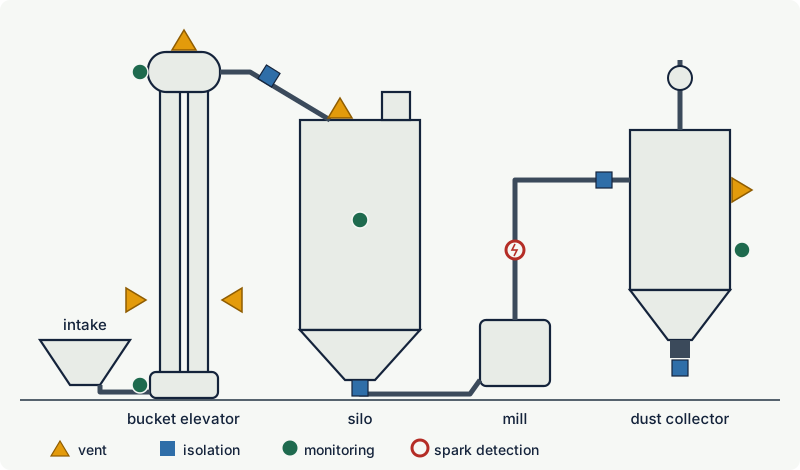
Dust collectors
What makes them high risk
A filter or cyclone is designed to collect the finest dust in the plant, and that is exactly the fraction with the lowest ignition energy and the highest Kst. A wood dust or food powder that is relatively coarse as a product can produce filter fines that are far more explosive; test data should therefore come from the collected dust, not from the product data sheet (see Dust explosion parameters explained).
The dirty side is normally Zone 20 inside, with the hopper and discharge often the worst points. The clean side is usually Zone 22 because a torn bag or loose cartridge releases dust into it, as explained in Dust zones 20, 21 and 22. Ignition sources come from outside as well as inside: hot particles from grinding, sanding, cutting or dryers travel along the ducts, and HSE guidance describes detectors that watch the product leaving a grinding plant for sparks or glowing material and trigger a water spray downstream, before the particle reaches a dust cloud such as the one in the filter. Filter elements and their support cages must be earthed, because an isolated conductive part charged by a dust stream gives the most energetic static discharges.
Typical protection package
- Location. Outdoors, or next to an outside wall, so that a vent can discharge safely. The US grain handling standard, for example, requires new fabric filter collectors to be outside, inside but protected by explosion suppression, or in a fire-rated room against an outside wall with vents to the outside.
- Vessel protection. Vent panels on the dirty side, sized for the dirty-side volume and the collected dust; flameless vents or suppression where the collector must stay indoors.
- Inlet isolation. A passive flap valve or an active barrier in the inlet duct so the explosion cannot travel back to the pickup points and into the building.
- Outlet isolation. A rotary valve certified as an isolation device, or another barrier, at the hopper outlet; protection of the clean-air duct if air returns to a workroom.
- Ignition control. Spark detection and extinguishing in the ducts, magnetic separation of tramp metal, earthing and bonding of all metal parts and filter cages, filter media suitable for the dust.
- Monitoring and interlocks. Differential pressure across the filter (blocked or torn elements), fan and airflow monitoring, and trips that stop the fan and conveyors when a vent bursts or suppression fires.
More on each device in Dust explosion protection: venting, suppression, isolation and containment.
Silos, bins and hoppers
A silo is a large confined volume that fills with a dust cloud every time it is loaded. The explosion pressure in a large volume rises more slowly than in a small one, but the amount of fuel and the size of the vented fireball are much larger, and tall, slender silos need a lot of vent area, which is usually only available in the roof. Explosions also travel from silo to silo through the gallery on top, the conveyor tunnel underneath and the dust removal system that links them.
Silos add two hazards of their own. First, self-heating: HSE guidance lists fishmeal, corn meal, dried sewage sludge and milk powder among the materials prone to spontaneous heating during long storage, and recommends temperature checks inside the stored mass or regular transfer between silos. A smouldering nest can ignite the cloud during the next filling or emptying. Second, fires inside a silo are dangerous to approach: opening a hatch to look inside can let air rush in, raise a cloud and cause an explosion through the opening. HSE guidance recommends cooling from outside or, where practicable, applying a fine water spray through a small opening. Deep-seated fires can be tackled with an inert atmosphere, but displacing the air from a large mass of powder takes a long time, and HSE notes that dissipating the residual heat of a fire in a large silo may take days or even weeks.
Typical protection: vents in the roof, sized for the silo volume, shape and the dust; isolation of the filling line, the bin vent filter and the conveyors; temperature monitoring for self-heating products; carbon monoxide monitoring of the headspace where smouldering is possible; and siting outdoors, which HSE guidance strongly recommends for large silos.
Bucket elevators
Why they ignite
A bucket elevator lifts product on buckets fixed to a belt that runs over a driven head pulley and a boot pulley at the bottom, inside two casings: the up-leg and the down-leg. Product is scooped up at the boot and thrown out at the head, so both legs carry a dust cloud in normal operation.
Most ignitions are mechanical. If the elevator chokes or the belt slips, the driven head pulley keeps turning against the stalled belt and can heat it until it smoulders. A belt that runs off-track rubs the casing. A bearing inside or partly inside the casing fails and overheats. Tramp metal, stones and loose buckets strike the casing. A non-conductive belt can charge up. Restarting a choked elevator again and again to clear it (jogging) generates heat and dust exactly where the cloud is densest.
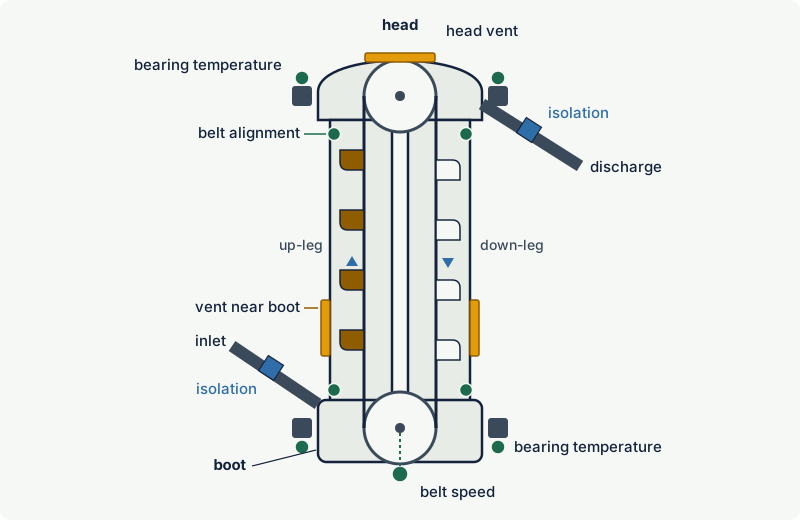
Ignition control by hazard monitoring
The US grain handling standard gives a clear, enforceable example of what good practice looks like. It requires that:
- bearings are mounted outside the leg casing, or that bearings inside or partly inside are monitored by vibration, temperature or another method;
- a motion detection device shuts the elevator down when the belt speed falls by no more than 20 % of its normal operating speed;
- belt alignment is monitored with an alarm, or the belt is kept tracking by a constant alignment system;
- belts and lagging bought since 1988 are conductive, with a surface resistance of no more than 300 megohms;
- a choked leg is never cleared by jogging;
- the head and the boot are accessible for inspection and cleaning.
Elevators with an operational explosion suppression system protecting at least the head and the boot are exempt from the bearing, motion and alignment requirements under that standard, which shows how suppression and monitoring are treated as alternative safeguards. Outside the grain sector the same measures are recognised good practice for any combustible product.
Explosion protection
HSE guidance states that explosion vents at the head and as close to the boot as practicable, which generally means within 6 m of the boot, will usually protect an elevator handling dusts with a Kst of 150 bar·m/s or less, provided the vents are as large as the cross-section of the leg (both legs for a panel at the head). Long elevators need additional vents along the legs, and dusts with a higher Kst need further design. Because vents near the boot are hard to place safely indoors, HSE recommends locating elevators outside buildings where possible. Indoors, suppression at the head and boot or flameless vents designed for elevators are the usual alternatives. The inlet chute and the discharge into the silo or conveyor need isolation, and an explosion or vent burst should stop the drive.
Inspection points
These checks belong in the routine inspection of each machine, in addition to the inspection of the Ex equipment installed on it (see Inspection of Ex installations under IEC 60079-17).
| Equipment | Check | Why |
|---|---|---|
| Dust collector | Differential pressure trend, bag or cartridge condition, earthing of cages and elements | Torn or blinded filters, static ignition |
| Dust collector | Hopper and discharge emptying, no long-term deposits | Self-heating, smouldering nests |
| Dust collector | Inlet isolation valve free and clean, latch and indicator working | Flap valves blocked by deposits do not close |
| Dust collector | Spark detection and extinguishing tested, nozzles clear | Embers from upstream processes |
| Silo | Roof vents free of corrosion, paint, product build-up and new obstructions; restraints in place | A vent that does not open turns the silo into a bomb |
| Silo | Temperature and carbon monoxide readings for self-heating products | Early warning of smouldering |
| Silo | Bin vent filter cleaned and earthed, high-level alarm working | Overfilling blows dust out and blinds filters |
| Bucket elevator | Speed, alignment and bearing monitors tested by simulation, trips stop the drive | Monitors that are bypassed or never tested give no protection |
| Bucket elevator | Head pulley lagging, belt tension and tracking, bucket fixings, boot cleaned out | Slip, rubbing and impact are the main ignition sources |
| Bucket elevator | Vents and suppressors at head, legs and boot; inspection doors closed and sealed | Open doors leak dust into the building and bypass the venting design |
| All | Housekeeping around the machine, leaks at flanges and doors, magnetic separators emptied | Settled dust is fuel for a secondary explosion; tramp metal causes sparks |
Findings that need action straight away include a disabled or bypassed monitor, a vent panel that has been painted, welded or covered, a flap valve jammed open, and visible dust layers around the machine (see Dust layers and housekeeping).
Lessons from investigated incidents
Only incidents with published official investigations are summarised here.
- Blaye, France, 1997 (grain silo). Eleven people died when an explosion destroyed much of a 44-cell grain silo. The French expert report by INERIS concluded that ignition most likely occurred in the centralised dust removal circuit (from impact or friction in its fan, or self-heating in the dust chamber). The flame ran through the gallery above the cells, probably raising settled dust, entered open storage spaces, where their elongated shape amplified the pressure, and travelled down the handling tower. Neither the silo nor the tower had explosion vents. Lessons drawn included preventing dust accumulation, spark and temperature detection, separating structures, fitting vents and avoiding very slender cells.
- Huntington, Indiana, USA, 2003 (aluminium dust collector). According to the CSB, aluminium dust ignited in a dust collector outside the building. The pressure wave travelled back through the ductwork, and a fireball raised and ignited dust that had accumulated on rafters and equipment; one worker died and others were burned. The CSB found that filters were cleaned infrequently, eroded ducts leaked dust and the company had not ensured that the collection system was designed to the guidance of a widely used fire code.
- Port Wentworth, Georgia, USA, 2008 (sugar refinery). The CSB concluded that the primary explosion most likely started in a sugar conveyor beneath two storage silos, recently enclosed with steel panels so that dust could build up to an explosive concentration, probably ignited by an overheated bearing. The blast dislodged dust and spilled sugar throughout the packing buildings, causing a cascade of secondary explosions; 14 workers died and 36 were injured. The CSB cited inadequately designed and maintained dust collection and handling equipment and poor housekeeping.
- East Rutherford, New Jersey, USA, 2012 (ink plant dust collection). Burning material from ducts that had plugged within days was carried to a rooftop dust collector. The CSB reports that the explosion there was contained by suppression equipment, but the pressure reversed the airflow into the pre-mix room, where a flash fire burned seven workers. The new system had not been tested or fully commissioned and its airflow was far below recommendations.
- Cambria, Wisconsin, USA, 2017 (dry corn mill). Five workers died and 14 were seriously injured. The CSB found that corn dust ignited inside process equipment and that fire spread through interconnected dust collection systems, causing explosions in dust collection equipment and then secondary explosions throughout the facility.
The common thread is not an exotic ignition source. It is a known hazard inside a machine, combined with connections that let the explosion travel and with dust in the building that turned it into a disaster. Isolation, shutdown interlocks and housekeeping would have broken that chain in each case.
Common mistakes and misconceptions
- Protecting the vessel but not its connections. A vented collector without inlet isolation can send the explosion back to every pickup point. Each duct, chute and conveyor needs an answer.
- Using product data for the collector. The fines in a filter are more explosive and easier to ignite than the bulk product. Test what the filter actually collects.
- Bypassing elevator monitors. Speed and alignment trips that cause nuisance stops are often disabled. Fix the cause and keep the trip; a slipping belt is an ignition source.
- Opening a hot silo to look inside. Air rushing in can raise a cloud and turn a smouldering fire into an explosion. Cool and inert from outside, following an emergency plan.
- Leaving inspection doors open. Doors on elevator legs and filters left open release dust into the building and change how the vent design behaves.
- Treating a new dust collection system as like-for-like. Changes of fan, ducting, filter type or product need a hazard analysis and commissioning tests, as the 2012 incident showed.
Frequently asked questions
Why do dust collectors explode?
A dust collector contains an explosive cloud of the finest, most sensitive dust in the plant during normal operation, and ignition sources such as sparks and embers from upstream processes, static from filter elements or self-heating deposits can reach it. If it is not vented or suppressed and its ducts are not isolated, the explosion bursts the housing and can travel back through the ducts into the building.
What zone is the inside of a silo?
The headspace of a silo that is filled with combustible dust is normally Zone 20, because a cloud forms every time it is filled. The surrounding areas are classified from the leaks at filters, hatches and connections and from the housekeeping standard, often Zone 22.
How are bucket elevators protected against explosions?
By preventing the frictional ignition sources with belt speed, belt alignment and bearing temperature monitoring that stops the elevator, conductive belts and good maintenance, and by protecting the casing with vents at the head and near the boot (and along long legs) or with suppression. The inlet and discharge are isolated and the elevator is best located outdoors.
Should a dust collector be inside or outside the building?
Outside, or against an outside wall with vents discharging outdoors, wherever possible. An indoor collector needs suppression or flameless venting, and in either case the inlet duct needs isolation so that an explosion cannot travel back into the building.
What is a spark detection and extinguishing system?
It is a set of infrared detectors in a duct that sense hot particles or embers, for example from a grinder or sander, and trigger an extinguishing water spray further downstream before the particle arrives. It removes ignition sources before they reach a dust collector or silo, but it does not protect against an explosion that starts inside the vessel.
Related on excodex
- Dust explosion protection: venting, suppression, isolation and containment
- Dust zones 20, 21 and 22 explained with practical examples
- Dust layers and housekeeping: how thick is too thick?
- Ignition sources in hazardous areas: the 13 ignition sources and how to control them
- Non-electrical equipment in hazardous areas: Ex h
- Standards spaces: IEC 60079-10-2, ISO 80079-36, EN 1127-1; questions in the forum
Standards and further reading
- IEC 60079-10-2, classification of areas, explosive dust atmospheres (zones inside and around filters, silos and elevators).
- ISO 80079-36 and ISO 80079-37, non-electrical equipment for explosive atmospheres (ignition hazard assessment of mechanical equipment such as elevators, fans and rotary valves).
- EN 14491, NFPA 68, EN 14373, EN 15089 and NFPA 69, design of venting, suppression and isolation.
- NFPA 660 (2025), standard for combustible dusts and particulate solids, which now contains the former agricultural and food (NFPA 61), wood (NFPA 664) and general (NFPA 654) requirements.
- OSHA 29 CFR 1910.272, grain handling facilities (filter collector location, bucket elevator monitoring, housekeeping): osha.gov
- HSE, HSG103 Safe handling of combustible dusts: precautions against explosions (elevators, filters, silos, self-heating, isolation): hse.gov.uk (free PDF)
- INERIS, summary of the expert report on the 1997 Blaye grain silo explosion: ineris.fr
- US Chemical Safety Board, final report on the 2008 Port Wentworth sugar dust explosions: csb.gov
- US Chemical Safety Board, 2003 Huntington aluminium dust collector explosion: csb.gov
- US Chemical Safety Board, 2012 East Rutherford dust collection flash fire: csb.gov
- US Chemical Safety Board, final report on the 2017 Cambria corn mill explosions: csb.gov
This article is general technical information prepared by the excodex editorial team. It does not replace the applicable standards, the equipment certificates and instructions, national regulations or the assessment of a competent person.