Dust explosion parameters explained: Kst, Pmax, St classes, MIE and minimum ignition temperatures
Abstract
Kst, Pmax and St classes describe how violently a dust cloud explodes; MIE, the cloud and 5 mm layer ignition temperatures, MEC and LOC describe how easily it ignites. What each value means, how it is tested in the 20 L sphere and 1 m³ vessel, and how it is used.
Dust explosion parameters are laboratory values that describe two different things. Severity tells you how violently a dust cloud explodes: the maximum explosion pressure Pmax (bar) and the dust-specific constant Kst (bar·m/s), which sorts dusts into explosion classes St 1 (Kst up to 200), St 2 (above 200 up to 300) and St 3 (above 300). Sensitivity tells you how easily it ignites: the minimum ignition energy MIE (mJ), the minimum ignition temperatures of a cloud and of a 5 mm layer (°C), the minimum explosible concentration MEC (g/m³) and the limiting oxygen concentration LOC (% by volume). Severity values are used to design venting, suppression, isolation and explosion-resistant equipment; sensitivity values are used to select equipment, set surface temperature limits, control static electricity and design inerting.
This article explains each parameter, how it is measured in the 20 litre sphere, the 1 m³ vessel and the other standard apparatus, typical values from published data, and how engineers use them.
Key points
- Pmax is the highest overpressure reached when a dust cloud of optimum concentration explodes in a closed vessel. Many organic dusts reach about 7 to 10 bar; fine aluminium powders exceed 12 bar.
- Kst is the maximum rate of pressure rise multiplied by the cube root of the vessel volume: Kst = (dP/dt)max × V^(1/3). It is normalised to 1 m³ and expressed in bar·m/s.
- St classes: St 0 (no explosion), St 1 (Kst above 0 up to 200), St 2 (above 200 up to 300), St 3 (above 300 bar·m/s). Most food, wood and plastic dusts are St 1 or St 2; fine light-metal powders are often St 3.
- MIE is the smallest capacitive spark energy that ignites the most easily ignitable cloud. Dust MIEs range from below 1 mJ for some very fine powders to more than 1000 mJ, compared with about 0.01 to 0.3 mJ for most gases and vapours.
- Minimum ignition temperatures are measured for a cloud (furnace test) and for a 5 mm layer (hot plate test). Installation rules limit equipment surface temperature to two thirds of the cloud value and to the 5 mm layer value minus 75 K.
- LOC is the highest oxygen concentration at which no explosion occurs. Inerting systems keep the oxygen level below it with a safety margin.
- All these values belong to the tested sample. Particle size, moisture and test method change them, so data must come from a representative sample and be compared only with values from the same method.
Two families of parameters
| Parameter | Unit | Question it answers | Main test standards | Used for |
|---|---|---|---|---|
| Pmax | bar (overpressure) | How high does the pressure rise in a closed vessel? | EN 14034-1, ASTM E1226 | Containment design, venting, suppression |
| Kst and St class | bar·m/s | How fast does the pressure rise? | EN 14034-2, ASTM E1226 | Vent area, suppression and isolation design |
| MEC (dust LEL) | g/m³ | How much dust is needed for an explosion? | EN 14034-3, ASTM E1515 | Concentration control in ducts and extraction |
| LOC | % O2 by volume | How far must oxygen be reduced? | EN 14034-4, ASTM E2931 | Inerting |
| MIE | mJ | How small a spark ignites the cloud? | ISO/IEC 80079-20-2, ASTM E2019 | Static electricity control, ignition source assessment |
| MIT of cloud | °C | How hot must a surface be to ignite a cloud? | ISO/IEC 80079-20-2, ASTM E1491 | Maximum surface temperature of equipment |
| MIT of 5 mm layer | °C | How hot must a surface be to ignite a layer? | ISO/IEC 80079-20-2, ASTM E2021 | Maximum surface temperature of equipment |
In Europe the explosion pressure tests are in the EN 14034 series; the ignition tests are collected in ISO/IEC 80079-20-2, which replaced the former IEC 61241-2 test standards and is being revised to also cover the explosion pressure characteristics, the lower flammable limit and the LOC. In North America the corresponding ASTM test methods are widely used.
Pmax and Kst: measuring explosion severity
The test vessels
Explosion severity is measured in a closed, pressure-resistant vessel. The reference vessel in the European and ASTM methods is a 1 m³ sphere or cylinder; the smaller 20 litre sphere is accepted as an alternative and is by far the most common in practice because it needs much less sample and time.
In both vessels the test runs the same way. A weighed amount of dust is blown into the vessel from a small pressurised container through a dispersion nozzle, creating a turbulent cloud. After a fixed ignition delay (about 0.6 s in the 1 m³ vessel and 0.06 s in the 20 litre sphere, according to the IFA, the institute that runs the GESTIS-DUST-EX database) two chemical igniters with a total energy of 10 kJ fire at the centre. A pressure sensor records the explosion. The test is repeated over a range of dust concentrations, and the highest pressure and the steepest pressure rise found in the series are reported.
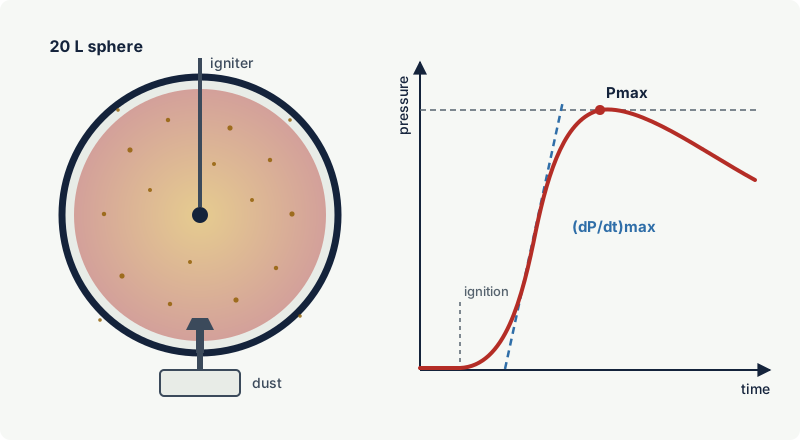
Some details matter when reading test reports:
- Pressure values are overpressures, measured from the pressure at ignition, and are usually quoted in bar.
- 20 litre results are corrected and calibrated. The test methods correct the measured pressure for the igniters and the cooling in the small vessel, and a 20 litre apparatus has to be calibrated so that its results agree with 1 m³ results within stated tolerances.
- Strong igniters can overdrive a small vessel. In 20 litres, 10 kJ of igniter energy is a large fraction of the energy released by a weak dust. ASTM E1226 warns of this overdriving and notes that dusts with low Kst values measured in the 20 litre sphere with 10 kJ igniters may not be explosible in a 1 m³ vessel, so marginal results are best confirmed at the larger scale.
- Turbulence matters. Rate of pressure rise depends strongly on how turbulent the cloud is at ignition, which is why the ignition delay and the dispersion system are fixed in the standards. NIOSH researchers estimated that a lower-turbulence 20 litre chamber gave rates of pressure rise for a coal dust about three times lower than the standard ASTM conditions.
Pmax
Pmax is the highest explosion overpressure measured over the range of concentrations. It depends little on vessel size once the vessel is large enough, and the IFA notes that reliable values need spherical vessels of at least 20 litres. In GESTIS-DUST-EX test data, flours, sugar, starch, wood, coal and plastic dusts mostly lie between about 7 and 10 bar, while fine aluminium powders reach about 12 to 13 bar.
Pmax is the pressure that a closed vessel must withstand if it is designed to contain an explosion, and an input to vent and suppression design. Ordinary silos, filters and buildings fail at a small fraction of these pressures.
Kst and the cubic law
The rate of pressure rise depends on the size of the vessel: in a larger vessel the flame has further to travel, so the pressure rises more slowly. For geometrically similar, compact vessels the product of the maximum rate of pressure rise and the cube root of the volume is constant. This is the cubic law, and the constant is the dust-specific deflagration index:
Kst = (dP/dt)max × V^(1/3)
Worked example. A dust tested in the 20 litre sphere (V = 0.020 m³, so V^(1/3) = 0.271 m) gives (dP/dt)max = 500 bar/s.
Kst = 500 bar/s × 0.271 m = 136 bar·m/s, so the dust is St 1.
The same law predicts that in a 1 m³ vessel the pressure would rise at about 136 bar/s, and in a 10 m³ silo at 136 / 10^(1/3) = about 63 bar/s, under the same turbulence. Real plant conditions are not test conditions, which is why Kst is used as a standardised input to design methods rather than to predict the actual pressure history in a silo.
Dust explosion classes St 0 to St 3
| Class | Kst (bar·m/s) | Description often used | Examples from GESTIS-DUST-EX samples |
|---|---|---|---|
| St 0 | 0 | not explosible under test conditions | coarse sawdust (median 1500 µm), anthracite sample |
| St 1 | above 0 up to 200 | weak to moderately explosible | wheat flour 87, beet sugar 59, polyethylene 122, maize starch 169 |
| St 2 | above 200 up to 300 | strongly explosible | cellulose 229, beech/pine wood dust 211 |
| St 3 | above 300 | very strongly explosible | fine aluminium powders, for example 415 and 600 |
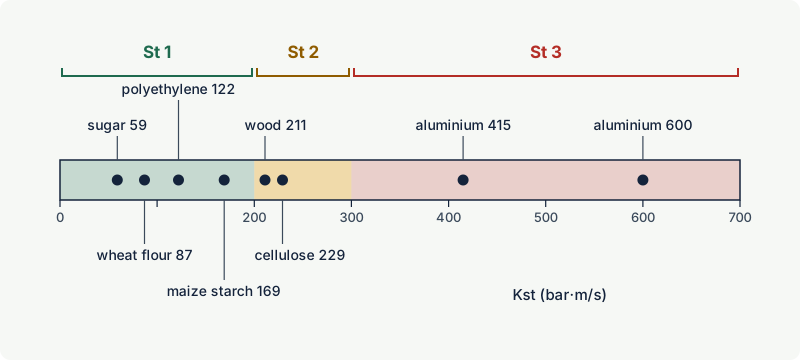
The St class is a severity class. It says nothing about how easily a dust ignites: an St 1 dust with a low MIE can be easier to ignite than an St 3 metal powder. Nor does "St 1" mean harmless; an St 1 dust explosion in a building can still be fatal.
How Pmax and Kst are used
- Explosion venting. Vent areas for silos, filters and buildings are calculated with EN 14491 or NFPA 68 from the vessel volume and shape, Kst, Pmax, the vent opening pressure and the reduced pressure the vessel can withstand. The required vent area grows with Kst.
- Suppression and isolation. Suppression systems and isolation devices (flap valves, rotary valves, chemical barriers) are tested and certified for a stated range of Kst and Pmax. A device approved for St 1 dusts may not protect against St 2.
- Containment. Equipment designed to be explosion-pressure-resistant or explosion-pressure-shock-resistant (EN 14460) must withstand at least the expected maximum pressure.
See Dust explosion protection: venting, suppression, isolation and containment.
MEC: the lower explosion limit of a dust cloud
The minimum explosible concentration is measured in the same vessels by reducing the dust concentration until the cloud no longer ignites in repeated tests. For many organic dusts and metal powders published values lie roughly between 15 and 125 g/m³; NIOSH measured about 80 g/m³ for a bituminous coal in both the 20 litre and the 1 m³ chamber. Lower igniter energies are often used for this test to avoid overdriving the small vessel.
The MEC helps when designing extraction and conveying systems to run below it, but it is a weak basis for protection on its own because real clouds are never uniform. See What makes a dust explosive?.
MIE: how small a spark ignites the cloud
The minimum ignition energy is the lowest energy, stored in a capacitor and discharged as a spark, that ignites the most easily ignitable dust and air mixture under test conditions. It is usually measured in a modified Hartmann tube (a vertical tube of about 1.2 litres), where a puff of air disperses the dust between two electrodes, and can also be measured in the 20 litre sphere or the 1 m³ vessel. Tests are run with or without an inductance in the discharge circuit; the inductance lengthens the spark and usually gives lower values, so reports must say which was used.
Because energies are tested in steps, results are often reported as a pair, such as 10/30 mJ: no ignition at 10 mJ, ignition at 30 mJ. Some GESTIS-DUST-EX samples:
| Material (one sample) | MIE |
|---|---|
| Lycopodium (club moss spores) | 3 to 10 mJ |
| Wheat flour, type 405 | 30 to 100 mJ |
| Milk powder | above 30 mJ |
| Cellulose | above 100 mJ |
| Pine and spruce sawing dust (coarse, median about 600 µm) | above 1000 mJ |
Dust MIEs are generally one to several orders of magnitude higher than those of flammable gases, but many dusts can still be ignited by electrostatic discharges. Assessing that risk is the main practical use of the MIE.
- Personnel and conductive plant. The energy of a spark is ½CU². Body capacitance is typically quoted at about 100 to 300 pF and a person can be charged to about 10 kV or more, so a spark from an insulated person is of the order of 10 mJ or more (German guidance TRGS 727 gives 7 to 15 mJ for 100 to 200 pF at 12 kV); metal plant items with larger capacitance can store more. Dusts with MIEs in this range or below need earthed personnel and plant as a minimum.
- Sensitivity bands. The former British code of practice BS 5958 used bands that are still widely quoted: below about 500 mJ earth the plant; below about 100 mJ consider earthing personnel; below about 25 mJ is where most ignition incidents have occurred; below about 10 mJ the dust is highly sensitive and insulating materials should be restricted; around 1 mJ it is extremely sensitive. These are guidance bands, not limits.
- Flexible intermediate bulk containers (FIBCs). The selection guidance in IEC TS 60079-32-1, as summarised by the Irish Health and Safety Authority, distinguishes powders with MIE above 1000 mJ, between 3 and 1000 mJ, and below 3 mJ, with more conductive bag types required as the MIE falls.
MIE falls steeply with particle size and rises at lower oxygen concentrations. As with all sensitivity data, the finest fraction of the product is the one to test. More in Static electricity as an ignition source.
Minimum ignition temperatures of clouds and layers
Hot surfaces ignite dust in two ways, and each has its own test.
Cloud: the furnace test
The minimum ignition temperature of a dust cloud is the lowest temperature of a hot surface at which the most ignitable dust and air mixture ignites. It is measured in a heated furnace: in the Godbert-Greenwald (G-G) furnace a small amount of dust is blown down through a vertical heated tube and the operator looks for flame at the bottom; the BAM oven blows the dust against a heated surface and can give lower values. Typical GESTIS-DUST-EX values are around 400 to 500 °C for many organic dusts and higher for many metals.
Layer: the 5 mm hot plate test
The minimum ignition temperature of a dust layer is measured by placing a 5 mm thick layer of dust on a temperature-controlled hot plate and finding the lowest plate temperature that makes the layer ignite (start to glow or burn). A layer insulates itself and heats up from within, so layer ignition temperatures are usually much lower than cloud values: lignite and some coals can ignite as a layer at around 225 to 300 °C. Some dusts melt instead of igniting, and test reports then state "melts". Thicker layers insulate better and ignite at even lower temperatures.
How the temperatures are used
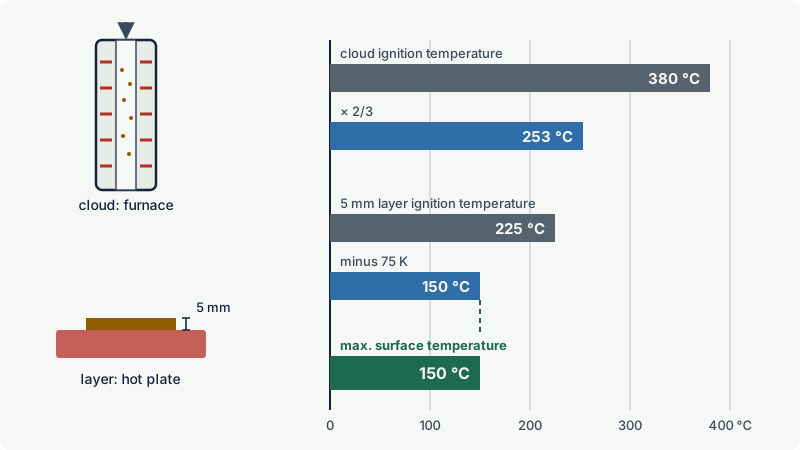
IEC 60079-14 sets the maximum permitted surface temperature of equipment in dust areas from both values:
- no more than two thirds of the cloud ignition temperature, and
- no more than the 5 mm layer ignition temperature minus 75 K, where layers up to 5 mm can form. Thicker layers require a larger reduction, and equipment that can be buried in dust needs a temperature limit established specifically for that situation.
Worked example. A lignite dust sample in GESTIS-DUST-EX has a cloud ignition temperature of 380 °C (G-G furnace) and a 5 mm layer ignition temperature of 225 °C.
- Cloud limit: 2/3 × 380 = 253 °C
- Layer limit: 225 - 75 = 150 °C
The lower value governs: equipment must have a maximum surface temperature of no more than 150 °C. A motor marked T135 °C is acceptable; a luminaire marked T160 °C is not. The full rules, including thicker layers, are in Surface temperature limits for dust: the two-thirds cloud rule and the 75 K layer margin.
LOC: the limiting oxygen concentration
The LOC is the highest oxygen concentration in a mixture of dust, air and inert gas at which no explosion occurs. It is measured by repeating the explosion test at the optimum dust concentration while replacing part of the air with inert gas, usually nitrogen, in steps of about 1 % oxygen. Published examples: a cellulose sample in GESTIS-DUST-EX has an LOC of 11 % by volume with nitrogen, and NIOSH found that a bituminous coal still exploded down to about 11.5 % oxygen in a 20 litre chamber, with the LOC falling to about 10 % at around 180 °C.
The inert gas matters: NIOSH notes that carbon dioxide is usually more effective than nitrogen for carbon-rich dusts but less effective for metal dusts, and some metals react with nitrogen or carbon dioxide at high temperature. LOC values also fall at higher temperature and pressure. Inerting systems therefore operate with a safety margin below the measured LOC, such as the margin of 2 percentage points cited from NFPA 69 in the NIOSH overview, and monitor the oxygen level continuously. See Oxygen concentration, enrichment and inerting.
Getting reliable data
Test results are only as good as the sample and the method:
- Test the right material. Sensitivity tests are normally run on the fine fraction (for example sieved below 63 µm) and dried sample, because fines and dry dust are the worst case. Include fines from filters and deposits, not only the product.
- Compare like with like. The IFA stresses that its values can be compared only with values measured by the same method. G-G and BAM cloud temperatures, MIE with and without inductance, and 20 litre and 1 m³ results can all differ.
- Use databases for orientation only. GESTIS-DUST-EX holds data for more than 7000 samples and is very useful for a first assessment, but each entry describes one sample. The wheat flour samples in the database, for example, have Kst values from 31 to 125 bar·m/s, all within St 1, depending on fineness and type.
| If you need to... | You need | Typical decision |
|---|---|---|
| decide whether a dust is a hazard at all | explosibility screening | Area classification needed or not |
| size explosion vents or choose suppression | Kst, Pmax | Vent area, suppressor and isolation selection |
| choose Ex equipment surface temperature | MIT cloud, MIT 5 mm layer | Maximum surface temperature, for example T135 °C |
| control static electricity | MIE | Earthing, conductive materials, FIBC type |
| design inerting | LOC | Oxygen set point and alarm levels |
| keep a conveying line below explosible concentration | MEC | Air-to-solids ratio, extraction design |
Common mistakes
- Treating St 1 as "low risk". St 1 dusts such as flour and sugar have destroyed buildings. The class only tells you how fast the pressure rises, not whether the explosion is survivable.
- Mixing up severity and sensitivity. A high Kst does not mean easy ignition, and a low MIE does not mean a violent explosion. Each design decision uses its own parameter.
- Using the cloud temperature alone. For many dusts the 5 mm layer limit (minus 75 K) is lower than the two-thirds cloud limit and governs equipment selection.
- Copying database values. One sample's data do not describe another supplier's product, a finer grade or the fines in your filter. Test a representative sample when the decision matters.
- Ignoring the test method. Comparing a 20 litre Kst with a 1 m³ value, or an MIE measured with inductance with one measured without, leads to wrong conclusions.
Frequently asked questions
What is Kst in dust explosions?
Kst is the deflagration index of a dust: the maximum rate of pressure rise measured in a closed test vessel, multiplied by the cube root of the vessel volume, in bar·m/s. It is a measure of explosion violence that is independent of vessel size for compact vessels, and it is the main input for designing explosion vents and suppression systems.
What are St 1, St 2 and St 3?
They are dust explosion classes based on Kst: St 1 above 0 up to 200 bar·m/s, St 2 above 200 up to 300, St 3 above 300; St 0 means no explosion under test conditions. Most organic dusts are St 1 or St 2, while fine aluminium and magnesium powders are often St 3.
What is the difference between the cloud and layer ignition temperature?
The cloud ignition temperature is the lowest hot-surface temperature that ignites a dust cloud, measured in a furnace. The layer ignition temperature is the lowest hot-plate temperature that ignites a 5 mm layer, usually much lower because the layer insulates itself. Equipment surface temperatures must respect both limits.
How is MIE of dust measured?
A dust cloud is dispersed in a vertical glass tube, usually the modified 1.2 litre Hartmann tube, and capacitive sparks of decreasing energy are discharged through it until ignition no longer occurs. The result is often given as a range between the highest energy that did not ignite and the lowest that did, and the report states whether an inductance was used in the circuit.
Why do 20 litre and 1 m³ results differ?
The small sphere has a different flame path, turbulence and wall cooling, and the 10 kJ igniters contribute a larger share of the energy. Test standards correct the 20 litre results and require them to agree with 1 m³ data within stated tolerances, but for weakly explosible dusts or critical designs the 1 m³ test remains the reference.
Related on excodex
- What makes a dust explosive? Particle size, concentration and the dust explosion pentagon
- Surface temperature limits for dust: the two-thirds cloud rule and the 75 K layer margin
- Dust explosion protection: venting, suppression, isolation and containment
- Static electricity as an ignition source: charging, discharges and bonding
- Flash point, autoignition temperature and minimum ignition energy: what is the difference?
- Dust groups IIIA, IIIB and IIIC
- Standards spaces: IEC 60079-14, IEC 60079-10-2, EN 1127-1, forum
Standards and further reading
- EN 14034-1 to EN 14034-4, determination of explosion characteristics of dust clouds: maximum explosion pressure, maximum rate of pressure rise, lower explosion limit and limiting oxygen concentration (1 m³ reference vessel, 20 litre sphere as alternative): EN 14034-1 catalogue entry
- ISO/IEC 80079-20-2:2016, combustible dusts test methods (cloud and layer ignition temperatures, MIE, resistivity, screening); a revision is in progress: catalogue entry
- ASTM E1226 (Pmax, Kst), ASTM E1515 (MEC), ASTM E2019 (MIE), ASTM E1491 (cloud ignition temperature), ASTM E2021 (layer ignition temperature), ASTM E2931 (LOC).
- IEC 60079-14, electrical installations in explosive atmospheres, including dust surface temperature limits.
- EN 14491 and NFPA 68, explosion venting; NFPA 69, explosion prevention systems including inerting; EN 14460, explosion-resistant equipment.
- IFA, explanation of the combustion and explosion characteristics in GESTIS-DUST-EX: dguv.de (PDF); database search: staubex.ifa.dguv.de
- K. L. Cashdollar, Dust explosions overview, NIOSH (test chambers, MEC, LOC, particle size): stacks.cdc.gov (PDF)
- BS 5958-1, code of practice for control of undesirable static electricity, general considerations (withdrawn; source of the MIE sensitivity bands still quoted in industry).
- Health and Safety Authority (Ireland), ATEX delivery guide on combustible dust (test methods, St classes, FIBC selection by MIE): hsa.ie
This article is general technical information prepared by the excodex editorial team. It does not replace the applicable standards, the equipment certificates and instructions, national regulations or the assessment of a competent person.