Flash point, autoignition temperature and minimum ignition energy: what is the difference?
Abstract
Flash point tells you when a liquid makes enough vapour to burn, autoignition temperature how hot a surface must be to ignite it, and minimum ignition energy how small a spark can do it. Definitions, solvent data table and what each means in practice.
Flash point, autoignition temperature and minimum ignition energy describe three different ways a flammable substance can be ignited. The flash point is the lowest liquid temperature at which the liquid gives off enough vapour to form an ignitable mixture with air above its surface; it tells you whether an explosive atmosphere can form at all. The autoignition temperature (AIT) is the lowest temperature at which a gas or vapour mixed with air ignites on its own, without a spark or flame; it sets the temperature class (T-class) of equipment. The minimum ignition energy (MIE) is the smallest spark energy that can ignite the most easily ignited mixture; it tells you how sensitive the substance is to sparks and static electricity.
The three are separate properties and none can be predicted from another: a liquid can have a high flash point and a low autoignition temperature, as diesel-type fuels do. This article explains each property, how it is measured, what it means for liquid handling, hot surfaces and static control, and gives a data table for common solvents.
Key points
- Flash point is a property of a liquid; gases have no flash point. If a liquid is handled above its flash point, an explosive vapour-air mixture can form near its surface.
- Autoignition temperature is the minimum temperature of a hot surface or hot container that ignites the mixture without any other ignition source. Equipment surface temperatures, expressed as the T-class, must stay below it.
- Minimum ignition energy is the lowest electrical spark energy, in millijoules (mJ), that ignites the most ignitable concentration. Most hydrocarbon vapours have MIE values of a few tenths of a millijoule; hydrogen, acetylene and carbon disulphide are below 0.02 mJ.
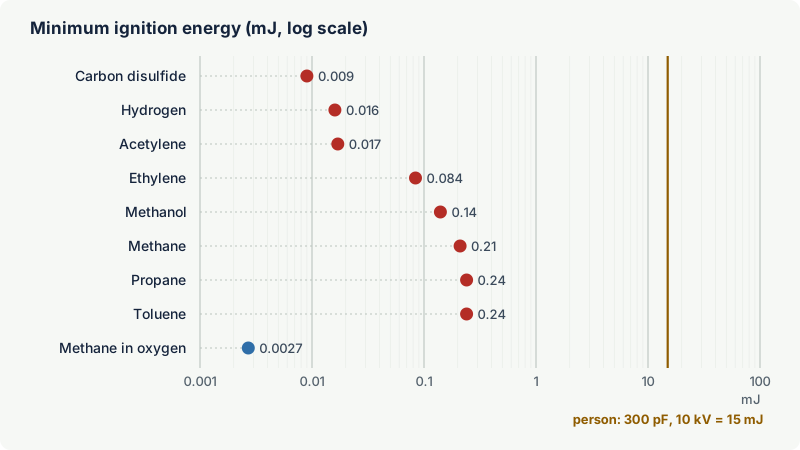
- A static spark from a charged person carries of the order of 10 mJ or more (E = ½CU²; for example 300 pF at 10 kV gives 15 mJ), many times the MIE of almost every flammable gas and vapour.
- A high flash point does not mean a high autoignition temperature: fuel oil No. 2 has a flash point of 52 °C but an AIT of 254 °C, lower than the 280 °C of natural gasoline.
- All three values depend on the test method, so data from different sources can differ; use the values from one consistent source.
Three properties, three questions
| Property | Question it answers | Applies to | Unit | Main practical use |
|---|---|---|---|---|
| Flash point | Can this liquid make an ignitable vapour at this temperature? | Liquids | °C | Area classification, storage, liquid classification |
| Autoignition temperature | How hot may a surface be before it ignites the mixture? | Gases, vapours, liquids | °C | T-class selection, hot work, process heat |
| Minimum ignition energy | How small a spark ignites the mixture? | Gases, vapours (dusts have their own MIE) | mJ | Static control, gas group, intrinsic safety |
A useful way to remember the difference: flash point is about the fuel (is there enough vapour?), while autoignition temperature and minimum ignition energy are about the ignition source (heat or spark). An explosion needs both.
Flash point: when does a liquid make enough vapour?
What the flash point means
Every liquid evaporates, and the vapour concentration just above its surface rises with temperature. The flash point is the temperature at which that concentration becomes high enough for a small test flame to ignite it momentarily. In physical terms it is close to the temperature at which the saturated vapour concentration reaches the lower explosive limit.
At the flash point the flame only flashes across the surface and goes out; sustained burning starts at a slightly higher temperature, sometimes called the fire point. The flash point is therefore the relevant value for explosion protection.
How it is measured
Flash point is measured in standardised cups:
- Closed-cup methods (for example Abel, ISO 13736, and Pensky-Martens, ISO 2719) heat the liquid in a covered cup so the vapour accumulates. They give the lower, more conservative values and are the ones used for hazard classification and area classification.
- Open-cup methods let vapour escape to the room and give higher results. An open-cup value should not be compared directly with a closed-cup value.
Always check which method a safety data sheet uses.
What it means in practice
- Liquid handled above its flash point: vapour can form an explosive atmosphere near open surfaces, leaks, vents and spills. This is the main trigger for hazardous area classification of liquids. Many common solvents have flash points below normal room temperature, so they are above their flash point whenever they are used.
- Liquid handled well below its flash point: an explosive vapour atmosphere is normally not expected, which is why diesel tanks at ambient temperature often need little or no hazardous area classification.
- The margin matters. Flash point is a test result, not a sharp boundary. Research on the "lower explosion point" (the lowest temperature at which the vapour above a liquid in a closed space can propagate an explosion) found it is only a few kelvin below the flash point for pure liquids, but can be 10 to 30 K lower for mixtures of liquids with different volatilities. Leave a clear margin, especially for blends.
- Heating and process conditions: a high flash point liquid can still be above its flash point inside a heated vessel, in a hot pipe, or on a hot day in direct sun. The process temperature counts, not the weather forecast.
- Mists and sprays ignite below the flash point. A fine spray from a leaking flange or pump seal can burn even when the bulk liquid is cold. In joint industry project tests by the UK HSE and Cardiff University, a mist of aviation kerosene (flash point 38 °C) ignited at ambient temperature at all tested release pressures. See flammable mists and sprays.
Flash point and classification of liquids
Flash point also drives the legal classification of liquids. Under GHS as adopted by US OSHA, Category 1 and 2 liquids have a flash point below 23 °C (split by initial boiling point at 35 °C), Category 3 covers 23 to 60 °C and Category 4 covers above 60 up to 93 °C. The EU CLP Regulation uses the first three categories only. Details in flammable liquids classification under GHS/CLP.
Autoignition temperature: when does heat alone ignite the mixture?
What the AIT means
The autoignition temperature is the lowest temperature at which a flammable gas or vapour mixed with air ignites spontaneously when it touches a hot surface or fills a hot vessel, with no flame or spark. ISO/IEC 80079-20-1 (which replaced IEC 60079-20-1) specifies a test in which the substance is introduced into a heated glass flask; ASTM E659 is the main US method.
Why AIT values differ between sources
AIT is strongly method-dependent. ASTM notes that larger test vessels give lower autoignition temperatures, that vessel material matters, and that pressure and oxygen concentration change the result. The measured value is therefore a reference point under standard conditions, not a universal constant. For the same reason, a small hot spot such as a bearing or a component surface usually needs to be considerably hotter than the AIT to cause ignition, while a large hot enclosure can ignite a mixture near the measured AIT.
What it means in practice: temperature classes
Any surface that the explosive atmosphere can reach must stay below the AIT of the gases present. Equipment is therefore marked with a temperature class that states its maximum surface temperature:
| T-class | Maximum surface temperature | Suitable for gases with AIT above | Example from the excodex library |
|---|---|---|---|
| T1 | 450 °C | 450 °C | Methane, AIT about 600 °C |
| T2 | 300 °C | 300 °C | Butane, AIT 372 °C |
| T3 | 200 °C | 200 °C | Hexane, AIT 225 °C |
| T4 | 135 °C | 135 °C | Diethyl ether, AIT 175 °C |
| T5 | 100 °C | 100 °C | (few common substances) |
| T6 | 85 °C | 85 °C | Carbon disulfide, AIT 90 °C |
The same logic applies to process equipment that is not electrical: steam lines, hot oil pipes, engine exhausts, dryers and friction in rotating machinery. A leak onto a hot surface needs no spark at all. How T-classes are assigned and checked is covered in temperature classes T1 to T6 and hot surfaces in hazardous areas.
A high flash point does not mean a high AIT
The two properties measure different things, and they often run in opposite directions. Light, volatile fuels have very low flash points but relatively high AITs; heavier fuels have higher flash points but lower AITs, because their larger molecules break down and oxidise more easily when heated.
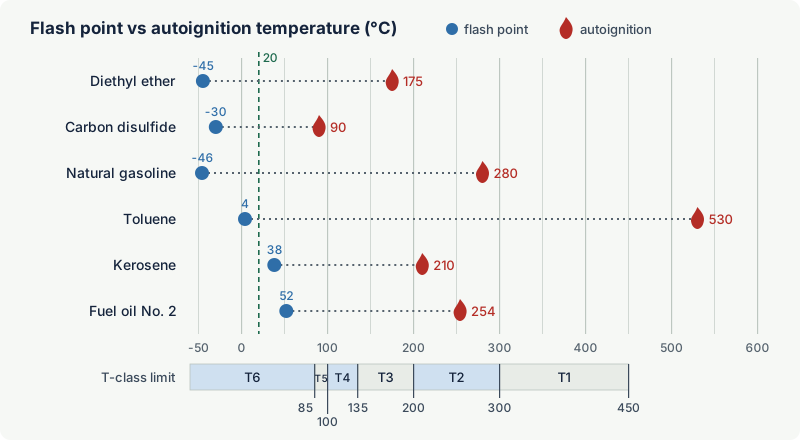
Example: A diesel generator stands on a skid with an uninsulated exhaust manifold. The fuel is similar to fuel oil No. 2: flash point 52 °C, AIT 254 °C. At ambient temperature the fuel tank does not produce an explosive vapour atmosphere, but a fine spray from a cracked fuel line onto a manifold well above the fuel's AIT can ignite without any spark. The control is not the flash point but surface temperature: shielding, insulation and routing fuel lines away from hot parts.
Minimum ignition energy: how small a spark?
What the MIE means
The minimum ignition energy is the lowest energy, stored in a capacitor and released as a spark, that ignites the most easily ignitable concentration of the substance in air under specified test conditions. It is expressed in millijoules (mJ). The most ignitable mixture is usually near or slightly richer than the stoichiometric ratio; close to the LEL or UEL, much more energy is needed.
Typical values
MIE values are small and spread over several orders of magnitude, so they are best compared on a logarithmic scale. Published values also vary with apparatus and electrode design. The figures below are the lowest values compiled in the CCPS (AIChE) guidance on static ignition; other references give hydrogen at about 0.016 to 0.02 mJ and methane at about 0.21 to 0.29 mJ.
What it means in practice: sparks and static electricity
- Static electricity is a real ignition source for almost all vapours. The energy stored on a charged object is E = ½ C V². A person with 300 pF capacitance charged to 10 kV stores 0.5 x 300 x 10^-12 x 10,000^2 = 0.015 J, or 15 mJ. This is an example calculation, not a fixed value: body capacitance is typically quoted as 100 to 300 pF and body voltages of about 10 kV or more occur, so a spark from a charged person is of the order of 10 mJ or more (German guidance TRGS 727 gives 7 to 15 mJ for 100 to 200 pF at 12 kV). That is 50 to 100 times the MIE of common solvent vapours. Bonding, earthing, antistatic footwear and flooring, and control of flow velocities are therefore standard measures (see static electricity as an ignition source).
- Mechanical and electrical sparks from tools, switches, relays and connectors easily exceed these energies, which is why ordinary electrical equipment is not allowed in hazardous areas.
- Gas groups follow ignition sensitivity. Substances with very low MIE, such as hydrogen, acetylene and carbon disulfide, belong to gas group IIC, which demands the strictest equipment design. The formal grouping uses the minimum igniting current (MIC) ratio and the maximum experimental safe gap (MESG), which correlate with MIE; see MESG and MIC.
- Oxygen enrichment lowers the MIE dramatically: the same compilation gives methane about 0.0027 mJ in pure oxygen, nearly eighty times lower than in air.
- Do not design to the MIE yourself. Energy-limited circuits are only acceptable when certified as intrinsically safe (Ex i), where the certification applies tested safety factors. The MIE is a hazard indicator, not a design limit.
Data for common solvents and fuel gases
Flash point, AIT and T-class come from the excodex gas library; for hydrogen, other compilations give AIT values of roughly 500 to 585 °C. MIE values are the lowest values in the CCPS compilation; values marked (calc.) were estimated by calculation in that source, and measured values reported elsewhere can be higher.
| Substance | Flash point (°C) | AIT (°C) | T-class | MIE (mJ) |
|---|---|---|---|---|
| Acetone | -20 | 539 | T1 | 0.19 (calc.) |
| Methanol | 9 | 440 | T2 | 0.14 |
| Ethanol | 12 | 400 | T2 | 0.23 (calc.) |
| Isopropyl alcohol | 12 | 399 | T2 | 0.21 (calc.) |
| Ethyl acetate | -4 | 470 | T1 | 0.23 (calc.) |
| Butanone (MEK) | -10 | 404 | T2 | 0.21 (calc.) |
| Hexane | -22 | 225 | T3 | 0.24 |
| n-Heptane | -7 | 204 | T3 | 0.24 |
| Cyclohexane | -17 | 244 | T3 | 0.22 |
| Toluene | 4 | 530 | T1 | 0.24 |
| Xylene (mixed isomers) | 25 | 464 | T1 | 0.2 |
| Benzene | -11 | 498 | T1 | 0.20 |
| Tetrahydrofuran | -14 | 230 | T3 | 0.19 (calc.) |
| Diethyl ether | -45 | 175 | T4 | 0.19 |
| Carbon disulfide | -30 | 90 | T6 | 0.009 |
| Methane | gas | about 600 | T1 | 0.21 |
| Propane | gas | 450 | T2 | 0.24 |
| Hydrogen | gas | 560 | T1 | 0.016 |
Two things stand out. First, MIE varies far less between ordinary solvents (roughly 0.1 to 0.3 mJ) than flash point and AIT do, so static control is needed for practically all of them. Second, T-class requirements are set by the substance with the lowest AIT in the area: one solvent such as diethyl ether or carbon disulphide can change the whole equipment selection.
Worked example: a solvent mixing room
A room is used to dilute paints with toluene and occasionally to clean parts with n-heptane. Room temperature is 20 °C.
- Flash point. Toluene (4 °C) and n-heptane (-7 °C) are both handled above their flash points. Open containers, spills and filling operations can produce an explosive atmosphere, so the room needs a hazardous area classification and ventilation assessment.
- Autoignition temperature. Toluene alone (AIT 530 °C) would allow T1 equipment, but n-heptane (AIT 204 °C) requires surface temperatures below 204 °C, so T3 equipment is needed. A heater or hot plate in the room must also stay below that value.
- Minimum ignition energy. Both vapours ignite at about 0.24 mJ, far below a static spark from a person. Containers, funnels and drums must be bonded and earthed during transfer, operators need antistatic footwear on a dissipative floor, and plastic containers and filling hoses must be selected with care.
- Gas group. Both are IIA substances, so IIA equipment is sufficient, but equipment marked IIB or IIC is also acceptable.
Each property controls a different part of the design. Missing any one of them leaves an ignition path open.
Common mistakes
- Confusing flash point with ignition temperature. A flash point of 60 °C does not mean the liquid needs 60 °C to ignite on a hot pipe; its AIT may be around 250 °C, or lower. Use AIT for hot surfaces and flash point for vapour formation.
- Selecting the T-class from the flash point. T-class depends only on the AIT of the gases and vapours present, never on flash point.
- Assuming a liquid below its flash point is always safe. Mists, sprays, foams, heated process conditions and mixtures with lighter components can all produce an explosive atmosphere below the nominal flash point.
- Comparing open-cup and closed-cup values. Open-cup results are higher. For safety decisions use closed-cup data.
- Treating a spark "below the MIE" as safe. The MIE is measured under optimum conditions in a laboratory; real sparks vary. Energy limitation is only valid through certified intrinsic safety.
- Mixing data sources. AIT and MIE values differ by source and method. Use one consistent data set and record it in the area classification or explosion protection document.
Frequently asked questions
What is the difference between flash point and autoignition temperature?
Flash point is the lowest temperature at which a liquid produces enough vapour to be ignited by an external flame or spark. Autoignition temperature is the lowest temperature at which the vapour-air mixture ignites by itself, with no flame or spark, for example on a hot surface. Flash point is usually tens to hundreds of degrees lower than the AIT, and one cannot be estimated from the other.
Why does diesel have a higher flash point but a lower autoignition temperature than petrol?
Petrol contains light, volatile components that evaporate easily, giving a flash point far below 0 °C. Diesel-type fuels have heavier molecules that evaporate less, so their flash point is above 50 °C, but those heavier molecules break down and react more easily when heated, so their AIT is lower. In the excodex library, fuel oil No. 2 has an AIT of 254 °C and natural gasoline 280 °C.
Do gases have a flash point?
No. Flash point describes how much vapour a liquid releases at a given temperature. A gas such as methane, propane or hydrogen is already fully in the gas phase, so the concept does not apply; for gases, the LEL, AIT and MIE are the relevant values. Liquefied gases are sometimes given very low flash points on data sheets, but in practice they are treated as gases.
Which T-class do I need for a substance?
Choose a T-class whose maximum surface temperature is below the autoignition temperature of every gas or vapour that can be present. For example, n-heptane with an AIT of 204 °C needs T3 (200 °C) or better, while diethyl ether at 175 °C needs T4 (135 °C). Equipment with a higher T-class number (cooler) is always acceptable.
How much energy is in a static spark from a person?
It depends on the body capacitance and the voltage, through E = ½CU². With typical body capacitances of 100 to 300 pF and voltages of about 10 kV or more, the result is of the order of 10 mJ or more; for example, 300 pF at 10 kV gives 15 mJ. That is far above the MIE of nearly all flammable gases and vapours, typically 0.01 to 0.3 mJ, which is why personnel earthing matters in solvent areas.
Is a low minimum ignition energy the same as a low autoignition temperature?
No. Hydrogen has one of the lowest MIEs (about 0.016 mJ) but a high AIT of 560 °C in the excodex library (other compilations give roughly 500 to 585 °C), so tiny sparks ignite it easily while moderately hot surfaces do not. Carbon disulphide is unusual in having both a very low MIE (0.009 mJ) and a very low AIT (90 °C).
Related on excodex
- LEL and UEL explained
- Temperature classes T1 to T6
- Static electricity as an ignition source
- Flammable mists and sprays
- How to find the gas group and temperature class of a substance
- Gas and solvent library: /gas; standards space IEC 60079-20-1; Ex marking check /tools/ex
Standards and further reading
- ISO/IEC 80079-20-1, Explosive atmospheres: material characteristics for gas and vapour classification, test methods and data (replaced IEC 60079-20-1 in 2017; IEC record: https://webstore.iec.ch/en/publication/635).
- ISO 13736 (Abel closed cup) and ISO 2719 (Pensky-Martens closed cup), flash point test methods.
- ASTM E659, Standard test method for autoignition temperature of chemicals: https://store.astm.org/e0659-15r23.html
- IEC 60079-0, general requirements for equipment, including temperature classes.
- IEC TS 60079-32-1, guidance on electrostatic hazards.
- US OSHA Hazard Communication Standard, Appendix B, flammable liquid categories: https://www.osha.gov/laws-regs/regulations/standardnumber/1910/1910.1200AppB
- CCPS (AIChE), corrections to the static ignition guidance book, including its table of minimum ignition energies: https://www.aiche.org/sites/default/files/book-errata/Errata_for_Avoiding_Static_Ingnition_1_10_09_03.pdf
- J. M. Kuchta, Investigation of fire and explosion accidents in the chemical, mining, and fuel-related industries, US Bureau of Mines Bulletin 680, NIOSH library: https://stacks.cdc.gov/view/cdc/219653
- Area classification of flammable mists: summary of joint-industry project findings, IChemE Hazards 26 (2016): https://www.icheme.org/media/11775/hazards-26-paper-38-area-classification-of-flammable-mists-summary-of-joint-industry-project-findings.pdf
- Experimental determination of flash points of flammable liquid aqueous solutions, Chemical Engineering Transactions 31 (2013): https://core.ac.uk/download/52665088.pdf
This article is general technical information prepared by the excodex editorial team. It does not replace the applicable standards, the equipment certificates and instructions, national regulations or the assessment of a competent person.