Flammable liquids classification under GHS/CLP and what it means for hazardous areas
Abstract
GHS and EU CLP classify flammable liquids by flash point and initial boiling point into Category 1 (H224), 2 (H225) and 3 (H226); GHS adds Category 4. What the categories mean, how they map to older systems, and why handling temperature and mists decide the hazardous area.
Under the UN Globally Harmonized System (GHS) and the EU CLP Regulation, a flammable liquid is classified by its closed-cup flash point and its initial boiling point. Category 1 (flash point below 23 °C, initial boiling point 35 °C or lower) carries H224 "Extremely flammable liquid and vapour"; Category 2 (flash point below 23 °C, boiling point above 35 °C) carries H225 "Highly flammable liquid and vapour"; Category 3 (flash point 23 to 60 °C) carries H226 "Flammable liquid and vapour". The GHS also has a Category 4 (flash point above 60 up to 93 °C, H227 "Combustible liquid"), which the EU does not use. For hazardous areas the category is only a first indicator: what decides whether an explosive atmosphere can form is whether the liquid is handled above its flash point, heated, sprayed or released under pressure.
This article sets out the criteria and label elements, explains how the older "extremely flammable / highly flammable / flammable" system and other schemes map onto them, and shows how to use the classification when assessing hazardous areas, including heated liquids and mists.
Key points
- GHS and CLP classify flammable liquids by two numbers only: the closed-cup flash point and the initial boiling point. The thresholds are 23 °C and 60 °C (93 °C for GHS Category 4) for flash point and 35 °C for boiling point.
- Categories 1 and 2 carry the flame pictogram and the signal word "Danger"; Category 3 carries the flame pictogram and "Warning". GHS Category 4 (used, for example, under the US OSHA Hazard Communication Standard) has no pictogram.
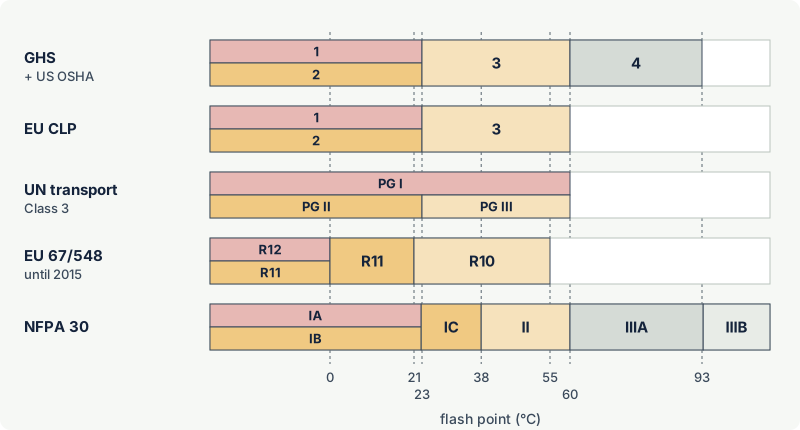
- The EU's old system (Directive 67/548/EEC, repealed on 1 June 2015) used "extremely flammable" (R12), "highly flammable" (R11) and "flammable" (R10) with thresholds of 0 °C, 21 °C and 55 °C; the categories do not map one to one.
- A liquid handled at or above its flash point can form an explosive vapour atmosphere above its surface and around leaks. Category 1 liquids, and most Category 2 liquids, are above their flash point at normal ambient temperatures; a Category 2 liquid with a flash point near 20 °C may be just below it on a cool day.
- The European Commission's non-binding guide to Directive 1999/92/EC suggests that keeping the liquid surface about 5 °C below the flash point is usually adequate for pure solvents and about 15 °C for solvent mixtures.
- Sprays and mists can ignite well below the flash point. Unclassified or Category 3 and 4 liquids released under pressure need their own assessment.
- The category says nothing about gas group or temperature class. Those come from the substance's MESG and autoignition temperature.
The GHS and CLP criteria
| Category | Flash point (closed cup) | Initial boiling point | Hazard statement | Signal word | Pictogram |
|---|---|---|---|---|---|
| 1 | below 23 °C | 35 °C or lower | H224 Extremely flammable liquid and vapour | Danger | GHS02 flame |
| 2 | below 23 °C | above 35 °C | H225 Highly flammable liquid and vapour | Danger | GHS02 flame |
| 3 | 23 °C to 60 °C | not used | H226 Flammable liquid and vapour | Warning | GHS02 flame |
| 4 (GHS only) | above 60 °C up to 93 °C | not used | H227 Combustible liquid | Warning | none |
The GHS defines a flammable liquid as one with a flash point of not more than 93 °C; CLP stops at 60 °C because the EU did not adopt Category 4. The US OSHA Hazard Communication Standard and its flammable liquids rule (29 CFR 1910.106) use all four categories. Aerosols are not classified as flammable liquids; they have their own hazard class.
Examples
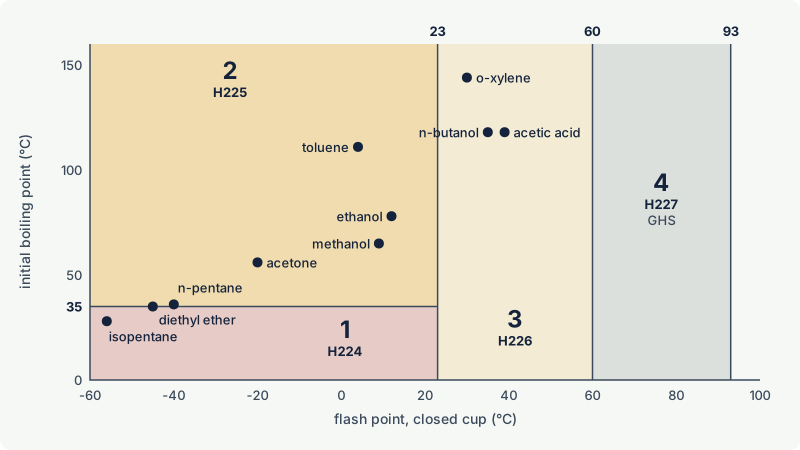
Applying the criteria to common solvents gives the following (flash points from the excodex library, boiling points from the IEC material data tables):
| Substance | Flash point | Boiling point | Category | Hazard statement |
|---|---|---|---|---|
| Isopentane | -56 °C | 28 °C | 1 | H224 |
| Diethyl ether | -45 °C | 35 °C | 1 | H224 |
| n-Pentane | -40 °C | 36 °C | 2 | H225 |
| Acetone | -20 °C | 56 °C | 2 | H225 |
| Toluene | 4 °C | 111 °C | 2 | H225 |
| Methanol | 9 °C | 65 °C | 2 | H225 |
| Ethanol | 12 °C | 78 °C | 2 | H225 |
| o-Xylene | 30 °C | 144 °C | 3 | H226 |
| n-Butanol | 35 °C | 118 °C | 3 | H226 |
| Acetic acid | 39 °C | 118 °C | 3 | H226 |
Two practical lessons follow. First, almost all common solvents are Category 2: a low flash point alone does not make a liquid Category 1, only a boiling point at or below 35 °C does. Second, substances close to a boundary are classified inconsistently. In the European Chemicals Agency (ECHA) classification and labelling inventory, as summarised by PubChem, most notifiers classify n-pentane (boiling point about 36 °C) as Category 2, but a minority as Category 1. The safety data sheet in hand is what the supplier has decided; check section 2 (classification) against section 9 (physical data).
How flash point and boiling point are determined
- Closed cup only. CLP requires a closed-cup method for the flash point. Open-cup values are usually higher and are not used for classification.
- Mixtures. The flash point of a mixture may be calculated instead of measured, but CLP accepts the calculated value only if it is at least 5 °C above the relevant threshold, and only under conditions such as a known composition and a homogeneous liquid phase. Small amounts of a volatile component can lower the flash point of a mixture a great deal.
- Sustained combustibility. Under CLP, liquids with a flash point above 35 °C and up to 60 °C need not be classified in Category 3 if they give negative results in the sustained combustibility test (UN test L.2). Transport rules have a similar relief.
- Gas oils, diesel and light heating oils with a flash point between 55 °C and 75 °C may be classified in Category 3 under CLP, even though part of that range lies above 60 °C.
Note: The relief for liquids that do not sustain combustion is a supply-labelling rule. The EU Seveso III Directive states that it does not hold under elevated conditions such as high temperature or pressure, and the same reasoning applies to area classification.
Older and parallel classification systems
Many plants still have drawings, drum labels, permits and procedures written with the old terms. The figure compares the main schemes on a flash point scale.
The old EU system (Directive 67/548/EEC)
Until the CLP Regulation replaced it (Directive 67/548/EEC was repealed with effect from 1 June 2015), the EU used three classes with their own symbols and risk phrases:
| Old class | Criteria | Usual CLP equivalent |
|---|---|---|
| Extremely flammable (F+, R12) | Flash point below 0 °C and boiling point 35 °C or lower | Category 1 (H224) |
| Highly flammable (F, R11) | Flash point below 21 °C, not extremely flammable | Category 2 (H225), or Category 1 if the boiling point is 35 °C or lower |
| Flammable (R10) | Flash point 21 °C to 55 °C | Category 3 (H226), but Category 1 or 2 if the flash point is 21 to 22 °C |
The French national institute for industrial environment and risks (INERIS) summarises this correspondence. The important consequences are that "highly flammable" under the old system can be Category 1 under CLP, and that liquids with a flash point between 55 and 60 °C, previously unclassified, are now Category 3. Area classification studies written with the old 55 °C limit in mind may not have considered them.
UN transport, US OSHA and NFPA 30
- Transport of dangerous goods (UN Model Regulations, ADR, IMDG, US 49 CFR): Class 3 covers liquids with a closed-cup flash point of 60 °C or lower, and liquids carried at or above their flash point. Packing group I applies to an initial boiling point of 35 °C or lower, group II to a flash point below 23 °C with a higher boiling point, group III to a flash point of 23 to 60 °C. The criteria are close to the GHS, but not identical.
- US OSHA: since the 2012 alignment with the GHS, 29 CFR 1910.106 uses Categories 1 to 4. Before that it used the classes IA, IB, IC, II and III, which NFPA 30 still uses: Class I below 37.8 °C (100 °F), split by a 22.8 °C (73 °F) flash point and a 37.8 °C boiling point; Class II 37.8 to 60 °C; Class IIIA 60 to 93 °C; Class IIIB 93 °C and above.
- Major-accident rules: the Seveso III Directive uses the CLP categories but adds handling conditions. Category 1 liquids, and Category 2 or 3 liquids kept above their boiling point, fall into the most stringent flammable liquid entry (P5a); Category 2 or 3 liquids under processing conditions such as high pressure or high temperature fall into P5b.
What the category means for hazardous areas
A supply classification describes the substance in a container at normal conditions. Area classification (IEC 60079-10-1; in the EU required by Directive 1999/92/EC) describes where and how often an explosive atmosphere can occur in a specific plant. The link between the two is the flash point compared with the actual temperature of the liquid.
| Classification | What it means at normal ambient temperature | Typical consequence for area classification |
|---|---|---|
| Category 1 (H224) | Far above its flash point and close to boiling. On a warm day or in a warm process it boils and behaves almost like a liquefied gas. | Vapour around every open surface, vent and leak; large vapour release rates; tank breathing and filling produce frequent releases |
| Category 2 (H225) | Usually above its flash point (below 23 °C); those with flash points near 20 °C sit close to it | Explosive atmosphere above open surfaces, at vents, around leaks and spills: zones are normally needed wherever the liquid is handled |
| Category 3 (H226) | Can be above or below its flash point depending on ambient and process temperature | Assess the maximum liquid temperature against the flash point; hot climates, sun on tanks and heated processes often bring it above |
| Category 4 or unclassified | Below its flash point at normal temperatures | Zones are needed only where the liquid is heated towards its flash point, kept hot, or released as a spray or mist |
Keep a margin to the flash point
A flash point is a laboratory value with an uncertainty, and the temperature of a liquid surface varies. The European Commission's non-binding guide to good practice for implementing Directive 1999/92/EC suggests that the concentration above a liquid stays below the lower explosive limit if the surface temperature is always kept far enough below the flash point, and gives about 5 °C as usually adequate for pure solvents and about 15 °C for solvent mixtures. US OSHA uses a similar idea in law: a Category 4 liquid heated for use to within 16.7 °C (30 °F) of its flash point must be handled as a Category 3 liquid.
Other properties come from other data
The category does not tell you the gas group, the temperature class or the vapour behaviour. A few examples from the excodex library:
- Diethyl ether (Category 1) is gas group IIB and needs temperature class T4 (autoignition temperature 175 °C).
- Acetone (Category 2) is IIA and T1.
- Kerosene (Category 3, flash point 38 °C) is IIA but needs T3 because its autoignition temperature is only 210 °C. A "less flammable" category does not mean a less demanding temperature class.
Take these values from ISO/IEC 80079-20-1 data or a maintained database, and record the source in the area classification documents.
Liquids handled above their flash point
The label describes the liquid at ambient temperature; the hazard depends on the temperature at which it actually escapes. Typical situations where a liquid is handled above its flash point:
- Heated processes: reactors, distillation, heated storage of viscous products, dryers, heat transfer fluid systems. A Category 3 liquid at 80 °C, or a Category 4 liquid heated above its flash point, behaves like a Category 2 liquid at ambient temperature.
- Hot climates and solar heating: drums and tank shells in direct sun can be far warmer than the air, which puts Category 3 liquids with flash points around 30 to 40 °C above their flash point for much of the year.
- Liquids kept above their boiling point under pressure (for example in a hot column) flash on release and form a vapour and droplet cloud much larger than a pool would produce; Seveso III puts them in its most stringent flammable liquid entry.
For these cases, IEC 60079-10-1 treats the release on the basis of the actual process conditions: a vapour release, an evaporating pool, a flashing liquid or a liquid that is boiling. The supply label does not enter the calculation.
Mists and sprays: below the flash point
A fine spray is not limited by vapour pressure: the droplets themselves burn. Mists can therefore ignite at temperatures well below the flash point of the liquid.
- IEC 60079-10-1 notes in its scope that flammable mists can form when liquids not considered hazardous because of their high flash point are released under pressure, and that its methods for gas and vapour do not then apply directly. An informative annex gives guidance on mists.
- The European Commission guide to Directive 1999/92/EC warns that explosive atmospheres can form below the flash point when liquids are dispersed into droplets, for example by spraying, and lists high-pressure systems such as hydraulics as a case to consider.
- Test evidence: in a joint industry project by the UK HSE and Cardiff University (published 2016), a kerosene-type jet fuel (flash point 38 °C) sprayed through a 1 mm hole ignited at ambient temperature at every pressure tested, from 1.7 to 20 barg. A light fuel oil (flash point 81 °C) did not ignite at ambient temperature up to 20 barg, but did ignite from 5 to 20 barg when preheated to 70 °C, still below its flash point. A hydraulic oil showed no sustained ignition up to 130 barg. Atomisation mattered as much as flash point.
- An earlier HSE literature review (research report RR980) identified pressurised sprays and condensation aerosols as the most likely sources of flammable mists, and found no established method for classifying areas around them.
In practice: high-pressure lubricating, hydraulic, fuel and heat transfer oil systems, spray painting and spray cleaning, and hot oil leaking onto cooler air all need a mist assessment, whatever the GHS category.
Worked example: one liquid, three situations
A plant uses n-butanol: flash point 35 °C, boiling point 118 °C, Category 3, H226; gas group IIA, autoignition temperature 343 °C, temperature class T2.
- Drum store at 15 to 25 °C. The liquid stays at least 10 °C below its flash point, more than the 5 °C margin suggested for a pure solvent, so no explosive vapour atmosphere is expected above a spill under normal conditions. If the store can exceed about 30 °C (summer, heating), the margin is gone.
- Reactor heated to 80 °C. The liquid is 45 °C above its flash point. The headspace is within the flammable range unless it is inerted, and vents, sample points, manways and seals around the reactor are release sources. Zones are assigned as for a Category 2 solvent, with equipment at least IIA T2 (and the usual practice of meeting the most demanding substance present in the area).
- Transfer pump at 6 barg. A flange or seal leak can produce a spray. Even at 20 °C, a fine mist of a liquid with a 35 °C flash point can be ignitable. The pump area needs a mist assessment, spray guards or flange shields where appropriate, and attention to hot surfaces nearby.
The same label covers a non-hazardous store and two hazardous areas. That is why area classification starts from process conditions, not from the hazard statement.
Common mistakes and misconceptions
- "Category 3 is safe to use with ordinary electrical equipment." Only if the liquid always stays well below its flash point and cannot form a mist. Heated, sunlit or pressurised Category 3 liquids create hazardous areas.
- Treating unclassified (flash point above 60 °C) liquids as non-flammable. Diesel, fuel oils, lubricating and heat transfer oils burn, can be heated above their flash point and can form ignitable mists.
- Reading old and new labels as equivalent. "Highly flammable" (R11) can be Category 1, and "flammable" (R10) stopped at 55 °C, so liquids between 55 and 60 °C were outside the old system.
- Taking gas group or temperature class from the hazard statement. H224, H225 and H226 say nothing about MESG or autoignition temperature; take those from material data.
- Assuming a liquid below its flash point cannot be ignited. Mists, foams, wicks (liquid soaked into insulation or rags) and thin films on hot surfaces can all burn below the bulk flash point.
Frequently asked questions
What is the difference between H224, H225 and H226?
They are the hazard statements for flammable liquids of Categories 1, 2 and 3 under GHS and CLP. H224 (extremely flammable) applies to liquids with a flash point below 23 °C and an initial boiling point of 35 °C or lower; H225 (highly flammable) to a flash point below 23 °C and a higher boiling point; H226 (flammable) to a flash point from 23 to 60 °C. H224 and H225 use the signal word "Danger", H226 "Warning".
Does an H226 liquid need a hazardous area?
Not automatically. An H226 liquid has a flash point between 23 and 60 °C, so whether it forms an explosive vapour atmosphere depends on the temperature at which it is handled and stored, including heating, solar gain and hot climates. If it can reach its flash point, or can be released as a spray or mist, the area must be classified.
What does "extremely flammable" mean under the old EU system?
Under Directive 67/548/EEC, "extremely flammable" (symbol F+, risk phrase R12) meant a liquid with a flash point below 0 °C and a boiling point of 35 °C or lower. It corresponds closely to today's Category 1 (H224). The old "highly flammable" (F, R11) and "flammable" (R10) classes used thresholds of 21 °C and 55 °C, so they do not map exactly onto Categories 2 and 3.
What is a GHS Category 4 flammable liquid?
It is a liquid with a flash point above 60 °C and up to 93 °C, labelled H227 "Combustible liquid" with the signal word "Warning" and no pictogram. The category exists in the GHS and is used under the US OSHA rules, but not in the EU CLP Regulation. These liquids create hazardous areas mainly when heated close to their flash point or sprayed.
Can a liquid ignite below its flash point?
Yes, if it is dispersed as a mist or spray, soaked into a wick such as insulation, or spread as a thin film on a hot surface. Tests by HSE and Cardiff University ignited kerosene sprays at ambient temperature and a preheated fuel oil spray below its flash point. Flash point describes the vapour above a bulk liquid, not droplets.
Related on excodex
- Flash point, autoignition temperature and minimum ignition energy
- Flammable mists and sprays: the overlooked explosion hazard
- How to carry out a gas hazardous area classification step by step
- How to find the gas group and temperature class of a substance
- Laboratories, workshops and small quantities: when is a hazardous area needed?
- Gas and solvent library with flash points: /gas; standards spaces IEC 60079-10-1, ISO/IEC 80079-20-1 and ATEX 1999/92/EC; questions in the forum
Standards and further reading
- Regulation (EC) No 1272/2008 (CLP), Annex I, section 2.6 (flammable liquids): criteria, label elements and additional considerations: https://reachonline.eu/clp/en/annex-i-2-2.6-2.6.2.html
- US OSHA Hazard Communication Standard, Appendix B (physical hazard criteria): https://www.osha.gov/laws-regs/regulations/standardnumber/1910/1910.1200AppB
- US OSHA 29 CFR 1910.106, flammable liquids: https://www.osha.gov/laws-regs/regulations/standardnumber/1910/1910.106
- PubChem summary of GHS hazard statements: https://pubchem.ncbi.nlm.nih.gov/ghs/
- US 49 CFR 173.121, Class 3 packing group assignment: https://www.law.cornell.edu/cfr/text/49/173.121
- Directive 2012/18/EU (Seveso III), Annex I: https://www.legislation.gov.uk/eudr/2012/18/annex/I
- European Commission, Non-binding guide to good practice for implementing Directive 1999/92/EC (ATEX workplace directive): https://publications.europa.eu/en/publication-detail/-/publication/c23f5429-1632-4b61-9eb1-a6c0e60828e0
- INERIS, flammable liquids fact sheet with the correspondence between old and CLP classes (in French): https://primarisk.ineris.fr/sites/default/files/6_Fiche_liquide_inflammable_v2_0.pdf
- IEC 60079-10-1, classification of areas, explosive gas atmospheres (includes an annex on flammable mists).
- ISO/IEC 80079-20-1, material characteristics for gas and vapour classification (flash point, boiling point, gas group and autoignition data).
- Gant et al., Area classification of flammable mists: summary of joint-industry project findings, IChemE Hazards 26 (2016): https://www.icheme.org/media/11775/hazards-26-paper-38-area-classification-of-flammable-mists-summary-of-joint-industry-project-findings.pdf
- UK HSE Research Report RR980, Generation of flammable mists from high flashpoint fluids: literature review: https://www.hse.gov.uk/research/rrhtm/rr980.htm
This article is general technical information prepared by the excodex editorial team. It does not replace the applicable standards, the equipment certificates and instructions, national regulations or the assessment of a competent person.