Laboratories, workshops and small quantities: when is a hazardous area needed?
Abstract
Small quantities of solvents and gases do not automatically need hazardous zones, but the decision must be justified. Zone NE, the 10 litre rule, fume cupboards, solvent cabinets, aerosol cans and a practical approach for labs and workshops.
Small quantities of flammable liquids and gases do not automatically create a hazardous area, but they do not automatically avoid one either. A zone is needed where an explosive atmosphere can form in a quantity that would cause harm if it ignited. In most laboratories and workshops that work with litre-scale solvents, fume cupboards and closed containers, a documented risk assessment concludes that no zones, or only zones of negligible extent (Zone 2 NE and similar), are needed, while a few places such as the inside of solvent cabinets, extract ducts, drains and pilot plants still need classification. There is no legal quantity below which the question can be skipped.
This article explains the "hazardous quantity" concept, zones of negligible extent under IEC 60079-10-1, the scales of laboratory work in UK and German guidance, fume cupboards, solvent cabinets, refrigerators, aerosol cans and workshops, and a step-by-step approach with a worked example.
Key points
- The ATEX workplace directive and UK DSEAR set no minimum quantity of flammable substance. What matters is whether an explosive atmosphere can occur in such quantities that special precautions are needed.
- European Commission guidance treats a continuous volume of more than 10 litres of explosive atmosphere in an enclosed space as hazardous whatever the size of the room, and gives a rule of thumb of one ten-thousandth of the room volume (8 litres in a room of 80 m³).
- IEC 60079-10-1:2020 allows a zone of negligible extent (Zone 0 NE, Zone 1 NE or Zone 2 NE) where an ignition would have negligible consequences; as quoted in a 2023 HySafe conference paper, its example for natural gas is a cloud of average concentration 50 % of the LFL smaller than 0.1 m³ or 1 % of the enclosed space, whichever is smaller.
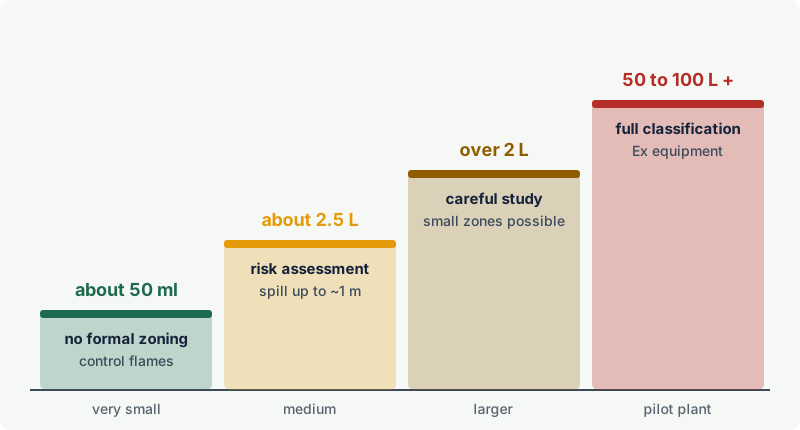
- UK HSE guidance considers formal zoning inappropriate for very small scale work (up to about 50 ml), expects risk assessment for medium scale work (up to about a 2.5 litre bottle on the bench) and more careful study above about 2 litres and at pilot scale.
- German laboratory guidance states that work with small quantities of flammable liquids in a properly working fume cupboard normally needs no zone, because the extract air dilutes the vapour.
- HSE guidance takes the inside of a cabinet storing low flash point liquids as Zone 2 and recommends no more than 50 litres of such liquids in workroom cabinets.
- Whether or not zones are designated, ignition sources near flammable liquids and gases must be controlled, and a decision not to zone must be written down and justified.
No minimum quantity, but a hazardous quantity
The workplace directive 1999/92/EC, and national laws based on it such as the UK Dangerous Substances and Explosive Atmospheres Regulations (DSEAR), define a hazardous place as one where an explosive atmosphere may occur in such quantities as to require special precautions to protect workers. There is no quantity threshold, so a laboratory is not exempt by definition, but it may conclude after assessment that no explosive atmosphere of a hazardous size can form.
The European Commission's non-binding guide to the directive gives the most quoted yardsticks:
- A continuous volume of more than 10 litres of explosive atmosphere in an enclosed space must always be regarded as hazardous, irrespective of the size of the room.
- As a rough rule of thumb, an explosive atmosphere in a room is potentially hazardous if it occupies more than one ten-thousandth of the room volume, only 8 litres in a room of 80 m³. This does not make the whole room hazardous, only the part where the atmosphere can form.
- Inside vessels that cannot withstand the explosion pressure, much smaller volumes are hazardous because of flying debris; no lower limit can be given.
- Exceptions may apply to work with very small quantities, for example in laboratories, decided on the local and operational conditions.
The guide also illustrates how little fuel it takes: one litre of liquid propane, evaporated and diluted to its lower explosive limit (LEL), makes about 13,000 litres of explosive atmosphere. For a solvent the arithmetic is similar. Ten litres of acetone vapour-air mixture at its LEL of 2.5 % contains 0.25 litres of vapour, about 0.6 g, which is less than one millilitre of liquid. The amount of liquid is therefore a poor guide on its own. What decides the hazard is how fast the vapour is released, how quickly it is diluted and how large the cloud above the LEL can become.
Zones of negligible extent (NE)
IEC 60079-10-1:2020 (edition 3) defines a zone of negligible extent as a zone in which an ignition, if it occurred, would have negligible consequences. The notation follows the zone type it would otherwise be: Zone 0 NE, Zone 1 NE or Zone 2 NE. The 2020 edition added a dedicated subclause on the concept. Its clause text is not public; the points below follow the summary and quotation in a 2023 HySafe conference paper from the MultHyFuel hydrogen refuelling project, in paraphrase:
- The concept covers cases where the release is negligible, or where the released quantity is negligible compared with the volume it disperses into.
- As an example for natural gas, a cloud with an average concentration of 50 % of the lower flammable limit (LFL) can be taken as negligible if its volume is less than 0.1 m³ or 1 % of the enclosed space concerned, whichever is smaller.
- Ignition of the cloud must not cause harmful overpressure or heat.
- Pressure limits, as the paper reports them: for releases from systems above 2000 kPa gauge (20 barg) Zone NE is not to be applied unless a specific detailed risk assessment documents otherwise, and between 1000 and 2000 kPa gauge (10 to 20 barg) consideration is to be given to such an assessment. The paper notes that the standard does not define what that assessment must contain.
In practice a zone of negligible extent is treated as non-hazardous for equipment selection, but it is not a shortcut. It must be justified by the release and ventilation assessment, documented, and not used where even a small flash could injure people, for example in a confined space. National guidance and industry codes can restrict its use further. The example values are for natural gas. According to the same HySafe paper, the standard allows the reference volumes to be scaled for other gases by comparing properties such as heat of combustion, maximum explosion pressure and rate of pressure rise with methane; scaling by the rate of pressure rise, the authors arrived at 0.01 m³ or 0.1 % of the enclosed space for hydrogen, ten times smaller than the natural gas example. More on the ventilation side in ventilation in area classification.
Laboratories: what the guidance says
Scale of work
The UK Health and Safety Executive (HSE) groups laboratory work with flammable liquids by scale:
| Scale | Typical quantity | HSE approach | Typical outcome |
|---|---|---|---|
| Very small | Up to about 50 ml | Spills can be mopped up and a small fire may burn out before anyone is harmed; formal zoning is inappropriate if the risk assessment confirms this | No zones; keep naked flames and strong ignition sources away |
| Medium | Up to about 2.5 litres (a Winchester bottle) on the open bench | A spill can spread an explosive atmosphere up to about 1 m radius but only a small height above the liquid; control ignition sources, retain spills, secure glassware, supervise | Usually no zones if precautions are in place and documented |
| Larger | Above about 2 litres in apparatus | Glassware failure, temporary hoses and heated vessels need careful study; semi-enclosure and forced extraction can limit any zone | Zones of very small or negligible extent, sometimes defined zones |
| Pilot plant | About 50 to 100 litres or more | Full hazardous area classification | Zones and Ex equipment likely |
German laboratory guidance (DGUV Information 213-851, the English edition of the guidelines whose core provisions are adopted in TRGS 526) comes to a similar view. The hazard assessment normally shows that no explosion zones need to be designated in a laboratory. When flammable liquids are handled in a fume cupboard in the small quantities usual in laboratories, at or below atmospheric pressure, even above their flash point, the extract air at full capacity can normally be assumed to dilute the vapour enough that no zone is needed inside. Some work, however, will need zones and an explosion protection document.
Both stress that ignition sources must be controlled in any case. HSE notes that ignition-protected versions of common laboratory electrical equipment (hot plates, heating mantles, stirrer controllers) may not exist, which is exactly why quantities, containment and supervision carry the load.
Fume cupboards
A fume cupboard (EN 14175) is a containment device and also the main explosion protection measure in a laboratory, because it dilutes vapour at the source.
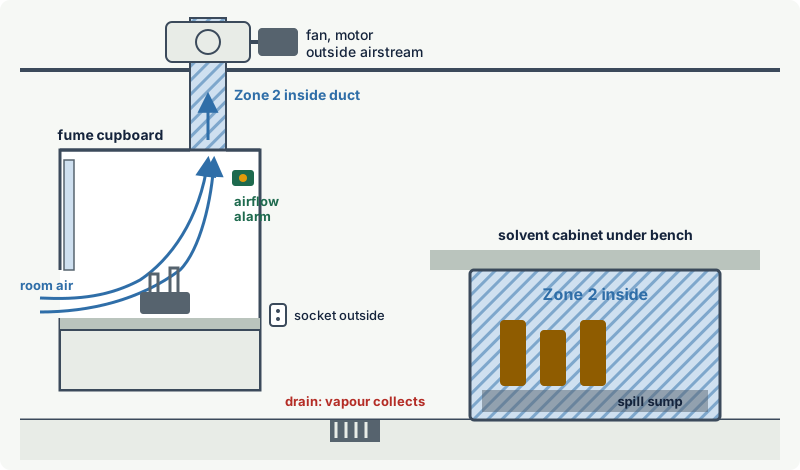
- Airflow monitoring. German rules require each fume cupboard to have automatic airflow monitoring with an optical and acoustic alarm that cannot be switched off. Without working extraction, the dilution argument no longer holds.
- Sash. Closing the sash protects the user and helps contain a small fire. Working with the sash open reduces containment.
- No storage inside. HSE warns against storing flammable chemicals in a fume cupboard used for experiments: in a small fire, failing bottles can release enough vapour to overwhelm the extract.
- Ignition sources inside. Hot plates, stirrers and heating mantles inside the cupboard are close to the release. German rules call for sockets outside the cupboard, or switchable from outside where one is needed inside.
- Extract ducts and fans. For mechanical extract systems carrying flammable vapour, HSE guidance on storage normally takes the inside of the ductwork as Zone 2, keeps the fan motor outside the duct and expects the fan impeller, casing and couplings to be suitable for that zone.
Refrigerators, ovens and instruments with flames
Enclosed spaces turn a small release into an explosion rather than a fire. HSE reports refrigerators exploding in laboratories when a light switch or thermostat contact sparked, and prefers units designed for flammables, with sparking components sealed from the interior, to designating the inside as a zone. German guidance requires such refrigerators to have no ignition sources inside, and labels on all others prohibiting flammable contents. Drying ovens need heating elements below the ignition temperature of the vapour or ventilation that prevents a build-up. Instruments with internal flames need a specific assessment; where the maximum leak is very small the atmosphere is of negligible extent.
Gases in the laboratory
HSE does not regard low-pressure mains gas pipes in domestic and similar premises as creating hazardous areas, but notes that laboratory gas pressures are often well above the 75 mbar typical of mains gas. Laboratory gases are also often unodorised and supplied through temporary hoses and regulators that can fail. The assessment should cover the largest leak the ventilation can dilute, leak detection and out-of-hours conditions. For liquefied flammable gases, HSE suggests good ventilation always and a Zone 2 where a liquid release is foreseeable and would not be dispersed quickly.
Solvent storage cabinets
In Europe they are built to EN 14470-1, which classifies them by fire resistance time from 15 to 90 minutes; doors close automatically in a fire. In the US, OSHA limits a single cabinet to 60 gallons of Category 1, 2 or 3 flammable liquids or 120 gallons of Category 4 liquids.
For area classification, HSE guidance (HSG51) says that the whole inside of a cabinet or bin used for lower flash point liquids should normally be taken as Zone 2. Nothing electrical belongs inside unless it is suitable for that zone, and if the cabinet is connected to an extract system, the ductwork and fan follow the same logic as other extract systems. HSG51 also recommends:
- spill retention of 110 % of the largest container;
- no more than 50 litres in cabinets and bins in a workroom for extremely flammable and highly flammable liquids and those with a flash point below the maximum ambient temperature, and no more than 250 litres for other flammable liquids with a flash point up to 60 °C; larger quantities need a recorded justification;
- location in a well-ventilated area away from the immediate process and not on escape routes.
German guidance limits flammable liquids with a flash point below 55 °C kept at the workplace for daily use to vessels of no more than 1 litre, with larger working quantities (breakable vessels up to 5 litres, other vessels up to 10 litres) kept in a protected place such as an EN 14470-1 cabinet. Safety cabinets should be inspected regularly, at least once a year being advisable, with attention to door closers, seals and the air exchange.
Workshops, aerosol cans and small trades
Aerosol cans
Most aerosol cans use a liquefied flammable gas such as butane, propane or dimethyl ether as propellant, and many contain flammable liquids as well. Damaged and falling cans leak, and a pallet of aerosols can produce a rapid, major fire. HSE accepts that an aerosol warehouse need not be Zone 2 if the aerosol industry's safe storage guide is closely followed, and says it should normally be classed as Zone 2 if those conditions cannot be met. In workshops the questions are about use: spraying many cans in a small unventilated space or inside a vehicle, and puncturing used cans for disposal, both release propellant near people and ignition sources.
Small trades and workshops
HSE's advice for nail technician workrooms is a model for small trades open to the public: it considers hazardous area classification inappropriate there and relies instead on limiting the workroom stock to about half a day's use, containers that do not break when knocked over, and less flammable products. Vehicle and maintenance workshops add a further point: the European guide notes that unventilated places below ground level, such as trenches, conduits and shafts, are particularly prone to collecting flammable substances, and inspection pits fall in the same category. HSG51 treats drainage channels and sumps from flammable liquid storage areas as Zone 1. For dusts, HSE sees a need for Zone 22 areas in woodworking but only very limited need for Zone 21; see dust zones 20, 21 and 22.
A practical approach
- List what is used and where. Substances, flash points, quantities, temperatures and gas supply pressures; the gas and solvent library helps.
- Reduce first. Substitute less volatile solvents, keep only the day's quantity at the bench, decant in the fume cupboard, and return containers to the cabinet.
- Identify releases. Sudden releases with a known maximum (a broken flask) differ from releases that continue until stopped (a failed hose).
- Estimate the extent. Compare the possible cloud with the 10 litre and one ten-thousandth yardsticks or the Zone NE criteria.
- Decide and record. No zone, Zone NE or a defined zone, with the reasoning, in the explosion protection document; see the explosion protection document.
- Control ignition sources anyway, including flames, hot plates, refrigerators and static.
- Escalate with scale. Pilot plants and kilo labs need a full classification; see how to carry out a gas hazardous area classification.
Worked example: a university synthesis laboratory
A synthesis laboratory of 60 m² floor area and 3 m height (180 m³) has four fume cupboards, solvents in 2.5 litre glass bottles, an under-bench EN 14470-1 cabinet holding about 30 litres, a rotary evaporator, a refrigerator and a hydrogen line to a gas chromatograph.
- Yardsticks. One ten-thousandth of 180 m³ is 18 litres, so the 10 litre limit for a continuous explosive atmosphere governs.
- Bench work. A dropped 2.5 litre bottle of acetone could create an explosive layer up to about 1 m around the spill for a short time, which would exceed 10 litres. The laboratory therefore decants only in the fume cupboards, carries bottles in bottle carriers and keeps spill kits at hand. With these controls the risk assessment concludes that the room itself needs no zone.
- Fume cupboards. Small-scale work at atmospheric pressure, with airflow monitoring and alarms, is treated as diluted below the LEL, so no zone inside. Hot plates and stirrers stay in the cupboard but sockets are outside, and the rotary evaporator's vacuum pump exhaust is routed into the extract.
- Cabinet and extract. The inside of the solvent cabinet is Zone 2, so nothing electrical is fitted inside; its extract duct and fan are treated as Zone 2 equipment.
- Refrigerator. Replaced with a unit whose interior is free from ignition sources, labelled accordingly; the old one is labelled for no flammable contents.
- Hydrogen line. Low flow through a flow-restricting device, welded or tested joints, a cylinder outside the building and good room ventilation support a Zone 2 NE justification around the chromatograph connections, using a hydrogen-specific cloud size (for example the 0.01 m³ derived in the HySafe paper) rather than the natural gas example; the reasoning and flow calculation are recorded.
The result: no zoned room space, two small zoned volumes and a written justification for everything else.
Common mistakes
- "We only use small quantities, so DSEAR or ATEX does not apply." There is no quantity exemption; the assessment can conclude that no zone is needed, but it has to be done and recorded.
- Treating Zone NE as an automatic answer. It needs a release and ventilation assessment and documentation, and it is unsuitable where a small flash could injure people.
- Using fume cupboards as solvent stores. Stored bottles add fuel to any fire in the cupboard and can overwhelm the extract.
- Keeping solvents in a domestic refrigerator. Lights, switches and thermostats inside are ignition sources in an enclosed space.
- Forgetting the hidden volumes. Cabinet interiors, extract ducts, drains, pits and waste solvent containers can hold explosive atmospheres when the room does not.
Frequently asked questions
Does a laboratory need hazardous area classification?
A laboratory must be assessed, but the assessment often concludes that no zones are needed in the room. UK and German guidance accept this for small-scale work with good fume cupboards, controlled quantities and controlled ignition sources. Cabinet interiors, extract ducts and pilot-scale equipment may still need zones.
Is the inside of a fume cupboard a hazardous zone?
Usually not, for small-scale laboratory work with working extraction. German guidance states that the extract airflow at full capacity normally dilutes the vapour enough that no zone is needed inside. This depends on the extraction working, so airflow monitoring with an alarm is essential, and larger quantities or pressurised work need their own assessment.
What zone is inside a flammable liquid safety cabinet?
UK HSE guidance takes the whole inside of a cabinet storing lower flash point flammable liquids as Zone 2. Nothing electrical should be inside unless it is suitable for Zone 2, and connected extract ductwork is normally treated the same way.
What does Zone 2 NE mean?
It is a zone of negligible extent: in theory a Zone 2 exists around a secondary release, but it is so small that an ignition would have negligible consequences. IEC 60079-10-1 recognises this notation, and in practice such a zone is treated as non-hazardous for equipment selection, provided the assessment justifies and documents it.
How much flammable liquid can I keep in a workshop?
HSE recommends, as maxima representing good practice rather than absolute limits, no more than 50 litres of highly flammable liquids in workroom cabinets or bins, and up to 250 litres of other flammable liquids with flash points up to 60 °C. German laboratory guidance limits containers at the workplace to 1 litre for liquids with a flash point below 55 °C. National rules apply.
Is a store of aerosol cans a hazardous area?
It can be. HSE accepts that an aerosol warehouse need not be Zone 2 if the aerosol industry's storage guide is closely followed, and otherwise expects Zone 2. Small stocks in a workshop are usually handled by keeping cans away from heat and ignition sources and controlling where they are sprayed and disposed of.
Related on excodex
- Hazardous area zones explained: Zone 0, Zone 1 and Zone 2
- Grades of release: continuous, primary and secondary
- Ventilation in area classification: degree of dilution and availability
- Estimating the extent of a hazardous zone
- Pharmaceutical and chemical plants: solvent handling and powders
- Portable electronics in hazardous areas
- Tools: gas and solvent library, acetone; standards spaces IEC 60079-10-1 and ATEX 1999/92/EC
Standards and further reading
- IEC 60079-10-1:2020, classification of areas, explosive gas atmospheres (definition of Zone NE and subclause on zones of negligible extent): IEC 60079-10-1:2020 catalogue entry
- Directive 1999/92/EC and the European Commission's non-binding guide to good practice for its implementation (hazardous quantities, 10 litre rule): EU Publications Office
- EN 14175, fume cupboards; EN 14470-1, fire safety storage cabinets for flammable liquids
- HSE, Hazardous area classification and laboratory operations: hse.gov.uk
- HSE, Electricity in potentially explosive locations: issues (aerosols, small trades, woodworking): hse.gov.uk
- HSE HSG51, Storage of flammable liquids in containers, third edition, 2015: hse.gov.uk (PDF)
- DGUV Information 213-851, Working safely in laboratories, 3rd edition, 2020 (English version of the German laboratory guidelines): PDF
- OSHA 29 CFR 1910.106, flammable liquids (storage cabinet limits): osha.gov
- MultHyFuel project, Zone negligible extent: example of specific detailed risk assessment (summary of the IEC 60079-10-1:2020 criteria), HySafe 2023: hysafe.info (PDF)
This article is general technical information prepared by the excodex editorial team. It does not replace the applicable standards, the equipment certificates and instructions, national regulations or the assessment of a competent person.