Pharmaceutical and chemical plants: solvent handling, powders and Ex equipment
Abstract
Explosion protection in pharmaceutical and fine chemical plants: flammable solvents, combustible powders, hybrid mixtures when powders are charged into solvent-filled reactors, dryers, nitrogen inerting with a purge example, cleanroom constraints and Ex equipment selection.
Pharmaceutical and fine chemical plants combine three explosion hazards: flammable solvents that are usually handled above their flash point, combustible powders such as active ingredients and excipients, and hybrid mixtures of both, which can form whenever a powder meets solvent vapour, for example when solids are charged into a reactor or solvent-wet product is dried. The most effective protection is to keep air out of the process with closed transfer and nitrogen inerting, to control static electricity, and to use equipment certified for the gas and dust zones that remain. Cleanroom requirements (cleanability, pressure cascades, high air change rates) shape how that equipment is installed but do not replace any of it.
This article walks through the hazards by unit operation, solvents, powders, hybrid charging, dryers, inerting with a worked purge example, cleanroom considerations, typical zones and equipment selection.
Key points
- Common process solvents such as acetone, ethanol, isopropyl alcohol, ethyl acetate, heptane, toluene and THF have flash points below normal room temperature, so any open handling creates an explosive atmosphere close to the liquid.
- Many organic powders (active ingredients, lactose, starch, cellulose, stearates, intermediates) are explosible dusts. Fine grades from milling and micronising are the most sensitive.
- Pouring powder into a vessel containing flammable solvent vapour is one of the most frequently cited static ignition scenarios in the process industries. The vapour can be ignited by a fraction of a millijoule, far less than most dusts need.
- Inerting with nitrogen removes the oxidant: the oxygen concentration is kept below the limiting oxygen concentration (LOC) with a safety margin, commonly at least 2 percentage points below the LOC with continuous monitoring, and verified by oxygen measurement.
- Fluid bed dryers handling solvent-wet product contain a hybrid mixture; organic-solvent drying is usually done in closed-loop nitrogen, and the dryer is built to withstand or relieve an explosion.
- Cleanroom HVAC can be relied on for dilution in area classification only if its availability is good and its failure is detected; cleanroom pressure cascades must be reconciled with containment of solvent vapour.
- Equipment often needs a combined marking for gas (frequently IIB, T3 or T4) and dust (IIIB for most organic powders), selected for the most demanding substance in the room.
Where the explosion hazards are
| Operation | Hazard | Typical protection |
|---|---|---|
| Solvent storage, drum and IBC dispensing | vapour from open handling and spills; static in pumping and filling | closed transfer, earthing and bonding, local extraction, Ex equipment in the dispensing area |
| Reactor charging of solids | hybrid mixture at the manway and inside; static from bags, liners and powder | inerting, closed charging systems, conductive equipment, earthed operators |
| Filtration and centrifuges | solvent vapour; air ingress when opening | nitrogen blanketing, oxygen monitoring, interlocked doors |
| Drying (vacuum, agitated filter, fluid bed, spray) | solvent vapour plus dust: hybrid inside the dryer | inert gas or closed loop, temperature limits, explosion-resistant design, venting or suppression |
| Milling, micronising, sieving | fine dust clouds; static; mechanical sparks and hot surfaces | inerting or explosion-resistant design, earthing, Ex h mechanical equipment |
| Blending, granulation, tableting, coating | dust; solvent in wet granulation and film coating | dust extraction, containment, Ex equipment where zoned |
| Solvent recovery and distillation | large vapour inventories, hot surfaces | closed systems, area classification as for a chemical plant |
| Cleaning with solvents (wipes, sprays) | small but frequent releases in cleanrooms | limited quantities, ventilation, small or negligible zones |
Solvents
Values from the excodex gas library:
| Solvent | Flash point | Autoignition | Gas group | T-class |
|---|---|---|---|---|
| Acetone | -20 °C | 539 °C | IIA | T1 |
| Methanol | 9 °C | 440 °C | IIA | T2 |
| Ethanol | 12 °C | 400 °C | IIB | T2 |
| Isopropyl alcohol | 12 °C | 399 °C | IIA | T2 |
| Ethyl acetate | -4 °C | 470 °C | IIA | T1 |
| n-Heptane | -7 °C | 204 °C | IIA | T3 |
| Toluene | 4 °C | 530 °C | IIA | T1 |
| Tetrahydrofuran | -14 °C | 230 °C | IIB | T3 |
| Diethyl ether | -45 °C | 175 °C | IIB | T4 |
| Dichloromethane | none listed | 605 °C | IIA | T1 |
Points that matter in practice:
- Gas group and temperature class are set by the worst solvent used in the room, not the main one. A multipurpose suite that occasionally uses THF or diethyl ether needs IIB and T3 or T4 equipment. Ethanol is IIB in IEC-based data but is listed in Group IIA (Group D) in NFPA 70 Article 505; sources differ, so check which basis your certification and classification use.
- Static accumulators. Hydrocarbons and aromatics such as heptane, hexane and toluene have very low electrical conductivity and keep their charge when pumped, filtered or stirred. Earthing the equipment is not enough to remove the charge from the liquid itself; flow velocity limits, relaxation time and inerting are also needed, see static electricity. In 2007 explosions and fire at a chemical distribution facility in Valley Center, Kansas, led the US Chemical Safety Board to warn that bonding and grounding may not be enough for such liquids and that safety data sheets should flag them.
- Dichloromethane is hard to ignite but not inert. The library gives it a flammable range of 13 to 22 % vol. Do not use it as an "inert" component when assessing mixtures.
Flash point, autoignition temperature and minimum ignition energy are compared in flash point, AIT and MIE.
Powders
Most organic solids handled in pharmaceutical plants burn, and in finely divided form they can explode. Particle size is the main driver: milled and micronised material is far more sensitive than granules. Some fine organic powders have minimum ignition energies of only a few millijoules, low enough for discharges from people, plastic liners or ungrounded metal parts. Explosion data (Kst, Pmax, MIE, minimum ignition temperatures, LOC) should be measured for each relevant material, because literature values for "similar" powders vary widely; see dust explosion parameters.
Inside mills, sieves, blenders, dryers, dust collectors and pneumatic transfer lines, dust clouds are part of normal operation, so these interiors are typically Zone 20 or Zone 21. Outside, good containment and housekeeping can limit zones to small Zone 22 areas or none. Dust layers in hidden places are the long-term danger: in 2003 a dust explosion at a plant making rubber components for pharmaceutical packaging in Kinston, North Carolina, killed six people. The US Chemical Safety Board found that fine plastic powder had accumulated above a suspended ceiling over a production area.
Hybrid mixtures: charging powders into solvent-filled reactors
When solids are tipped through a manway into a reactor that already contains solvent, several things happen at once:
- The headspace above the solvent is within or above the explosive range for any solvent handled near or above its flash point, and the falling powder pushes vapour out of the manway into the operator's breathing zone and the room.
- The powder becomes charged as it slides out of a bag or down a chute, and so do plastic bags, liners and the operator.
- A charged powder heap or a highly charged plastic liner can produce brush discharges, and a thin insulating layer on a conductive backing can produce propagating brush discharges, both able to ignite solvent vapour.
- The combination of vapour and dust ignites more easily and burns more violently than either alone, even when the vapour is below its LEL: see hybrid mixtures.
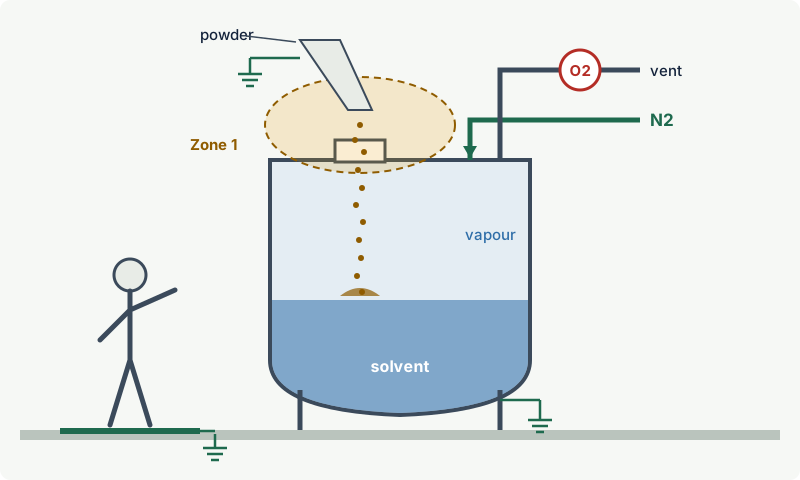
The measures, in order of effectiveness:
- Change the sequence. Where the chemistry allows, charge solids into the empty, inerted vessel first and add solvent afterwards through a closed line.
- Inert the vessel. Purge the headspace with nitrogen to a verified oxygen level before charging and keep a nitrogen flow during charging so that the outflow at the opening is inert gas, not vapour-air mixture.
- Use closed charging. Split valves, containment bags with docking ports, glove box isolators, vacuum conveyors and screw feeders avoid opening the manway at all, and they also protect operators from potent compounds.
- Control static. Earth the vessel, chutes, funnels and drums; use conductive or dissipative bags and liners; earth people through dissipative footwear and flooring. For flexible intermediate bulk containers (FIBC), only types designed for flammable atmospheres may be used: Type C (conductive, earthed during filling and emptying) or Type D (static protective without an earth connection), not Type A or B. The test methods and types are defined in IEC 61340-4-4; detailed static guidance is in IEC TS 60079-32-1.
- Classify and equip. The area around an open manway during charging is typically a local Zone 1 (and a dust zone), and equipment there must suit both.
Dryers
Drying removes solvent from a wet solid and therefore creates the hybrid mixture by design.
- Vacuum tray, agitated filter and conical dryers operate closed and under reduced pressure, which keeps oxygen out. The critical moments are breaking the vacuum (break with nitrogen, not air), opening for discharge, and leaks during operation. Oxygen monitoring of the vapour line and nitrogen blanketing are common.
- Fluid bed dryers blow hot gas through the product. With aqueous granulation, the hazard is the dust. With organic solvents, the gas inside carries solvent vapour as well, so organic-solvent fluid bed drying is normally done with nitrogen in a closed loop, with a condenser to recover solvent and an oxygen analyser to confirm inert conditions. The dryer is typically designed to withstand the explosion pressure, or protected by venting or suppression, with isolation of connected ducts.
- Spray dryers for organic-solvent feeds similarly use closed-cycle nitrogen.
For all dryers the inlet gas temperature and the heating surfaces must stay below the autoignition temperature of the solvent and the ignition and self-heating temperatures of the product, with margin. The constructive options are described in dust explosion protection.
Inerting
Inerting replaces enough of the oxygen with nitrogen (sometimes carbon dioxide or argon) that no flame can propagate. The key value is the limiting oxygen concentration (LOC), the oxygen level below which the mixture cannot burn. It depends on the fuel, the inert gas, temperature and pressure; it should be taken from test data for the actual solvent and powder, and for a hybrid the lower of the values applies.
The plant runs at a maximum permitted oxygen concentration below the LOC. Common practice, reflected in NFPA 69 and in published guidance, is to stay at least 2 percentage points below the LOC when oxygen is continuously monitored, and to operate at no more than 60 % of the LOC when the LOC is below 5 %; without continuous monitoring the margins are larger. Oxygen analysers on the vessel or vent line, with alarms and trips, verify the result. Their performance is covered by IEC 60079-29-0, which includes oxygen detectors.
Nitrogen is an asphyxiant. Inert gas leaving manways and vents, and vessel entry after inerting, need their own controls, see oxygen deficiency.
Worked example: how many purge cycles?
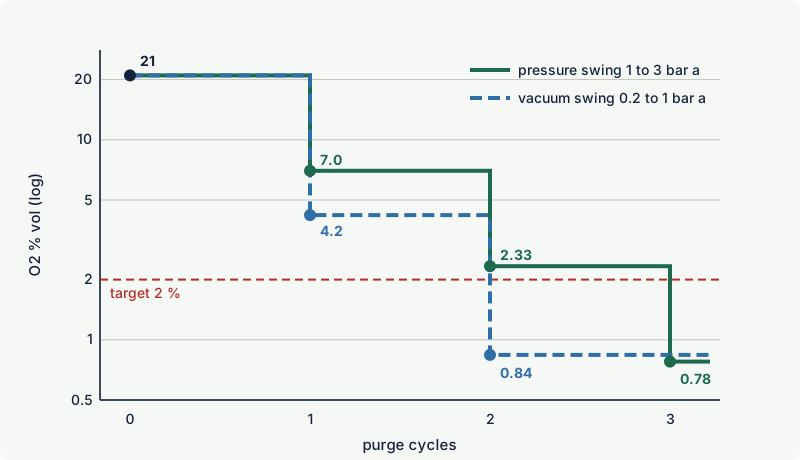
A reactor full of air (21 % oxygen) must be brought below 2 % before solvent and solids are charged. The figures below assume pure nitrogen and perfect mixing after each step.
- Pressure-swing purge, 1.0 to 3.0 bar absolute: each cycle (pressurise with nitrogen, then vent back to 1.0 bar) divides the oxygen fraction by 3. After one cycle 7.0 %, after two 2.33 %, after three 0.78 %. Three cycles are needed.
- Vacuum-swing purge, 0.2 to 1.0 bar absolute: each cycle (evacuate to 0.2 bar, break vacuum with nitrogen) multiplies the oxygen fraction by 0.2. After one cycle 4.2 %, after two 0.84 %. Two cycles are needed.
- Verify: real mixing is imperfect and nitrogen is not perfectly pure, so the oxygen level must be confirmed with an analyser before charging, and the purge recipe validated on the actual vessel.
Cleanroom and GMP considerations
Good manufacturing practice (GMP) and explosion protection both have to be satisfied, and they sometimes pull in different directions.
- Pressure cascades. Cleanrooms are held at positive pressure to protect the product, while rooms with solvent vapour or potent compounds should not push contaminated air into corridors. Airlocks are designed so that both aims are met (for example a lower-pressure "sink" or higher-pressure "bubble" airlock between the process room and the corridor), and the classification must consider where air, and vapour, actually flows when doors open.
- HVAC as safety ventilation. Cleanrooms often have high air change rates, which dilute vapour well. Area classification may take credit for this only if the ventilation availability is good: monitored air flow, alarms, interlocks that stop solvent operations on HVAC failure, and secure power. Recirculating air that may contain solvent vapour needs care; extract near the sources, at low level for heavy vapours. The method is in ventilation in area classification.
- Cleanable Ex equipment. Ex equipment in cleanrooms must also be smooth, sealed and washable: stainless steel enclosures, high IP ratings for washdown, Ex luminaires installed flush and sealed into ceiling panels, Ex-certified operator panels. Pressurised enclosures (Ex p) are used for complex equipment.
- Through-wall design. Keep electrical equipment out of the classified room altogether by placing drives, panels and services in a technical area behind the wall, with only the process face and sealed penetrations in the cleanroom.
- Hidden spaces. Ceiling voids above cleanroom panels, return-air plenums and ducts can collect dust or vapour. Seal them, include them in the classification and in inspection and cleaning.
- Static in cleanrooms. Low humidity, synthetic garments and insulating floors favour charging. Use dissipative flooring and footwear where flammable atmospheres exist, and earth all conductive items.
- Cleaning agents. Alcohol wipes and sprays are small, frequent releases. They are usually covered by limiting quantities and by ventilation, sometimes with zones of negligible extent; see small quantities.
Typical zones and equipment selection
Zones are site-specific; the following are common outcomes, not rules:
| Location | Typical classification |
|---|---|
| Inside a reactor or tank with solvent above its flash point, not inerted | Zone 0 |
| Inside an inerted vessel with monitored oxygen | may be treated as non-hazardous or a lower zone while inerting is reliable; air-ingress situations still classified |
| Open manway during charging | local Zone 1 and dust zone 21 |
| Process room around closed equipment with good ventilation | Zone 2 or non-hazardous, depending on releases and ventilation availability |
| Inside mill, sieve, blender, fluid bed dryer, dust collector | Zone 20 or 21; with solvent also a gas zone (hybrid) |
| Around tablet presses and dust-tight containment | Zone 22 locally, or none with good extraction |
| Drum dispensing booth with local extraction | Zone 1 inside the booth, Zone 2 around it |
Equipment selection follows from the zones and the substances:
- Gas: group IIB is common in multipurpose plants (ethanol, THF, ether); T3 for heptane and THF, T4 for diethyl ether.
- Dust: most organic pharmaceutical powders are non-conductive, group IIIB. The maximum surface temperature follows from the dust's ignition temperatures, see surface temperature limits for dust.
- Hybrid areas: equipment must meet both the gas and the dust requirements, for example
II 2GD Ex db IIB T4 Gb Ex tb IIIB T135°C Db. How to read such markings is explained in how to read an Ex marking. - Mechanical equipment: agitators, pumps, mills, rotary valves and fans in zones need assessment for mechanical ignition sources and are supplied with an Ex h marking under ISO 80079-36 and -37.
Common mistakes and misconceptions
- Classifying for the main solvent only. Multipurpose plants change solvents. Classify and select equipment for the most demanding solvent and powder that may be used in each room.
- Opening a reactor to add powder "quickly". Short operations are when most charging fires happen. Inert, use closed charging or change the sequence.
- Relying on earthing alone for solvents and powders. Earthing removes charge from conductors, not from insulating liquids, powders, liners or people in insulating footwear.
- Using ordinary plastic bags, liners or Type A/B FIBCs near solvent vapour. Use conductive or dissipative packaging designed for flammable atmospheres, or transfer the product into a closed system first.
- Assuming the inert gas is there. Nitrogen supply failures, open hatches and leaks happen. Measure oxygen continuously where inerting is a safety measure, with alarms and interlocks.
- Treating the cleanroom ceiling as clean. Dust and vapour can collect above suspended ceilings and in return-air plenums. Include these spaces in classification, inspection and cleaning.
Frequently asked questions
Why is adding powder to a reactor containing solvent dangerous?
The headspace contains flammable solvent vapour, and the falling powder, its packaging and the operator become electrostatically charged. A discharge can ignite the vapour, which needs only a fraction of a millijoule, and the powder adds to the explosion. Inerting, closed charging and static control are the main protections.
What is a hybrid mixture in pharmaceutical manufacturing?
A mixture of combustible dust with flammable vapour or gas in the same air, typical of solvent-wet powders in dryers and of powder charging into solvent-containing vessels. Hybrid mixtures can ignite with less energy and at lower concentrations than either component alone. Equipment and protection must cover both the gas and the dust hazard.
What oxygen level is safe for nitrogen inerting?
It depends on the limiting oxygen concentration (LOC) of the actual materials, which should come from test data. Common practice is to stay at least 2 percentage points below the LOC with continuous oxygen monitoring, and to use larger margins without monitoring or when the LOC is very low. The oxygen level must be verified by measurement.
Do fluid bed dryers need ATEX protection?
Usually yes. The inside of a fluid bed dryer handling combustible powder is a dust zone, and with organic solvents it also contains flammable vapour. Such dryers are typically built to withstand or relieve an explosion, protected by isolation of connected ducts, and for organic solvents operated with nitrogen in a closed loop.
Can cleanroom ventilation make an area non-hazardous?
It can reduce or remove zones only if the ventilation is effective at the source of release and its availability is good, meaning air flow is monitored and solvent operations stop or are made safe when it fails. High air change rates alone do not justify declassification without that reliability.
Which FIBC type can be used with flammable solvents?
Only types designed for flammable vapour atmospheres: Type C, which is conductive and must be earthed during filling and emptying, and Type D, which is static protective without an earth connection. Type A has no static protection, and Type B is not intended for flammable gas or vapour atmospheres. Inner liners must also be compatible.
Related on excodex
- Hybrid mixtures: when flammable gas and combustible dust are present together
- Static electricity as an ignition source
- Oxygen concentration, enrichment and inerting
- Dust zones 20, 21 and 22 explained
- Laboratories, workshops and small quantities
- Tools: gas and solvent library, ethanol, tetrahydrofuran, Ex marking check, standards spaces IEC 60079-10-1 and IEC 60079-10-2, forum
Standards and further reading
- IEC 60079-10-1 and IEC 60079-10-2, classification of areas for gas and dust atmospheres.
- IEC 60079-14, electrical installations design, selection and installation of equipment, including initial inspection (2024 edition; "erection" in the title of earlier editions).
- IEC TS 60079-32-1, electrostatic hazards, guidance.
- IEC 61340-4-4:2018 (edition 3), electrostatic classification of flexible intermediate bulk containers (FIBC).
- ISO 80079-36 and ISO 80079-37, non-electrical equipment for explosive atmospheres.
- NFPA 69, Standard on Explosion Prevention Systems (inerting and oxygen margins); NFPA 660, Standard for Combustible Dusts and Particulate Solids (2025), which superseded NFPA 652 and NFPA 654 for combustible dusts.
- Cunliffe, Avoiding explosions by means of inerting systems, IChemE Symposium Series 148 (2001): icheme.org
- US Chemical Safety Board, dust explosion and fire, Kinston, North Carolina (2003): csb.gov
- US Chemical Safety Board, explosions and fire, Valley Center, Kansas (2007), static accumulator liquids: csb.gov
This article is general technical information prepared by the excodex editorial team. It does not replace the applicable standards, the equipment certificates and instructions, national regulations or the assessment of a competent person.