Oxygen deficiency: nitrogen, argon and other inert gas hazards
Abstract
Nitrogen, argon, helium and carbon dioxide kill by displacing oxygen, with no smell and no warning; one or two breaths of pure inert gas can cause collapse. Physiology, oxygen alarm levels, sources such as liquid nitrogen and purging, room calculations and monitoring.
Oxygen deficiency occurs when another gas displaces part of the air, so that the oxygen concentration falls below the normal 20.9 % by volume. Inert gases such as nitrogen, argon and helium, and also carbon dioxide, are colourless and odourless and give no warning: below about 10 % oxygen people lose the ability to move and lose consciousness, and one or two breaths of pure inert gas can cause collapse. US OSHA defines an oxygen-deficient atmosphere as one below 19.5 % oxygen, and the protection is the same everywhere: control the sources, ventilate, measure oxygen with a working monitor, and never enter or rescue without breathing apparatus.
This article explains why inert gases kill without warning, what each oxygen level does to the body, where the gas comes from (liquid nitrogen, purging, welding, fire suppression), how to estimate the oxygen level after a release, and how to choose, place and set oxygen monitors.
Key points
- Fresh air contains 20.9 % oxygen. US OSHA treats below 19.5 % as oxygen-deficient and above 23.5 % as oxygen-enriched; industrial gas association guidance calls the situation hazardous below 18 % and death from asphyxia almost certain below 10 %.
- Inert gases give no warning: they have no smell, and breathing them does not cause breathlessness, because they also wash carbon dioxide out of the blood and the breathing reflex is not triggered.
- The US Chemical Safety Board counted 80 deaths and 50 injuries from nitrogen asphyxiation in 85 US workplace incidents between 1992 and 2002, most of them in or near confined spaces; about 10 % of the deaths were rescuers.
- One litre of liquid nitrogen produces about 700 litres of gas (sources give 694 to 696); liquid argon about 847 and liquid helium about 757. A small dewar can make a room deadly.
- IEC guidance on gas detectors (IEC 60079-29-2, first edition 2007) gives typical oxygen deficiency alarms between 19.0 and 19.5 %, and warns that a fall to 19.5 % is already a 7 % loss of the original oxygen, meaning about 7 % of the air has been replaced by something else.
- An oxygen monitor is not a carbon dioxide or toxic gas detector. Carbon dioxide is toxic at concentrations that hardly move the oxygen reading.
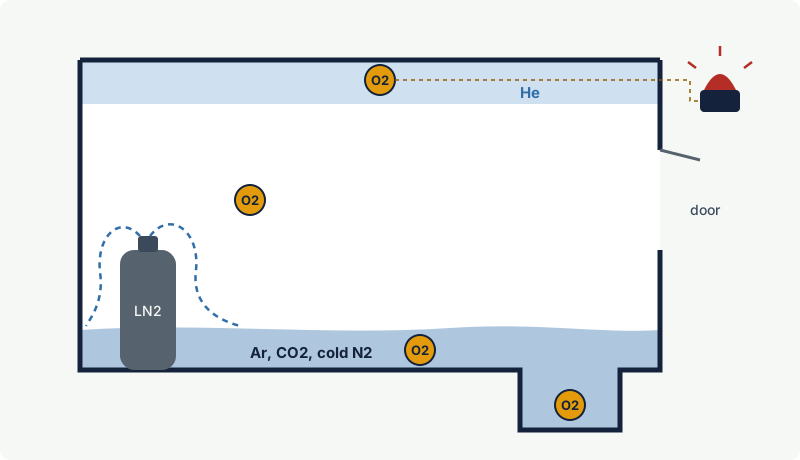
- Place oxygen sensors where the gas collects: low for argon, carbon dioxide and cold vapour from cryogenic liquids, high for helium, close to the release point, with alarms visible before people enter.
Why inert gas kills without warning
What the body notices and what it does not
The urge to breathe is driven mainly by the level of carbon dioxide in the blood, not by lack of oxygen. When a person holds their breath, carbon dioxide builds up and the discomfort forces the next breath. When a person breathes nitrogen or argon, the opposite happens: the gas carries carbon dioxide out of the lungs as normal, so there is no feeling of suffocation. UK HSE guidance on welding gases notes that there is little sense of breathlessness to warn the victim, and that inhaling an atmosphere with no oxygen causes loss of consciousness in seconds. The US Chemical Safety Board (CSB) notes that unconsciousness can follow only one or two breaths.
At intermediate levels the first effects are on the brain: judgement, coordination and attention are impaired, and the victim may feel tired, confused or euphoric rather than alarmed. A person who notices that something is wrong may no longer be able to work out what, or to climb a ladder.
Effects by oxygen level
The values below are the effects listed by the US Compressed Gas Association and quoted by the CSB. Individual sensitivity varies with health, exertion and altitude, so use them as an illustration, not as a safe limit.
| Oxygen (% vol) | Reported effects |
|---|---|
| 20.9 | Normal |
| 19.0 | Some adverse physiological effects, not noticeable |
| 16.0 | Increased pulse and breathing rate, impaired thinking and attention, reduced coordination |
| 14.0 | Abnormal fatigue on exertion, emotional upset, faulty coordination, poor judgement |
| 12.5 | Very poor judgement and coordination, impaired breathing that may cause permanent heart damage, nausea and vomiting |
| Below 10 | Inability to move, loss of consciousness, convulsions, death |
The CSB adds that at 4 to 6 % oxygen a victim can fall into a coma in less than 40 seconds. Industrial gas association guidance gives three thresholds that are easy to remember: the situation is hazardous below 18 %, death from asphyxia is almost certain below 10 %, and loss of consciousness is immediate below 6 %.
Oxygen percentage and altitude
What matters to the body is the partial pressure of oxygen, which is the percentage multiplied by the atmospheric pressure. At high altitude the air still contains 20.9 % oxygen but less of it per breath. IEC guidance on gas detectors (the first edition of IEC 60079-29-2, the source of the IEC values quoted in this article) puts this in perspective: breathing 19.5 % oxygen is physiologically similar to working about 650 m higher. That is why a reading of 19.5 % is not immediately dangerous for a healthy person at rest, and also why it is not "safe" either: the problem is the other 7 % of the air.
How much gas has replaced the air?
An oxygen reading tells you how much of the air has been displaced. If the oxygen reads C % instead of 20.9 %, the fraction of the air replaced by other gases is (20.9 - C) / 20.9.
| Oxygen reading | Air displaced by other gas | As ppm of the other gas |
|---|---|---|
| 20.8 % | about 0.5 % | about 5,000 ppm |
| 20.4 % | about 2.4 % | about 24,000 ppm |
| 19.5 % | about 6.7 % | about 67,000 ppm |
| 18.0 % | about 14 % | about 140,000 ppm |
If the displacing gas is nitrogen, this matters only as asphyxiation. If it is anything else, the other gas is usually the bigger hazard long before the oxygen reading looks abnormal. IEC guidance warns that oxygen detectors must not be relied on to indicate carbon dioxide, and the UK workplace exposure limits for carbon dioxide are 5,000 ppm (8 hours) and 15,000 ppm (15 minutes), concentrations that move the oxygen reading by only 0.1 to 0.3 percentage points. The same applies to flammable gases: 10 %LEL of methane is 0.44 % vol and changes the oxygen reading by less than 0.1. Measure the other gas directly.
Where inert gas comes from
| Source | How oxygen deficiency arises | Typical locations |
|---|---|---|
| Liquid nitrogen, liquid argon, liquid helium | Evaporation, spills, venting from relief valves, filling of dewars; about 700 to 850 litres of gas per litre of liquid | Laboratories, hospitals and biobanks, food freezing, cryogenic storage rooms, MRI and NMR rooms (helium) |
| Nitrogen purging and inerting | Nitrogen used to purge or blanket vessels, reactors, pipelines and tanks; it flows out of openings and stays inside equipment | Process plants, refineries, maintenance turnarounds, tank cleaning |
| Welding and cutting gases | Argon, helium, nitrogen and carbon dioxide shielding and purge gases collect in fabrications, tanks and pipes | Fabrication shops, pipe welding with purge dams, shipbuilding |
| Gas fire suppression | Discharge of inert gas or carbon dioxide systems into protected rooms | Server rooms, electrical rooms, turbine enclosures |
| Carbon dioxide from processes | Fermentation, dry ice, beverage dispensing systems | Breweries, wineries, cellars, cold stores |
| Nitrogen generators and supply lines | Leaking connections, nitrogen line confused with breathing air or compressed air | Any site with a nitrogen network |
Two patterns are common in incident reports. The first is nitrogen mistaken for air: the CSB found that 12 of the 85 incidents it reviewed involved confusing nitrogen with breathing air, accounting for about 20 % of the fatalities. Breathing air connections must be incompatible with nitrogen connections, and lines and cylinders must be clearly identified.
The second is the hazard outside the opening. In 2005, at a refinery in Delaware City, Delaware, two contract workers died from nitrogen asphyxiation while working near a 24-inch opening on top of a reactor that was being purged with nitrogen; one of them died attempting to rescue the other. Among its lessons, the CSB stressed that an oxygen-deficient atmosphere can exist outside a confined space opening, not only inside it, and that barricades, warnings and access control are needed at every temporary opening during purging. UK HSE notes that accidents have occurred when workers placed only their head and shoulders into a confined space.
Where the gas goes
Gas density decides where a deficient atmosphere forms (see vapour density):
- Argon (relative density 1.38) and carbon dioxide (1.52) are heavier than air and collect at floor level, in pits, trenches, cellars and the bottom of vessels.
- Nitrogen (0.967) has almost the same density as air at the same temperature and mixes readily. But nitrogen from a cryogenic liquid is cold and dense at first, so it flows along floors and into pits before warming.
- Helium (0.138) rises and collects under ceilings and in roof voids; a magnet quench in an MRI room releases a large volume quickly.
UK HSE advises testing the entire volume, especially the deepest areas where a dense gas may be present, and not relying on gases to sink or rise, because air movement can disturb the layers.
Worked example: liquid nitrogen in a small room
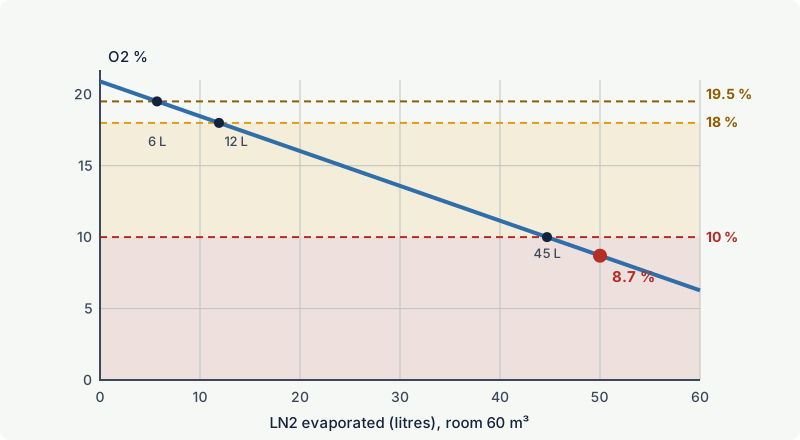
A laboratory store is 5 m x 4 m x 3 m, a volume of 60 m³, with no mechanical ventilation. It contains a 50 litre liquid nitrogen dewar. What happens if the dewar loses its vacuum, or is knocked over, and the liquid evaporates?
A simple and widely used estimate assumes that the gas released pushes an equal volume of air out of the room, without ventilation:
O2 (%) = 20.9 x (V_room - V_gas) / V_room
With about 0.7 m³ of nitrogen gas per litre of liquid:
| Liquid evaporated | Nitrogen gas | Average oxygen in the room |
|---|---|---|
| 5 litres | 3.5 m³ | 19.7 % |
| 10 litres | 7 m³ | 18.5 % |
| 20 litres | 14 m³ | 16.0 % |
| 50 litres (whole dewar) | 35 m³ | 8.7 % |
The full dewar would take the room average below 10 %, in the range where death is likely. Worse, the gas is cold and collects at floor level first, so a person who bends down or falls into it meets a lower concentration than the average. Even 6 litres, a small spill, brings a closed room of this size to a typical 19.5 % alarm level.
The calculation is a screening tool, not a design. Real rooms leak and ventilate, mixing is not instant, and evaporation takes time. But if the simple estimate gives less than about 19.5 %, the room needs ventilation sized for the release, fixed oxygen monitoring, or a smaller quantity of liquid, and a full assessment should follow.
Oxygen monitoring
Alarm levels
There is no single international set point, but the guidance points the same way:
| Reference | Value | Meaning |
|---|---|---|
| Fresh air | 20.9 % | Normal; UK HSE asks that any difference from it be investigated |
| IEC guidance (IEC 60079-29-2, first edition 2007) | 19.0 to 19.5 % | Typical deficiency alarm range |
| US OSHA | below 19.5 % | Oxygen-deficient atmosphere |
| Industrial gas association guidance | below 18 % | Situation hazardous |
| US OSHA | above 23.5 % | Oxygen-enriched atmosphere |
Site procedures differ. Some use a single low alarm at 19.5 % with immediate evacuation (as in some university cryogen procedures), some prevent access below 18 %, and two-stage arrangements combine an early warning with a lower evacuation and no-entry level. A high alarm is needed wherever enrichment is possible, for example near liquid oxygen or oxygen supply systems, because enrichment greatly increases fire risk (see oxygen concentration, enrichment and inerting). IEC guidance notes that a 19.5 % alarm already responds only after about 7 % of the air has been displaced, which may not be adequate protection on its own in some circumstances. For setting alarm levels in general, see setting gas detector alarm levels.
Fixed and personal monitors
- Fixed oxygen monitors protect rooms with cryogenic liquids, gas cylinder stores, MRI rooms, suppression-protected rooms, analyser houses and nitrogen generator rooms. The alarm should sound and flash inside the room and be visible outside the door, so nobody walks into a deficient atmosphere. Linking the alarm to start extract ventilation is good practice.
- Personal monitors protect people who move between areas, enter confined spaces or work near purged equipment. In confined spaces the oxygen channel is the first one read (see portable gas detectors and confined space entry).
- Location: follow the gas. Low sensors for argon, carbon dioxide and cryogenic nitrogen; high sensors for helium; near the likely release point (the dewar filling station, the purge vent, the cylinder manifold) and in the breathing zone where people work.
Sensor technology and its limits
Most portable and many fixed oxygen monitors use electrochemical oxygen cells; paramagnetic analysers are common in process and analyser applications. IEC guidance points out several limits that matter for inert gas work:
- Limited life. Electrochemical oxygen cells are consumed in use; IEC guidance says typical lifetimes under favourable conditions can exceed two years, and sensitivity falls with age. Check them with gas and replace them as the manufacturer specifies.
- Pressure and altitude. Some oxygen sensors respond to pressure; for some electrochemical types the sensitivity is proportional to atmospheric pressure. Check the reading in fresh air before use and after a significant change of altitude.
- Cold and condensation. Low temperature and low humidity slow electrochemical response. When a cold instrument is carried into warm, humid air (for example out of a cold store), water condensing on the sensor membrane can cause a sudden false low reading; IEC guidance mentions drops to 16 % or lower, recovering over some minutes. Both effects are relevant around cryogenic liquids and cold rooms.
- Carbon dioxide interference. Some oxygen sensors give a small upscale signal in high carbon dioxide, which makes the oxygen reading look better than it is.
Bump testing and calibration follow the same principles as for other gas detectors: fresh air for the 20.9 % point, and a certified low-oxygen test gas (or nitrogen for zero, where the manufacturer allows it) to prove the low alarm. See gas detector calibration and bump testing.
Preventing oxygen deficiency incidents
- Know the inventory. List every source of inert gas and carbon dioxide, with the largest credible release, and the rooms and spaces it could reach.
- Reduce and ventilate. Keep cryogenic liquids and cylinders in well-ventilated areas; fill dewars outdoors or in rooms designed for it; pipe vents and relief valves to a safe place outside.
- Monitor. Fixed oxygen monitoring where the screening calculation shows a credible risk; personal monitors for people working near purges and in confined spaces.
- Control access. Barricade and sign openings of purged equipment; treat the area around the opening as hazardous. Use a permit system and gas testing before entry.
- Separate nitrogen from breathing air. Use incompatible connections, colour coding and labelling; never use nitrogen to power tools or ventilate a space.
- Plan the rescue. Train people that a collapsed colleague in a deficient atmosphere must not be rescued without breathing apparatus. UK HSE notes that accident history shows multiple workers are often affected because would-be rescuers get into difficulty themselves.
- Never "sweeten" with oxygen. Adding oxygen to correct a deficient atmosphere creates enrichment and a fire risk; ventilate with air instead, as UK HSE guidance stresses.
Common mistakes and misconceptions
- "Nitrogen is harmless, it is 78 % of the air." Nitrogen is harmless only as part of air. Breathing it without oxygen causes collapse within one or two breaths.
- "I would notice." There is no smell, no breathlessness and the first effect is impaired judgement. Rely on monitors, not senses.
- "The danger is only inside the vessel." Purge gas flows out of openings. Workers have died with only their head and shoulders inside, or next to an opening.
- "The oxygen monitor will warn me of carbon dioxide." Carbon dioxide reaches its exposure limits long before the oxygen reading changes noticeably. Use a carbon dioxide detector where it is present.
- Placing the oxygen sensor at the wrong height. A sensor at ceiling height does not warn of argon on the floor, and one at the floor does not see helium under the ceiling.
- Rushing in to rescue. UK HSE notes that when several workers are affected, it is mainly because would-be rescuers got into difficulty themselves. Raise the alarm and wait for people with breathing apparatus.
Frequently asked questions
At what oxygen level should an oxygen monitor alarm?
IEC guidance gives a typical deficiency alarm between 19.0 and 19.5 % by volume, and 19.5 % matches the US OSHA definition of an oxygen-deficient atmosphere. Some sites add a second, evacuation level at a lower value such as 18 %, which industrial gas association guidance identifies as hazardous. Where oxygen enrichment is possible, a high alarm is needed too, for example at 23.5 %, the US OSHA enrichment limit.
How long can you survive in a nitrogen atmosphere?
In pure nitrogen or argon, unconsciousness can follow one or two breaths and death within minutes. At 4 to 6 % oxygen the US Chemical Safety Board reports that a victim can fall into a coma in less than 40 seconds. There is no safe exposure time in an atmosphere with very low oxygen.
Why can't you feel oxygen deficiency?
Inert gases have no smell, and the breathing reflex is driven mainly by carbon dioxide in the blood, not by the lack of oxygen. Breathing nitrogen or argon removes carbon dioxide normally, so there is no feeling of suffocation. The first symptoms are impaired judgement and coordination, which stop people from recognising the danger.
How much gas does liquid nitrogen produce?
About 700 litres of gas per litre of liquid at atmospheric pressure (sources give 694 to 696). Liquid argon produces about 847 and liquid helium about 757 litres of gas per litre. A 50 litre dewar evaporating in a closed 60 m³ room can reduce the average oxygen concentration below 10 %.
Where should an oxygen sensor be installed?
Where the gas collects and where people are: low down for argon, carbon dioxide and cold nitrogen from cryogenic liquids, high for helium, close to the likely release point and in the breathing zone of the work area. The alarm should be seen and heard inside the room and outside the entrance, so that nobody enters during an alarm.
Related on excodex
- Oxygen concentration, enrichment and inerting
- Portable gas detectors and confined space entry
- Vapour density: which gases rise, which sink, and why it matters
- Setting gas detector alarm levels for flammable and toxic gases
- Fixed gas detection systems: design principles
- Gas library: nitrogen, argon, helium, carbon dioxide, oxygen; standards space IEC 60079-29-2; questions in the forum
Standards and further reading
- IEC 60079-29-2:2015, Explosive atmospheres, gas detectors: selection, installation, use and maintenance of detectors for flammable gases and oxygen: https://webstore.iec.ch/en/publication/21961
- IS/IEC 60079-29-2:2007, the first edition of the same guidance as adopted in India, publicly available (oxygen alarm levels and sensor limitations; the IEC values quoted in this article come from this edition, so check the current edition for a real project): https://law.resource.org/pub/in/bis/S05/is.iec.60079.29.2.2007.pdf; IEC webstore (current edition, IEC 60079-29-2:2015): webstore.iec.ch
- US Chemical Safety Board, Safety Bulletin: Hazards of nitrogen asphyxiation (2003): https://www.csb.gov/assets/1/20/sb-nitrogen-6-11-03.pdf
- UK HSE, EIS45 Asphyxiation hazards in welding and allied processes (2014): https://www.hse.gov.uk/PUBNS/eis45.pdf
- UK HSE, General hazards of carbon dioxide, including workplace exposure limits: https://www.hse.gov.uk/carboncapture/carbondioxide.htm
- Asia Industrial Gases Association, AIGA 008/04 Hazards of inert gases (adopted from EIGA Doc 44): https://asiaiga.org/uploaded_docs/AIGA%20008_04_Hazards%20of%20Inert%20Gases%20.pdf
- US OSHA, 29 CFR 1910.146, Permit-required confined spaces (definitions of oxygen-deficient and oxygen-enriched atmospheres): https://www.osha.gov/laws-regs/regulations/standardnumber/1910/1910.146
This article is general technical information prepared by the excodex editorial team. It does not replace the applicable standards, the equipment certificates and instructions, national regulations or the assessment of a competent person.