Setting gas detector alarm levels for flammable and toxic gases
Abstract
Flammable gas alarms are set as a fraction of the LEL, typically 10 to 25 %LEL for the first alarm. Toxic gas alarms start from exposure limits (TWA, STEL), but fixed detectors use instantaneous ppm levels. How to choose levels, latching and actions.
Flammable gas detector alarms are set as a percentage of the lower explosive limit (%LEL): the first alarm is typically somewhere between 10 and 25 %LEL and the second alarm higher, often 20 to 60 %LEL, so that people can act long before the gas can burn. Toxic gas alarms are set in parts per million (ppm) and start from occupational exposure limits such as the 8-hour time-weighted average (TWA) and the 15-minute short-term exposure limit (STEL), but fixed detectors measure the concentration at one point and one moment, so their alarms are instantaneous levels chosen for the action they trigger, not exposure measurements. In every case the set point is a design decision: it must leave a margin for detector error and response time, avoid nuisance alarms, and be tied to a defined action.
This article explains how %LEL and ppm alarm levels are chosen, what the standards and regulators say, how latching and reset should work, and how to connect each alarm to an action.
Key points
- The EU ATEX product directive requires devices with a measuring function for explosion protection to keep the alarm threshold far enough below the explosion limits, allowing for operating conditions and measuring errors.
- IEC guidance says the lowest flammable alarm should be as low as possible without causing false alarms, and that set points may need review during the early operation of a new system.
- A UK HSE research review quotes flammable gas alarm levels of typically around 10 to 30 %LFL, and UK offshore guidance under which fixed detectors are normally set to alarm at 20 %LFL methane.
- For toxic gases, two instantaneous levels (low and high) are typical; the low and high alarms are usually based on the 8-hour and 15-minute exposure limits where they exist, adjusted for the situation.
- Fixed detectors should use instantaneous alarms. TWA and STEL alarms belong in personal monitors worn in the breathing zone.
- Alarms that trigger action on a hazardous concentration should latch and need a deliberate manual reset; a lower, warning-only alarm may be non-latching.
- When a detector is calibrated with a different gas from the one it must detect, the alarm settings need an extra margin for the uncertainty in the response factor.
Why an alarm level needs a design basis
An alarm level is a compromise between two failures. Set it too high and the gas may reach a dangerous concentration before anyone acts. Set it too low and normal background levels, sensor drift and process events cause nuisance alarms, people stop trusting the system, and alarms get inhibited.
Three requirements frame the choice:
- The explosion limit margin. Annex II of the ATEX directive 2014/34/EU requires devices with a measuring function for explosion protection to incorporate a safety factor, so that the alarm threshold lies far enough outside the explosion limits, taking into account the operating conditions and possible errors of the measuring system.
- As low as practicable. IEC guidance on selection and maintenance of flammable gas detectors (IEC 60079-29-2) recommends that the lowest set point be as low as possible consistent with avoiding false alarms, and notes that set points may need frequent review in the early stages of operation.
- Time to act. The whole chain must be fast enough: release, gas transport to the sensor, sensor response, signal processing, any alarm delay, and then the human or automatic response. IEC guidance asks that the total delay of the system be shorter than the maximum the application allows. A lower set point buys time.
The first alarm should always lead to an action. An HSE research review of alarm setting stressed that the first alarm should trigger something, not be ignored or automatically cancelled, and that set points should not be "fit and forget": they should be reviewed with site data.
Flammable gases: %LEL alarm levels
What the %LEL scale means
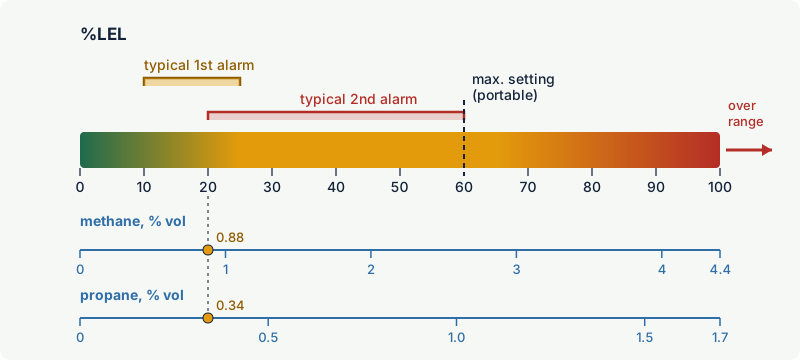
Flammable gas detectors usually display 0 to 100 %LEL, where 100 %LEL is the lower explosive limit of the calibration gas. The LEL of methane is 4.4 % by volume, so 20 %LEL of methane is 0.88 % vol. For propane, with an LEL of 1.7 % vol, 20 %LEL is only 0.34 % vol. Working in %LEL lets the same alarm level mean the same distance from flammability, whatever the gas, provided the detector reads that gas correctly. See LEL and UEL explained for the background.
Where the common numbers come from
There is no single mandatory alarm level for flammable gas in the IEC standards. The values seen in practice come from a few sources:
| Source or context | Value | What it means |
|---|---|---|
| HSE research review of alarm practice (RR973) | About 10 to 30 %LFL | Typical range of flammable gas warning levels |
| UK offshore practice quoted by HSE | 20 %LFL (methane) | Normal first alarm for fixed flammable gas detectors offshore |
| US OSHA confined space rule (29 CFR 1910.146) | Above 10 %LFL | Defines a hazardous atmosphere for permit-required confined spaces, so portable monitors used for entry commonly alarm at 10 %LEL |
| Earlier IEC performance standard for portable 0 to 100 %LEL instruments | Not above 60 %LFL | Upper limit for any alarm setting; IEC recommended the same limit for other Group II detectors |
| IEC guidance for catalytic sensors | Not below 5 % (methane), 10 % (propane, butane), 20 % (gasoline vapour) of the LFL | Lower limit to avoid false alarms from environmental effects |
A frequent arrangement is a first alarm in the 10 to 25 %LEL range and a second alarm at roughly twice the first, but the right values depend on the application. Confined spaces, enclosed modules and air intakes usually justify lower settings than open, well-ventilated process areas.
Lower limits: false alarms and sensor capability
The lower an alarm is set, the more temperature, humidity and zero drift matter. IEC guidance for catalytic sensors recommends not setting the alarm below about 5 %LFL for methane, 10 %LFL for propane and butane, and 20 %LFL for gasoline vapours, and points out that toxicity precautions are needed in the last case because petrol vapour is harmful long before it is flammable. Infrared detectors usually have better zero stability, but the same logic applies: a set point must sit clearly above the normal noise and drift of the instrument and above any normal background in the area.
Response factors and calibration margins
A %LEL reading is only correct for the gas the detector was calibrated with. Catalytic and infrared sensors respond differently to different gases (see catalytic vs infrared detectors). If a detector calibrated for methane must protect against n-pentane or toluene vapour, the displayed value may be much lower than the real %LEL, and an alarm "at 20 %LEL" may actually trip at 35 or 40 %LEL of the real gas.
IEC guidance gives two options: calibrate so the display reads correctly for the target gas, or keep the calibration gas reading and lower the alarm set points to compensate. Whenever a substitute calibration gas and response factors are used, it recommends additional safety margin and lower alarm settings, because relative responses vary between sensors and change as sensors age. Where several gases may be present, the detector should be set up for the gas to which it is least sensitive. The calibration side is covered in gas detector calibration and bump testing.
Over-range
A catalytic sensor can read low in a very rich atmosphere because there is not enough oxygen for the gas to burn on the bead. IEC guidance therefore expects catalytic detectors that meet the IEC performance standard to hold (lock) an over-range indication once full scale is exceeded; stand-alone transmitters and older instruments may not. The control system must treat over-range as the highest alarm and latch it; a reading that later falls is not proof that the gas has gone.
Toxic gases: ppm alarm levels and exposure limits
The limit values
Occupational exposure limits are written for exposure assessment, not for detector alarms, but they are the natural starting point:
- TWA (time-weighted average): the average concentration over a reference period, normally 8 hours, that most workers can be exposed to day after day.
- STEL (short-term exposure limit): the average over a short period, normally 15 minutes, that should not be exceeded.
- Ceiling: a value that should not be exceeded at any time (used in some US limits).
- IDLH (immediately dangerous to life or health): a US NIOSH value for a concentration that could kill, cause lasting harm or prevent escape; it is used for respirator selection and emergency planning, not as an alarm level.
Instantaneous alarms versus TWA alarms
A fixed detector samples air at one point, often not at breathing height and not where people are standing. It cannot measure anyone's exposure. The HSE review therefore recommends instantaneous alarms on fixed detectors, typically a low and a high level, based on the 8-hour and 15-minute limits where these exist and then adjusted for the situation.
Personal monitors are different. They are worn in the breathing zone and can compute a running TWA and STEL as well as instantaneous alarms. TWA alarms suit cumulative hazards such as carbon monoxide; peak-driven hazards such as hydrogen sulphide are controlled mainly by the instantaneous alarms. Setting an instantaneous alarm exactly at an 8-hour TWA value, on the other hand, is a common source of nuisance alarms, because short excursions above the TWA are allowed as long as the average stays below it.
Example limits and settings
| Gas | EU indicative limit (8 h / 15 min) | Other reference values | Example alarm practice |
|---|---|---|---|
| Hydrogen sulphide | 5 ppm / 10 ppm | ACGIH TLV 1 ppm TWA, 5 ppm STEL; NIOSH IDLH 100 ppm | UK offshore guidance: 10 ppm alarm, 15 ppm general platform alarm; US offshore rule: alarms at 20 ppm. HSE review example: 10 and 40 ppm for a fixed point detector, 5 and 10 ppm for a portable detector |
| Carbon monoxide | 20 ppm / 100 ppm | OSHA PEL 50 ppm TWA; NIOSH IDLH 1200 ppm | Personal monitors often combine an instantaneous alarm with a TWA alarm |
| Chlorine | No 8-hour value / 0.5 ppm | 1999 UK guidance for chlorine installations (HSG28, HSG40), as quoted by HSE | First alarm between 1 and 5 ppm, high alarm about three times the first stage |
The chlorine row shows why old settings need review: the guidance values quoted by HSE are above the EU short-term limit of 0.5 ppm. Exposure limits differ between jurisdictions and change over time, so check the current national list before setting alarms. The hydrogen sulphide article covers H2S limits and alarm settings in detail.
Factors that move a toxic alarm up or down
The HSE review lists the factors to weigh. In short form:
- fixed or personal detector, and whether the area is normally occupied;
- point or open path detection;
- how long it takes to escape, and whether escape is difficult;
- exposure limits and emergency values (TWA, STEL, IDLH);
- normal background levels and short process events;
- cross-sensitivity to other gases and instrument effects such as drift;
- how fast the concentration could rise, and the time to alarm;
- the number of alarm levels, and mixtures of gases.
Two levels are usually enough. A third level adds complexity without adding safety unless it triggers a clearly different action. A single high alarm can be right where the response is always immediate evacuation.
The international guidance for toxic gas detectors in workplaces is IEC 62990-2:2021 (in Europe EN IEC 62990-2). The older European guide EN 45544-4 was withdrawn in 2023.
Oxygen alarm levels
Fresh dry air contains about 20.9 % vol oxygen. IEC guidance gives a typical oxygen deficiency alarm between 19.0 and 19.5 % vol, but warns that a fall of only 1.4 % vol (to 19.5 %) means about 7 % of the air has been displaced by something else, which may itself be toxic or flammable. US OSHA defines an oxygen-deficient atmosphere as below 19.5 % and an oxygen-enriched atmosphere as above 23.5 % by volume. Where oxygen enrichment is possible (oxygen supply systems, liquid oxygen, electrolysers), a high oxygen alarm is needed as well. See oxygen deficiency.
Latching, delays and reset
Latching versus non-latching
A latching alarm stays on after the concentration falls back below the set point, until someone resets it on purpose. A non-latching alarm follows the gas: on when above the set point, off when below.
The earlier IEC performance standard for flammable gas detectors (IEC 60079-29-1, now replaced by IEC 60079-29-0) made latching mandatory for the alarms and outputs of fixed and continuous-duty portable detectors that signal a potentially hazardous concentration: once triggered, they stayed on until someone reset them by hand. With two or more set points, the lowest could be non-latching. In every case the alarm had to remain active as long as the gas was present; a supplementary sounder could be silenced, and software latching was acceptable.
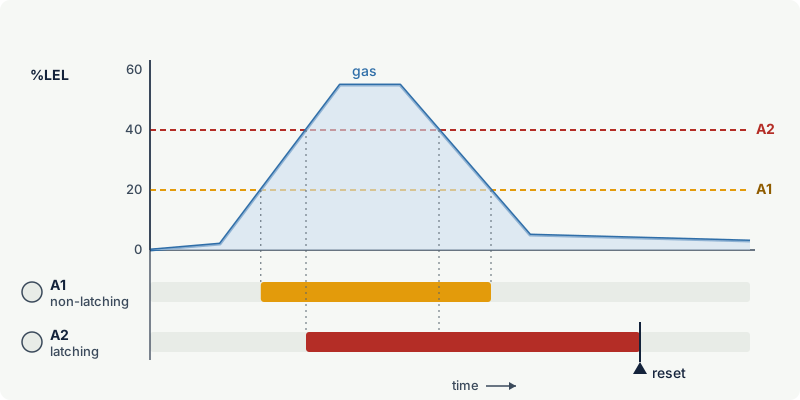
Latching matters for three reasons. A release that peaks and disperses before anyone looks at the panel is still recorded and investigated. Executive actions such as shutdowns do not restart on their own when the reading drops. And a falling catalytic reading during a major release, which may mean the atmosphere has gone above the LEL, does not cancel the alarm.
Delays, averaging and voting
Short spikes from process events can be filtered by a short delay or by averaging the signal over a few seconds, but every second of filtering adds to the time to alarm. It must be included in the response time budget, not added afterwards to silence nuisance alarms. Voting (for example, two detectors in alarm before an automatic shutdown) reduces spurious trips; the first alarm from any single detector should still warn people.
Inhibits and maintenance mode
During calibration, alarms and outputs may be inhibited. The earlier IEC performance standard required this state to be signalled, with a transmittable output on fixed apparatus, unless the alarms re-enable themselves within 15 minutes. In practice, every inhibit should be visible on the control panel and logged, and the area should be covered by other means while detectors are out of service.
Linking each alarm to an action
An alarm level only makes sense together with its action. A simple alarm philosophy, written down in the cause and effect matrix, could look like this:
| Signal | Typical meaning | Typical actions |
|---|---|---|
| First alarm (A1) | Gas present, investigate | Local and control room alarm, start or boost ventilation, stop hot work, send someone with a portable detector |
| Second alarm (A2) | Significant release | Area evacuation, isolation of the gas source, shutdown of equipment, removal of non-Ex ignition sources |
| Over-range | Concentration above measuring range | Treated as the highest alarm, latched |
| Fault | Detector cannot measure | Fault alarm, maintenance call, compensating measures until repaired |
| Voted alarm (for example 2 out of N at A2) | Confirmed release | Automatic executive actions (emergency shutdown, deluge) |
Executive actions and their integrity are covered in fixed gas detection systems and gas detection and functional safety.
Worked example: a gas compressor building
A ventilated building houses natural gas compressors. Point infrared detectors calibrated for methane are installed at roof level and near the compressor packing.
- Gas and scale. The gas is mostly methane (LEL 4.4 % vol), so the detectors are calibrated with methane and the display reads %LEL of methane. Natural gas also contains small amounts of heavier hydrocarbons; the response factors given by the manufacturer for ethane and propane are checked to confirm they do not read lower than methane.
- Purpose. The building is entered for maintenance, and the main risk is an accumulation under the roof.
- First alarm. 10 %LEL (0.44 % vol): this is an enclosed space where gas can accumulate and people enter, so the design team chooses the lower end of the usual range. The action is an alarm inside the building and in the control room, and the ventilation fans switch to high speed (their motors are suitable for the zone).
- Second alarm. 20 %LEL (0.88 % vol) on any one detector: building alarm with evacuation, and isolation of the gas supply valves. Shutdown of the compressors is voted on two detectors at 20 %LEL to avoid spurious trips, while the single-detector alarm still evacuates the building.
- Latching. The first alarm is non-latching; the second alarm, the voted trip and over-range latch until manual reset in the control room.
- Check. With the IR detectors' zero stability and a normal background of 0 %LEL, a 10 %LEL setting is not expected to cause nuisance alarms. The settings are recorded with their reasons and reviewed after six months of operation data.
The numbers in this example are design choices for one plausible case, not standard values. Another site with different gas, ventilation, occupancy and sensor technology could reasonably choose others.
Common mistakes
- Copying factory defaults without a design basis. Default set points are a manufacturer's starting point. Each alarm level should be chosen and recorded for the actual gas, area and action.
- Using a methane-calibrated detector for heavier vapours without correction. The alarm may trip at a much higher real %LEL. Apply the response factor with margin, or calibrate for the target gas.
- Setting fixed toxic detectors to the 8-hour TWA. A fixed detector does not measure exposure, and alarms at TWA level often cause nuisance alarms. Use instantaneous levels chosen for the response, and personal monitors for exposure.
- Making the high alarm self-resetting. A release that triggered evacuation or shutdown must be investigated before reset. Executive alarms and over-range should latch.
- Adding delays to cure nuisance alarms. Find the cause (background, drift, location, cross-sensitivity) first. If a delay is justified, include it in the time-to-alarm calculation.
- Forgetting oxygen enrichment. An oxygen detector with only a low alarm will not warn of enrichment where oxygen is stored or produced.
Frequently asked questions
What %LEL should a gas detector alarm at?
There is no single mandatory value. First alarms are typically set between 10 and 25 %LEL, and UK offshore practice uses 20 %LEL methane; second alarms are higher, and the earlier IEC performance standard did not allow portable 0 to 100 %LEL instruments to be set above 60 %LEL. Confined and enclosed spaces usually justify lower levels, often 10 %LEL.
What is the difference between the low and high alarm on a gas detector?
The low (first) alarm is an early warning that gas is present and leads to investigation or preventive action, such as more ventilation. The high (second) alarm means a significant release and leads to evacuation, isolation or shutdown. Each level should be linked to a defined action in the alarm philosophy.
Should gas detector alarms be latching?
Alarms that respond to a hazardous concentration and start protective actions should latch and need a deliberate manual reset. The earlier IEC performance standard required this for fixed and continuous-duty portable detectors, while allowing the lowest alarm to be non-latching. Over-range indications should also latch.
How do I set toxic gas alarm levels from TWA and STEL?
Use the exposure limits as a starting point: low and high instantaneous alarms are often based on the 8-hour and 15-minute limits, then adjusted for escape time, background levels, rate of rise and sensor performance. Fixed detectors use instantaneous alarms only, while personal monitors can add running TWA and STEL alarms. Record the reasoning for each setting.
At what oxygen level should an oxygen detector alarm?
IEC guidance gives a typical deficiency alarm between 19.0 and 19.5 % vol, and US OSHA defines oxygen deficiency as below 19.5 % and enrichment as above 23.5 %. A small drop in oxygen means a larger amount of another gas, which may be toxic, so oxygen detectors do not replace toxic gas detectors.
Related on excodex
- LEL and UEL explained
- Gas detector calibration and bump testing
- Fixed gas detection systems: design principles
- Hydrogen sulphide (H2S) detection
- Portable gas detectors and confined space entry
- Gas library: /gas; standards spaces IEC 60079-29-0 and IEC 60079-29-2; ATEX 2014/34/EU; questions in the forum
Standards and further reading
- IEC 60079-29-0:2025, Explosive atmospheres, gas detection equipment: general requirements and test methods for flammable, oxygen and toxic gas detectors (formerly IEC 60079-29-1 and IEC 60079-29-4): https://webstore.iec.ch/en/publication/77173
- IEC 60079-29-2:2015, Explosive atmospheres, gas detectors: selection, installation, use and maintenance of detectors for flammable gases and oxygen: https://webstore.iec.ch/en/publication/21961
- IEC 62990-2:2021, Workplace atmospheres, gas detectors: selection, installation, use and maintenance of detectors for toxic gases and vapours (EN IEC 62990-2 in Europe).
- Directive 2014/34/EU, Annex II, requirements for devices with a measuring function for explosion protection: https://www.legislation.gov.uk/eudr/2014/34/annex/II
- HSE Research Report RR973, Review of alarm setting for toxic gas and oxygen detectors (2013): https://www.hse.gov.uk/research/rrpdf/rr973.pdf
- Commission Directive 2009/161/EU, indicative occupational exposure limit values (includes hydrogen sulphide): https://www.legislation.gov.uk/eudr/2009/161/annex
- Commission Directive (EU) 2017/164, indicative occupational exposure limit values (includes carbon monoxide): https://www.legislation.gov.uk/eudr/2017/164/annex
- Commission Directive 2006/15/EC, indicative occupational exposure limit values (includes chlorine): https://www.legislation.gov.uk/eudr/2006/15/annex
- US OSHA chemical data for carbon monoxide (PEL, NIOSH REL and IDLH): https://www.osha.gov/chemicaldata/462
- US OSHA, 29 CFR 1910.146, permit-required confined spaces: https://www.osha.gov/laws-regs/regulations/standardnumber/1910/1910.146
- US OSHA, hydrogen sulphide standards and exposure limits: https://www.osha.gov/hydrogen-sulfide/standards
- US 30 CFR 250.490, hydrogen sulphide requirements for offshore operations: https://www.law.cornell.edu/cfr/text/30/250.490
- Australian Institute of Occupational Hygienists, Gas detectors and their place in occupational hygiene: https://www.aioh.org.au/media/2026/04/Gas-Detectors-and-Their-Place-in-Occupational-Hygiene.pdf
This article is general technical information prepared by the excodex editorial team. It does not replace the applicable standards, the equipment certificates and instructions, national regulations or the assessment of a competent person.