Portable gas detectors and confined space entry
Abstract
Before entering a confined space, test the air from outside with a bump-tested portable monitor: oxygen first, then flammable gas, then toxic gases, at several levels. Keep monitoring during the work. 4-gas monitors, sampling pumps and limits explained.
A portable gas detector is a battery-powered instrument that measures the air where a person works and alarms when it becomes dangerous. For confined space entry, the usual instrument is a 4-gas monitor (oxygen, flammable gas in %LEL, carbon monoxide and hydrogen sulphide), bump tested before use. The atmosphere is tested from outside before anyone enters, in a fixed order (oxygen, then flammable gases, then toxic gases) and at several depths, and it is monitored continuously while people are inside, because conditions in a confined space can change within minutes.
This article explains what a 4-gas monitor measures and its blind spots, how to carry out pre-entry testing step by step, how to use sampling pumps and probes correctly, what continuous monitoring involves, and the daily bump test that makes the readings trustworthy.
Key points
- Most confined space deaths are caused by the atmosphere: lack of oxygen, toxic gas, or fire and explosion. Many victims are would-be rescuers; a 1986 NIOSH alert stated that more than 60 % of confined space fatalities occur among them.
- US OSHA requires the atmosphere of a permit space to be tested before entry with a calibrated direct-reading instrument, for oxygen, then flammable gases and vapours, then toxic contaminants, in that order. UK HSE guidance gives the same order.
- Oxygen comes first because catalytic flammable gas sensors need oxygen (about 10 % vol minimum) and read falsely low or zero in oxygen-deficient air.
- US OSHA treats as hazardous an atmosphere with oxygen below 19.5 % or above 23.5 %, flammable gas above 10 % of the LFL, or a toxic substance above its exposure limit. UK HSE guidance asks that any difference from the normal 20.9 % oxygen be investigated.
- Test from outside, through the opening, with a sampling pump and probe. Allow time for the sample to travel the tube plus the sensor response time, and test at the top, middle and bottom because gases stratify.
- A personal monitor worn in the breathing zone during the work is the last warning. Pre-entry test results only describe the space at the moment of testing.
- Bump test portable monitors before each day's use (US OSHA guidance); an untested monitor may read a perfect zero with a dead sensor.
What a 4-gas monitor measures
A standard 4-gas monitor combines four sensors chosen to cover the most common confined space hazards:
| Channel | Usual sensor | Typical unit | What it protects against | Typical alarm basis |
|---|---|---|---|---|
| Oxygen (O2) | Electrochemical | % vol | Asphyxiation (deficiency) and increased fire risk (enrichment) | Low and high alarms; US OSHA limits 19.5 % and 23.5 % |
| Flammable gas | Catalytic bead, or infrared | %LEL | Fire and explosion | Low alarm at or below 10 %LEL is common for entry work |
| Carbon monoxide (CO) | Electrochemical | ppm | Poisoning by combustion gases, engine exhaust, smouldering | National exposure limits, for example EU indicative limits of 20 ppm (8 h) and 100 ppm (15 min) |
| Hydrogen sulphide (H2S) | Electrochemical | ppm | Poisoning from sewage, sludge, sour crude, decaying organic matter | National exposure limits, for example EU and UK limits of 5 ppm (8 h) and 10 ppm (15 min) |
Personal monitors usually have an instantaneous alarm and, for toxic gases, time-weighted average (TWA) and short-term exposure limit (STEL) alarms computed by the instrument. Setting these levels is covered in setting gas detector alarm levels and, for H2S in particular, in hydrogen sulphide detection.
The blind spots of a 4-gas monitor
A 4-gas monitor only measures four things. A space may contain other hazards that it will not show:
- Other toxic gases and vapours. Solvents, ammonia, chlorine, sulphur dioxide, nitrogen dioxide or hydrogen cyanide need their own sensors. Many solvent vapours are toxic at a few hundred ppm or less, far below the 10 %LEL a flammable sensor can resolve: 10 %LEL of hexane (LEL 1 % vol) is 1,000 ppm. A photoionisation detector (PID) is commonly used for volatile organic compounds at ppm level.
- Flammable gas in an inert space. A catalytic sensor needs oxygen. In a vessel purged with nitrogen it may read zero even when hydrocarbon is present; the danger appears when air enters later. Use an infrared flammable sensor in inerted or low-oxygen spaces, and measure oxygen at the same time (see catalytic vs infrared detectors).
- Hydrogen with an infrared sensor. An infrared flammable sensor cannot see hydrogen. Battery rooms, electrolysis cells and some process vessels need a catalytic or a dedicated hydrogen sensor.
- Dust. US OSHA's definition of a hazardous atmosphere includes airborne combustible dust at or above its lower flammable limit; a gas monitor does not measure dust.
The atmosphere hazards of a space come from its contents, its history and the work to be done. The instrument should be selected for that list, not the other way round.
Certification of the instrument
If the space is, or may be, a hazardous area (a tank that held fuel, a sewer, a vessel being cleaned of solvent), the monitor itself must be certified for use in an explosive atmosphere, with a marking that suits the zone, gas group and temperature class (see how to read an Ex marking). Performance requirements for gas detectors, including portable ones, are in IEC 60079-29-0:2025 (formerly IEC 60079-29-1).
Why confined space atmospheres kill
A confined space is enclosed, with restricted entry and exit, and not designed for continuous occupancy: tanks, vessels, silos, pits, sewers, manholes, ducts, ship holds. UK law (the Confined Spaces Regulations 1997) defines it by the combination of enclosure and a reasonably foreseeable "specified risk", which includes fire or explosion and loss of consciousness from gas, fume, vapour or lack of oxygen. US OSHA rules for general industry (29 CFR 1910.146) define permit-required confined spaces in a similar way.
Three features make the atmosphere the main killer:
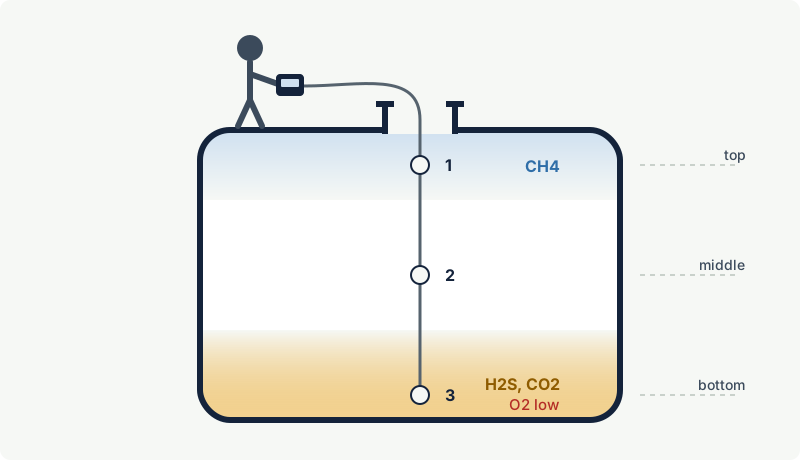
- Little natural ventilation. Gas that enters or is released stays there and may stratify: light gases such as methane at the top, heavy gases such as H2S, carbon dioxide or solvent vapours at the bottom.
- Hidden sources. Sludge releases H2S and methane when stirred; rust consumes oxygen; inert gas leaks through valves; adjacent equipment may vent into the space.
- No warning to the senses. Oxygen deficiency and carbon monoxide cannot be smelt, and H2S deadens the sense of smell at high concentrations. UK HSE guidance notes that air with no oxygen can cause unconsciousness within seconds. See oxygen deficiency.
The pattern of multiple deaths is well known: a worker collapses, a colleague enters to help without breathing apparatus and collapses too. A NIOSH alert published in 1986 found that more than 60 % of confined space fatalities occur among would-be rescuers. A gas monitor on the rescuer's belt is not a rescue plan; the rescue arrangements must be in place before entry.
Pre-entry testing step by step
The pre-entry test establishes whether the space is safe to enter. It is done by a trained person, with a working instrument, from outside the space, and recorded on the entry permit.
- Check the instrument. Confirm the calibration is in date and carry out a bump test (see the last section). Check the battery will last for the whole job, including continuous monitoring.
- Start up and zero in clean air. Switch on and let the instrument stabilise in known clean air, away from the space and from vehicle exhaust. Zeroing next to the opening can set the zero on contaminated air.
- Test from outside. Lower a sampling probe through the opening, or open a small sampling point first. UK HSE guidance notes that the atmosphere can often be tested from outside without entry, by drawing samples through a long probe.
- Follow the order. Read oxygen first, then flammable gas, then toxic gases. A low oxygen reading means the flammable reading of a catalytic sensor is not reliable.
- Test at several levels. Sample near the top, at mid-height and near the bottom, and at points away from the opening where air does not circulate (corners, behind baffles, in sumps). In each position, wait at least the transport time of the sample line plus the instrument's response time. US OSHA's guidance appendix asks for each parameter to be measured for at least the instrument's minimum response time.
- Compare with the acceptable entry conditions. These are written in the permit before the test, not chosen after seeing the results. If any value is outside them, do not enter: ventilate, isolate and clean, then test again.
- Record. Write the readings, time, location in the space, instrument serial number and tester on the permit.
Worked example: what a small oxygen drop means
A tester measures 20.4 % vol oxygen at the bottom of a pit, against 20.9 % in fresh air. The flammable and toxic channels read zero. Is the pit safe?
Oxygen is only displaced, not destroyed, by other gases. If the air contains 20.9 % oxygen, then a fall of 0.5 percentage points means that about 0.5 / 20.9 = 2.4 % of the air has been replaced by something else, which is about 24,000 ppm. The reading is above the OSHA limit of 19.5 %, but that limit does not make 2.4 % of an unknown gas acceptable:
- If the gas is carbon dioxide from fermentation, 24,000 ppm is well above the UK workplace exposure limits for carbon dioxide (5,000 ppm over 8 hours, 15,000 ppm over 15 minutes), and the source may still be producing it.
- If it is methane, 2.4 % vol is 55 %LEL (methane LEL 4.4 % vol), and the flammable sensor should have shown it. A zero reading points to a sensor problem or to a gas the sensor does not see.
- If it is nitrogen from a leaking purge line, the oxygen may fall further at any time.
The rule that follows: an oxygen sensor cannot be used to detect toxic or flammable gases (a drop of 0.1 % oxygen already corresponds to about 5,000 ppm of something else), but an unexplained oxygen drop is a reason to find the cause before entry. UK HSE guidance asks for any difference from the normal 20.9 % to be investigated and the risk assessed.
Sampling pumps and probes
Most pre-entry tests use a monitor with a built-in or clip-on pump that draws air through a probe and tubing. The tube makes testing from outside possible, but it adds a delay and several ways to get a wrong answer.
Transport time
The sample has to travel the length of the tube before the sensors see it, and then the sensors need their own response time. The transport time is simply the internal volume of the tube divided by the pump flow.
Example: A tester uses 15 m of tubing with a 3 mm internal diameter, and the pump draws 0.5 litres per minute (illustrative values; use the actual tubing and the manufacturer's flow data). The tube volume is π x (0.15 cm)² x 1,500 cm, about 106 cm³ or 0.106 litres. Transport time = 0.106 / 0.5 min, about 13 seconds. If the sensors need 25 seconds to reach 90 % of the final reading, the tester must wait at least 38 seconds at each point, and longer for a gas such as H2S that is partly absorbed on the tube walls.
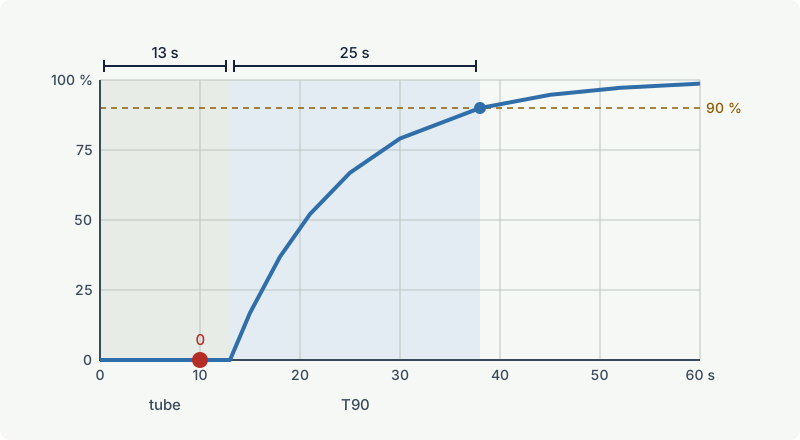
Manufacturers give transport times or maximum tube lengths for their pumps; UK HSE guidance simply says to allow time for the sample to displace the air in the probe. Pumped instruments are also bump tested through the same tubing and probe that will be used, which proves the whole sample path.
Things that go wrong with sample lines
- Leaks. A cracked tube or loose fitting dilutes the sample with outside air. Block the inlet briefly: a working pump should give a flow fault alarm.
- Blockage and water. Kinked tubing, mud or water reduce the flow. Use the water-stop filter and keep the probe tip out of liquid.
- Absorption and condensation. Reactive gases (H2S, chlorine, ammonia) and heavy solvent vapours stick to many tube materials, and water condensing in the tube absorbs soluble gases. Use the tubing the manufacturer specifies, keep it short and wait longer.
- Moving too fast. US OSHA's guidance appendix suggests testing about 1.2 m (4 feet) ahead of the entrant and to each side when descending into a possibly stratified atmosphere, and slowing down to match the sampling speed and detector response when a probe is used.
Continuous monitoring during entry
The pre-entry test is a snapshot. Conditions change during the work: disturbed sludge releases H2S or methane, hot work produces CO, solvent cleaning raises the vapour concentration, an isolation fails, the fan stops. UK HSE guidance states that conditions should be monitored continuously where, for example, forced ventilation is used, either with fixed monitors or with personal monitors worn by individual workers. US OSHA requires periodic testing as necessary during entry, to confirm acceptable entry conditions are being maintained.
Good practice for monitoring during entry:
- Each entrant wears a personal monitor in the breathing zone (on the collar or chest), not left at the entrance or in a pocket.
- Monitor where the work is. For deep spaces, the attendant can also keep a pumped instrument sampling from the work area.
- Alarm means leave. Agree in advance that any alarm means immediate evacuation, not checking the display. Re-entry needs a new test once the cause is found.
- Test again after breaks. Retest before re-entry after any interruption, as UK HSE guidance notes may be needed each time the space is re-entered.
- Think about the work. Hot work, chemical cleaning and coating need specific monitoring (flammable vapour from coatings, oxygen enrichment from leaking oxygen hoses). See hot work permits in hazardous areas.
- Ventilation is not monitoring. Forced ventilation reduces concentrations but does not prove them, and a fan whose inlet picks up engine exhaust or vented gas makes the space worse. Position the inlet in clean air and keep monitoring.
Bump tests and calibration of portable monitors
A portable monitor protects only if its sensors still respond to gas. Electrochemical cells dry out or are exhausted, catalytic beads are poisoned by silicones and other substances, and filters block, often without any fault indication: the display shows a perfect 20.9 % oxygen and zero everything else.
US OSHA's 2024 information bulletin on portable gas monitors recommends a bump test or calibration check before each day's use, a full calibration with certified gas if the instrument fails, removal from service if it fails the calibration, and calibration records kept for the life of the instrument. A bump test applies test gas above the alarm set points and confirms that each sensor responds and each alarm works. Docking stations automate this and keep the records, but they rely on in-date gas of the right concentration. Check again after a drop, after exposure to high concentrations or sensor poisons, and after an alarm event. Methods, gases and records are covered in detail in gas detector calibration and bump testing.
Common mistakes
- Zeroing next to the hatch. If the instrument is zeroed in contaminated air, every reading after that is too low. Zero in known clean air.
- Reading too quickly. The display does not change until the sample has travelled the tube and the sensors have responded. Wait for transport time plus response time at every point.
- Testing only at the opening. Heavy and light gases stratify. Test top, middle and bottom and in dead corners.
- Trusting a catalytic %LEL reading in low oxygen. Below about 10 % vol oxygen the catalytic reading is meaningless. Read oxygen first and use an infrared sensor in inerted spaces.
- Assuming 4 gases cover everything. Solvents, ammonia, chlorine and other toxics need specific sensors, and a 10 %LEL alarm is far above the toxic limit of most vapours.
- Skipping the bump test. A poisoned or dead sensor reads zero. Test with gas before each day's use.
Frequently asked questions
What is the correct order for confined space gas testing?
Test oxygen first, then flammable gases and vapours, then toxic gases. US OSHA's permit-required confined space rule requires this order, and UK HSE guidance gives the same order. Oxygen comes first because catalytic flammable gas sensors need oxygen to give a valid reading; flammable gases come before toxic ones because fire or explosion is usually the more immediate threat to life.
What oxygen level is safe for confined space entry?
US OSHA treats an atmosphere with less than 19.5 % or more than 23.5 % oxygen as hazardous. Normal air contains 20.9 %, and UK HSE guidance asks for any difference from that value to be investigated before entry, because a drop in oxygen means another gas has displaced part of the air.
What does a 4-gas monitor detect?
A 4-gas monitor usually measures oxygen (% vol), flammable gas (%LEL), carbon monoxide (ppm) and hydrogen sulphide (ppm). It does not detect other toxic gases, solvent vapours at toxic concentrations or dust, and a catalytic flammable sensor does not work in low-oxygen air. Add sensors that match the hazards of the actual space.
How long should I wait when sampling through a tube?
Wait at least the transport time of the tube (its internal volume divided by the pump flow) plus the response time of the sensors, at every sampling point. With long tubes this can be most of a minute or more. Check the manufacturer's data for the pump and tubing, and bump test through the same tube.
Do I need continuous monitoring in a confined space if the pre-entry test was clear?
Yes, in most cases. The pre-entry test only shows the conditions at that moment, and work in the space can release gas, consume oxygen or produce fumes. UK HSE guidance calls for continuous monitoring, for example when forced ventilation is used, and US OSHA requires testing during entry as necessary to confirm that acceptable conditions are maintained.
Related on excodex
- Gas detector calibration and bump testing
- Oxygen deficiency: nitrogen, argon and other inert gas hazards
- Hydrogen sulphide (H2S) detection: exposure limits, sensor selection and alarm settings
- Catalytic (pellistor) vs infrared flammable gas detectors
- Vapour density: which gases rise and which sink
- Gas library: /gas; standards spaces IEC 60079-29-0 and IEC 60079-29-2; questions in the forum
Standards and further reading
- US OSHA, 29 CFR 1910.146, Permit-required confined spaces (general industry), including the testing order and the definition of a hazardous atmosphere: https://www.osha.gov/laws-regs/regulations/standardnumber/1910/1910.146
- US OSHA, 29 CFR 1910.146 Appendix B, Procedures for atmospheric testing: https://www.osha.gov/laws-regs/regulations/standardnumber/1910/1910.146AppB
- UK HSE, L101 Safe work in confined spaces, Approved Code of Practice to the Confined Spaces Regulations 1997 (third edition, 2014): https://www.hse.gov.uk/pubns/priced/l101.pdf
- US NIOSH, Alert: Request for assistance in preventing occupational fatalities in confined spaces, publication 86-110 (1986): https://www.cdc.gov/niosh/docs/86-110
- US OSHA, Calibrating and testing direct-reading portable gas monitors, Safety and Health Information Bulletin (2024 update): https://osha.gov/publications/shib093013
- IEC 60079-29-0:2025, Explosive atmospheres, gas detection equipment: general requirements and test methods (formerly IEC 60079-29-1): https://webstore.iec.ch/en/publication/77173
- IEC 60079-29-2:2015, Explosive atmospheres, gas detectors: selection, installation, use and maintenance of detectors for flammable gases and oxygen: https://webstore.iec.ch/en/publication/21961
This article is general technical information prepared by the excodex editorial team. It does not replace the applicable standards, the equipment certificates and instructions, national regulations or the assessment of a competent person.