Hot work permits in hazardous areas
Abstract
How hot work permits control welding, cutting and grinding in hazardous areas: permit-to-work roles, isolation and preparation, gas testing before and during the work, fire watch, pressurised habitats and the lessons of fatal hot work explosions.
Hot work in or near a hazardous area, meaning welding, cutting, grinding, brazing, burning or any other work that can produce flames, sparks or hot surfaces, is allowed only under a written hot work permit. The permit makes sure that flammable material has been removed and isolated, that the atmosphere has been tested with a gas detector before the work starts and is monitored continuously while it lasts, that sparks are contained, that a fire watch is in place during and after the work, and that the permit is formally issued, suspended, handed over and cancelled. The first question is always whether the hot work can be avoided altogether.
This article goes through the permit life cycle, isolation and preparation, gas testing, the fire watch and pressurised welding habitats, and closes with the lessons of fatal hot work explosions investigated by the US Chemical Safety Board (CSB).
Key points
- The CSB identified over 60 deaths since 1990 from fires and explosions during hot work on tanks, and in all the cases it summarised, the workers did not know that an explosive amount of vapour had accumulated.
- OSHA 29 CFR 1910.252 prohibits cutting and welding in explosive atmospheres, requires combustibles to be moved at least 35 ft (10.7 m) away where practicable, and requires a fire watch for at least half an hour after the work where a fire watch is needed.
- Gas testing must be done immediately before and continuously during hot work, not only at the start of the shift: atmospheres change as the day warms, as tanks are filled and as process operations continue nearby.
- Tests must cover every place vapour can come from: the item itself, connected or adjacent tanks, vents, drains, sewers and hidden spaces such as tank skirts and double bottoms.
- NFPA 326, as summarised by the CSB, requires all work to stop if the flammable gas reading reaches 10 % of the lower explosive limit; many sites stop at a lower alarm and require no detectable flammable gas before starting.
- Pressurised welding habitats allow hot work on live plant only with clean air from a safe intake, positive pressure and automatic shutdown of the hot work on gas detection or loss of pressure.
What counts as hot work
The CSB bulletin on hot work quotes a common definition: work involving burning, welding or a similar operation that is capable of initiating fires or explosions. In practice permit systems include:
- open flame work: gas welding, cutting torches, burners, heat shrinking with a flame, bitumen boilers;
- spark-producing work: electric arc welding, grinding, abrasive cutting, needle gunning, drilling steel, chipping;
- other ignition sources taken into a hazardous area: non-Ex electrical tools and equipment, combustion engines and vehicles, and non-certified electronic devices. Safety Alert 521 of the US offshore regulator (issued in August 2026 under the name of the new Marine Minerals Administration, into which BSEE and the Bureau of Ocean Energy Management are being merged in phases), for example, recommends hot work permits whenever non-certified portable electronic devices cannot be avoided in a hazardous area.
Many sites split the permit into two classes, often called hot work with naked flame and hot work with spark potential, with stricter conditions for the first.
Avoid it first. The CSB's first lesson is to use alternatives where possible: cold cutting with hydraulic or pneumatic saws, bolted or clamped connections instead of welded ones, mechanical repair clamps, or removing the item to a workshop outside the hazardous area.
The permit-to-work system
A hot work permit is one type of permit within a permit-to-work system. The UK HSE guidance HSG250 describes the principles that apply to all permits, and they matter more for hot work than for almost any other job.
Roles. The permit is prepared and issued by an authorised person who knows the plant and its hazards (often called the issuing or area authority). The person in charge of the work accepts it, briefs the team and keeps it at the work site. An authorised gas tester carries out the gas tests. A fire watch is named. Large sites add a site checker or permit coordinator who sees all live permits together.
Content. The permit states the exact work, the location and equipment, the hazards found in the risk assessment, the precautions (isolations, gas test requirements, fire protection, personal protective equipment), the time of validity and the signatures of issuer and acceptor.
Cross-referencing. Isolations are often recorded on separate isolation certificates, and several permits may affect the same plant. HSG250 recalls that on Piper Alpha there was no cross-referencing when work under one permit affected work under another, and suspended permits were filed in the safety office rather than the control room, so the oncoming shift could not see which equipment was isolated. Every hot work permit should show the isolations it depends on and any other work nearby that could release flammable material.
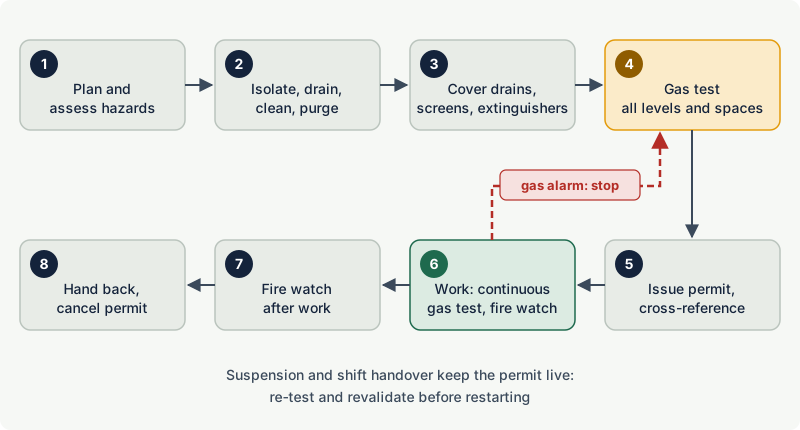
Suspension, handover and hand-back. Work may be suspended for a general alarm, for process operations such as sampling nearby, or while waiting for parts. A suspended permit remains live until it is cancelled, so its isolations stay in place, and the work restarts only after the issuer has checked the site and revalidated the permit, including a new gas test. Work that runs over a shift needs a formal handover. At the end, the work site is checked, the fire watch period completed, and the permit handed back and cancelled.
Isolation and preparation
Gas testing confirms that preparation worked; it does not replace it. Before a permit is issued, the sources of flammable material are removed or separated from the work.
- Positive isolation. Equipment to be worked on is separated from live process lines by spades or blinds, removal of a spool piece, or a double block and bleed arrangement appropriate to the hazard. A single closed valve is not positive isolation. HSE has separate guidance on the safe isolation of plant and equipment.
- Drain, clean and purge. Liquids are drained, residues and sludge cleaned out, and the equipment purged with water, steam or inert gas and then ventilated. OSHA requires containers that held flammable materials to be cleaned so that no flammable residues remain, connected lines disconnected or blanked, and hollow spaces vented before heating or welding.
- Hidden sources. Scale, sludge, porous linings, the space under tank skirts, jackets and double walls can hold or produce flammable vapour after cleaning. Biological activity in organic wastes can generate methane or hydrogen.
- Drains, vents and openings. Drains, sewers, cable trenches and open tank vents within reach of sparks are covered or sealed. Vents of nearby tanks are considered as release points.
- Combustibles and sparks. Combustible material is moved away (OSHA: at least 35 ft, 10.7 m, where practicable) or covered with fire-resistant blankets, and welding screens or spark containment are used. Sparks from grinding and cutting travel far and fall through gratings to lower levels.
- Oxygen. Cutting torches use oxygen, and a leaking hose or torch can enrich a confined space. Oxygen must never be used to ventilate or "freshen" a space.
- Cathodically protected pipelines. Before cutting such a pipeline, a temporary bond is installed across the cut, because the voltage gradient can cause an arc when the pipe is separated.
Gas testing: before and during
The CSB singled out its second and third lessons, analyse the hazards and monitor the atmosphere, for special attention, and concluded that hazard analysis and the proper use of a combustible gas detector would likely have warned the workers in the cases it reviewed. Its fourth lesson, test the area, extends the testing to everything around the work.
Who tests, with what
Gas tests are made by a trained, authorised gas tester using a portable detector that has been calibrated and bump tested as the manufacturer requires. The tester must understand the instrument's limits:
- Catalytic (pellistor) sensors need oxygen to work. In an inerted or oxygen-deficient space they can read low or zero even with a high hydrocarbon concentration; use an infrared sensor or a % volume measurement, together with an oxygen sensor.
- Infrared sensors do not respond to hydrogen, which matters where hydrogen can be present, for example in battery rooms, electrolysis plants or waste tanks with biological activity.
- Calibration gas and response factors. A detector calibrated on methane reads differently for heavier hydrocarbons and solvents; the site procedure states the calibration gas and the correction factors or the more conservative alarm settings used.
Where to test
The CSB cases show that "the gas test was fine" often meant "the gas test was in the wrong place". Test:
- inside the equipment to be worked on, at several points and levels;
- at the work point itself, including the far side of the wall to be cut or welded;
- low for vapours heavier than air and high for gases lighter than air;
- in connected and adjacent tanks and vessels, and at their vents;
- in drains, sewers, trenches, pits and any enclosed spaces such as tank skirts.
When to test
Test immediately before the work starts, after every break or suspension, and continuously during the work, with a fixed or portable monitor with audible and visual alarms placed between the most likely source of vapour and the work point. A test at 7 am says nothing about the atmosphere at 2 pm on a warming day.
Acceptance criteria
| Measurement | Common criterion | Source or status |
|---|---|---|
| Flammable gas before starting | No detectable reading (0 % LEL within the instrument's resolution) | Common site practice; insurance industry loss prevention guidance quoted by the CSB: on any detectable reading, work does not begin or continue until the source is found and controlled |
| Flammable gas during the work | Stop all work at 10 % LEL at the latest, often at a lower site alarm | NFPA 326 as summarised by the CSB, for work on tanks and containers that held flammables |
| Oxygen | Within the normal range of air; enrichment from torch leaks is a fire hazard | OSHA confined space definitions treat below 19.5 % and above 23.5 % by volume as hazardous |
| Toxic gases | Below the exposure limits set by the site's risk assessment | Depends on the substances present, for example hydrogen sulphide |
A reading that rises during the work is a warning that the preparation has failed somewhere. The correct response is to stop, make the site safe, withdraw, find the source and re-test, not to ventilate harder and carry on.
Fire watch
A fire watch is a trained person whose only job is to watch for fire. During the work, the fire watch looks for sparks and hot slag landing on combustible material, including on lower levels and behind walls, has suitable extinguishers or a charged hose at hand, and has the authority to stop the work.
After the work, smouldering material can flare up long after the welder has left. OSHA 1910.252 requires the fire watch to be maintained for at least half an hour after welding or cutting is completed. NFPA 51B, the US consensus standard on hot work fire prevention, has called for at least one hour since its 2019 edition, and many site procedures and insurers' permit forms also require an hour or more, with further checks of the area afterwards. The hand-back of the permit includes a final inspection of the work area and its surroundings.
Pressurised welding habitats
On offshore installations and large process plants it is sometimes necessary to weld on or near live equipment that cannot be shut down and gas-freed. A pressurised habitat creates a protected volume around the work instead of trying to make the whole surrounding area gas-free.
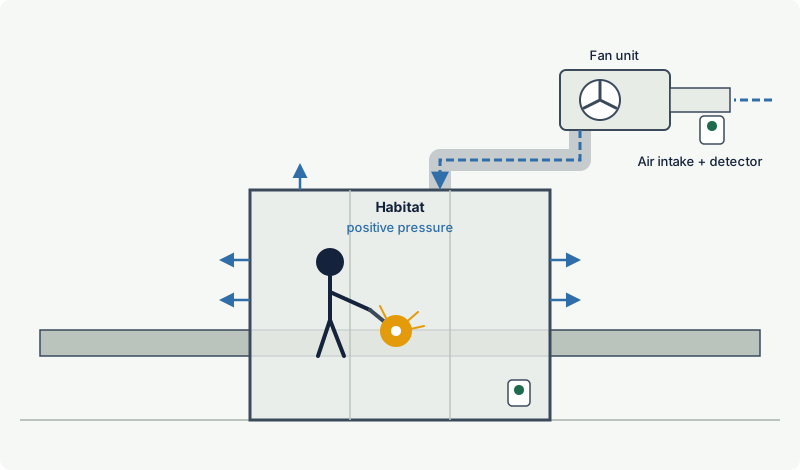
The principles come from pressurisation, the same idea that IEC 60079-13 applies to pressurised and artificially ventilated rooms:
- Clean air from a safe place. A fan draws air from an intake located outside the hazardous area or at a point where gas is not expected, and ducts it into the habitat.
- Positive pressure. The habitat is kept slightly above the outside pressure so that air leaks outwards through every gap, keeping external gas out. Flow and pressure are monitored.
- Gas detection at the air intake and inside the habitat, and often at the habitat boundary.
- Automatic shutdown. Detection of gas, or loss of pressure or airflow, automatically cuts the power to welding sets and other ignition sources inside, and raises an alarm; the system design decides what happens to the fan and intake so that gas is not drawn in.
- Fire-resistant construction, a fire watch, safe means of escape, and protection of the occupants against fumes and heat.
The habitat equipment, its controls and its detectors are themselves in a hazardous area and must be suitable for it. Purge, pressure and shutdown functions are proved before each use and recorded on the permit.
Lessons from hot work explosions
The CSB's 2010 safety bulletin, "Seven key lessons to prevent worker deaths during hot work in and around tanks", summarises 11 accidents. In seven, no gas testing was done; in four, testing was done improperly. A selection:
| Incident (official findings) | What happened | Lesson |
|---|---|---|
| Motiva Enterprises refinery, Delaware City, USA, 2001; 1 killed, 8 injured | Welding sparks on a catwalk ignited hydrocarbon vapour from a sulphuric acid tank with holes in its roof and shell; gas testing was done only at the start, about five hours earlier, as the day warmed | Monitor continuously; do not allow hot work near tanks with known holes |
| Bethune Point wastewater plant, Daytona Beach, USA, 2006; 2 killed | Cutting a roof above a methanol tank vent; sparks ignited vapour at the vent and the flame passed a corroded flame arrester into the tank | Test at vents; maintain flame arresters; use written permits |
| Partridge-Raleigh oilfield, Raleigh, Mississippi, USA, 2006; 3 killed | Welding between interconnected oil tanks; the workers used a lit torch to "check" a tank for vapour | Never test with a flame; isolate and test connected tanks |
| Packaging Corporation of America, Tomahawk, Wisconsin, USA, 2008; 3 killed | Welding on top of a tank of recycled water and fibre waste; bacteria had produced hydrogen in the tank | Analyse the hazards of "non-flammable" tanks; test before and during |
| MAR Oil, La Rue, Ohio, USA, 2008; 2 killed | Welding near the vent of interconnected crude oil tanks while oil flowed into an adjacent tank, displacing vapour | Consider process movements in connected equipment |
| ConAgra Foods, Boardman, Oregon, USA, 2009; 1 killed | Gas was tested only from the tank entrance; flammable gas had collected in a hidden space under the tank skirt | Test at the work point and in hidden spaces |
| TEPPCO Partners, Garner, Arkansas, USA, 2009; 3 killed | Torch-cutting on the floating roof of a gasoline tank; the permit recorded a gas test at 7:00, the explosion came at about 14:30 | Re-test immediately before and during the work |
Earlier, in 1995, five workers died at the Pennzoil refinery in Rouseville, Pennsylvania, when vapour from a waste tank was ignited by welding on a stairway between two tanks; the investigation by the US EPA noted that the morning gas test had not been repeated as the day warmed.
Worked example: welding a bracket near a methanol tank
A bracket on a handrail must be replaced 6 m from the atmospheric vent of a methanol storage tank. The excodex library gives methanol a flash point of 9 °C, a lower explosive limit of 6 % by volume and a vapour density of 1.11, so on a warm day the vent can release vapour that spreads close to the ground and at the tank roof.
- Avoid. A bolted bracket was considered but the handrail design requires welding. Moving the handrail section to the workshop is not possible.
- Assess. The risk assessment identifies the tank vent, a nearby drain and the pipe rack above. Tank filling is a source of vapour release, so no filling is allowed while the permit is live; this is written on the permit and the control room confirms it.
- Prepare. The flame arrester on the vent is inspected and found in good condition. The drain is sealed, combustible material is removed, and fire-resistant blankets and screens are placed on the side facing the tank.
- Test. The gas tester checks the work point, the drain, the vent area and the ground below the work: no flammable gas detected, oxygen normal.
- Monitor. A portable monitor, with its reading corrected for methanol as the site procedure specifies and its alarm set at 10 % LEL or lower, is placed between the vent and the work point, and the welder wears a personal detector.
- Work. The fire watch has an extinguisher and the authority to stop work. After lunch the area is re-tested before welding resumes.
- Finish. The fire watch stays for the time required by the site procedure (one hour in this case, above the OSHA minimum of 30 minutes), then the issuer inspects the area, and the permit is handed back and cancelled.
Common mistakes
- One gas test at the start of the day. Atmospheres change with temperature, process operations and the work itself. Monitor continuously and re-test after every break.
- Testing only the item being worked on. Connected tanks, vents, drains and hidden spaces were the vapour sources in several fatal accidents.
- Relying on a closed valve. Use positive isolation and record it on a cross-referenced isolation certificate.
- Using the wrong detector. Catalytic sensors fail in low oxygen, infrared sensors miss hydrogen, and calibration gas matters.
- Leaving when the welding stops. Smouldering fires appear after the work ends; keep the fire watch for the required time and inspect before hand-back.
- Contractors and host company each assuming the other tested. The permit must name who tests, when and with what, and the host must supervise contractors' hot work.
Frequently asked questions
What is a hot work permit?
It is a written authorisation, issued by a competent person who knows the plant, that allows a specific job involving flames, sparks or heat to be done at a stated place and time under stated precautions. It records the hazards, isolations, gas test results, fire protection and the people responsible, and it is cancelled formally when the work and the fire watch are finished.
What LEL reading is acceptable for hot work?
Most sites require no detectable flammable gas before hot work starts. During the work, NFPA 326 as summarised by the CSB requires all work to stop at 10 % of the lower explosive limit, and many sites set a lower alarm. Any rising reading means the preparation has failed and the work must stop until the source is found.
How long must a fire watch stay after hot work?
OSHA 29 CFR 1910.252 requires at least half an hour after welding or cutting is completed where a fire watch is required. NFPA 51B (2019 edition onwards) calls for at least one hour, and many company procedures follow that, with a final inspection before the permit is closed.
Is grinding hot work?
Yes. Grinding and abrasive cutting throw hot particles over considerable distances and are treated as hot work in hazardous areas, usually in the spark-potential category of the permit system. The same applies to drilling steel and to bringing non-Ex electrical tools into the area.
What is a welding habitat?
A welding habitat is a temporary enclosure built around hot work on live plant. It is supplied with clean air from a safe intake and kept at positive pressure, with gas detectors at the intake and inside that automatically shut down the welding power if gas is detected or the pressure is lost.
Related on excodex
- Portable gas detectors and confined space entry
- Catalytic (pellistor) vs infrared flammable gas detectors
- Gas detector calibration and bump testing
- Oxygen concentration, enrichment and inerting
- Portable electronics in hazardous areas: phones, tablets, cameras and tools and Earthing, bonding and equipotential bonding in hazardous areas
- Gas library: methanol, hydrogen, methane; standards space IEC 60079-13; forum
Standards and further reading
- US Chemical Safety Board, "Seven key lessons to prevent worker deaths during hot work in and around tanks", Safety Bulletin 2009-01-SB (2010): bulletin PDF
- OSHA 29 CFR 1910.252, welding, cutting and brazing, general requirements: osha.gov
- HSE, HSG250 "Guidance on permit-to-work systems" (2005): free PDF
- IEC 60079-13:2017, equipment protection by pressurized room "p" and artificially ventilated room "v": IEC webstore
- NFPA 51B, fire prevention during welding, cutting and other hot work (the 2019 edition extended the fire watch after hot work to at least one hour; summary on the ANSI blog: blog.ansi.org); NFPA 326, safeguarding of tanks and containers for entry, cleaning or repair
- API RP 2009, safe welding, cutting and hot work practices in the petroleum and petrochemical industries
This article is general technical information prepared by the excodex editorial team. It does not replace the applicable standards, the equipment certificates and instructions, national regulations or the assessment of a competent person.