Gas detector calibration and bump testing
Abstract
A bump test proves a gas detector responds and alarms; a calibration adjusts its reading to a certified gas. Portable monitors are bump tested before each day's use; fixed detectors at intervals proven by records. Gases, response factors and records explained.
A bump test briefly exposes a gas detector to a known test gas to prove that the sensors respond and the alarms work; it measures nothing and adjusts nothing. A calibration sets the detector's zero in clean air and its span with a certified calibration gas, so that the reading matches the true concentration. Portable gas monitors should be bump tested, or calibration checked, before each day's use, as recommended by US OSHA; fixed detectors are gas tested and recalibrated at intervals set by the manufacturer, regulations and the site's own test records, starting short and extending only when the records justify it.
This article defines the different checks, gives frequency guidance, explains what makes a good calibration gas, how to calibrate for one gas using another (response factors), and what to record.
Key points
- A bump test is a qualitative check: test gas at a concentration high enough to trigger all alarms, no adjustment. A calibration check compares the reading with a known concentration against a tolerance. A full calibration adjusts zero and span.
- Many sensor failures (catalyst poisoning, a blocked sinter, a dried-out electrochemical cell) leave the zero reading perfect. Only gas applied to the sensor proves that it still responds.
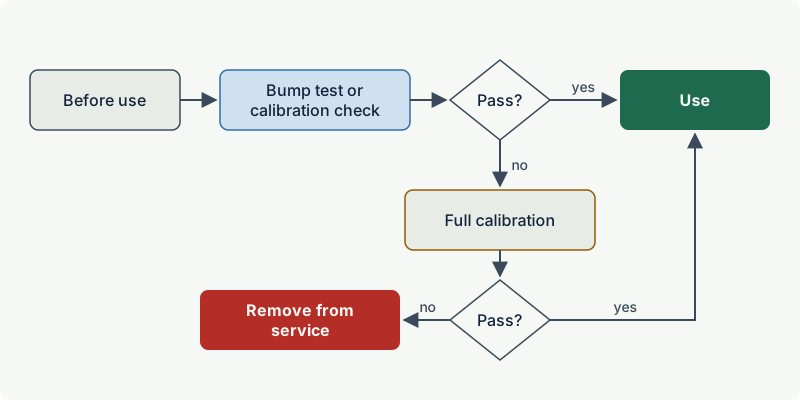
- US OSHA, adopting the position of the US International Safety Equipment Association, recommends a bump test or calibration check of portable monitors before each day's use, and a full calibration if the check fails.
- IEC guidance recommends starting fixed systems with frequent checks (it suggests weekly as an example) and extending the interval (for example to monthly) only as the maintenance records build confidence.
- Calibration gas should be certified, traceable, within its expiry date and of the composition the manufacturer specifies; catalytic sensors need a test gas in air (at least 10 % vol oxygen).
- A detector can be calibrated with a substitute gas using response factors, but the result is less certain: add margin to alarm settings, calibrate hydrogen detectors only with hydrogen, and use methane test gas where methane may be present.
- Record every test with as-found and as-left readings. The records are the evidence that justifies the test interval.
Definitions: three different checks
The words are used loosely in the field, and the same word can mean different things in different documents. These are the meanings used by US OSHA in its 2024 information bulletin and, in substance, by IEC guidance:
| Check | What is done | Adjustment | Pass criterion | Typical frequency |
|---|---|---|---|---|
| Bump test (function check) | Expose the sensors to test gas long enough to trigger all alarms | None | Every sensor responds and every alarm activates | Portable: before each day's use |
| Calibration check | Expose the sensors to a known concentration and compare the reading | None | Reading within the manufacturer's tolerance; OSHA quotes typically 10 to 20 % of the test gas value | Portable: as an alternative to the bump test; fixed: routine gas test |
| Full calibration | Set zero in clean air or zero gas, then set span with certified gas | Zero and span adjusted | Reading equals the gas concentration after adjustment; returns to zero | When a check fails, and at the interval set by the manufacturer and site records |
IEC guidance (IEC 60079-29-2) uses the terms field check or response check for applying test gas without adjusting zero, sensitivity or alarm levels, and recalibration for the periodic adjustment of zero and sensitivity. It recommends recalibration if the field check result is not within about ±10 % of the expected reading. For alarm-only instruments without a display, it recommends a test gas 5 %LEL above the highest alarm set point, so that all alarms must actuate.
Why only gas proves a detector works
Most gas detectors have a quiet failure mode. A poisoned catalytic bead balances perfectly in clean air. A sinter blocked by paint or dust still lets the sensor read zero. An electrochemical cell that has dried out in a hot, dry climate or been exhausted by gas exposure shows a stable baseline. None of these problems produce a fault signal, and all of them reduce or destroy the response to gas. See catalytic vs infrared detectors and electrochemical toxic gas sensors.
IEC guidance says plainly that errors and failures of gas detectors may not be self-evident, and that the reliability of a measurement depends on testing with gas, which exercises the whole measuring function. Electronic self-tests and panel test buttons check the alarm circuits and displays, but not the sensor's response to gas.
Example: In 2019 two people died from hydrogen sulphide at an oilfield waterflood station in Odessa, Texas. The US Chemical Safety Board (CSB) found that the fixed H2S detection and alarm system was not working: the control panel was not receiving signals from its sensors, so neither alarm activated. Among its findings, the CSB called for documented programmes covering installation, calibration, inspection and maintenance of detection systems.
How often: frequency guidance
Portable monitors
US OSHA's information bulletin on calibrating and testing direct-reading portable gas monitors (updated in 2024) recommends a bump test or calibration check before each day's use, in line with the manufacturer's instructions; if the instrument fails, a full calibration before use; and if it fails the calibration, removal from service. IEC guidance asks for frequent field checks of portable instruments, carried out immediately before each use in arduous or unknown situations or where the instrument is rarely used, and notes that the earlier IEC performance standard required portable instrument manuals to give a method for a functional check with gas before each day of use.
Additional checks are sensible after events that can change a sensor's response:
| Event | Why it matters | Action |
|---|---|---|
| Instrument dropped or damaged | Explosion protection and sensors may be affected | Take out of service, inspect, recalibrate before use |
| Exposure above the measuring range | Catalytic and semiconductor sensors can shift zero or sensitivity | Check with gas; recalibrate if needed |
| Exposure to poisons (silicones, leaded fuel, phosphate esters) | Permanent loss of catalytic sensitivity | Bump test immediately; repeat frequently while the risk exists |
| Alarm on H2S or another sulphur or halogen compound in a multi-gas monitor | These substances can inhibit catalytic sensors, temporarily or permanently | Check the flammable sensor before further use |
| Gas test that releases a permit to work | The result must be trustworthy | IEC suggests a response check after the test as well, with both results logged |
| Unknown status (spare, long storage, returned from hire) | Sensors age in storage too | Check before use |
Fixed detectors
For fixed systems, IEC guidance recommends calibration on commissioning, then testing and recalibration at defined intervals. For a new installation it suggests frequent checks at first, perhaps weekly, extended perhaps to monthly as the maintenance records build confidence. In practice, where the manufacturer, a regulation and the site procedure give different intervals, the shortest is used. IEC guidance also suggests a visual check of the control panel once per shift and regular functional checks of lamps, sounders and outputs with test switches.
Some regulations set intervals directly. For example, US rules for offshore oil and gas operations (30 CFR 250.490) require H2S detectors to be tested with 10 to 30 ppm of H2S at least once every 24 hours during drilling and well work in H2S areas, and at least every 14 days in production, with recalibration if the result is outside 2 ppm or 10 % (whichever is greater) of the applied concentration.
Where the detector is part of a safety instrumented function, the proof test interval used in the SIL calculation also sets a maximum interval; see gas detection and functional safety.
Calibration gas: what makes a good one
- Certified and traceable. Use cylinders supplied with a certificate of analysis, traceable to a national measurement standard. OSHA recommends certified, traceable test gas and never using a test gas past its expiry date.
- The right balance gas. A catalytic sensor needs oxygen to work, so its test gas must be the flammable gas in air (IEC guidance asks for at least 10 % vol oxygen in the mixture). A test gas in nitrogen will give a falsely low or zero response on a catalytic sensor.
- The right concentration. For calibration, IEC guidance suggests a concentration that gives a reading well up the scale (between about 25 and 75 % of full scale for portable instruments), unless the manufacturer specifies otherwise. A typical flammable span gas is 50 %LEL. To verify alarms, the gas must be slightly above the highest set point.
- Reactive gases need care. Hydrogen sulphide, chlorine and similar gases are stable in a cylinder only for a limited time and are absorbed by many materials. Use the regulators, tubing and adapters the manufacturer specifies (materials resistant to absorption and corrosion), keep tubing short, and respect shelf life. IEC guidance notes that very reactive gases such as fluorine, hydrogen chloride or ozone are not suitable for field calibration mixtures.
- The right flow and adapter. Diffusion detectors need a calibration adapter that surrounds the sensor and keeps ambient air out, with gas at the flow rate the manufacturer specifies, because the adapter and flow are designed to give the same response as gas arriving by diffusion. Aspirated (pumped) instruments need gas at atmospheric pressure: a demand-flow regulator, a gas bag, or an overflow tee with a blow-off.
- Clean zero. Zero in genuinely clean air. Where ambient air may contain the gas (or carbon dioxide for a CO2 sensor), use zero air from a cylinder.
Cross-calibration and response factors
A detector often has to protect against a gas that is impractical to carry in a cylinder, such as a solvent vapour. IEC guidance describes two ways to calibrate with a substitute gas, using the relative response data that manufacturers determine in the laboratory for a model of detector:
- Calibrate so the display reads correctly for the test gas, and apply the relative response to the substance of interest (in software or in the alarm settings).
- Adjust the display to an artificial reading on the test gas, so that the instrument reads approximately correctly for the substance of interest.
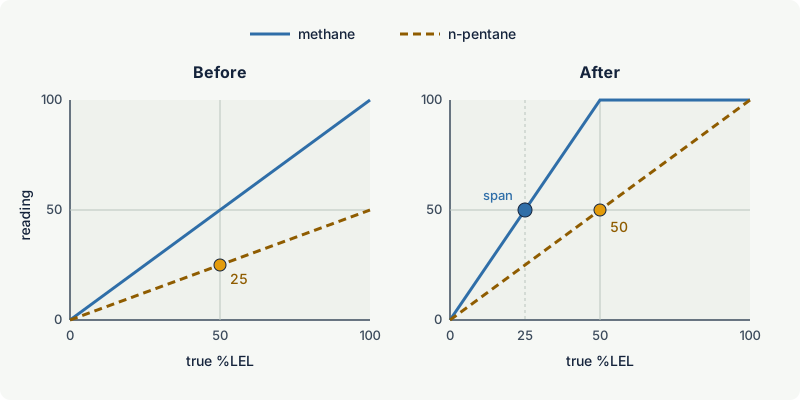
Example: A catalytic detector must protect a solvent store against n-pentane vapour. The manufacturer's data say that, on a methane calibration, this model reads n-pentane at 0.5 times its true %LEL (the figure is illustrative; use the actual data for the sensor). With method 2, the technician applies 25 %LEL methane and sets the display to 50 %LEL. Now 50 %LEL of n-pentane gives the same sensor signal as 25 %LEL methane, so it reads 50. Methane itself would read double, which is the safe direction. The alarm settings should still include a margin, because the 0.5 factor varies between individual sensors and changes as the sensor ages.
IEC guidance adds several rules that follow from how sensors age:
- Methane first. The response of a catalytic sensor to methane tends to deteriorate before its response to other gases. Where methane could be present, methane test gas is recommended for checks, even if another gas is used for the calibration.
- Otherwise, a "hard" gas. Propane, pentane or hexane mixtures are often recommended because sensitivity to them tends to fall before most other substances. In practice, pressurised test kits can hold n-pentane only up to about 50 %LEL and n-hexane up to about 10 %LEL, because higher concentrations would condense in the cylinder.
- Least sensitive gas. Where several gases may be present, calibrate for the one the sensor is least sensitive to, provided it stays adequately sensitive to the others; otherwise use separate detectors.
- Hydrogen only with hydrogen. Hydrogen detectors should be calibrated with hydrogen.
- Extra margin. Whenever the test gas differs from the target gas, use additional safety margins and lower alarm settings (see setting gas detector alarm levels).
For infrared detectors, cross-calibration is less forgiving: the response of an IR sensor differs much more from gas to gas and is often non-linear, so a single factor may be right at one point only. Use the manufacturer's gas tables or linearisation for the target gas rather than a simple factor.
A good calibration procedure
The detailed steps come from the manufacturer's manual, but a sound procedure for a fixed detector includes:
- Permit and inhibit. Inform the control room, inhibit executive outputs (so the test does not shut down the plant) and make sure the inhibit is indicated. Arrange other protection, such as a portable detector, for the period the detector is out of service.
- Inspect. Check the detector, sinter or optics, weather guard and cable entries; clean or replace filters as required.
- Zero. Confirm the zero in clean air or with zero gas; record the as-found zero, then adjust if needed.
- Apply span gas. Fit the adapter, apply certified gas at the specified flow, wait for a stable reading and record the as-found value before any adjustment. Note the response time if the procedure asks for it.
- Adjust and record. If the reading is outside tolerance, adjust span and record the as-left value.
- Return to zero. Remove the gas and confirm the reading returns to zero; repeat if zero and span interact.
- Alarms and outputs. Confirm alarms and signals at the control system (a full loop test from sensor to panel), then remove the inhibit and confirm normal monitoring.
For sampling systems, IEC guidance calls the gas test applied at the sample point the most important test of the system: apply gas at atmospheric pressure (for example from a bag) at the end of the sample line and confirm that the analyser gives the same reading as when gas is applied directly. This reveals leaks, blockages and absorption in the line.
Docking stations for portable monitors automate bump tests and calibrations and keep the records, but they are only as good as the gas connected to them: check cylinder expiry and concentration settings.
Records
Records turn testing into evidence. IEC guidance recommends an instrument maintenance record for each portable instrument or detector head, a dossier for each fixed system, and the use of records to find the right interval. OSHA recommends keeping calibration records for the life of each instrument.
A useful calibration record contains:
- instrument or tag number, model and serial number, location;
- date, person, and procedure used;
- test gas: composition, concentration, cylinder batch or lot and expiry date;
- as-found zero and span readings, as-left readings, and the tolerance applied;
- alarm and output checks, and response time if measured;
- result (pass, adjusted, failed), parts replaced, and next due date.
Trends matter more than single results. A sensor that needs large span adjustments at every visit is losing sensitivity and should be replaced before it fails; a detector that never drifts may justify a longer interval. IEC guidance also recommends marking portable instruments with the date of calibration and the date the next one is due.
Common mistakes
- Treating a zero reading as proof that a detector works. Poisoned or blocked sensors read zero. Only a gas test proves the response.
- Calibrating catalytic sensors with gas in nitrogen. Without oxygen the sensor cannot respond properly. Use flammable gas in air.
- Adjusting before recording the as-found value. Without as-found data there is no evidence of how far the detector had drifted, or whether it would have alarmed.
- Using expired or wrong-concentration gas. Old reactive gas has lost concentration; the detector is then set to over-read or under-read. Check the label and certificate every time.
- Cross-calibrating without margin. Response factors are typical values for a model, not for the individual sensor in front of you, and they change with age. Use lower alarm settings when calibrating with a substitute gas.
- Leaving outputs inhibited after the work. A forgotten inhibit removes protection without anyone noticing. Make inhibits visible and check them at shift handover.
Frequently asked questions
What is the difference between a bump test and a calibration?
A bump test exposes the detector to test gas to confirm that the sensors respond and the alarms activate, without measuring accuracy or adjusting anything. A calibration sets the zero and span of the instrument with a certified gas so that the reading matches the true concentration. A calibration check sits in between: it compares the reading with a known gas against a tolerance, without adjustment.
How often should a portable gas detector be bump tested?
US OSHA, following the US International Safety Equipment Association, recommends a bump test or calibration check before each day's use. IEC guidance asks for frequent checks, immediately before use in arduous or unknown conditions. Extra checks are needed after a drop, after exposure to high concentrations or sensor poisons, and when the instrument's status is unknown.
How often should fixed gas detectors be calibrated?
There is no single interval. IEC guidance recommends calibrating on commissioning, testing frequently at first (it gives weekly as an example) and extending the interval, for example to monthly, as the records show the detectors are stable. Manufacturer instructions, regulations and safety instrumented function proof test intervals may set shorter limits.
Can I calibrate a gas detector with a different gas?
Yes, using the manufacturer's relative response data, but with care. Use methane test gas where methane may be present, calibrate hydrogen detectors only with hydrogen, and set alarm levels lower to allow for the uncertainty of the response factor. Infrared detectors need the manufacturer's gas-specific data because their response varies strongly between gases.
What calibration gas should I use for a catalytic LEL sensor?
Use a certified mixture of the specified gas in air, typically around 50 %LEL, within its expiry date, applied with the manufacturer's adapter and flow rate. The mixture must contain enough oxygen (IEC guidance says at least 10 % vol) for the catalytic reaction; gas in nitrogen will not give a valid response.
Related on excodex
- Setting gas detector alarm levels
- Catalytic (pellistor) vs infrared flammable gas detectors
- Electrochemical toxic gas sensors
- Portable gas detectors and confined space entry
- Fixed gas detection systems: design principles
- Gas library: /gas; standards spaces IEC 60079-29-2 and IEC 60079-29-0; questions in the forum
Standards and further reading
- IEC 60079-29-2:2015, Explosive atmospheres, gas detectors: selection, installation, use and maintenance of detectors for flammable gases and oxygen: https://webstore.iec.ch/en/publication/21961
- IS/IEC 60079-29-2:2007, the first edition of the same guidance as adopted in India, publicly available: https://law.resource.org/pub/in/bis/S05/is.iec.60079.29.2.2007.pdf; IEC webstore (current edition, IEC 60079-29-2:2015): webstore.iec.ch
- IEC 60079-29-0:2025, Explosive atmospheres, gas detection equipment: general requirements and test methods (formerly IEC 60079-29-1 and IEC 60079-29-4): https://webstore.iec.ch/en/publication/77173
- IEC 62990-2:2021, Workplace atmospheres, gas detectors: selection, installation, use and maintenance of detectors for toxic gases and vapours.
- US OSHA, Calibrating and testing direct-reading portable gas monitors, Safety and Health Information Bulletin SHIB 11-26-2024: https://www.osha.gov/publications/shib093013
- US 30 CFR 250.490, hydrogen sulphide requirements for offshore operations, including detector testing: https://www.law.cornell.edu/cfr/text/30/250.490
- US Chemical Safety Board, executive summary of the investigation into the 2019 hydrogen sulphide release at a waterflood station in Odessa, Texas: https://www.csb.gov/assets/1/20/Executive_Summary_from_Final_Report.pdf
This article is general technical information prepared by the excodex editorial team. It does not replace the applicable standards, the equipment certificates and instructions, national regulations or the assessment of a competent person.