Electrochemical toxic gas sensors: how they work and their limitations
Abstract
An electrochemical gas sensor is a small fuel cell whose current is proportional to the toxic gas concentration. How the cell works, which gases it measures, and its limits: cross-sensitivity, finite life, and the effects of temperature, humidity and pressure.
An electrochemical toxic gas sensor is a small fuel cell. The target gas diffuses through a narrow opening to a catalytic working electrode, where it is oxidised or reduced; the reaction releases or consumes electrons, and the resulting current, typically from tens of nanoamperes to a few microamperes per ppm depending on the gas and the cell, is proportional to the gas concentration. The design makes these sensors selective, linear and very low in power, which is why they are the standard choice for carbon monoxide, hydrogen sulphide, oxygen and many other gases in personal monitors and fixed detectors. Their limitations are a finite life, cross-sensitivity to other gases that react at the same electrode, and sensitivity to extremes of temperature, humidity and pressure.
This article explains how the cell works, which gases it measures, and each limitation, with published examples and two worked cases.
Key points
- The current of an electrochemical cell is limited by how fast gas can diffuse through its capillary or membrane, so it is proportional to concentration. A zero point and one calibration point define the whole range.
- Most toxic gas cells have three electrodes: working, counter and reference. An electronic circuit, the potentiostat, holds the working electrode at a fixed potential relative to the reference.
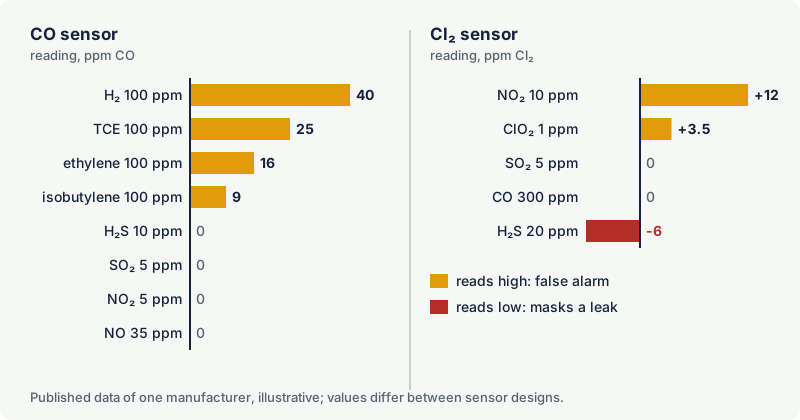
- Cross-sensitivity can be positive (false readings or false alarms) or negative (a real hazard reads low and may not alarm). One manufacturer's published data for a carbon monoxide sensor show 100 ppm of hydrogen reading as about 40 ppm of CO; other designs differ.
- Sensor life is limited: manufacturers commonly state around two years in clean air for common CO, H2S and oxygen cells, and shorter lives for some reactive gases. Life ends sooner in hot, dry or contaminated conditions.
- Most cells use a water-based acid electrolyte. Long periods in very dry air, below the humidity range on the data sheet, dry them out; constant high humidity dilutes the electrolyte and can make the cell leak; condensation blocks the gas path.
- Temperature changes both the sensitivity and the zero; instruments compensate electronically, but sudden changes still cause transients. Typical operating ranges are about -20 to +50 °C.
- A sensor that has dried out, been exhausted or been poisoned can still read a perfect zero. Only test gas proves it responds.
How an electrochemical cell works
Construction
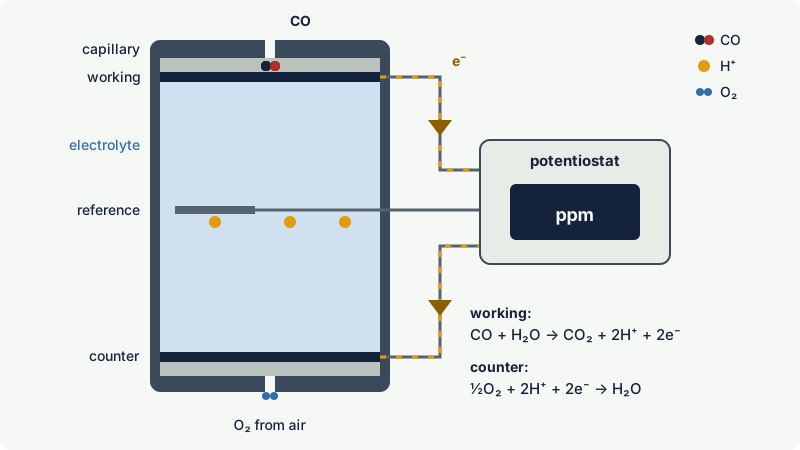
A typical cell is a small sealed plastic housing containing:
- a diffusion barrier: a fine capillary hole or a porous membrane that limits how fast gas reaches the electrode, often behind a dust filter and sometimes a chemical filter;
- a working (sensing) electrode: a high-surface-area precious-metal catalyst bonded to a porous, water-repellent membrane, so gas can reach it from one side and electrolyte wets it from the other;
- a reference electrode, which provides a stable potential and carries almost no current;
- a counter electrode, where the opposite reaction takes place;
- an electrolyte, most commonly a mineral acid such as dilute sulphuric acid, connecting the electrodes inside the cell.
The reactions
For carbon monoxide, the working electrode oxidises the gas:
CO + H2O → CO2 + 2H+ + 2e-
and the counter electrode reduces oxygen:
½O2 + 2H+ + 2e- → H2O
The overall reaction is the oxidation of CO to CO2, the same as in a fuel cell. Hydrogen sulphide, sulphur dioxide and nitric oxide are also oxidised at the working electrode. Gases such as nitrogen dioxide and chlorine work the other way round: they are reduced at the working electrode, and the current flows in the opposite direction.
Why the current is proportional to concentration
The working electrode is made so active that every molecule arriving there reacts at once. The rate of reaction, and therefore the current, is then set only by how fast gas diffuses through the capillary or membrane, which is proportional to the concentration outside. The result is a linear output from zero to the top of the range, so calibration needs only a zero point and one span point. Changing the size of the diffusion barrier tailors a sensor for a low ppm range or a high one.
Because the diffusion barrier is mechanical, the calibration of a healthy cell tends to be stable compared with some other technologies. Sensitivity still falls slowly with age, and one published characterisation of air quality cells reported downward drift of roughly 0.5 to 2 % per month depending on gas and conditions.
Three electrodes and bias
In a two-electrode cell the counter electrode also serves as reference, and its potential drifts as current flows. A three-electrode cell separates the two functions: the potentiostat circuit holds the working electrode at a fixed potential relative to the reference and lets the counter electrode take whatever potential it needs. Some cells add a fourth, auxiliary electrode that is not exposed to gas and is used to correct the zero for temperature.
Many cells run with zero potential difference between working and reference electrodes. Others need a bias, a set potential of a few hundred millivolts, to drive the reaction of interest, for example cells for nitric oxide, ethylene oxide or hydrogen chloride. Unbiased cells are usually shorted while the instrument is off, while biased cells must be kept at their bias, or need a stabilisation time after power-up before they read correctly.
Oxygen cells
The common oxygen sensor is a galvanic cell: oxygen is reduced at the sensing electrode, and a lead anode is oxidised. The cell generates its own current and needs no bias, but it consumes its lead, so its life is set by the total oxygen exposure, stated by some manufacturers in "%O2-hours". Cells with a capillary respond to the volume concentration of oxygen; cells with a solid membrane respond to its partial pressure, so they read differently at altitude or under process pressure unless corrected. Lead-free oxygen cells that pump oxygen electrochemically also exist.
Typical gases
| Gas | Reaction at the working electrode | Notes |
|---|---|---|
| Carbon monoxide (CO) | Oxidation | Most common toxic cell; hydrogen is the classic interferent |
| Hydrogen sulphide (H2S) | Oxidation | Standard sensor in oil, gas and wastewater; see H2S detection |
| Sulphur dioxide (SO2) | Oxidation | Responds to H2S unless filtered |
| Nitric oxide (NO) | Oxidation | Biased cell |
| Nitrogen dioxide (NO2) | Reduction | Can give negative readings on H2S and SO2 cells |
| Chlorine (Cl2), chlorine dioxide (ClO2), ozone (O3) | Reduction | Strong oxidisers cross-react with each other |
| Ammonia (NH3) | Oxidation | Often a shorter rated life than CO or H2S cells |
| Hydrogen cyanide (HCN), hydrogen chloride (HCl), hydrogen fluoride (HF) | Various | Specialised cells; check interferences carefully |
| Phosphine (PH3), arsine (AsH3), silane (SiH4) | Oxidation | Semiconductor manufacturing and fumigation, low ppm ranges |
| Ethylene oxide (EtO) | Oxidation | Needs a very active electrode and high bias, so alcohols and CO also respond |
| Hydrogen (H2) | Oxidation | ppm-range leak and early-warning detection |
| Oxygen (O2) | Reduction | Galvanic or pumped cell, % vol range |
Toxic gas cells measure in the ppm range, far below the lower explosive limit (LEL). A CO or H2S cell protects people from toxic exposure; it is not a flammable gas detector, even though both gases are flammable. Flammable gas detection in %LEL needs catalytic or infrared sensors (see catalytic pellistor vs infrared).
Cross-sensitivity
The catalyst on the working electrode is chosen for the target gas, but it is not perfectly selective. Any gas that can be oxidised or reduced at the electrode's potential produces a current, and the instrument reports it as target gas. Cross-sensitivity is usually stated as the reading produced by a given concentration of interferent.
Three practical consequences:
- Positive cross-sensitivity causes false readings and nuisance alarms. Hydrogen is the classic problem for CO sensors, around battery charging, electrolysers and some process streams.
- Negative cross-sensitivity is more dangerous. Hydrogen sulphide gives negative readings on some chlorine cells, and nitrogen dioxide gives negative readings on some H2S and SO2 cells. A real leak of the target gas can be partly cancelled and fail to reach the alarm level.
- Filters help. Chemical filters in front of the electrode remove some interferents while passing the target gas, for example activated carbon to remove organic vapours from a CO cell. Filters have their own capacity and life, and they do not remove gases such as hydrogen, which is why "hydrogen-compensated" CO cells with a second working electrode exist.
Cross-sensitivity data are usually measured with one interferent at a time. In real atmospheres several interferents act together, and the effects do not always simply add. Guidance on toxic gas detectors, such as IEC 62990-2, treats selectivity and cross-sensitivity as part of detector selection. In practice the user must list the gases that may be present and check the manufacturer's data for the exact cell against them.
Lifetime and ageing
An electrochemical cell is a consumable. Its life is limited by changes in the catalyst, loss or contamination of the electrolyte, and, for oxygen cells, consumption of the anode. One manufacturer's published figures give about two years in air for its oxygen, CO and H2S cells, about one year for its standard ammonia, hydrogen and phosphine cells and its hydrogen-compensated CO cell, and a sealed storage life of around six months for most cells, stored at 0 to 20 °C. Other designs claim longer lives; the data sheet for the exact cell is the reference.
Life is shortened by:
- heat and dryness, which evaporate the water in the electrolyte (see below);
- high or continuous exposure to the target gas, especially for ammonia and other cells that are consumed by their reaction;
- contaminants: high concentrations of solvent vapours, and gases or vapours that adsorb on the catalyst or inhibit it (the data sheet lists the known poisons for each cell);
- storage beyond the stated shelf life before installation.
Ageing shows first as reduced sensitivity and slower response, not as an obvious fault. A cell at the end of its life can still read zero in clean air. That is why bump tests and calibration with real gas are essential (see gas detector calibration and bump testing), and why many sites replace cells on a fixed schedule as well as on test results.
Temperature, humidity and pressure effects
Temperature
Reaction rates and diffusion speed up with temperature, so a cell's sensitivity and its zero current both change. Instruments carry a temperature sensor and correct for the cell's characteristic, but the correction is not perfect, especially near the ends of the range and during fast changes. Typical operating ranges are about -20 to +50 °C, some cells only to +40 °C. Practical effects: an instrument stored in a cold vehicle and used at once may read low, and one left in a hot car may read high and lose electrolyte. Recalibrating at the temperature of use gives the best accuracy.
Humidity
The electrolyte is water-based and exchanges water vapour with the air through the gas path:
- Dry air (long periods below the lower humidity limit of the data sheet) evaporates water and can dry the cell to the point of failure. Hot, dry climates and heated, air-conditioned rooms shorten life.
- Constant high humidity makes the acid electrolyte absorb water. The volume grows, the electrolyte is diluted, and the cell can leak or burst.
- Condensation on the filter or capillary blocks the gas path and reduces the reading.
- Rapid changes of temperature, and with some cells of humidity, for example walking from an air-conditioned control room into hot, humid outdoor air, can produce short-lived signal transients.
Typical operating ranges are about 15 to 90 % relative humidity, non-condensing. Where cells keep drying out, as with H2S detection in desert oil fields, metal oxide semiconductor sensors are often used instead (see H2S detection).
Pressure
Cells are designed for atmospheric pressure, often within about ±10 %. A sudden pressure change, such as a door slamming in a pressurised room, a vehicle in a tunnel or a sample pump starting, pushes gas through the capillary and causes a short spike that can briefly trigger an alarm. Membrane-type oxygen cells measure partial pressure and read high or low when the absolute pressure changes; a pressure correction is needed for use at altitude or under pressure.
Oxygen and the sample
The counter electrode of an oxidising cell, such as a CO cell, consumes oxygen. In normal air this is no issue, but in a sample stream with little or no oxygen, such as an inerted vessel or a nitrogen purge, some cells read incorrectly over time. Detectors used in such atmospheres need the manufacturer's confirmation that the cell is suitable.
Worked examples
Hydrogen and a CO alarm
A battery charging area has CO detection for diesel forklift exhaust, with the low alarm at 30 ppm. During equalisation charging, hydrogen around the batteries reaches 100 ppm locally, which is only 0.25 % of its LEL of 4 % vol. Using the published figure for one CO cell (100 ppm H2 reads about 40 ppm CO), the detector would read about 40 ppm and alarm although no CO is present. The cure is a hydrogen-compensated CO cell or a different location for the CO detector, not raising the alarm level. The hydrogen itself is managed by ventilation and, where needed, separate hydrogen detection (see battery rooms and charging areas).
Hydrogen sulphide masking chlorine
A wastewater plant doses chlorine near a sludge area where H2S is often present at a few ppm. The chlorine detector has a low alarm at 0.5 ppm. Using one manufacturer's published data for one chlorine cell, 20 ppm H2S reads about -6 ppm Cl2 (another chlorine cell from the same manufacturer shows almost no H2S effect, which is why the data for the exact cell matter); assuming the effect scales linearly, each ppm of H2S subtracts roughly 0.3 ppm from the chlorine reading. With 5 ppm H2S present, a real chlorine concentration of 1.5 ppm would read close to zero and no alarm would sound. The design must place the chlorine detector away from H2S sources, choose a cell with filtering or low H2S interference, or confirm with the manufacturer how the instrument handles mixed atmospheres.
Electrochemical sensors in hazardous areas
Electrochemical cells need very little power, which makes them well suited to intrinsically safe detector heads. Fixed detectors in hazardous areas are certified like any other electrical equipment, for example as flameproof or intrinsically safe, for the zone, gas group and temperature class. The Ex certificate covers ignition protection only.
Detection performance is tested separately. IEC 60079-29-0:2025 sets general requirements and test methods for gas detection equipment, including toxic gas detectors for safety monitoring (type TX-SM) and for exposure measurement (type TX-HM), and oxygen detectors; it replaced IEC 60079-29-1, IEC 60079-29-4 and the safety monitoring type of IEC 62990-1. IEC 62990-2:2021 gives guidance on selecting, installing, using and maintaining toxic gas detectors. For alarm settings see setting gas detector alarm levels.
Common mistakes
- Trusting a stable zero. A dried-out or exhausted cell can read zero perfectly. Prove response with gas.
- Ignoring negative cross-sensitivity. List every gas that may be present and check that none can mask the target gas.
- Using a CO or H2S cell as a flammable gas detector. These ppm sensors protect against toxic exposure, far below the LEL.
- Installing cells beyond their shelf life, or storing spares hot. Life starts to run before installation.
- Mounting detectors where they bake in the sun or in hot, dry air streams. Shade, sun shields and the right location extend life.
- Using standard cells in oxygen-free samples or under pressure without the manufacturer's confirmation.
Frequently asked questions
How long do electrochemical gas sensors last?
Common CO, H2S and oxygen cells are typically rated for about two years in clean air, and some designs for longer. Cells for reactive gases such as ammonia often last less. Heat, dryness, high gas exposure and contaminants shorten life, so actual replacement is decided by bump tests and calibration results.
What is cross-sensitivity in a gas sensor?
Cross-sensitivity is the response of a sensor to a gas other than its target. In electrochemical cells it happens because other gases also react at the working electrode. It can raise the reading and cause false alarms, or lower it and hide a real hazard.
Why does my CO detector alarm when there is hydrogen?
Hydrogen is oxidised at the platinum-type catalysts used in many CO cells, so it produces a current that the instrument reads as CO. One manufacturer's published data for a CO cell show 100 ppm hydrogen reading as about 40 ppm CO, and other designs differ. Hydrogen-compensated CO cells use a second electrode to subtract the hydrogen signal.
Do electrochemical sensors work in hot, dry climates?
They work, but water evaporates from the electrolyte faster, which shortens life, and sustained very low humidity can dry a cell out. In hot deserts, sun shields, careful location and more frequent testing help; for H2S, metal oxide semiconductor sensors are often chosen instead.
Do electrochemical sensors need oxygen?
Oxygen cells measure it, and many toxic gas cells, such as CO cells, consume a little oxygen at the counter electrode. In normal air this is irrelevant. In samples with little or no oxygen, check with the manufacturer that the cell will read correctly over the expected exposure time.
Related on excodex
- Fixed gas detection systems: design principles
- Hydrogen sulphide (H2S) detection: exposure limits and sensors
- Gas detector calibration and bump testing
- Setting gas detector alarm levels for flammable and toxic gases
- Portable gas detectors and confined space entry
- Oxygen deficiency: nitrogen, argon and other inert gas hazards
- Gas library: /gas; standards space IEC 60079-29-0
Standards and further reading
- IEC 60079-29-0:2025, explosive atmospheres, gas detection equipment, general requirements and test methods (flammable, oxygen and toxic gas detectors): https://webstore.iec.ch/en/publication/77173
- IEC 62990-2:2021, workplace atmospheres, selection, installation, use and maintenance of detectors for toxic gases and vapours.
- IEC 60079-29-2, selection, installation, use and maintenance of detectors for flammable gases and oxygen.
- Electrochemical gas sensor, construction and principle: https://en.wikipedia.org/wiki/Electrochemical_gas_sensor
- D. S. Silvester, new innovations in ionic liquid-based miniaturised amperometric gas sensors (2019), including the evaporation limit of aqueous cells: https://core.ac.uk/download/328381198.pdf
- L. Saunders and B. R. Horrocks, Review: aspects of electrochemical gas sensor technologies, ECS Sensors Plus, doi:10.1149/2754-2726/adf2b9: https://www.electrochem.org/ecsnews/ecssp-review-electrochemical-gas-sensor-technologies
- HSE Research Report RR973, review of alarm setting for toxic gas and oxygen detectors (2013): https://www.hse.gov.uk/research/rrhtm/rr973.htm
This article is general technical information prepared by the excodex editorial team. It does not replace the applicable standards, the equipment certificates and instructions, national regulations or the assessment of a competent person.