Hydrogen sulphide (H2S) detection: exposure limits, sensor selection and alarm settings
Abstract
H2S is toxic at a few ppm, kills within minutes at several hundred ppm and deadens the sense of smell from about 100 ppm. Exposure limits (EU, UK, OSHA, ACGIH, NIOSH), sensor types, alarm settings and detector placement explained.
Hydrogen sulphide (H2S) is a colourless, flammable gas that smells of rotten eggs at very low concentrations, but it deadens the sense of smell from about 100 ppm and can cause collapse within one or two breaths at around 700 ppm and above, so a gas detector, never the nose, must be relied on. Occupational limits are low: the EU and UK limits are 5 ppm over 8 hours and 10 ppm over 15 minutes, the ACGIH threshold limit value is 1 ppm (8 hours) and 5 ppm (15 minutes), and US NIOSH sets 100 ppm as immediately dangerous to life or health. H2S is normally detected with electrochemical sensors (sometimes metal oxide semiconductor sensors), with personal monitors commonly alarming at around 5 and 10 ppm and fixed detectors at levels set by the site's risk assessment or by regulation, with first alarms typically between 5 and 20 ppm.
This article covers the properties and toxicity of H2S, the exposure limits in the main jurisdictions, how to choose sensors, how to set alarms and where to place detectors.
Key points
- H2S is toxic long before it is flammable: its LEL is 4 % vol (40,000 ppm), thousands of times higher than its exposure limits. A %LEL detector does not protect people from H2S.
- The smell is not a warning. People notice it at well under 1 ppm, but olfactory paralysis can occur above about 100 ppm, so the smell can fade while the concentration is rising.
- EU indicative limits are 5 ppm (8 hours) and 10 ppm (15 minutes); the UK workplace exposure limits are the same. ACGIH recommends 1 ppm and 5 ppm. US OSHA's general industry limit is a 20 ppm ceiling, with a single peak up to 50 ppm for 10 minutes allowed only if there is no other exposure.
- Electrochemical cells are the most common H2S sensors: selective, low power, but with limited life and sensitivity to humidity, temperature and some other gases. Semiconductor sensors tolerate hot and dry conditions but are less selective.
- H2S is slightly heavier than air (relative density 1.18). It collects in pits, trenches and enclosed spaces, but process releases follow the momentum and density of the whole gas stream.
- H2S inhibits catalytic flammable gas sensors, and it is reactive: test gas cylinders have a limited shelf life and test equipment must be made of suitable materials.
Properties of hydrogen sulphide
| Property | Value |
|---|---|
| Formula, CAS number | H2S, 7783-06-4 |
| Appearance and odour | Colourless; rotten eggs at low concentrations |
| Relative density (air = 1) | 1.18 |
| Lower and upper explosive limits | 4 % vol and 45.5 % vol (other sources give 4.3 to 45 %) |
| Autoignition temperature | 260 °C (temperature class T3) |
| Gas group | IIB |
| Burning | Produces sulphur dioxide, itself toxic |
Values from the excodex card for hydrogen sulphide. H2S dissolves readily in water, so it is released from sour water, sludge and liquids when they are agitated, heated or acidified. It is produced by bacterial decay of organic matter (sewers, manure, wastewater, biogas) and is found in sour crude oil and natural gas, refineries, coke production and wood pulp production. Its burning product, sulphur dioxide, is a separate toxic hazard after ignition or flaring.
Toxicity: why H2S kills so quickly
H2S is thought to act mainly by inhibiting cytochrome c oxidase, an enzyme that cells need to use oxygen, which explains why the nervous system and heart are affected first. At high concentrations people can collapse after only a few breaths, which also makes H2S a classic cause of multiple fatalities when would-be rescuers enter without breathing apparatus.
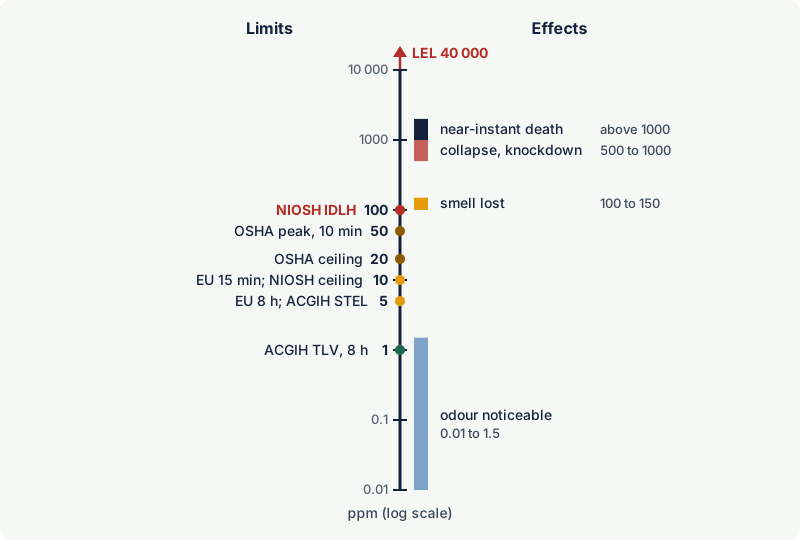
US OSHA summarises the effects by concentration roughly as follows (simplified):
| Concentration (ppm) | Typical effects |
|---|---|
| 0.01 to 1.5 | Odour first noticeable to some people |
| 2 to 5 | With prolonged exposure: nausea, tearing of the eyes, headache; airway effects in some asthmatics |
| 50 to 100 | Eye and airway irritation after about an hour |
| 100 | Coughing, eye irritation, loss of smell after 2 to 15 minutes; drowsiness after 15 to 30 minutes |
| 100 to 150 | Loss of smell (olfactory fatigue or paralysis) |
| 200 to 300 | Marked eye and airway irritation; fluid in the lungs with prolonged exposure |
| 500 to 700 | Staggering and collapse within about 5 minutes; death after 30 to 60 minutes |
| 700 to 1000 | Rapid unconsciousness ("knockdown") within 1 to 2 breaths; death within minutes |
| 1000 to 2000 | Nearly instant death |
Olfactory fatigue: the smell is a trap
Sources differ on the odour threshold: the UK Health Security Agency gives about 0.008 ppm, OSHA a range of 0.01 to 1.5 ppm. Either way, the nose detects H2S far below any limit, which gives a false sense of security. Two effects defeat it:
- Olfactory fatigue. With continued exposure, even at moderate levels, the perceived smell weakens.
- Olfactory paralysis. Above about 100 ppm the sense of smell can stop working within minutes. A worker who walks into a rising cloud may notice the smell, then lose it, and conclude that the gas has gone.
The practical rule is simple: smell may tell you H2S is around; only a detector can tell you how much, and the absence of smell means nothing.
Exposure limits
| Jurisdiction or body | 8-hour value | Short-term value | Notes |
|---|---|---|---|
| EU indicative limit (Directive 2009/161/EU) | 5 ppm (7 mg/m3) | 10 ppm (14 mg/m3), 15 minutes | Member States set national limits taking these values into account |
| UK workplace exposure limit (EH40) | 5 ppm | 10 ppm, 15 minutes | As listed by the UK Health Security Agency |
| ACGIH TLV (US, advisory) | 1 ppm | 5 ppm STEL | Lowered from 10 ppm and 15 ppm |
| US OSHA, general industry | none | 20 ppm ceiling; peak up to 50 ppm for one period of up to 10 minutes if no other measurable exposure in the shift | Legally enforceable |
| US OSHA, construction and shipyards | 10 ppm TWA | none | Legally enforceable |
| US NIOSH REL | none | 10 ppm ceiling, 10 minutes | Recommendation |
| US NIOSH IDLH | not applicable | not applicable | 100 ppm, immediately dangerous to life or health; used for respirator selection and emergency planning |
Limits change and national lists differ, so check the current values for the country of the site. In US offshore oil and gas operations, a separate rule (30 CFR 250.490) sets detection and alarm requirements, described below.
Sensor selection
Electrochemical sensors
An electrochemical cell oxidises H2S at a sensing electrode and produces a current proportional to the concentration. It is the standard choice for personal monitors and most fixed H2S detectors:
- Strengths: good selectivity, a linear response in the ppm range, low power (ideal for battery instruments), simple calibration.
- Limitations: a finite life (IEC guidance notes that lifetimes under favourable conditions can exceed two years); sensitivity falls with time; very low humidity can dry out the electrolyte and low temperatures slow the response; other gases can produce positive or negative signals; some cells need oxygen to work over long periods.
See electrochemical toxic gas sensors for the principle in detail.
Metal oxide semiconductor sensors
A heated metal oxide film changes its electrical resistance when H2S adsorbs on it. These sensors are used for H2S in fixed detectors and are often chosen for hot, dry climates where electrochemical cells tend to dry out:
- Strengths: rugged, long service life, tolerant of high temperatures and low humidity.
- Limitations: non-linear response, less selective, influenced by humidity and other gases; IEC guidance notes that new sensors can need a long burn-in time and that sensors may need hours to recover, or may change permanently, after exposure above their measuring range.
Other principles
For very low levels (ppb) and process or environmental monitoring, analysers based on colorimetry (a reactive tape that darkens with H2S), gas chromatography and other principles are used; IEC 62990-2 describes the common measuring principles for toxic gases. They are generally used as analysers or sampling systems rather than as personal safety detectors.
Why a flammable gas detector is not enough
H2S is flammable, but its toxic limits are thousands of times below its LEL. A %LEL detector will alarm on H2S only at concentrations that are already lethal. H2S also inhibits catalytic (pellistor) sensors, reducing their response to the flammable gases they are meant to see; infrared flammable detectors are not affected in that way. In sour service, use infrared detectors for the flammable hazard and dedicated H2S detectors for the toxic hazard. See catalytic vs infrared detectors.
Alarm settings
Alarm levels for H2S follow the general method in setting gas detector alarm levels: start from the exposure limits, then adjust for escape time, background levels, rate of rise and the capability of the sensor. Examples from regulations and guidance:
| Application | Low alarm | High alarm | Source |
|---|---|---|---|
| Portable detector (example) | 5 ppm | 10 ppm | HSE research review example, in line with the UK limits |
| UK offshore installations, fixed detection | 10 ppm (audible and visual alarm in the area) | 15 ppm (general platform alarm) | HSE offshore information sheet, as quoted by HSE research |
| US offshore oil and gas operations | Detection capability of at least 10 ppm | 20 ppm (audible and visual alarms) | 30 CFR 250.490 |
| Fixed point detector (example) | 10 ppm | 40 ppm | HSE research review example |
Some points to keep in mind:
- Personal monitors should combine instantaneous alarms with running TWA and STEL alarms. For H2S the instantaneous alarms matter most, because the danger comes from peaks.
- Low settings and sensor capability. Settings around 1 ppm, matching the ACGIH value, demand good zero stability and resolution and may cause nuisance alarms where background levels fluctuate. If such settings are chosen, select instruments whose specification supports them.
- Latching and actions. The high alarm should latch. Typical actions are to stop work, put on escape breathing apparatus where provided, move upwind or crosswind to a safe muster point, and prevent anyone entering without breathing apparatus. Rescue is a planned activity with breathing apparatus, never an improvised one.
- Who wears personal monitors. After the 2019 fatalities in Odessa, Texas, the US Chemical Safety Board recommended that the operator make a personal H2S detector part of every employee's and visitor's protective equipment at sites where exposure to 10 ppm or more is possible.
Where to place H2S detectors
Placement follows the general rules in where to install gas detectors, with some H2S specifics:
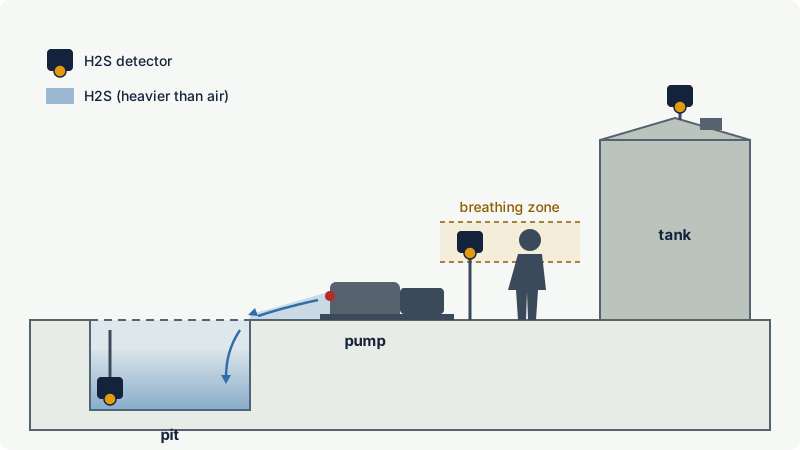
- Sources first. Put detectors close to the likely release points: pump seals, compressor packing, sample points, drains, tank vents and gauging hatches, separators and sour water equipment.
- Low points and enclosures. At a relative density of 1.18, H2S released without much momentum settles in pits, trenches, sumps, cellars, manholes and tank bottoms, and accumulates in shelters and pump houses with poor ventilation.
- The whole gas, not just H2S. In sour gas, H2S is a small part of the stream. A high-pressure leak of mostly methane carries the H2S with it as a jet and then rises; place detectors for the behaviour of the whole release.
- Breathing zone. Where people work, detectors for personal protection belong near the height at which people breathe, and on the access routes and at the entrances to buildings and confined areas.
- Air intakes. Building and HVAC air intakes where H2S could be drawn in usually need detection, often with automatic damper closure.
As an example of prescriptive placement, the US offshore rule requires, on production platforms handling gas with 20 ppm or more of H2S, at least one sensor per 400 square feet (about 37 m2) of deck area where the atmosphere could reach 20 ppm, a sensor within 10 feet (about 3 m) of each vessel, compressor, wellhead, manifold or pump that could release enough H2S to reach 20 ppm at that distance, and sensors in living quarters.
Worked example: when does the H2S alarm come before the flammable alarm?
A process stream is mostly methane (LEL 4.4 % vol) with some H2S. Suppose it leaks and mixes with air, and both an infrared flammable detector (first alarm 20 %LEL) and an H2S detector (first alarm 10 ppm) see the same cloud. The concentration of H2S in air equals the gas concentration in air multiplied by the H2S fraction in the stream.
- Stream with 1 % H2S (10,000 ppm). At the flammable alarm, the gas in air is 20 % of 4.4 % = 0.88 % vol, so H2S in air is 0.88 % × 1 % = 0.0088 % vol = 88 ppm, close to the IDLH of 100 ppm. The H2S alarm at 10 ppm comes much earlier, at a gas concentration of only 0.1 % vol (about 2 %LEL). Here the toxic hazard governs completely.
- Stream with 500 ppm H2S. At 0.88 % vol gas in air, H2S is 0.88 % × 0.05 % = 4.4 ppm, below the H2S alarm. The flammable alarm comes first. HSE research quotes UK offshore guidance (HSE Offshore Information Sheet 6/2009) under which fixed flammable gas detection may be used to indicate the toxic hazard where H2S in the process stream is known to be below 500 ppm, on this kind of reasoning.
The calculation assumes that H2S and methane disperse together and that both detectors see the same concentration. In reality H2S dissolved in liquids, released from water or accumulating in low points can behave quite differently, which is why dedicated H2S detectors are used wherever H2S is a credible hazard.
Testing H2S detectors
H2S is reactive. Test gas cylinders have a limited shelf life and must be used before their expiry date; H2S is absorbed by many plastics and rubbers, so regulators, tubing and calibration adapters must be of materials the manufacturer specifies, with short tubing runs. Personal monitors should be bump tested before each day's use. Fixed detectors are tested at intervals set by the manufacturer, regulations and site records; the US offshore rule, for example, requires testing with 10 to 30 ppm H2S at least every 24 hours during drilling and well work, and at least every 14 days in production. Details in gas detector calibration and bump testing.
Warning: The 2019 Odessa, Texas, incident investigated by the US Chemical Safety Board shows what happens when these basics fail. A worker was exposed to H2S released from a pump inside a pump house; the fixed detection system was not sending signals to its alarm panel, and he was not wearing his personal monitor. He died, and so did his spouse, who later came to look for him.
Common mistakes
- Trusting the smell. Olfactory paralysis above about 100 ppm removes the warning exactly when it is needed. Use detectors.
- Relying on %LEL detectors for H2S. The flammable alarm can come at lethal H2S concentrations in sour streams. Use dedicated ppm detectors.
- Using catalytic flammable sensors in sour service without frequent tests. H2S inhibits the catalyst. Prefer infrared for the flammable hazard, or bump test catalytic sensors often.
- Mounting all detectors high or all detectors low. H2S on its own sinks, but a methane-rich release rises. Place detectors for the actual release scenarios and for where people are.
- Rescuing without breathing apparatus. Many H2S fatalities are rescuers. The response plan must forbid entry without breathing apparatus.
- Using old or improvised calibration gear. Expired H2S test gas and unsuitable tubing give low readings, so detectors get adjusted to over-read or under-read.
Frequently asked questions
What are the exposure limits for hydrogen sulphide?
In the EU and the UK, 5 ppm averaged over 8 hours and 10 ppm over 15 minutes. ACGIH recommends 1 ppm (8 hours) and 5 ppm (15 minutes). US OSHA sets a 20 ppm ceiling for general industry, with a single 10-minute peak up to 50 ppm allowed only if there is no other exposure, and 10 ppm TWA for construction and shipyards; NIOSH gives 100 ppm as immediately dangerous to life or health.
At what level should an H2S detector alarm?
There is no single value. Portable and personal monitors are often set at about 5 ppm (low) and 10 ppm (high), in line with EU and UK limits, plus TWA and STEL alarms. Fixed systems are set by risk assessment or regulation: UK offshore guidance uses 10 and 15 ppm, and US offshore rules require alarms at 20 ppm.
Why can't you smell H2S at high concentrations?
H2S paralyses the sense of smell. According to the UK Health Security Agency, olfactory paralysis can occur above about 100 ppm, and OSHA lists loss of smell after 2 to 15 minutes at 100 ppm. The smell can disappear while the concentration keeps rising.
Is H2S heavier than air?
Yes, slightly: its relative density is about 1.18. Released on its own without momentum, it tends to collect in low points such as pits, trenches and tanks. In a mixture with lighter gases such as methane, or in a hot or pressurised release, it moves with the rest of the gas.
Which sensor is best for H2S detection?
Electrochemical sensors are the most widely used for ppm-level H2S, especially in personal monitors, because they are selective and need little power. Metal oxide semiconductor sensors are used in fixed detectors where heat and low humidity would dry out electrochemical cells. The choice depends on climate, interfering gases, required range and maintenance capability.
Related on excodex
- Setting gas detector alarm levels
- Electrochemical toxic gas sensors
- Gas detector calibration and bump testing
- Portable gas detectors and confined space entry
- Vapour density: which gases rise and which sink
- Gas cards: hydrogen sulphide, sulphur dioxide, methane; standards space IEC 60079-29-2; questions in the forum
Standards and further reading
- IEC 62990-2:2021, Workplace atmospheres, gas detectors: selection, installation, use and maintenance of detectors for toxic gases and vapours (EN IEC 62990-2 in Europe).
- IEC 60079-29-0:2025, Explosive atmospheres, gas detection equipment: general requirements and test methods, including toxic gas detectors.
- US OSHA, hydrogen sulphide hazards: https://www.osha.gov/hydrogen-sulfide/hazards
- US OSHA, hydrogen sulphide standards and exposure limits: https://www.osha.gov/hydrogen-sulfide/standards
- UK Health Security Agency, hydrogen sulphide toxicological overview: https://www.gov.uk/government/publications/hydrogen-sulphide-properties-incident-management-and-toxicology/hydrogen-sulphide-toxicological-overview
- Commission Directive 2009/161/EU, indicative occupational exposure limit values (annex): https://www.legislation.gov.uk/eudr/2009/161/annex
- HSE Research Report RR973, Review of alarm setting for toxic gas and oxygen detectors (2013): https://www.hse.gov.uk/research/rrpdf/rr973.pdf
- US 30 CFR 250.490, hydrogen sulphide requirements for offshore oil and gas operations: https://www.law.cornell.edu/cfr/text/30/250.490
- US Chemical Safety Board, executive summary of the investigation into the 2019 hydrogen sulphide release in Odessa, Texas: https://www.csb.gov/assets/1/20/Executive_Summary_from_Final_Report.pdf
This article is general technical information prepared by the excodex editorial team. It does not replace the applicable standards, the equipment certificates and instructions, national regulations or the assessment of a competent person.