Vapour density: which gases rise, which sink, and why it matters for detector placement
Abstract
Vapour density compares a gas with air (air = 1). Methane and hydrogen rise, propane and solvent vapours sink. Cold, hot and diluted releases change the picture. How density, temperature and mixing decide where gas goes and where detectors belong.
Vapour density (more precisely, relative density) is the density of a gas or vapour divided by the density of air at the same temperature and pressure, so air = 1. Gases below 1 tend to rise: hydrogen (0.07), methane (0.55) and ammonia (0.59). Gases and vapours above 1 tend to sink and spread along the floor: propane (1.52), butane (2.01) and almost every solvent vapour. For detector placement this sets the starting height (high for light gases, low for heavy ones), but temperature, release momentum and dilution with air can override it, and a gas diluted to its lower explosive limit is almost as heavy as air.
This article explains how relative density is calculated, which common gases rise and which sink, why cold and hot releases behave differently, what happens once the gas mixes with air, and how all this translates into practical detector heights.
Key points
- Relative density compares a gas with air at the same temperature and pressure. For an ideal gas it is simply its molar mass divided by about 29 g/mol, the average molar mass of air.
- Only a handful of flammable gases are lighter than air: hydrogen, methane, ammonia and a few others. Practically all vapours of flammable liquids are heavier than air; among common substances only water vapour is clearly lighter.
- IEC detector guidance treats gases below a relative density of about 0.8 as lighter than air and above about 1.2 as heavier than air; in between, both behaviours must be considered.
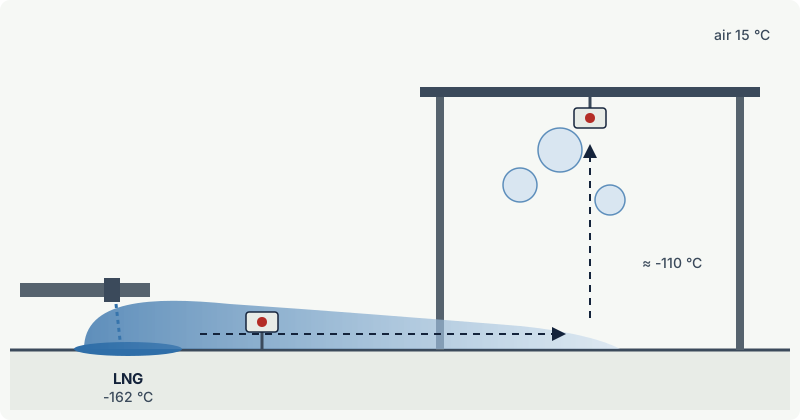
- Temperature changes density in proportion to absolute temperature. Methane vapour from LNG at -162 °C is about 1.4 times as dense as ambient air and hugs the ground until it warms to around -110 °C.
- Dilution removes most of the buoyancy: a methane-air mixture at its lower explosive limit is only about 2 % lighter than air, and a propane-air mixture at its LEL only about 1 % heavier.
- Detector height is a starting point, not the full answer: release momentum, ventilation and wind usually move gas more strongly than buoyancy once it is diluted.
What vapour density means
The term is used in two ways, which causes confusion:
- In safety data sheets, hazardous area work and gas detection, vapour density means relative density with air = 1. A value of 1.52 for propane means propane is 1.52 times as dense as air.
- In chemistry textbooks, vapour density is sometimes defined relative to hydrogen, which makes it about half the molar mass. On that scale propane would be about 22. Always check which reference a table uses; in the Ex and gas detection world it is air.
Both gases being compared must be at the same temperature and pressure. That condition is easy to forget, and it is exactly where cold and hot releases behave unexpectedly.
How to calculate it
For ideal gases, density at a given temperature and pressure is proportional to molar mass. Air has an average molar mass of about 29 g/mol, so:
- relative density ≈ molar mass of the gas / 29
A few checks: methane (16 g/mol) gives 0.55, propane (44 g/mol) gives 1.52, toluene (92 g/mol) gives 3.2. Gases with a molar mass below 29 are lighter than air, above 29 heavier.
For a mixture, the relative density is the volume-weighted average of the components. IEC gas detection guidance makes the same point: mixing gases and vapours causes no significant change of volume, so the mixture density can be calculated directly from the volume fractions.
Example: A natural gas with 90 % methane, 6 % ethane, 2 % propane and 2 % nitrogen has a relative density of about 0.9 × 0.554 + 0.06 × 1.04 + 0.02 × 1.52 + 0.02 × 0.967 = 0.61. It is lighter than air. A rich associated gas with much more ethane and propane can approach or exceed 1, so the actual composition matters.
Which gases rise and which sink
The figure and table show relative densities from the excodex gas library. The shaded band from 0.8 to 1.2 marks gases that IEC guidance treats as "similar to air": they can spread in any direction.
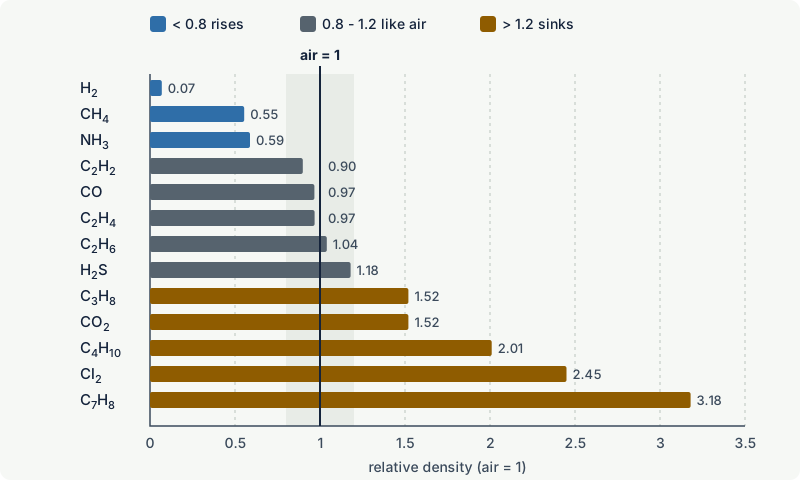
| Substance | Relative density (air = 1) | Behaviour at ambient temperature |
|---|---|---|
| Hydrogen | 0.0696 | Rises fast, collects under roofs and in high pockets |
| Helium (not flammable) | 0.138 | Rises fast |
| Methane | 0.554 | Rises |
| Ammonia | 0.588 | Rises when warm and dry (but see cold releases) |
| Water vapour | 0.622 | Rises |
| Acetylene | 0.899 | Close to air |
| Carbon monoxide, nitrogen | 0.967 | Same as air |
| Ethylene | 0.968 | Same as air |
| Ethane | 1.04 | Same as air |
| Hydrogen sulphide | 1.18 | Slightly heavy, collects in pits |
| Argon | 1.38 | Heavy |
| Propane, carbon dioxide | 1.52 | Heavy, flows into low points |
| Butane, acetone | 2.01 | Heavy |
| Chlorine | 2.45 | Very heavy |
| Toluene | 3.18 | Very heavy, spreads in a thin layer |
Two observations are worth remembering:
- The light flammable gases are few. Hydrogen, methane and ammonia are the important ones in industry. Everything with three or more carbon atoms (propane, butane, LPG, all petrol and solvent components) is heavier than air.
- Practically all vapours are heavy. The first edition of IEC 60079-29-2 notes that, among vapours, only water vapour is lighter than air and that only a few (methanol among them) are similar to air; all others are denser, most of them considerably. The excodex library lists methanol at 1.11.
Temperature: why cold gas sinks and hot gas rises
Gas density is inversely proportional to absolute temperature (in kelvin). The relative density of a released gas compared with the surrounding air is therefore:
- effective relative density = tabulated relative density × (air temperature in K / gas temperature in K)
The IEC detector guidance puts it as a rule of thumb: a temperature rise of about 30 K offsets a relative density about 10 % above air, and the converse applies to cold releases.
Cold releases
- LNG vapour. Liquefied natural gas boils at about -162 °C. Methane vapour at that temperature is about 1.4 times as dense as air at 15 °C, denser than propane at room temperature. It only becomes neutral when it has warmed to roughly -110 °C (the exact figure depends on the air temperature and the LNG composition; the US NOAA gives about -106 °C). Until then the cloud stays low, and the cold vapour condenses moisture from the air into a visible white fog. NOAA notes that the visible water fog can persist longer than the flammable gas, so the edge of the fog is not the edge of the flammable cloud.
- Liquefied gases under pressure. When pressurised LPG or ammonia escapes, the liquid flashes and cools to its boiling point, well below 0 °C, as IEC guidance points out. Propane vapour at its boiling point of -42 °C is almost twice as dense as ambient air, and the cloud also contains liquid droplets. Even ammonia, a light gas at room temperature, can form a cold "ammonia fog" that the US National Response Team describes as likely to remain low to the ground.
- High-pressure gas. Gas that expands from high pressure cools down. Near the leak, a natural gas jet can be colder and denser than the tabulated value suggests, although its momentum usually dominates there.
Hot releases
Hot releases rise even when the gas is heavy at room temperature, because the warm carrier air and the gas are both expanded:
- Vapour leaving an oven, dryer or hot process vessel rises with the hot air at first, then cools, mixes and may settle again further away.
- Releases above hot equipment (compressor packages, turbines, furnaces) are lifted by the thermal plume of the equipment itself.
Example: A solvent dryer exhausts air at 60 °C containing toluene vapour at 25 % of its LEL (0.25 % by volume). At the same temperature the mixture would be only 0.5 % heavier than air. Corrected for temperature (288 K / 333 K) its effective relative density is about 0.87: the plume rises. If the duct leaks into a cool room, the leaking mixture first rises with the warm air, cools within metres and then behaves like slightly heavy, almost neutral air.
Dilution: why the mixture matters more than the pure gas
A detector never sees pure gas. It sees a mixture of gas and air, and that mixture is far closer to the density of air than the pure gas is. The relative density of a mixture containing a volume fraction x of gas with relative density d is simply 1 + x × (d - 1).
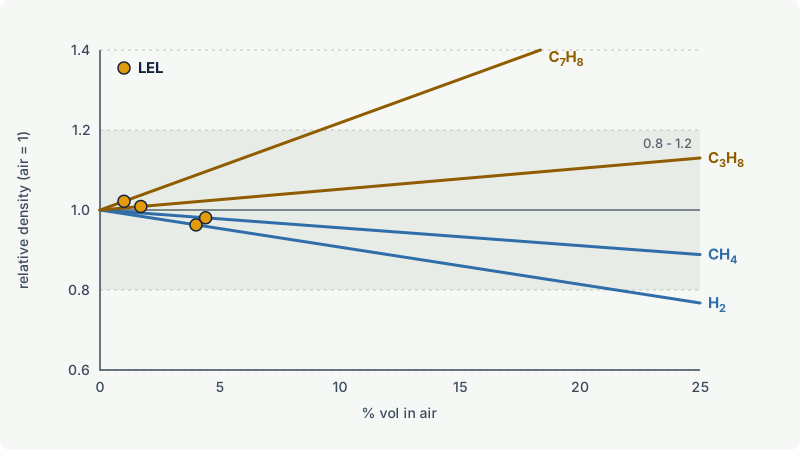
| Gas | Pure gas | Mixture at 50 % LEL | Mixture at LEL |
|---|---|---|---|
| Hydrogen (LEL 4 %) | 0.07 | 0.98 | 0.96 |
| Methane (LEL 4.4 %) | 0.55 | 0.99 | 0.98 |
| Ammonia (LEL 15 %) | 0.59 | 0.97 | 0.94 |
| Propane (LEL 1.7 %) | 1.52 | 1.004 | 1.009 |
| Toluene (LEL 1 %) | 3.18 | 1.011 | 1.022 |
This has three practical consequences:
- Buoyancy acts mainly near the source, where the gas is rich. The rich core of a methane leak rises, the rich core of a propane leak slumps. Once diluted towards the LEL, the cloud is carried by air movement, and even a gentle draught moves it more than its remaining buoyancy does.
- Gas does not separate again. IEC guidance stresses that once gases are mixed they stay mixed; a diluted methane cloud does not "unmix" and float to the ceiling. Layers form only where the release is slow and the air still, so that the rich gas reaches the ceiling or floor before it mixes.
- Heavy vapours form thin layers. In still air, vapour from a spill flows along the floor in a layer that can be only a few centimetres deep. IEC guidance recommends that portable measurements for vapours in undisturbed air include readings very close to the floor or ground, and warns that pits, trenches and tunnels can fill from the bottom up and carry vapour over long distances.
What this means for detector placement
The density of the gas gives the first answer to "how high?". The table summarises the usual starting points:
| Gas behaviour | Examples | Starting position for point detectors |
|---|---|---|
| Lighter than air (below about 0.8) | Hydrogen, methane, natural gas, warm ammonia | High: under the ceiling, in the roof apex or in the highest pocket between beams, near the extract |
| Similar to air (0.8 to 1.2) | Ethylene, ethane, acetylene, carbon monoxide, hydrogen sulphide | Near the source and in the breathing zone; often both high and low |
| Heavier than air (above about 1.2) | Propane, butane, LPG, petrol and solvent vapours | Low: close to the floor, at the low side of the slab, in pits, trenches and drains, above standing water level |
| Cold releases of light gases | LNG, refrigerated or flashing ammonia | Low near the cryogenic or liquefied gas equipment, plus high where the warmed gas collects |
| Hot releases | Dryer and oven exhausts, gas above hot machinery | Higher than the density alone suggests, and in the extract |
In practice "high" and "low" mean close to the ceiling or floor, but not so close that the sensor sits in a dead air pocket, in water, dust or washdown spray. No standard sets one fixed height. Installation guidance often quotes positions around 0.3 m from the floor for gases heavier than air and near the ceiling for lighter gases, but the right position follows the likely release, the gas behaviour and the airflow (IEC 60079-29-2). Some jurisdictions do set heights for particular uses; one public example is the New York City rule for residential natural gas alarms, which requires wall-mounted units to be no more than 12 inches (about 0.3 m) below the ceiling and 3 to 10 feet horizontally from the appliance. That rule applies only to residential natural gas alarms in New York City; industrial installations follow the detector manual and the site's detection philosophy rather than one fixed number.
Density is only one of several placement factors. Release momentum, ventilation paths, wind, congestion and access for testing are just as important; they are covered in detail in where to install gas detectors.
Worked example: one room, three gases
A small utility building has a natural gas boiler, an LPG cylinder store against the outside wall and a refrigeration plant with ammonia.
- Natural gas boiler. Relative density about 0.6. A leak at the gas train is low-pressure and buoyant. Place a methane detector high, above the gas train and close to the ceiling or the high-level vent, not beside the combustion air inlet.
- LPG store. Relative density 1.5 to 2 (propane and butane). Leaks flow down and along the floor towards the lowest point. Place detectors low, near the cylinder manifold and at any floor drain, sump or doorway threshold where gas could flow out; remove or seal floor drains where possible.
- Ammonia plant. Relative density 0.59 at room temperature, so the classic answer is "high". But a liquid leak from the receiver or a flange on a liquid line can produce a cold, dense fog. Here detectors are placed high above the machinery and also at low level near the liquid-carrying equipment, as the risk assessment of the refrigeration system defines.
One room therefore needs three different heights, which is why "all detectors at 1.5 m" is never the right default.
Common mistakes and misconceptions
- Using one height for all gases. Mounting every sensor at the same height ignores density. Choose the height per gas, and use more than one height for near-neutral gases and uncertain releases.
- Assuming a light gas is always found at the ceiling. Cold releases (LNG, flashing ammonia) start heavy, and high-pressure jets go where they point. Light-gas logic alone misses the early, dangerous part of these releases.
- Assuming a heavy vapour will reach a detector at knee height. In still air a vapour layer can be only centimetres deep. Low means low, and in pits and trenches it means inside them.
- Expecting diluted gas to separate and float or sink. A cloud diluted to around its LEL has almost the density of air and moves with the air. Placement must follow the air paths, not only the density.
- Mixing up the two definitions of vapour density. A value of 22 for propane (relative to hydrogen) and 1.52 (relative to air) describe the same gas. Use the air-based value for safety work.
- Taking the density of the main component for a mixture. Natural gas, refinery gas and biogas vary in composition; calculate the mixture density from the actual analysis.
Frequently asked questions
Is propane heavier or lighter than air?
Propane is heavier than air, with a relative density of about 1.52. Leaking propane, and LPG in general, flows downwards and collects at floor level and in low points such as pits, drains and basements. Detectors for propane are mounted low, close to the floor and near possible leak points.
Is natural gas heavier or lighter than air?
Natural gas is lighter than air because it is mostly methane, which has a relative density of about 0.55; pipeline gas with some ethane and propane is typically around 0.6. It rises from a low-pressure leak, so detectors are mounted high. The exception is cold vapour from liquefied natural gas, which is heavier than air until it warms to around -110 °C.
Which flammable gases are lighter than air?
The important ones are hydrogen, methane (natural gas) and ammonia; acetylene is slightly lighter but close to air. Carbon monoxide, ethylene and ethane are practically the same density as air. Almost every other flammable gas and every common solvent vapour is heavier than air.
Does temperature change whether a gas rises or sinks?
Yes. Density falls as absolute temperature rises, so hot releases rise and cold releases sink. As a rule of thumb from IEC guidance, about 30 K of temperature difference offsets a density difference of about 10 %. Cold methane from LNG and flashing liquefied gases such as propane and ammonia can form heavy, low-lying clouds.
At what height should a detector for a heavy gas be mounted?
Low, close to the floor and at the points where the gas will flow and collect, such as trenches, pits, sumps and the low side of a sloping floor. No standard sets one fixed height: installation guidance often quotes positions around 0.3 m from the floor, high enough to stay clear of standing water, dirt and washdown, but the right position follows the likely release, the gas behaviour and the airflow (IEC 60079-29-2). Follow the detector manual and confirm the positions with the site's area classification and air movement.
What does a relative density between 0.8 and 1.2 mean?
IEC gas detection guidance treats gases in this range as having a density similar to air. Temperature differences and normal turbulence decide where they go, so they can spread in any direction. Detectors are placed close to the likely sources and in the breathing zone, often at more than one height.
Related on excodex
- Where to install gas detectors: height, distance and common mistakes
- LEL and UEL explained
- Methane, propane and LPG: properties every safety engineer should know
- Ventilation in area classification
- Oxygen deficiency: nitrogen, argon and other inert gas hazards
- Gas library with relative densities: /gas; standards spaces IEC 60079-29-2 and IEC 60079-10-1; questions in the forum
Standards and further reading
- IEC 60079-29-2, Explosive atmospheres, gas detectors: selection, installation, use and maintenance of detectors for flammable gases and oxygen (current edition 2015): https://webstore.iec.ch/en/publication/21961
- IEC 60079-29-2 first edition (2007), as adopted by the Bureau of Indian Standards, with the guidance on relative density, temperature and propagation quoted in this article: https://law.resource.org/pub/in/bis/S05/is.iec.60079.29.2.2007.pdf; IEC webstore (current edition, IEC 60079-29-2:2015): webstore.iec.ch
- IEC 60079-10-1, classification of areas, explosive gas atmospheres (treats buoyancy and release conditions in zone extent).
- US NOAA, Liquefied Natural Gas (LNG) as a marine fuel, fact sheet (2025): https://response.restoration.noaa.gov/sites/default/files/LNG.pdf
- US National Response Team, quick reference guide for anhydrous ammonia: https://nrt.org/sites/2/files/NRT%20CBRN%20CHEM%20Ammonia%20NH3%20QRG%20FINAL%202020%2004%2006.pdf
- New York City rule 1 RCNY 908-02, installation and location of natural gas alarms: https://www.nyc.gov/assets/buildings/rules/1_RCNY_908-02.pdf
- Vapour density, definitions relative to hydrogen and to air: https://en.wikipedia.org/wiki/Vapour_density
This article is general technical information prepared by the excodex editorial team. It does not replace the applicable standards, the equipment certificates and instructions, national regulations or the assessment of a competent person.