Methane, propane and LPG: properties every safety engineer should know
Abstract
Natural gas (mostly methane) is lighter than air and stays a gas; LPG (propane, butane) is heavier than air and stored as a liquid that expands about 270 times. Density, LEL/UEL, T-class, gas group, odorisation, incidents and detector placement compared.
Methane, the main component of natural gas, and propane and butane, the components of liquefied petroleum gas (LPG), ignite in much the same way: all are gas group IIA, their lower explosive limits lie between 1.4 and 4.4 % by volume, and they need temperature class T1 (methane) or T2 (propane, n-butane). They differ completely in how they behave once released. Natural gas is lighter than air (relative density about 0.55 to 0.6) and cannot be liquefied by pressure at ambient temperature, so it is distributed as a gas. LPG is 1.5 to 2 times as heavy as air and is stored as a liquid under its own vapour pressure: one litre of liquid propane makes about 270 litres of gas. Both are odourless; gas supplied to consumers is odorised so that a leak can be smelled well below the lower explosive limit (at one fifth of it under US rules), while process gas is often not odorised.
This article compares the properties that matter for safety, explains why LPG and LNG releases are so much larger than they look, covers odorisation and its limits, summarises well-documented incidents and shows how the differences change detector placement and calibration.
Key points
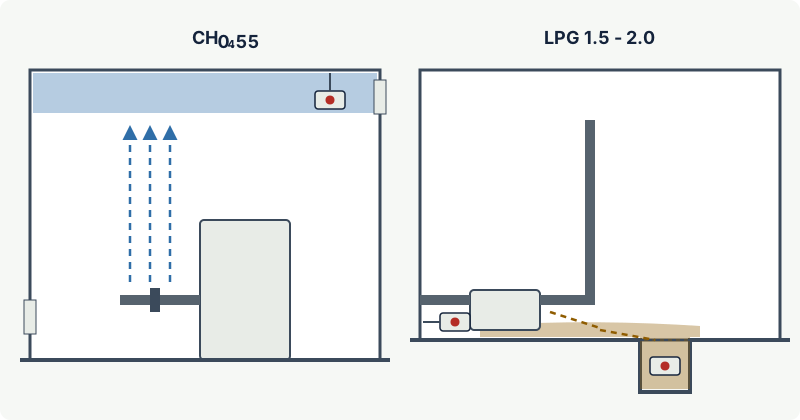
- Natural gas is mostly methane (relative density 0.554); pipeline gas with some ethane and propane is around 0.6. It rises from a leak. LPG (propane 1.52, butane 2.01) sinks, flows along the ground and collects in pits, drains and basements.
- Propane boils at -42 °C and butane at about -0.5 °C. At 20 °C propane has a vapour pressure of about 8.4 bar absolute; a liquid leak flashes into a cold, dense cloud of vapour and droplets.
- One litre of liquid propane gives about 0.27 m³ of gas, enough for about 16 m³ of mixture at the lower explosive limit. One litre of LNG gives about 0.6 m³ of methane, enough for about 14 m³.
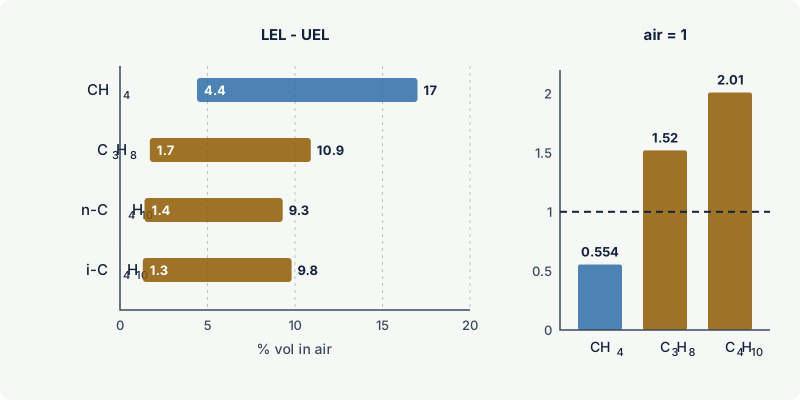
- Lower and upper explosive limits (excodex library, from IEC data): methane 4.4 to 17 %, propane 1.7 to 10.9 %, n-butane 1.4 to 9.3 %. Many older and North American sources give 5 % for methane and 2.1 % for propane.
- Methane is IIA and T1 (autoignition about 600 °C); propane is IIA and T2 (450 °C); n-butane IIA and T2 (372 °C). In underground coal mines methane is the Group I reference gas.
- US rules require natural gas in distribution lines and LPG to be odorised so that they are detectable by smell at one fifth of the lower explosive limit. Smell is a warning, not a detection system: odorant can fade and noses tire.
- Catalytic flammable gas sensors are more sensitive to methane than to propane in %LEL terms; a detector calibrated on methane can under-read LPG.
What natural gas and LPG are
Natural gas is a mixture whose largest component is methane. The US Energy Information Administration describes it as methane with smaller amounts of natural gas liquids (ethane, propane, butanes, pentanes) and non-hydrocarbon gases such as carbon dioxide and water vapour; processing removes most of the heavier components, although some ethane is often left. It is handled as:
- pipeline gas, from high-pressure transmission down to low-pressure distribution;
- compressed natural gas (CNG), stored at high pressure as a gas;
- liquefied natural gas (LNG), cooled to about -162 °C and stored close to atmospheric pressure. According to the US NOAA, LNG is more than 85 % methane, with ethane and traces of heavier components.
Methane's critical temperature is about -83 °C, so at ambient temperature it cannot be liquefied by pressure alone. That is why natural gas is either compressed as a gas or cooled to make LNG.
LPG is, in the words of the US OSHA definition, any material composed predominantly of propane, propylene, butanes or butylenes, or mixtures of them. Commercial products range from almost pure propane to almost pure butane, with blends for vehicle fuel (autogas) and for different climates. Because propane and butane are well below their critical temperatures at ambient conditions, they are stored as liquids in pressure vessels, cylinders and tanks, with vapour above the liquid.
Properties side by side
| Property | Methane | Propane | n-Butane |
|---|---|---|---|
| Formula, molar mass | CH4, 16.0 g/mol | C3H8, 44.1 g/mol | C4H10, 58.1 g/mol |
| Relative density (air = 1) | 0.554 | 1.52 | 2.01 |
| Boiling point at 1 atm | -161.5 °C | -42.1 °C | -0.5 °C |
| Vapour pressure at 20 °C | gas (above critical temperature) | about 8.4 bar abs | about 2.1 bar abs |
| Liquid density | 0.42 kg/L at -161.5 °C | 0.51 kg/L at 15 °C | 0.58 kg/L at 15 °C |
| Gas from 1 L of liquid (15 °C, 1 atm) | about 620 L | about 270 L | about 240 L |
| LEL / UEL | 4.4 / 17 % vol | 1.7 / 10.9 % vol | 1.4 / 9.3 % vol |
| Autoignition temperature, T-class | about 600 °C, T1 | 450 °C, T2 | 372 °C, T2 |
| Gas group, typical MESG | IIA, 1.12 mm (Group I in mines) | IIA, 0.92 mm | IIA, 0.98 mm |
Boiling points, vapour pressures and liquid densities are from the NIST Chemistry WebBook fluid property data; the expansion figures are calculated from them. Flammability data are from the excodex library (methane, propane, butane, isobutane); MESG values are from the IEC material data tables. Isobutane, common in LPG blends, boils at about -12 °C, has an LEL of 1.3 % and an autoignition temperature of 460 °C (T1).
Explosive limits: why sources differ
The excodex library uses the values of the IEC material data standard, now ISO/IEC 80079-20-1: 4.4 % for methane and 1.7 % for propane. US data such as the NIOSH Pocket Guide give 2.1 % for propane, and NOAA quotes 5 % for LNG vapour. The differences come from test methods. For instrument settings, use the values the detector manufacturer and the site's standards specify, and be consistent: a "20 % LEL" alarm means a different gas concentration depending on which LEL is used (see LEL and UEL explained).
The lower LEL of propane and butane matters as much as their density. About 1.7 % propane is flammable, against 4.4 % methane; a small LPG leak can therefore produce a flammable cloud sooner, and it stays near the ground where it is not diluted by rising.
Phase behaviour: why liquefied gas releases are large
A leak from the vapour space of an LPG tank releases gas. A leak from the liquid space, or from a liquid line, releases liquid that immediately boils because it is far above its atmospheric boiling point. Part of it flashes to vapour at once; the rest forms droplets and a cold pool that evaporates by drawing heat from the ground and air. The resulting cloud is cold, contains liquid aerosol and is much denser than the tabulated relative density suggests (see vapour density).
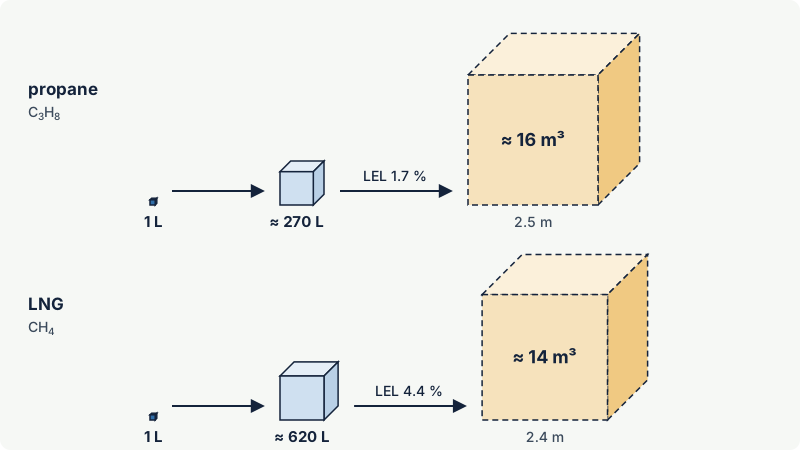
Example: 1 litre of liquid propane at 15 °C weighs about 0.51 kg. Propane gas at 15 °C and 1 atm has a density of about 1.87 kg/m³, so the litre becomes about 0.27 m³ of gas. At the LEL of 1.7 %, that gas makes about 0.27 / 0.017 = 16 m³ of flammable mixture, a cube about 2.5 m on each side. A dripping liquid connection releasing one litre per minute can therefore fill a small room or a pit with flammable mixture within minutes. For LNG, 1 litre (about 0.42 kg of methane) gives about 0.62 m³ of gas and about 14 m³ at its LEL of 4.4 %.
Three further consequences of the phase behaviour:
- Vapour pressure depends on temperature. Butane's vapour pressure is close to atmospheric near 0 °C, so butane cylinders deliver little gas in cold weather, while propane still does. Conversely, tanks in the sun or near fires build pressure quickly.
- BLEVE. A pressurised LPG vessel engulfed in fire can fail when the shell above the liquid level overheats and weakens. The sudden release of boiling liquid produces a blast and a fireball (a boiling liquid expanding vapour explosion, BLEVE). Emergency responders keep their distance from a fire-exposed LPG tank rather than approach it.
- Cryogenic hazards of LNG. Cold LNG vapour is heavier than air until it warms to around -110 °C, and spills onto water can cause rapid phase transitions with local overpressure. Cold liquid embrittles ordinary carbon steel.
Odorisation and its limits
Methane, propane and butane have no smell. Odorants, usually sulphur compounds such as mercaptans (ethanethiol, also called ethyl mercaptan) or tetrahydrothiophene (thiophane), are added so that people notice leaks.
| Gas | Typical requirement (US example) |
|---|---|
| Natural gas in distribution lines | 49 CFR 192.625: readily detectable by a person with a normal sense of smell at one fifth of the lower explosive limit; operators must check odorant levels periodically |
| LPG | 29 CFR 1910.110: odorised by an approved agent so that it is detectable down to one fifth of the lower flammable limit; for example 1.0 lb of ethyl mercaptan or thiophane per 10 000 US gallons |
Other countries have comparable rules. Odorisation has limits that safety engineers must design for:
- Not all gas is odorised. US rules exempt certain transmission lines and industrial supplies, and odorant is omitted where it would harm the later use of the gas. Gas in process plants, compressor stations and at many LNG and feed-gas facilities may be unodorised.
- Odour fade. Odorant can be adsorbed or oxidised in new pipework and vessels, so the gas can arrive with too little smell. Odour fatigue means a person stops noticing a smell after a short exposure. After the 2009 natural gas explosion in Garner, North Carolina, the US Chemical Safety Board (CSB) recommended training people about both effects and using combustible gas detectors instead of relying on smell.
- One fifth of the LEL is a warning threshold, not a safe level. By the time people smell gas, a richer cloud may already exist closer to the leak.
Detector placement and calibration
The physical differences translate directly into different detection designs:
| Aspect | Natural gas (methane) | LPG (propane, butane) |
|---|---|---|
| Where gas goes | Rises from low-momentum leaks; collects under roofs, in roof apexes and ceiling voids | Sinks and flows along the floor; collects in pits, trenches, drains, cellars and low points of the site |
| Point detector height | High, near the ceiling or at the high-level extract; also at the air intakes of buildings and turbines | Low, close to the floor near pumps, loading connections and manifolds, at drains and the low side of the slab, above standing water |
| Special cases | LNG and cold vapour: also low near cryogenic equipment; high-pressure jets: near the source in three dimensions | Liquid leaks form cold, dense clouds; consider pits and adjacent buildings in the path of the slumping gas |
| Hazardous area shape | Extends mainly upwards from release points | Extends horizontally at low level, often with additional zones in below-grade spaces |
| Calibration (catalytic sensors) | Methane, or methane test gas where methane may be present | Propane or the specific LPG; a methane-calibrated sensor may under-read |
Calibration and cross-sensitivity
IEC guidance on flammable gas detectors (IEC 60079-29-2, first edition) explains points that are often missed:
- Catalytic sensors respond more strongly to methane, in %LEL terms, than to most other gases except hydrogen. A sensor calibrated on methane and exposed to propane therefore reads low. If methane is used as a surrogate calibration gas, the alarm set point or the calibration reading must be corrected with the manufacturer's relative response data.
- Methane sensitivity is lost first when catalytic sensors are poisoned. Where methane may be present, a methane test gas is recommended for field checks, even if another gas is used for calibration.
- Infrared sensors respond only to gases that absorb in the band they are built for, and their response differs from gas to gas. Use an infrared detector only for the gas or range of gases it is calibrated for.
- Alarm levels: to avoid false alarms, the same guidance recommends not setting flammable gas alarms below 5 % LEL for methane and 10 % LEL for propane and butane. See setting gas detector alarm levels.
Where both natural gas and LPG may be present, either calibrate for the gas to which the sensor is least sensitive (and confirm it still responds adequately to the others) or install separate detectors at the two heights.
Typical incidents
The US Chemical Safety Board has investigated several fatal accidents that show these properties at work:
| Year, place | Gas | What happened (CSB findings, summarised) | Lesson |
|---|---|---|---|
| 1998, Albert City, Iowa (farm) | Propane | An 18 000 gallon propane tank exploded while emergency responders were at the scene; two volunteer firefighters were killed and seven other responders injured | Train responders for BLEVE hazards; protect above-ground piping from vehicle damage |
| 2007, Ghent, West Virginia (convenience store) | Propane | During a transfer between tanks, propane escaped through a defective liquid withdrawal valve on a tank placed against the back wall, entered the building through attic vents and exploded about half an hour later; four people were killed and others seriously injured | Heavy gas finds its way into buildings; keep separation distances; evacuate immediately on a significant leak |
| 2009, Garner, North Carolina (food plant) | Natural gas | Gas purged from new piping into a building accumulated and exploded; four workers were killed and dozens injured | Purge to a safe place outdoors; monitor with detectors, do not rely on smell (odour fade and fatigue) |
| 2010, Middletown, Connecticut (power plant under construction) | Natural gas | New gas piping was cleaned by blowing natural gas through it at about 650 psi to atmosphere; the gas found an ignition source and exploded; six workers were killed | Do not use flammable gas to clean pipes; use air or other inherently safer methods |
Two of the four events involved methane, which is often seen as the "safer" gas because it rises. Large or confined releases of natural gas are just as deadly as LPG releases; buoyancy only helps when there is somewhere for the gas to go.
Common mistakes and misconceptions
- "Natural gas rises, so it cannot accumulate." It accumulates under roofs, in ceiling voids and in any enclosure without a high-level opening, and cold or high-pressure releases do not rise at first.
- Mounting LPG detectors at breathing height. LPG flows along the floor; a detector at 1.5 m may stay silent while the floor-level layer is flammable.
- Using one calibration gas for both. A methane-calibrated catalytic detector under-reads propane, and infrared detectors respond differently to the two gases.
- Relying on smell. Odorant may be absent, faded or no longer noticed. Fixed or portable detectors are the measurement; smell is a back-up.
- Underestimating liquid leaks. A small liquid leak of LPG produces hundreds of times its volume in gas and thousands of times its volume in flammable mixture.
- Treating "IIA" as "low risk". IIA describes flame transmission and spark sensitivity for equipment selection, not the consequences of an explosion; all four incidents above involved IIA gases.
Frequently asked questions
What is the difference between natural gas and LPG?
Natural gas is mainly methane, lighter than air, and distributed as a gas through pipes (or as compressed gas or cryogenic LNG). LPG is propane, butane or a mixture, heavier than air, and stored as a liquid under pressure in tanks and cylinders. LPG has a lower LEL (about 1.4 to 1.7 % against 4.4 % for methane) and needs a lower temperature class (T2 against T1).
Is propane heavier than air?
Yes. Propane has a relative density of 1.52 and butane 2.01, so LPG sinks, spreads along the ground and collects in low places such as drains, pits, basements and cellars. Detectors for LPG are mounted low, near the floor.
What is the LEL of methane and propane?
The IEC-based values in the excodex library are 4.4 % by volume for methane and 1.7 % for propane, with upper limits of 17 % and 10.9 %. Older and North American sources often give 5 % for methane and 2.1 % for propane. Use one consistent set of values for detector calibration and alarm settings.
What temperature class and gas group are methane and propane?
Both are gas group IIA. Methane has an autoignition temperature of about 600 °C and needs T1; propane about 450 °C and needs T2, as does n-butane (372 °C). Equipment for LPG areas should therefore be at least IIA T2. In underground coal mines, methane is covered by Group I equipment.
Why does natural gas smell if methane is odourless?
An odorant, usually a mercaptan or tetrahydrothiophene, is added so that leaks can be smelled. In the United States, gas in distribution lines must be detectable by smell at one fifth of the lower explosive limit, and LPG must be odorised to the same level. Odorant can fade in new pipework and people stop noticing smells, so detectors remain necessary.
How much gas does one litre of liquid propane make?
About 270 litres of gas at 15 °C and atmospheric pressure. Mixed with air at the lower explosive limit of 1.7 %, that is about 16 m³ of flammable mixture. This is why liquid-phase leaks of LPG are far more dangerous than they appear.
Related on excodex
- Vapour density: which gases rise, which sink, and why it matters
- Where to install gas detectors: height, distance and common mistakes
- Catalytic (pellistor) vs infrared flammable gas detectors
- Fuel stations and LPG autogas: hazardous areas around dispensers, tanks and vents
- Coal mine methane: firedamp, monitoring and Group I equipment
- Gas cards: methane, propane, butane; standards spaces IEC 60079-29-2 and IEC 60079-10-1; questions in the forum
Standards and further reading
- ISO/IEC 80079-20-1, material characteristics for gas and vapour classification (LEL, UEL, autoignition temperature, MESG and gas group data); 2010 IEC edition as adopted by the Bureau of Indian Standards: https://law.resource.org/pub/in/bis/S05/is.iec.60079.20.1.2010.pdf; IEC webstore (current edition, ISO/IEC 80079-20-1:2017): webstore.iec.ch
- IEC 60079-29-2, gas detectors: selection, installation, use and maintenance (first edition 2007, as adopted by the Bureau of Indian Standards): https://law.resource.org/pub/in/bis/S05/is.iec.60079.29.2.2007.pdf; IEC webstore (current edition, IEC 60079-29-2:2015): webstore.iec.ch
- IEC 60079-10-1, classification of areas, explosive gas atmospheres.
- NIST Chemistry WebBook, thermophysical properties of fluid systems: https://webbook.nist.gov/chemistry/fluid/
- US EIA, Natural gas explained: https://www.eia.gov/energyexplained/natural-gas/
- US NOAA, Liquefied Natural Gas (LNG) as a marine fuel, fact sheet: https://response.restoration.noaa.gov/sites/default/files/LNG.pdf
- US 49 CFR 192.625, odorization of gas: https://www.law.cornell.edu/cfr/text/49/192.625
- US OSHA 29 CFR 1910.110, storage and handling of liquefied petroleum gases: https://www.osha.gov/laws-regs/regulations/standardnumber/1910/1910.110
- NIOSH Pocket Guide to Chemical Hazards, propane: https://www.cdc.gov/niosh/npg/npgd0524.html
- US CSB investigations: Little General Store propane explosion (2007): https://www.csb.gov/little-general-store-propane-explosion/; Herrig Brothers farm propane tank explosion (1998): https://www.csb.gov/herrig-brothers-farm-propane-tank-explosion/; ConAgra natural gas explosion (2009): https://www.csb.gov/conagra-natural-gas-explosion-and-ammonia-release/; Kleen Energy natural gas explosion (2010): https://www.csb.gov/kleen-energy-natural-gas-explosion/
This article is general technical information prepared by the excodex editorial team. It does not replace the applicable standards, the equipment certificates and instructions, national regulations or the assessment of a competent person.