Coal mine methane: firedamp, monitoring and Group I equipment
Abstract
Firedamp is the methane released by coal seams. How mines keep it far below its explosive range with ventilation and gas drainage, the methane limits at which power is cut, how Group I equipment (M1/M2, EPL Ma/Mb) is chosen, and what major explosions taught.
Firedamp is the flammable gas of coal mines: mostly methane that desorbs from the coal and surrounding strata as the seam is mined. It forms an explosive mixture with air between roughly 5 and 15 % by volume, and coal mines prevent explosions by keeping it far below that range with ventilation and gas drainage, by monitoring it continuously, and by cutting the electrical power automatically when it reaches set limits, typically between 1 and 2 %. Equipment used underground belongs to Group I: category M1 (EPL Ma) may stay energised in firedamp, while category M2 (EPL Mb) must be switched off when an explosive atmosphere arises.
This article explains where firedamp comes from, the methane limits and power cutting rules, Group I equipment, mine ventilation and gas drainage, and the lessons of two well-documented explosions.
Key points
- Firedamp is mainly methane, which is lighter than air (relative density 0.55) and tends to layer along the roof and collect in cavities. Its explosive range is usually quoted in mining as 5 to 15 % vol; the IEC-based data in the excodex library give 4.4 to 17 %.
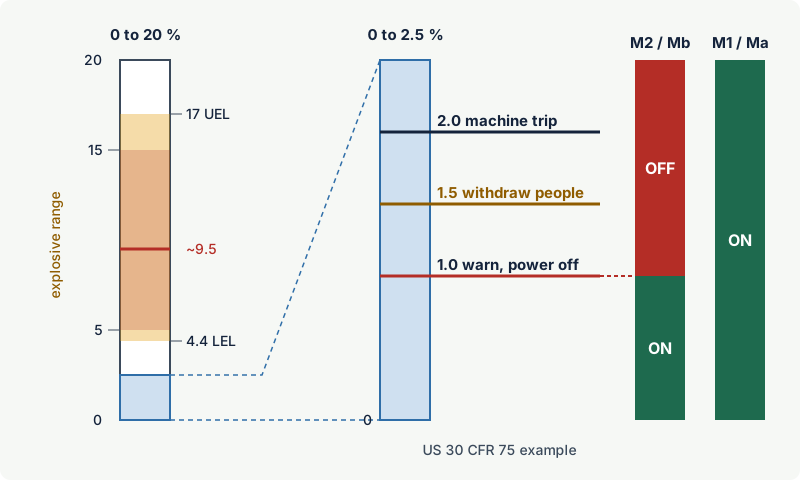
- Mining rules act at concentrations far below the LEL. In the US, for example, electrical equipment in a working place must be de-energised at 1.0 % methane and people withdrawn at 1.5 %; machine-mounted methane monitors warn at 1.0 % and trip the machine at 2.0 % or on a monitor fault.
- Group I covers underground mines and their surface installations endangered by firedamp and/or combustible coal dust. Category M1 (EPL Ma) must remain safe even with an explosive atmosphere present and with two independent faults; category M2 (EPL Mb) is designed to be de-energised when firedamp appears.
- The maximum surface temperature of Group I equipment is 150 °C where coal dust can settle on it, and 450 °C where a dust layer is prevented. Temperature classes T1 to T6 are not used for Group I.
- Coal dust turns a local methane ignition into a mine-wide explosion. Rock dusting dilutes it with incombustible stone dust; US rules require at least 80 % incombustible content and more where methane is present.
- The 2010 explosions at Upper Big Branch (USA) and Pike River (New Zealand) each killed 29 people. Both began with the ignition of accumulated methane, and both investigations found that warning signs and basic controls had been neglected.
Firedamp and the other mine gases
Coal holds large amounts of methane adsorbed on its internal surfaces. When the seam is cut, broken or relieved of pressure, the gas is released: from the face and the cut coal, from the roof and floor strata, and above all from the goaf (gob), the caved area left behind a longwall. Emissions rise sharply during cutting and when barometric pressure falls, because gas then expands out of the goaf into the airways. Sudden outbursts of gas and coal occur in some seams.
Miners have long used traditional names for the gases they meet:
| Name | Main components | Hazard |
|---|---|---|
| Firedamp | methane | flammable, explosive |
| Blackdamp (chokedamp) | carbon dioxide and nitrogen, with depleted oxygen | asphyxiation |
| Whitedamp | carbon monoxide | toxic; produced by fires and spontaneous combustion |
| Stinkdamp | hydrogen sulfide | toxic |
| Afterdamp | mixture left after an explosion or fire, rich in CO | in many historical explosions it killed more miners than the blast itself |
Methane data from the excodex library: LEL 4.4 % vol, UEL 17 % vol, autoignition temperature about 600 °C, relative density 0.554. The 4.4 % follows the IEC/EN data; the 5 % found in mining texts and many US sources comes from a different test method and apparatus, so the two figures describe the same gas measured in different ways. The most violent mixture is near stoichiometric, about 9.5 % in air. Methane is gas group IIA in surface industry, but underground in coal mines it is a Group I hazard, with its own equipment rules. Its properties are compared with other fuels in methane, propane and LPG.
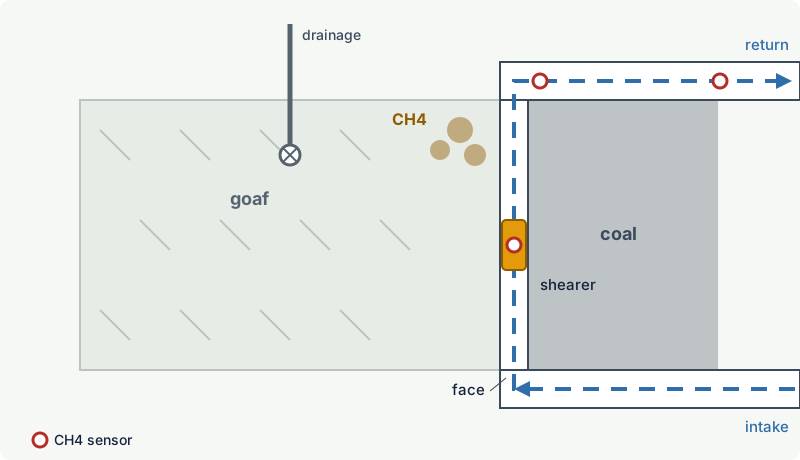
Because methane is buoyant, it forms roof layers where the air velocity is low: along the roof of roadways, in roof cavities and at the top of rises. A reading taken at head height can be well below the concentration a few centimetres under the roof, which is why examinations and sensors look specifically at the roof and at the return side of the face.
Methane limits and power cutting
Every coal-mining country sets methane action levels, and they sit far below the LEL to leave time to react and to allow for local layers that the instrument does not see. The exact values, the locations they apply to, and the actions differ by country, so the national rules always govern. The US federal rules are a well-documented example:
| Location (US, 30 CFR Part 75) | Methane | Required action, in summary |
|---|---|---|
| Working place or intake air course | 1.0 % | de-energise electrical equipment in the area (except intrinsically safe monitoring), shut off other mechanised equipment, adjust ventilation; no other work until below 1.0 % |
| Working place or intake air course | 1.5 % | withdraw everyone except those needed to correct the condition; disconnect power at the source |
| Return air split | 1.0 % / 1.5 % | ventilation changes at once / withdraw people and cut power |
| Bleeder split or other return | 2.0 % | maximum permitted |
| Machine-mounted methane monitor | 1.0 % | warning signal visible to the operator |
| Machine-mounted methane monitor | 2.0 % or monitor fault | automatic de-energisation of the machine |
In the UK, the Electricity at Work Regulations 1989 long required electricity to be cut off where firedamp exceeding 1.25 % was found in the general body of the air. That mining part of the regulations was revoked in 2015 when the Mines Regulations 2014 took over, which illustrates that the numbers move with legislation and must be checked in the current national text.
Two features are common to all such schemes:
- Fail-safe tripping. A methane monitor that is faulty, out of calibration or switched off must be treated as if it were in alarm. The US rule makes the machine trip automatically when the monitor is not working properly.
- Calibration. Methane sensors drift and can be poisoned. The US rules require machine-mounted monitors to be calibrated with a known methane-air mixture at least every 31 days; bump checks are typically done far more often.
Group I equipment: M1, M2, Ma and Mb
Equipment for mines susceptible to firedamp forms its own group, Group I, in both the EU ATEX Directive 2014/34/EU and the IEC 60079 series. The separate group exists because mining equipment faces a different combination of conditions: methane together with coal dust, severe mechanical abuse, water and confined spaces, and a regime in which power is removed when gas appears. Group II equipment, even if suitable for gas group IIA, is not Group I equipment. See equipment groups I, II and III.
| ATEX category | IEC EPL | Protection | Behaviour when firedamp appears | Typical equipment |
|---|---|---|---|---|
| M1 | Ma | very high: safe in normal operation and with two independent faults, or with two independent means of protection | must keep working | gas monitoring and alarm, communications, escape lighting, sensors of the atmospheric monitoring system, usually intrinsically safe (Ex ia) |
| M2 | Mb | high: safe in normal operation and under arduous conditions | intended to be de-energised | coal cutters, conveyor drives, pumps, switchgear, transformers, lighting, usually flameproof (Ex d) or increased safety |
In short, following the definitions in IEC 60079-0: EPL Ma equipment must not ignite firedamp in normal operation, nor with expected or rare malfunctions, even if it stays energised while gas is present; EPL Mb equipment must not ignite it in normal operation or with expected malfunctions during the period between the gas appearing and the power being cut. The mapping between categories and EPLs is explained in ATEX equipment categories and Equipment Protection Levels.
Markings and temperature
Typical markings are I M2 Ex db I Mb for a flameproof motor or switchgear enclosure and I M1 Ex ia I Ma for an intrinsically safe methane sensor. The Roman numeral I after the protection concept is the equipment group. Equipment certified for both mines and surface industry carries both markings.
Group I equipment has no temperature class. Its maximum surface temperature is limited to 150 °C on any surface where coal dust can form a layer, and 450 °C where a dust layer is prevented, for example inside a dust-tight enclosure. Flameproof enclosures for mines are tested with methane, and they must also withstand the mechanical impacts of a mining environment; see flameproof enclosures.
Non-electrical ignition sources
Mechanical equipment in Group I must also be assessed for ignition hazards (ISO 80079-36 and -37). In coal mines the most important non-electrical source is frictional ignition: hot streaks produced when cutting picks strike hard sandstone or pyrite. Sharp picks, effective water sprays at the cutting drum, and good ventilation at the cutting head are the controls, and their failure was central to the Upper Big Branch explosion described below.
Legal framework in the EU
In the EU, Group I equipment is placed on the market under Directive 2014/34/EU. The workplace directive 1999/92/EC, however, excludes mineral-extracting industries covered by the mining directives 92/91/EEC and 92/104/EEC, so underground mines are not zoned under ATEX 1999/92 in the usual way. Their gas management, ventilation and electrical rules come from those directives and national mining law.
Ventilation and gas drainage
Ventilation is the primary protection. Main fans, usually exhausting at the surface, pull fresh air down the intake airways, across the working faces and out through the return airways. Stoppings, doors and regulators direct the air; seals isolate worked-out areas.
Key elements of a firedamp control plan:
- Air quantity. Each face and heading needs enough air to dilute the expected methane, including peaks during cutting and during falls of barometric pressure, to below the action levels with margin.
- Auxiliary ventilation. Development headings (dead ends) are ventilated with auxiliary fans and ducts. A stopped auxiliary fan quickly lets methane accumulate at the face, so these fans are commonly interlocked with the electrical supply to the heading.
- Air velocity at the roof. Sufficient velocity prevents methane layers. Roof cavities and the tailgate corner of a longwall are classic accumulation points.
- Gas drainage. Where ventilation alone cannot cope, methane is captured before it reaches the airways: boreholes drilled into the seam ahead of mining (pre-drainage) or into the strata and goaf behind the face (post-drainage), connected to a pipe range and an extraction plant at the surface. The captured gas can contain high methane concentrations and is often used for power generation; the pipe system itself must be managed so that it does not draw in air into the explosive range.
- Bleeder systems and seals. Worked-out areas are either ventilated through bleeder entries, with methane limits at the bleeder outlet, or sealed. Sealed areas can pass through the explosive range as their atmosphere changes.
Worked example: air needed at a longwall face
A longwall face is expected to release 0.15 m³/s of methane into the ventilating air during cutting (a value for this example only; real values come from gas emission measurements and prediction for the seam). The return must stay below a planned maximum of 1.0 %.
- Required air flow: Q_air = q_CH4 x (1 - c) / c = 0.15 x 0.99 / 0.01 = 14.9 m³/s.
- With a design margin, planning for 0.75 % in the return instead: Q_air = 0.15 x 0.9925 / 0.0075 = 19.9 m³/s, about 20 m³/s.
- If gas drainage captures half of the goaf methane and the emission into the air falls to 0.08 m³/s, the same 20 m³/s keeps the return at about 0.4 %.
The example shows why ventilation and drainage are designed together, and why a production increase that raises methane emission must be matched by more air or more drainage before it happens, not after the first alarms.
Methane monitoring
Mines use several layers of measurement:
- Machine-mounted monitors on continuous miners, longwall shearers and other cutting machines, with sensors as close as practicable to the cutting head and, on longwalls, at the return end of the face. They warn and trip the machine automatically.
- Fixed sensors and atmospheric monitoring systems in returns, at belt conveyors, near auxiliary fans and at drainage plants, reporting continuously to a control room on the surface and tripping power to districts. Sensors left energised during gas outbreaks must be category M1.
- Hand-held methane detectors carried by examiners and supervisors, used for pre-shift and on-shift examinations. US rules require tests at least 300 mm (12 inches) from the roof, face, ribs and floor, and examiners deliberately test roof cavities and the top of the roadway.
- Tube bundle and gas chromatograph analysis for sealed areas and spontaneous combustion monitoring (carbon monoxide and other indicator gases).
Catalytic (pellistor) sensors measure methane well in the 0 to 5 % range but need oxygen and can be overranged; thermal conductivity sensors measure high concentrations up to 100 %, for example in drainage pipes; infrared sensors are increasingly used for methane and are not poisoned. The trade-offs are explained in catalytic vs infrared gas detectors. The flame safety lamp, developed from the early 19th century as a safe light for gassy mines, is still used in some countries to detect methane (by the cap on the flame) and oxygen deficiency.
Coal dust and the hybrid hazard
A methane ignition on its own is usually a local event. What makes it lethal across a mine is coal dust: the pressure wave of the first explosion raises dust from the roadways, and the dust cloud carries the flame for long distances. Methane in the air also makes coal dust easier to ignite, the hybrid effect described in hybrid mixtures.
The defence is rock dusting: spreading inert limestone or dolomite dust so that the mixture cannot propagate a flame. US rules require the combined dust in underground areas to be at least 80 % incombustible, increased by 0.4 percentage points for every 0.1 % of methane in the ventilating air, a direct legal expression of the hybrid effect. Water barriers and stone dust barriers are used in many countries to stop a propagating explosion.
Lessons from two 2010 explosions
Upper Big Branch, West Virginia, USA, 5 April 2010. An explosion killed 29 miners and injured two. The federal mine safety agency found that methane, likely liberated from floor fractures where the mine had cut into a fault zone, had accumulated in the tailgate area of the longwall because of poor ventilation and roof control, including a roof fall that restricted the air leaving the face. The shearer was the likely ignition source: two picks were worn flat and had lost their carbide tips, producing hot streaks on sandstone, and seven water spray nozzles were missing. The methane ignition reached a larger accumulation and then ignited coal dust, which carried the explosion through the mine because rock dusting was grossly inadequate. The agency called the disaster entirely preventable and documented skipped or inadequate examinations and pressure not to report hazards.
Pike River, New Zealand, 19 November 2010. An explosion killed 29 men; two escaped. The Royal Commission concluded that the immediate cause was the ignition of a substantial volume of methane. The mine's ventilation and gas drainage systems could not keep up with development and hydro-mining, which released large quantities of methane, and in the 48 days before the explosion there were 21 reports of methane reaching explosive levels and 27 further reports of lower but dangerous levels. The location of the main fan underground, and damage to the surface back-up fan, meant the mine could not be re-ventilated quickly after the explosion.
The common lessons:
- Ventilation and drainage capacity must lead production, not follow it.
- Repeated methane alarms are a warning about the system, not nuisance trips to be reset.
- Machine maintenance (picks, water sprays, methane monitors) is explosion protection.
- Rock dusting is what keeps a local ignition from becoming a mine-wide disaster.
- Examinations must be real, recorded honestly and acted on.
Common mistakes and misconceptions
- "Methane is safe below 5 %." Action levels are 1 to 2 % because a roof layer, a cavity or the air at the cutting head can be inside the explosive range while the general body of air reads low.
- Treating Group II IIA equipment as acceptable underground because methane is IIA. Coal mines need Group I equipment, certified for methane, coal dust, the 150 °C surface limit and mining conditions.
- Resetting a tripped methane monitor without finding the cause. The trip is the system working; the investigation is about ventilation, drainage or a gas feeder.
- Measuring only at head height. Methane layers at the roof; examinations and sensor positions must reflect that.
- Forgetting non-electrical ignition. Frictional sparking at the cutting drum is a major ignition source; picks and sprays are safety equipment.
- Seeing coal dust as a housekeeping issue only. Coal dust turns a local ignition into an explosion along the roadways. Incombustible content must be measured and maintained.
Frequently asked questions
What is firedamp in a coal mine?
Firedamp is the flammable gas released from coal seams and the surrounding rock, consisting mainly of methane. It is lighter than air and explosive at roughly 5 to 15 % in air. Mines control it with ventilation, gas drainage and continuous monitoring.
At what methane level is power cut in a coal mine?
It depends on the country and the location in the mine, but action levels are typically between 1 and 2 %. In the US, electrical equipment in a working place must be de-energised at 1.0 % methane and people withdrawn at 1.5 %, and machine-mounted monitors trip the machine at 2.0 %. Check the current national mining regulations for the values that apply.
What is the difference between M1 and M2 equipment?
Both are Group I categories for mines. M1 equipment has a very high level of protection and may keep operating in an explosive atmosphere, because it stays safe even with two independent faults; it is used for gas monitoring and communications. M2 equipment has a high level of protection and must be de-energised when firedamp reaches the action level.
What do EPL Ma and Mb mean?
They are the IEC equipment protection levels for Group I. Ma corresponds to ATEX category M1 and remains safe when left energised in an outbreak of gas, even with rare malfunctions. Mb corresponds to M2 and is safe in the period between an outbreak of gas and the equipment being switched off.
Why is coal dust so dangerous in methane explosions?
A methane ignition raises coal dust into the air, and the dust cloud can carry the flame through the whole mine. Methane also makes the dust easier to ignite. Rock dusting with inert stone dust keeps the incombustible content high enough to stop flame propagation.
What is the maximum surface temperature for Group I equipment?
150 °C on surfaces where coal dust can form a layer, and 450 °C where a dust layer is prevented, for example inside a dust-tight enclosure. Group I equipment does not use the temperature classes T1 to T6.
Related on excodex
- Equipment groups I, II and III: mining, gas and dust
- ATEX equipment categories 1, 2 and 3 and how they relate to EPLs
- Hybrid mixtures: when flammable gas and combustible dust are present together
- Catalytic (pellistor) vs infrared flammable gas detectors
- How to read an Ex marking
- Tools: methane and carbon monoxide in the gas library, Ex marking check, standards spaces ATEX 2014/34/EU and IEC 60079-0, forum
Standards and further reading
- IEC 60079-0, Explosive atmospheres, equipment general requirements (edition 8, 2026), including Group I and EPLs Ma and Mb.
- IEC 60079-1 (flameproof enclosures) and IEC 60079-11 (intrinsic safety), both including Group I requirements.
- ISO 80079-36 and ISO 80079-37, non-electrical equipment for explosive atmospheres.
- Directive 2014/34/EU, Annex I, equipment group I and categories M1 and M2: legislation.gov.uk
- Directive 1999/92/EC, Article 1, scope and exclusion of mineral-extracting industries: legislation.gov.uk
- US 30 CFR 75.323 (actions for excessive methane), 75.342 (methane monitors) and 75.403 (rock dust): law.cornell.edu, 75.342, 75.403
- MSHA, Report of investigation, Upper Big Branch Mine-South explosion, executive summary: msha.gov
- Royal Commission on the Pike River Coal Mine Tragedy, Volume 1 overview: pikeriver.royalcommission.govt.nz
This article is general technical information prepared by the excodex editorial team. It does not replace the applicable standards, the equipment certificates and instructions, national regulations or the assessment of a competent person.