ATEX equipment categories 1, 2 and 3 and how they relate to EPLs
Abstract
ATEX categories M1, M2 and 1, 2, 3 (G or D) define how much protection equipment gives, which zones it may serve and which conformity assessment route applies. This guide explains each category, the notified body routes and the link to EPLs Ga to Dc.
ATEX equipment categories are the protection classes defined in Annex I of Directive 2014/34/EU. Mining equipment (group I) is category M1 or M2; equipment for all other places (group II) is category 1, 2 or 3, followed by G for gas or D for dust. Category 1 gives a very high level of protection and may be used in Zones 0/20, 1/21 and 2/22; category 2 a high level for Zones 1/21 and 2/22; category 3 a normal level for Zones 2/22 only. Each category corresponds to an equipment protection level (1G to Ga, 2G to Gb, 3G to Gc, and likewise for dust and mines), and the category also decides whether a notified body must be involved in certification.
This article explains what each category demands, which conformity assessment modules apply, how categories map to zones and EPLs, and what that means when you buy or inspect equipment.
Key points
- Group I (mines) has categories M1 and M2; group II (all other places) has categories 1, 2 and 3, each for gas (G), dust (D) or both.
- Category 1 equipment must stay safe even with rare faults, using two independent means of protection or tolerating two independent faults. Category 2 must stay safe with frequently occurring disturbances and normally expected faults. Category 3 must be safe in normal operation.
- Directive 1999/92/EC sets the default selection: category 1 in Zone 0 or 20; category 1 or 2 in Zone 1 or 21; category 1, 2 or 3 in Zone 2 or 22.
- Categories correspond to EPLs: M1 and M2 to Ma and Mb, 1G, 2G, 3G to Ga, Gb, Gc, and 1D, 2D, 3D to Da, Db, Dc.
- Categories M1 and 1 need an EU-type examination by a notified body plus notified body involvement in production (or, as an alternative for any category, unit verification of the individual item). Electrical equipment and internal combustion engines of categories M2 and 2 need the same type examination with a different production module. Other category 2 equipment and all category 3 equipment are assessed by the manufacturer.
- A four-digit notified body number after the CE marking appears only when a notified body is involved in the production control phase.
Where categories come from
The ATEX equipment directive, 2014/34/EU, applies to equipment, protective systems and components intended for use in potentially explosive atmospheres. It replaced Directive 94/9/EC from 20 April 2016, keeping the same group and category structure; certificates issued under 94/9/EC remain valid under the new directive. The earlier directive had been mandatory since 1 July 2003.
Annex I of the directive sorts equipment into two equipment groups:
- Group I: equipment for underground parts of mines, and those parts of surface installations of mines, liable to be endangered by firedamp and/or combustible dust.
- Group II: equipment for use in other places liable to be endangered by explosive atmospheres.
Within each group, the category states the level of protection. The manufacturer designs and certifies equipment for a category; the employer selects the category that suits the zone. The category then appears on the label after the Ex hexagon and the group, as in II 2 G. How the rest of the marking reads is covered in How to read an Ex marking.
Group I: categories M1 and M2
| Category | Protection level | Intended use | What the design must achieve |
|---|---|---|---|
| M1 | Very high | Mines endangered by firedamp and/or combustible dust, where equipment must keep working | Remain functional in an explosive atmosphere; safe even with rare faults, through two independent means of protection or tolerance of two independent faults |
| M2 | High | Same locations | Intended to be de-energised when an explosive atmosphere occurs; protection holds in normal operation and under severe conditions such as rough handling and changing environments |
The distinction reflects mining practice. Equipment that must keep working during a gas outbreak, typically methane monitoring and communication systems, needs M1. Most production equipment is M2 and is switched off by the mine's gas monitoring when methane rises. Read more in Coal mine methane: firedamp, monitoring and Group I equipment.
Group II: categories 1, 2 and 3
| Category | Protection level | Explosive atmosphere expected | Design principle (Annex II) | Zones (1999/92/EC) |
|---|---|---|---|---|
| 1 | Very high | Present continuously, for long periods or frequently | Safe even in rare incidents: two independent means of protection, or safe with two faults occurring independently | 0, 1, 2 (G) or 20, 21, 22 (D) |
| 2 | High | Likely to occur occasionally | Safe with frequently occurring disturbances or equipment faults that normally have to be taken into account | 1, 2 (G) or 21, 22 (D) |
| 3 | Normal | Unlikely, and if it occurs, infrequent and short | Foreseeable ignition sources of normal operation prevented | 2 (G) or 22 (D) |
The letter after the category says which atmosphere it covers: G for gases, vapours and mists, D for dusts. Equipment for both carries both letters, for example II 2 G D or as separate markings. A G marking alone says nothing about dust: dust ingress, dust layers and surface temperature under dust are not assessed.
Two special forms are common:
- Slash markings such as
II 1/2 G. Different parts of the equipment meet different categories, typically a sensor that reaches through a tank roof into a Zone 0 vapour space while its housing sits in Zone 1. The instructions state which part is which. - Brackets such as
II (1) G. The equipment itself is installed outside the hazardous area (or in a less hazardous one) but contains safety-related circuits or devices that serve category 1 equipment, typically an intrinsic safety isolator. Such safety, controlling and regulating devices fall within the directive even though they are not located in the explosive atmosphere.
How categories relate to zones and EPLs
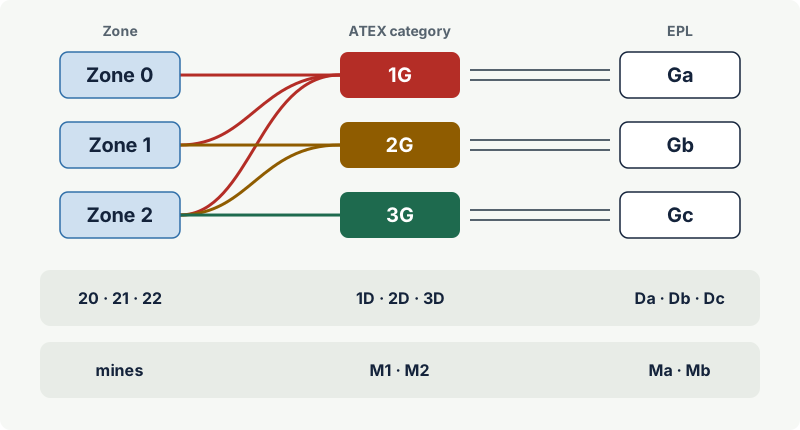
| Area | Default category (1999/92/EC) | Corresponding EPL (IEC 60079-14) |
|---|---|---|
| Zone 0 | 1G | Ga |
| Zone 1 | 1G or 2G | Ga or Gb |
| Zone 2 | 1G, 2G or 3G | Ga, Gb or Gc |
| Zone 20 | 1D | Da |
| Zone 21 | 1D or 2D | Da or Db |
| Zone 22 | 1D, 2D or 3D | Da, Db or Dc |
| Mines, equipment must stay energised | M1 | Ma |
| Mines, equipment de-energised on gas | M2 | Mb |
Directive 1999/92/EC (Annex II, part B) states the category defaults and adds that the explosion protection document, based on the risk assessment, may provide otherwise. The IEC installation standard does the same with EPLs. The risk-based route and its limits are discussed in Equipment Protection Levels (EPL).
Category and EPL: the same idea, not the same thing
In everyday work, category and EPL can be treated as equivalent, and European certificates and labels show both, for example II 2 G Ex db IIC T4 Gb. The differences matter only in specific cases:
- Legal status. The category is a legal classification under EU law. The EPL is a technical rating from the IEC 60079 and ISO 80079 standards, used worldwide, including under the IECEx scheme where categories do not exist.
- Dust grouping. ATEX keeps dust equipment in group II with the letter D. The IEC system puts dust equipment in a separate Group III with subgroups IIIA, IIIB and IIIC, which ATEX categories do not express. See Equipment groups I, II and III.
- Scope of the assessment. The category covers all ignition hazards of the product, electrical and non-electrical. For non-electrical equipment, the EPL is now also assigned through ISO 80079-36 (marking
Ex h), so the two again line up. - Associated devices. Bracket markings (
II (1) Gand[Ex ia Ga]) describe the protection delivered to circuits in the hazardous area, not the location of the device itself.
Conformity assessment routes per category
The category also decides how the manufacturer must demonstrate conformity. Article 13 of Directive 2014/34/EU links each category to conformity assessment modules defined in the annexes of the directive.
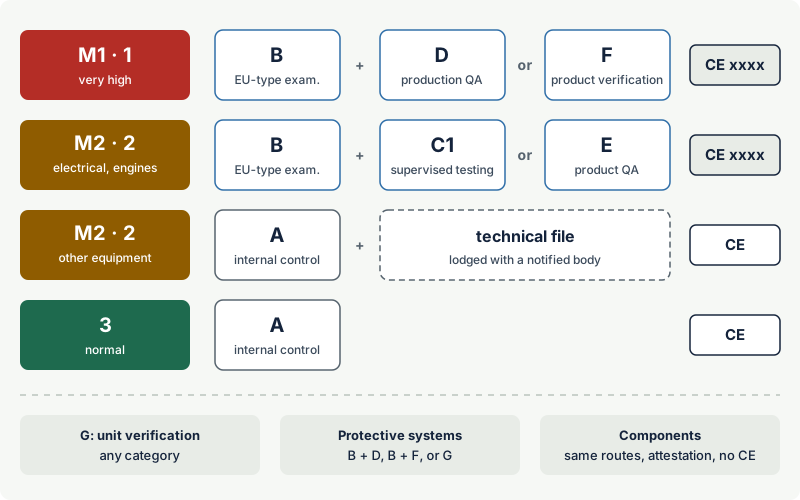
| Category | Equipment type | Modules (Annex) | Notified body role |
|---|---|---|---|
| M1 and 1 | All equipment | B (III) EU-type examination, plus D (IV) production quality assurance or F (V) product verification | Type examination and production surveillance |
| M2 and 2 | Electrical equipment and internal combustion engines | B (III), plus C1 (VI) internal production control with supervised product testing or E (VII) product quality assurance | Type examination and production surveillance |
| M2 and 2 | Other equipment (for example non-electrical) | A (VIII) internal production control, and technical documentation sent to a notified body, which acknowledges receipt and keeps it | Archives the file only |
| 3 | All equipment | A (VIII) internal production control | None |
| Any category | Any equipment | G (IX) unit verification, as an alternative | Verifies the individual unit |
Two further rules complete the picture:
- Protective systems (for example flame arresters, explosion venting or suppression systems placed on the market as autonomous systems) follow the category 1 route (B plus D or F) or unit verification (G).
- Components (items essential to safe functioning but with no autonomous function, such as a certified empty flameproof enclosure) follow the same procedures as the equipment they are intended for, but receive a written attestation of conformity instead of CE marking and an EU declaration of conformity.
What this means on the label and in the paperwork
Under Article 16 of the directive, the notified body's four-digit identification number follows the CE marking when that body is involved in the production control phase. So:
- Categories M1 and 1, and electrical equipment of categories M2 and 2, normally show
CE xxxx. - Non-electrical category 2 equipment and category 3 equipment normally show
CEwithout a number. The notified body that holds a category 2 non-electrical file does not supervise production and issues no type examination certificate; its acknowledgement of receipt is not a certificate. - Equipment of categories M1, 1, M2 and 2 (electrical) has an EU-type examination certificate (unless unit verification was used), numbered in a pattern such as
ABC 24 ATEX 1234 X. Under the old directive this was called an EC-type examination certificate.
Category 3 equipment is often tested voluntarily by a third party, and the manufacturer may hold an IECEx certificate as well, but neither is required by the directive. The manufacturer still has to meet the essential health and safety requirements, usually by applying the harmonised standards. More on the process in EU-Type Examination Certificates and Notified Bodies explained and on the paperwork in The ATEX Declaration of Conformity and the CE and Ex marking.
Worked example: a pump set for Zone 1
A refinery orders a pump set for an outdoor Zone 1 handling n-heptane (gas group IIA, autoignition temperature 204 °C, temperature class T3). The pump, coupling and motor are supplied together.
| Item | Category needed | Typical marking | Conformity route | Documents the buyer should receive |
|---|---|---|---|---|
| Pump (non-electrical) | 2G | II 2 G Ex h IIA T3 Gb | A plus technical file lodged with a notified body | EU declaration of conformity, instructions |
| Electric motor | 2G | II 2 G Ex db eb IIC T4 Gb | B plus C1 or E | EU declaration of conformity, EU-type examination certificate reference, instructions |
| Coupling | 2G (if it has its own ignition risks) | II 2 G Ex h IIA T4 Gb | A plus file lodged | Declaration, instructions |
The checks, in order:
- Category 2 (or 1) for every item, because the area is Zone 1. Category 3 parts would be acceptable only in Zone 2.
- G marking on every item: the site has no combustible dust.
- Gas group IIA or higher, and temperature class T3 or lower temperature (T3, T4, T5, T6), because n-heptane ignites at 204 °C and T3 limits surfaces to 200 °C. The margin is small, so many users prefer T4 here. The pump's actual T-class also depends on the liquid temperature stated in its instructions.
- Notified body number after CE on the motor, none expected on the pump.
- Whether the combination is supplied as an assembly with its own declaration, or as separately certified items that the installer must combine according to each set of instructions. The European Commission's ATEX guidelines explain when an assembly must itself be assessed.
Common mistakes
- Reading the category as a zone number. Category 2 belongs to Zone 1 (and may also be used in Zone 2). Category 3 is the Zone 2 category.
- Calling category 3 equipment "uncertified". It is legally placed on the market under the manufacturer's own conformity assessment. Its level of protection is lower, not its legal status.
- Taking a notified body's acknowledgement of a technical file for a certificate. For non-electrical category 2 equipment the notified body only stores the file; it has not examined the design.
- Assuming G covers dust. Gas-only equipment may let dust in or run too hot under a dust layer. Dust zones need a D marking.
- Installing an ATEX component as finished equipment. Components carry an attestation, not CE marking, and become compliant only inside complete equipment.
- Using group II equipment in a mine, or group I equipment above ground. Group I is assessed for firedamp and mining conditions; it says nothing about other gases such as propane, which has a smaller safe gap than methane.
Frequently asked questions
What is ATEX category 2?
Category 2 is the high level of protection in equipment group II. The equipment must stay safe with frequently occurring disturbances and the equipment faults that normally have to be expected. By default it may be used in Zone 1 and Zone 2 (2G) or Zone 21 and Zone 22 (2D).
Which ATEX category do I need for Zone 1?
Category 2G or 1G for gas, which corresponds to EPL Gb or Ga. For Zone 21 (dust) the equivalent is category 2D or 1D. The explosion protection document may require a higher category where the consequences of an ignition are severe.
Is category 3 equipment certified by a notified body?
Not necessarily. Directive 2014/34/EU allows category 3 equipment to be assessed by the manufacturer alone (internal production control, module A). Many manufacturers still obtain voluntary third-party test reports or IECEx certificates, and equipment containing safety devices for higher categories, such as associated apparatus, involves a notified body for those parts.
What does II 1/2 G mean?
It means different parts of the equipment meet different categories, typically a part in Zone 0 (category 1) and the rest in Zone 1 (category 2). Level sensors mounted through a tank wall are the classic example. The instructions show which part is designed for which zone.
What is the difference between an ATEX category and an EPL?
The category is the legal classification of the EU directive; the EPL is the technical rating used by IEC and ISO standards worldwide. They correspond one to one (1G with Ga, 2G with Gb, 3G with Gc, and so on), and EU equipment normally shows both.
Do ATEX categories apply outside the EU?
The categories are defined by EU law, so they are not used under the IECEx scheme or in North America, where the EPL or the Division system is used instead. The UK, Turkey and some other countries apply rules modelled on the ATEX directive; see Ex certification in other markets.
Related on excodex
- ATEX explained: the two EU directives 2014/34/EU and 1999/92/EC
- Equipment Protection Levels (EPL): Ga, Gb, Gc, Da, Db, Dc
- EU-Type Examination Certificates and Notified Bodies explained
- ATEX vs IECEx: differences, similarities and which one you need
- Non-electrical equipment in hazardous areas: Ex h
- Ex marking check: /tools/ex, standards spaces: ATEX 2014/34/EU, ATEX 1999/92/EC, ISO 80079-36
Standards and further reading
- Directive 2014/34/EU, equipment and protective systems intended for use in potentially explosive atmospheres (Annex I categories, Article 13 conformity assessment, Article 16 CE marking): https://eur-lex.europa.eu/legal-content/EN/TXT/HTML/?uri=CELEX:32014L0034
- Directive 2014/34/EU, list of annexes and modules (legislation.gov.uk): https://www.legislation.gov.uk/eudr/2014/34/contents
- Directive 1999/92/EC, Annex II part B, criteria for the selection of equipment (legislation.gov.uk): https://legislation.gov.uk/eudr/1999/92/annex/II/data.xht
- Guidelines on the application of Directive 2014/34/EU, European Commission (summary page on EU-OSHA): https://osha.europa.eu/en/legislation/guidelines/guidelines-directive-201434-eu-atex-product-directive
- European Commission page on ATEX harmonised standards and guidelines: https://single-market-economy.ec.europa.eu/single-market/goods/european-standards/harmonised-standards/equipment-explosive-atmospheres-atex_en
- IEC 60079-0, equipment general requirements (EPL definitions); IEC 60079-14, installation design and selection; ISO 80079-36, non-electrical equipment, basic method and requirements
This article is general technical information prepared by the excodex editorial team. It does not replace the applicable standards, the equipment certificates and instructions, national regulations or the assessment of a competent person.