EU-Type Examination Certificates and Notified Bodies explained
Abstract
Under ATEX 2014/34/EU a notified body issues an EU-type examination certificate (Module B) for category 1 and electrical category 2 equipment, then oversees production under Module D, E, F or C1. Modules, categories, certificate validity and NANDO checks explained.
An EU-type examination certificate is the document a notified body issues under Module B of the ATEX directive 2014/34/EU after examining a representative specimen of a product and confirming that its design meets the directive's essential health and safety requirements. It is required for category M1 and 1 equipment, for protective systems, and for electrical equipment and internal combustion engines of category M2 and 2, unless the single-unit route (Module G) is used. It never stands alone: a notified body must also oversee production under a second module (D, F, C1 or E). A notified body is a conformity assessment body designated by an EU Member State, notified to the European Commission and listed with a four-digit number in the NANDO database.
This article explains what notified bodies do, what each conformity assessment module means, which equipment needs which modules, what an EU-type examination certificate contains and how long it stays valid, and how to check a notified body in NANDO.
Key points
- A notified body is designated by a national notifying authority, notified to the Commission and other Member States, and given a four-digit identification number that is listed in NANDO.
- Module B (EU-type examination, Annex III) assesses the design; Modules D, E, F and C1 assess production; Module A is the manufacturer's own control; Module G verifies single units.
- Category M1/1 equipment and protective systems need Module B plus Module D or F; electrical equipment and engines of category M2/2 need Module B plus Module C1 or E; any category may use Module G instead.
- An EU-type examination certificate cannot be issued for category 3 equipment or for non-electrical category 2 equipment; for the latter, the technical documentation is sent to a notified body, which acknowledges receipt and keeps it.
- The four-digit number after the CE marking belongs to the notified body that oversees production, which need not be the body that issued the EU-type examination certificate.
- EU-type examination certificates have no mandatory validity period; they remain valid until the approved type is changed or the generally acknowledged state of the art moves beyond the specifications applied.
- The manufacturer, not the notified body, remains responsible for the conformity of every product placed on the market.
What a notified body is and how it gets the job
The ATEX directive leaves most conformity assessment to manufacturers. Where it requires an independent check, only a notified body may do it. Each Member State appoints a notifying authority (Article 18), which assesses candidate bodies against the requirements of Article 21: among them legal personality under a Member State's law, independence from the products assessed (no design, supply or consultancy for them), impartiality, technical competence, professional secrecy and liability insurance. Competence is usually demonstrated through accreditation to the ISO/IEC 17000 series of conformity assessment standards, for example ISO/IEC 17065 for product certification.
The notifying authority then notifies the body to the Commission and the other Member States. When a body is notified for the first time under any EU product legislation, the Commission assigns it an identification number in the format NB xxxx, which it keeps for all the legislation it is notified under. The Commission publishes the list, with the activities each body is notified for, in NANDO (Article 26).
Some points that often surprise buyers:
- Manufacturers may choose any notified body notified for the relevant procedure, in any Member State; it need not be in the manufacturer's country. Notified bodies may also work outside the EU.
- Countries with agreements with the EU designate notified bodies too, for example Switzerland under its mutual recognition agreement and Türkiye under the Customs Union; Türkiye's bodies are notified to the Commission through NANDO.
- Notified bodies must take part in coordination. The European ATEX Notified Bodies Group (ExNBG) issues "clarification sheets" that are not legally binding but that each notified body must apply as general guidance.
- Assessments must be proportionate and avoid unnecessary burdens on manufacturers (Article 29), without lowering the level of protection.
A notification can be restricted, suspended or withdrawn if a body no longer meets the requirements (Article 27). That is one reason to check NANDO rather than rely on an old certificate.
The conformity assessment modules in plain language
The ATEX directive borrows its procedures from the EU's common set of "modules", labelled A to H. Annexes III to IX of the directive each describe one of them.
| Module | Annex | Who does what | Document issued |
|---|---|---|---|
| B, EU-type examination | III | Notified body examines the technical documentation and a specimen representative of production, carries out tests | EU-type examination certificate |
| D, quality assurance of the production process | IV | Notified body approves and audits the manufacturer's quality system for production, final inspection and testing | Quality assurance notification (QAN) |
| E, product quality assurance | VII | Notified body approves and audits the quality system for final inspection and testing | Quality assurance notification (QAN) |
| F, product verification | V | Notified body examines and tests every product | Certificate of conformity |
| C1, internal production control plus supervised product testing | VI | Manufacturer tests each product for the explosion protection aspects under the responsibility of a notified body | Conformity to type notification |
| A, internal production control | VIII | Manufacturer alone (for non-electrical category 2: documentation sent to a notified body) | None from a notified body |
| G, unit verification | IX | Notified body examines and tests an individual product | Certificate of conformity |
Think of it as two questions. Module B answers "is the design right?". Modules D, E, F and C1 answer "is every product made like the approved design?". Module G answers both questions for one single item, which suits one-off equipment such as a special machine built for one site.
Module D covers the whole production process and is linked to category 1; Module E covers the final inspection and testing and is linked to category 2. A quality system built on EN ISO 9001 and EN ISO/IEC 80079-34 gives a presumption of conformity with these modules for the provisions those standards cover. See quality assurance for Ex manufacturers.
Which equipment needs which modules
Article 13 links the modules to the equipment group and category, which come from the intended zone of use; see ATEX equipment categories.
| Product | Required procedure | EU-type examination certificate? |
|---|---|---|
| Category 1 equipment (Zone 0 / 20) and category M1 mining equipment | B + D, or B + F, or G | Yes (except under G) |
| Autonomous protective systems (e.g. flame arresters, explosion venting, suppression) | Same as category 1 | Yes (except under G) |
| Category M2 and 2 electrical equipment and internal combustion engines | B + C1, or B + E, or G | Yes (except under G) |
| Category M2 and 2 non-electrical equipment | A, with technical documentation sent to a notified body; or G | No |
| Category 3 equipment (Zone 2 / 22) | A, or G | No |
| Safety, controlling and regulating devices outside the hazardous area | Procedure of the category of the equipment they protect | Depends on that category |
| Components | Same procedure as the equipment; written attestation of conformity instead of CE marking | As for the equipment |
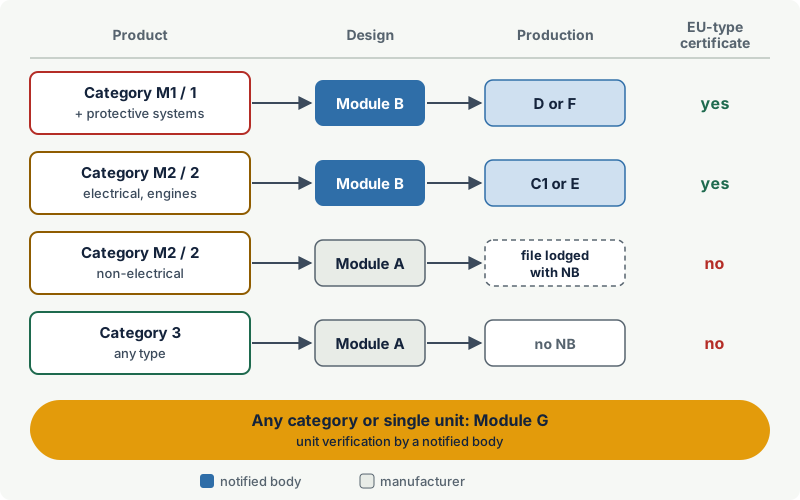
Two details complete the picture. First, for all products, conformity with the requirement on "other hazards" (Annex II, point 1.2.7) may be shown by internal production control. Second, safety devices placed outside the hazardous area are marked with the category of the equipment they protect in brackets, for example II (1) G for an intrinsically safe interface feeding category 1 equipment, and are assessed accordingly.
Note: For category 3 and non-electrical category 2 products, the ATEX guidelines state that an EU-type examination certificate cannot be issued. A certification body may issue a voluntary certificate, but it is then not acting as a notified body: the certificate must not show a notified body number or the CE marking, and it is not an EU-type examination certificate.
Inside an EU-type examination certificate
What it contains
Annex III requires the certificate to contain the manufacturer's name and address, the conclusions of the examination, any conditions for its validity and the data needed to identify the approved type. The ExNBG has agreed a common format, and the ATEX guidelines list the typical content:
- the certificate number;
- name and type of the product, and the manufacturer's name and address;
- the harmonised standards used, where applicable;
- a description of the product and the parameters significant for explosion safety;
- specific conditions of use (for equipment) or a schedule of limitations (for components).
Certificate numbers commonly combine the notified body's abbreviation, the year, the word ATEX, a serial number and, where applicable, a suffix: XXX 24 ATEX 0123 X. The X means specific conditions of use apply; U marks a component certificate. Both are explained in the X and U suffixes.
The detailed assessment and test report stays with the manufacturer and the notified body; the body may release its content only with the manufacturer's agreement, apart from its duties to authorities. The certificate itself is meant to give the information needed to check that products match the approved type and to support in-service checks.
Changes to the product
The manufacturer must inform the notified body of every modification to the approved type that may affect conformity with the essential requirements or the conditions of the certificate. Such changes need an additional approval, issued as an addition to the original certificate. A product that differs from all approved versions is not covered, however small the change looks.
How long is it valid?
The directive sets no fixed validity period. According to the ATEX guidelines, certificates remain valid indefinitely, or until an expiry date if one is shown, but several things can end their validity:
- a modification of the approved type that has not been approved;
- a substantive development of the generally acknowledged state of the art, for example a revised harmonised standard whose foreword states that the state of the art has changed for an essential requirement.
In the second case the manufacturer should arrange a re-evaluation within the transition period; notified bodies are expected to alert certificate holders when harmonised standards are revised. A new certificate has no retroactive effect: products placed on the market while a valid certificate existed are not affected. Certificates issued under the old Directive 94/9/EC remain valid under 2014/34/EU on the same basis.
The manufacturer must keep the certificate, its annexes and additions with the technical documentation for 10 years after the last product of the type has been placed on the market.
Production modules, the QAN and the number after CE
Module B alone does not allow a product to be sold. The production module decides which notified body number appears on the product.
Under Module D or E, the notified body assesses the manufacturer's quality system, issues a quality assurance notification (QAN), carries out periodic audits and may make unannounced visits, with product tests where necessary. The manufacturer must tell the body about any intended change to the quality system. Surveillance covers only the assessed area, and notified bodies typically list the EU-type examination certificates covered by their surveillance.
Under Module F or C1 the notified body checks products rather than the quality system. In all four cases, and under Module G, the CE marking is followed by the identification number of the notified body involved in the production phase. The manufacturer's EU declaration of conformity names the notified body that carried out the EU-type examination and gives the certificate number; see the ATEX declaration of conformity.
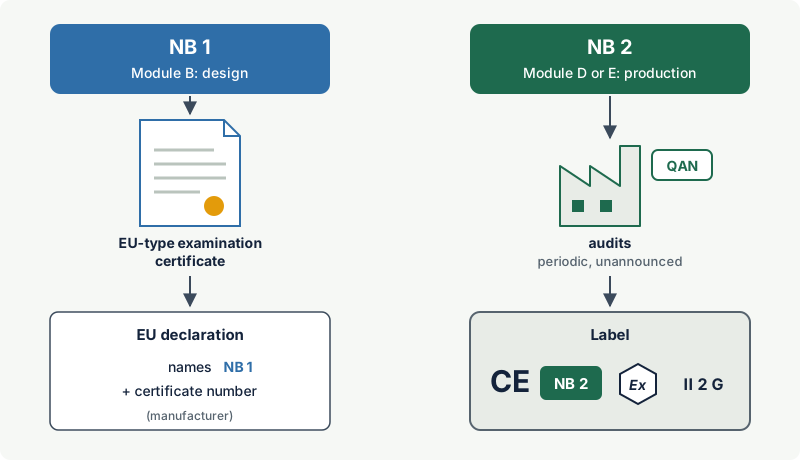
Example: A manufacturer obtains an EU-type examination certificate for an increased-safety junction box (category 2 G, electrical) from notified body 1. Its factory has a quality system already approved under Module E by notified body 2, which adds the new certificate to the list covered by its QAN. Each box is marked CE followed by the number of notified body 2, the Ex hexagon, II 2 G and the standard marking. The EU declaration of conformity names notified body 1 and the certificate number. An inspector checking the box looks up both numbers in NANDO.
A frequent variant is the own-brand product. If a trader sells another manufacturer's certified product under its own name, the trader becomes the manufacturer in law. The ATEX guidelines describe the route: the original notified body issues a new EU-type examination certificate in the trader's name based on the original, the trader obtains its own QAN, and both QANs are updated so that the line of quality assurance can be traced back to the actual factory.
NANDO: how to check a notified body
NANDO stands for New Approach Notified and Designated Organisations. It is the Commission's public list of notified bodies, now part of the Commission's Single Market Compliance Space portal; the old NANDO address redirects there. For each body it shows the identification number, name, country, the legislation it is notified under, and the procedures and product types covered.
To check an ATEX certificate or label:
- Read the number. Take the four-digit number after the CE marking from the label, and the certificate number and notified body from the EU declaration of conformity.
- Search NANDO by body number or by legislation, Directive 2014/34/EU.
- Check the scope. The notification must cover the annex used (for example Annex III for EU-type examination, Annex IV for production quality assurance) and the type of product.
- Check the status and dates. A notification may have been restricted, suspended or withdrawn, or may not have existed when the certificate was issued.
- Confirm the certificate with the body. There is no central public register of EU-type examination certificates, so the issuing body is the authoritative source; some bodies offer an online check.
How to verify that an Ex certificate is genuine covers forged certificates and the warning signs in more detail. For IECEx certificates, by contrast, a public online database exists; see ATEX vs IECEx.
When no procedure can be completed in time
Article 13(5) allows a Member State's competent authority, on a justified request, to authorise the placing on the market of specific products (not components) in its own territory without the normal procedure, where their use is in the interest of protection, for example an urgently needed safety product. The essential requirements still apply, and the derogation is meant to remain exceptional.
Common mistakes and misconceptions
- "The notified body number on the label is the certificate issuer." It is the body supervising production. The issuer of the EU-type examination certificate is named in the declaration of conformity.
- "Every ATEX product has an EU-type examination certificate." Category 3 and non-electrical category 2 products cannot have one. Asking for it causes delays and sometimes invites misleading documents.
- "ATEX certificates expire after a few years." No validity period is required, but a certificate can lose its basis through unapproved changes or a substantive change in the state of the art.
- "The notified body guarantees the product." The manufacturer remains fully responsible for conformity, the EU declaration of conformity and every unit produced.
- "Any accredited test laboratory can issue ATEX certificates." Laboratories may test, but only a body notified under 2014/34/EU for the relevant annex can issue EU-type examination certificates and QANs.
- "A certificate PDF is proof enough." Check the notified body in NANDO and confirm the certificate with the body; scope and status matter as much as the document.
Frequently asked questions
What is an EU-type examination certificate?
It is the certificate a notified body issues under Module B (Annex III) of Directive 2014/34/EU when a representative specimen of a product meets the essential health and safety requirements. It is required for category M1/1 equipment, protective systems and category M2/2 electrical equipment and engines (unless unit verification, Module G, is used), always together with a production module.
Do ATEX EU-type examination certificates expire?
The directive does not require a validity period, so certificates normally have no expiry date. They stop being a valid basis if the approved type is changed without approval or if the generally acknowledged state of the art develops substantively, for example through a revised harmonised standard.
Which ATEX equipment needs a notified body?
Category M1/1 equipment and protective systems, and category M2/2 electrical equipment and internal combustion engines, need a notified body for both design and production. Non-electrical category 2 equipment only needs its technical documentation lodged with a notified body. Category 3 equipment needs no notified body.
What is the four-digit number after the CE marking?
It is the identification number of the notified body involved in the production control phase, for example the body that issued the QAN under Module D or E. It can differ from the body that issued the EU-type examination certificate. Category 3 products normally show no number.
How do I check a notified body in NANDO?
Search the Commission's NANDO list, now part of the Single Market Compliance Space, by the four-digit number or by Directive 2014/34/EU. Check that the body is notified for the annex and product type concerned and that the notification was active when the certificate was issued.
What is the difference between an EU-type examination certificate and a QAN?
The EU-type examination certificate approves the design of a product type. The QAN approves the manufacturer's quality system for producing it under Module D or E. A product needing Module B also needs a production module, such as a QAN, before it can carry the CE marking.
Related on excodex
- ATEX explained: the two EU directives 2014/34/EU and 1999/92/EC
- ATEX vs IECEx: differences, similarities and which one you need
- The ATEX Declaration of Conformity and the CE and Ex marking
- Quality assurance for Ex manufacturers: QAN, QAR and ISO/IEC 80079-34
- How to verify that an Ex certificate is genuine
- Standards spaces: ATEX 2014/34/EU, ISO/IEC 80079-34; tool: Ex marking check
Standards and further reading
- Directive 2014/34/EU, Article 13 (conformity assessment procedures), Articles 17 to 33 (notified bodies), Annexes III to IX (modules): EUR-Lex
- European Commission, ATEX 2014/34/EU Guidelines, 6th edition January 2026, and the link to ATEX notified bodies in NANDO: single-market-economy.ec.europa.eu
- European Commission, notified bodies (role, designation, free choice of body): single-market-economy.ec.europa.eu
- NANDO list of notified bodies in the Single Market Compliance Space: webgate.ec.europa.eu
- ISO/IEC 80079-34, application of quality systems for Ex product manufacture
- ISO/IEC 17065, requirements for bodies certifying products, processes and services
- IEC 60079-0, explosive atmospheres: general requirements for equipment
This article is general technical information prepared by the excodex editorial team. It does not replace the applicable standards, the equipment certificates and instructions, national regulations or the assessment of a competent person.