Quality assurance for Ex manufacturers: QAN, QAR and ISO/IEC 80079-34
Abstract
A type certificate proves one design; production quality assurance proves every unit matches it. What ISO/IEC 80079-34 adds to ISO 9001, how ATEX QANs and IECEx QARs are audited, how often, and how changes to certified products must be controlled.
Production quality assurance is the part of Ex certification that makes sure every unit leaving the factory is built exactly like the design that was tested. Under the EU ATEX directive it takes the form of a quality assurance notification (QAN), issued by a notified body under Module D or E; under the IECEx scheme it is a Quality Assessment Report (QAR), required for every IECEx certificate of conformity. Both are assessed against ISO/IEC 80079-34, which adds Ex-specific requirements to ISO 9001, and both depend on regular audits and strict control of changes.
This article explains what the standard requires in practice, how initial and surveillance audits work, how often they take place, and how a manufacturer should handle a change to a certified product without losing its certification.
Key points
- A type certificate covers a design; the QAN or QAR covers the factory's ability to reproduce that design in every unit. Neither works without the other.
- ISO/IEC 80079-34:2018 (edition 2) is the current standard for quality management systems for Ex product manufacture; it follows the structure of ISO 9001:2015 and must be read together with it. A revision is in preparation.
- Under ATEX, a QAN is needed where the conformity route uses Module D (category M1/1 equipment and protective systems) or Module E (category M2/2 electrical equipment and engines); a quality system to EN ISO 9001 and EN ISO/IEC 80079-34 gives a presumption of conformity with these modules.
- Under IECEx, every certificate of conformity needs a QAR, including certificates for Zone 2 equipment.
- IECEx surveillance audits take place about every 12 months, or every 18 months for manufacturers with a certified ISO 9001 system; a QAR is valid for at most three years before reassessment.
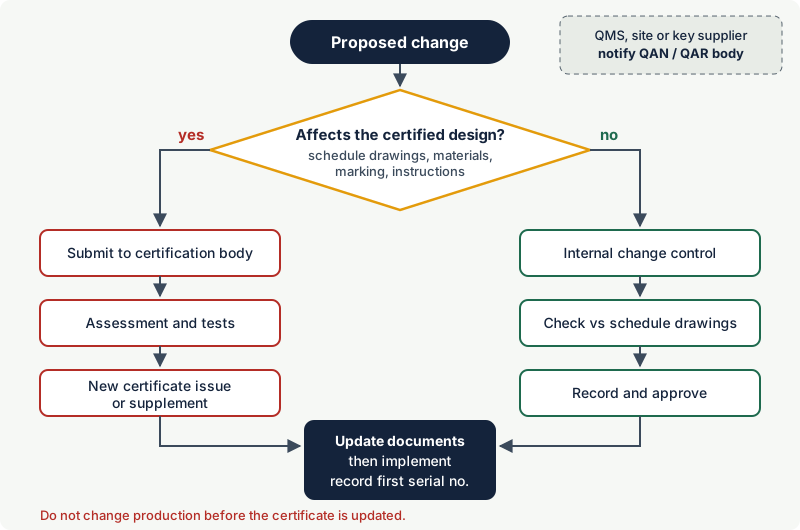
- Any change that affects the certified design, its schedule drawings, marking or instructions must be approved by the certification body before production changes; changes to the quality system itself must be notified as well.
Design certificate and production QA: two halves of one approval
Type testing examines one sample, sometimes a handful. It proves that the design can meet the standards, not that next year's production will. Production quality assurance closes that gap.
| ATEX (EU, Directive 2014/34/EU) | IECEx (international scheme) | |
|---|---|---|
| Design document | EU-type examination certificate (Module B) | Ex Test Report (ExTR) and certificate of conformity (CoC) |
| Production document | QAN under Module D (Annex IV) or Module E (Annex VII) | QAR |
| When required | Category M1/1 and protective systems (B + D, or B + F); category M2/2 electrical equipment and engines (B + E, or B + C1) | Every CoC |
| Issued by | A notified body chosen by the manufacturer | An IECEx certification body (ExCB) |
| Reference standard | EN ISO 9001 with EN ISO/IEC 80079-34 (presumption of conformity), or another model giving equivalent results | ISO/IEC 80079-34 |
| Visible on the product | Notified body number after the CE marking | QAR reference on the CoC, not on the label |
Module D covers the whole production process, including manufacturing techniques and tests before and during manufacture. Module E covers only final inspection and testing of the finished product. Modules F and C1 replace the quality system approval by product checks, and category 3 equipment needs no notified body at all; see EU-type examination certificates and notified bodies. IECEx has no self-declaration route, so even the simplest Zone 2 luminaire needs a QAR.
A single audit against ISO/IEC 80079-34 can serve both schemes when the same body is both a notified body and an ExCB, but the QAN and the QAR remain separate approvals that lapse separately; see ATEX vs IECEx.
What ISO/IEC 80079-34 adds to ISO 9001
The current edition, ISO/IEC 80079-34:2018, replaced the first edition of 2011. It reproduces the relevant ISO 9001:2015 text in boxes and adds Ex-specific requirements under the same clause numbers. A European revision based on a 2025 ISO/IEC draft has been through enquiry, so check for a newer edition before relying on clause details.
The idea running through the whole standard is simple: every Ex product must conform to the type described in its certificate and technical documentation. An ISO 9001 certificate alone does not prove that, because ISO 9001 does not know what a flamepath, a creepage distance or a schedule drawing is.
Documentation that traces back to the certificate
The standard distinguishes three layers of documents:
- Schedule drawings: drawings and documents listed in the certificate or test report. They define the certified design.
- Related drawings: drawings not listed in the certificate but linked to a schedule drawing, used for detailed manufacture or purchasing.
- Manufacturer's documentation: work instructions, data sheets and sales literature that the certification body did not assess.
Production may only use related drawings and work instructions that are consistent with the schedule drawings. A typical audit finding is a workshop drawing showing a tolerance, material or dimension that no longer matches the certified schedule drawing.
The Ex-specific requirements in practice
The table summarises what auditors typically look for, following the clause structure of the standard and the order in which a product passes through the factory.
| Area | What auditors typically look for in Ex production |
|---|---|
| Responsibilities and competence | Defined people responsible for certification matters; staff trained on the Ex-critical features of the products they make, inspect or test |
| Design and development | Changes to certified designs controlled and submitted to the certification body before release |
| External providers | Purchase specifications for Ex-critical parts; control of subcontracted operations such as casting, machining, PCB assembly or encapsulation; declarations of conformity from external providers where appropriate |
| Production | Control of Ex-critical characteristics: flamepath dimensions and surface finish, creepage and clearance distances, encapsulation, winding insulation, gaskets |
| Identification and traceability | Traceability of significant parts and of each product to its certificate and issue |
| Release | Routine tests required by the type-of-protection standards, final inspection, correct marking and instructions (including specific conditions of use) before release |
| Nonconforming output and complaints | Segregation and disposition of nonconforming product; analysis of complaints and field failures that concern Ex safety; recalls where needed |
| Monitoring and improvement | Calibrated measuring and test equipment, internal audits and management review that cover Ex requirements |
The informative Annex A of the standard gives guidance for each type of protection. Its headings show what auditors focus on: castings, machining, cemented joints and routine overpressure tests for flameproof enclosures; components, printed circuit boards and routine tests for intrinsic safety; windings, terminal boxes and accessories for increased safety; material control and filling for oil and powder filling; gaskets and cemented parts for dust protection by enclosure. Annex B covers parts whose protective paths cannot be measured directly, such as sintered breathing elements, which are verified by tests such as pore size or density.
Note: Traceability matters even for parts that carry no marking. An IECEx decision sheet (DS 2023/002) accepts that an Ex component built in only by its own manufacturer may be left unmarked, but only because the component is then treated as a significant part whose traceability the quality system must ensure.
Audits: initial assessment, surveillance and reassessment
Initial assessment
The process is similar under both schemes. The manufacturer applies with its quality system documentation; the certification body reviews the documents and then visits the site. Under ATEX Annex IV, the audit team must include at least one member with experience in the product field and technology concerned, and the decision, with its reasoning, is notified to the manufacturer. Under IECEx, the ExCB may not issue a QAR until both the document review and the site assessment are complete, and the QAR is registered in the IECEx online system.
Each manufacturing location that carries out critical operations, such as assembly, routine testing, final inspection or marking, falls within the assessment. Using a subcontractor does not move the responsibility: the ATEX guidelines state that the manufacturer cannot rely on audits of third parties to discharge its own obligations.
Surveillance audits
Surveillance checks that the approved system is still applied. IECEx guidance for ExCBs states that surveillance should be product-based: the auditor picks certified products and follows them from drawings to release. Typical activities are:
- comparing the current production drawings with the schedule drawings of the latest certificate issue;
- watching Ex-critical operations, for example machining of flamepaths or soldering of intrinsically safe circuits;
- witnessing or checking records of routine tests, and the calibration of the gauges and test rigs used;
- checking marking, nameplates and instructions against the certificate, including any X conditions;
- reviewing complaints, nonconformities, corrective actions, internal audits, management review and changes since the last visit;
- checking new manufacturing locations and critical suppliers.
Under ATEX, the notified body carries out periodic audits and may also make unexpected visits, during which it may test products. The directive does not fix the audit interval; it is set by the notified body. Under IECEx the interval is defined by scheme guidance.
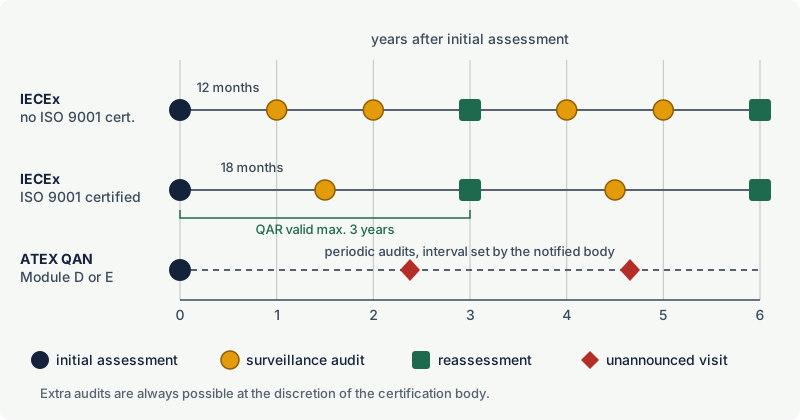
| Item | IECEx QAR | ATEX QAN |
|---|---|---|
| Surveillance interval | About 12 months; about 18 months with a certified ISO 9001 system | Set by the notified body (periodic audits) |
| Unannounced visits | Additional audits at the ExCB's discretion | Explicitly allowed, with product tests if necessary |
| Reassessment | Full reassessment; a QAR is valid for no more than three years | Reassessment when the quality system changes significantly, as decided by the notified body |
| Visible status | QAR and CoC status in the IECEx online system | QAN held by manufacturer and notified body; notified body informs authorities and other notified bodies of refusals, suspensions and withdrawals |
Audit outcomes
IECEx guidance grades audit results from A (requirements met, at most a few minor nonconformities) through B (minor nonconformities, corrective action verified at the next visit) and C (major nonconformities or non-compliant product, follow-up visit needed) to D and E, where certificates are suspended pending reassessment or cancelled. A suspended IECEx certificate does not affect products made while it was current, but nothing new may be produced under it. Under ATEX, a notified body can restrict, suspend or withdraw a QAN, and it must tell its notifying authority and the other notified bodies.
Change control: the most common way to lose conformity
Most conformity problems in Ex production do not start with bad workmanship but with an uncontrolled change: a new supplier, a cheaper alloy, a modified gasket, a different PCB layout, a relocated production line. Both schemes put the duty on the manufacturer:
- Under ATEX, the manufacturer must inform the notified body that issued the EU-type examination certificate of every modification to the approved type that may affect conformity; such changes need an additional approval, issued as an addition to the certificate. Separately, the manufacturer must tell the notified body that approved the quality system about any intended change to that system, and the body decides whether reassessment is necessary.
- Under IECEx, the manufacturer must advise the ExCB that issued the certificate of any change to the certified equipment. The ExCB decides whether a new issue of the certificate is needed. New issues do not cancel earlier ones, which stay valid until cancelled or suspended.
Practical case: a change of casting alloy
A manufacturer of flameproof junction boxes wants to switch to a new aluminium casting supplier using a slightly different alloy. The alloy designation appears on a schedule drawing.
- Classify the change. Because the material is defined in the certified documentation, this is a change to the certified design, not an internal matter.
- Submit it. The manufacturer sends the new material specification and test certificates to the certification body that holds the type certificate (ExCB for IECEx, notified body for ATEX).
- Assessment. The body checks the alloy against the material requirements of IEC 60079-0, for example the limits on light-metal content that apply to some groups and equipment protection levels, and decides whether tests such as overpressure or flame transmission must be repeated with castings from the new source.
- New certificate issue. Once accepted, the body issues a new certificate issue (IECEx) or an addition to the EU-type examination certificate (ATEX) with the revised drawing.
- Implement. Only now are the related drawings, purchase specifications and incoming inspection plan updated. The first serial number made with the new alloy is recorded, and old castings are used up or segregated under control.
- Audit trail. At the next surveillance audit the auditor will look for exactly this chain of evidence.
If the manufacturer had switched first and asked later, every enclosure made in between would have been outside its certificate.
Common mistakes
- "Our ISO 9001 certificate covers it." ISO 9001 is the base, not the Ex requirement. Under IECEx a certified ISO 9001 system lengthens the audit interval but does not replace the QAR.
- Treating the QAN or QAR as permanent. Both depend on surveillance. Missed audits or unresolved major nonconformities lead to suspension.
- Changing first, notifying later. Products made after an uncontrolled change to a certified design do not conform, even if the change was an improvement.
- Losing the link between schedule and related drawings. Workshop drawings drift from the certified ones over the years unless each revision is checked against the certificate.
- Assuming the subcontractor's audit is enough. The manufacturer named on the certificate remains responsible for the quality of subcontracted Ex-critical operations.
- Forgetting marking and instructions. A wrong nameplate or missing specific conditions of use in the manual is a nonconformity as serious as a wrong dimension.
Frequently asked questions
What is the difference between a QAN and a QAR?
A QAN is a notified body's decision approving a manufacturer's quality system under Module D or E of the ATEX directive. A QAR is the report of an IECEx certification body's audit of a manufacturing site, required for every IECEx certificate of conformity. Both are usually assessed against ISO/IEC 80079-34, and one audit can produce both if the body holds both roles.
What is ISO/IEC 80079-34?
It is the international standard that specifies requirements for a quality management system for manufacturing Ex products in accordance with their certificates. The current edition is ISO/IEC 80079-34:2018; it follows ISO 9001:2015 clause by clause and adds Ex-specific requirements, with informative guidance for each type of protection. A revised edition is in preparation.
How often are IECEx manufacturers audited?
IECEx guidance for certification bodies sets surveillance audits about every 12 months, or about every 18 months if the manufacturer has a certified ISO 9001 quality system. A QAR is valid for no more than three years, after which a full reassessment is needed. The certification body may add audits at its discretion.
Does every ATEX product need a QAN?
No. A QAN is only needed when the conformity route uses Module D or Module E. Category 3 equipment and non-electrical category 2 equipment are covered by internal production control (for category 2, with the technical documentation lodged with a notified body), Modules F and C1 use product checks instead of a quality system approval, and unit verification (Module G) assesses individual items.
Do I need to tell the certification body about a change to a certified product?
Yes, whenever the change may affect conformity with the certificate, which includes anything shown on the schedule drawings, materials, marking and instructions. The body decides whether a new certificate issue or an addition is needed, and the change should not reach production before that decision. Changes to the quality system, such as a new site, must also be notified.
Related on excodex
- EU-Type Examination Certificates and Notified Bodies explained
- The IECEx scheme explained: CoC, ExTR, QAR and the online certificate database
- ATEX vs IECEx: differences, similarities and which one you need
- The X and U suffixes on Ex certificates
- Flameproof enclosures (Ex d): how flamepaths stop an internal explosion
- Standards spaces: ISO/IEC 80079-34, ATEX 2014/34/EU, IECEx
Standards and further reading
- ISO/IEC 80079-34:2018, explosive atmospheres: application of quality management systems for Ex product manufacture (edition 2): webstore.iec.ch
- ISO 9001:2015, quality management systems: requirements.
- IEC 60079-0, explosive atmospheres: general requirements for equipment (material requirements, marking, documentation).
- Directive 2014/34/EU, Annex III (EU-type examination, modifications to the approved type), Annex IV (Module D) and Annex VII (Module E).
- European Commission, ATEX 2014/34/EU Guidelines, 6th edition January 2026, sections on quality assurance modules and subcontracting: single-market-economy.ec.europa.eu
- IECEx, frequently asked questions on the certified equipment scheme (audit intervals, certificate status, changes): iecex.com
- IECEx OD 025, guidelines on the management of assessment and surveillance programmes for manufacturers' quality systems: iecex.com
This article is general technical information prepared by the excodex editorial team. It does not replace the applicable standards, the equipment certificates and instructions, national regulations or the assessment of a competent person.