ATEX vs IECEx: differences, similarities and which one you need
Abstract
ATEX is EU law; IECEx is a voluntary international certification scheme. Both use the IEC 60079 family, but they differ in certificates (EU-type examination vs CoC), quality audits (QAN vs QAR), self-declaration and markets. When you need one, the other or both.
ATEX and IECEx answer different questions. ATEX (Directive 2014/34/EU) is European Union law: equipment for potentially explosive atmospheres cannot be placed on the EU market without it. IECEx is the International Electrotechnical Commission's voluntary certification scheme: it proves that equipment fully complies with the IEC 60079 series and the related ISO/IEC and ISO 80079 standards and is made under an audited quality system, and many countries use it as their route to market. You need ATEX to sell in the EU, EEA, Switzerland and Türkiye; you need IECEx where a regulator or customer asks for it, for example in Australia; and many manufacturers hold both, often from a single test programme.
This article compares the two side by side: legal status, certificates, quality system audits (QAN and QAR), markings and markets, and explains how dual certification works in practice.
Key points
- ATEX certification is a legal requirement for placing equipment on the EU market; IECEx certification is voluntary unless a national regulator or a buyer makes it mandatory.
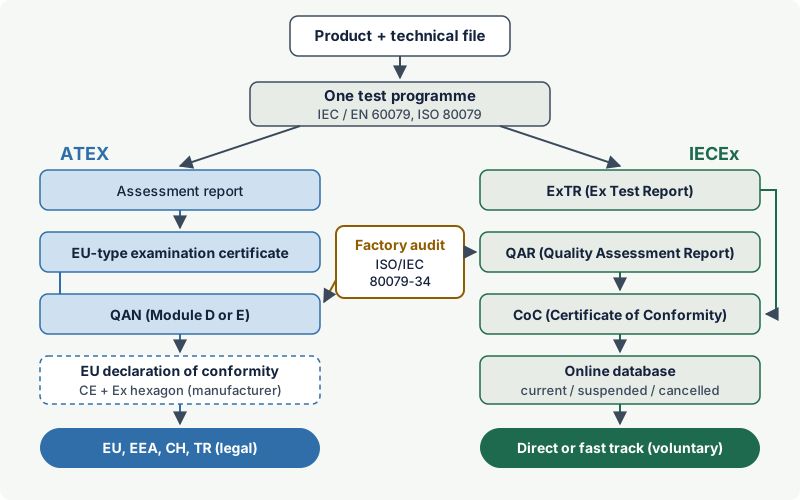
- Under ATEX, the key third-party documents are the EU-type examination certificate and the quality assurance notification (QAN); under IECEx they are the Ex Test Report (ExTR), the Quality Assessment Report (QAR) and the Certificate of Conformity (CoC).
- ATEX allows manufacturer self-declaration for category 3 equipment (Zone 2 and 22) and documented self-assessment for non-electrical category 2 equipment; IECEx has no self-declaration route, so every certified product is independently tested and its factory audited.
- Under ATEX, harmonised standards are a means of showing compliance with the legal requirements; under IECEx, full compliance with the listed IEC or ISO/IEC standards is the requirement itself.
- Every IECEx CoC is published in the IECEx online database with its status (current, suspended or cancelled); there is no equivalent central public register of EU-type examination certificates.
- Both schemes test against essentially the same technical standards, so one test campaign can support both certificates, provided the body involved is both an EU notified body and an IECEx certification body.
Two systems with different purposes
ATEX: a law for a market
Directive 2014/34/EU sets essential health and safety requirements (EHSRs) and conformity assessment procedures for equipment, protective systems, safety devices and components used in potentially explosive atmospheres. The manufacturer, not the certification body, carries legal responsibility: it completes the procedure, signs the EU declaration of conformity and affixes the CE marking. A notified body takes part only where the directive requires it, mainly for category 1 and electrical category 2 equipment. Our article on the two ATEX directives explains the legal framework.
Because the directive is the law, standards are a tool. Harmonised European standards (the EN IEC 60079 and EN ISO 80079 series) give a presumption of conformity with the EHSRs they cover, but a manufacturer may use other solutions if it can show the EHSRs are met.
IECEx: a certification scheme for the world
IECEx, the IEC System for Certification to Standards Relating to Equipment for Use in Explosive Atmospheres, began in 1996 and has been endorsed by the United Nations Economic Commission for Europe (UNECE) as an internationally recognised certification system for this sector. In October 2026 its website listed 36 member countries, including EU states, the United Kingdom, the United States, China, India, Japan, Türkiye and Australia. It runs four schemes: certified equipment, certified service facilities (repair and overhaul workshops), personnel competence, and a conformity mark licensing system. This article deals with the equipment scheme; the others are covered in the IECEx scheme explained and competence of people working in hazardous areas.
IECEx is not a law. It becomes binding only when a national regulation, a contract or a site standard calls for it. Its value lies in mutual acceptance: IECEx certification bodies (ExCBs) and test laboratories (ExTLs) are assessed by peers under common rules, and the scheme requires every ExCB to accept test results from the other bodies in the scheme.
The documents: EU-type examination certificate and QAN vs ExTR, QAR and CoC
ATEX documents
For category M1/1 equipment, protective systems, and electrical equipment and engines of category M2/2, a notified body examines a representative specimen and issues an EU-type examination certificate (Module B). It identifies the product, the manufacturer, the standards applied and the explosion protection parameters, and may contain specific conditions of use (an "X" after the certificate number) or a schedule of limitations for a component ("U").
Production is then covered by a second module. Where a notified body approves the manufacturer's quality system (Module D for category 1, Module E for category 2), it issues a quality assurance notification (QAN) and audits the factory periodically, with the right to make unannounced visits. A quality system based on EN ISO 9001 and EN ISO/IEC 80079-34 gives a presumption of conformity with these modules. The alternatives are product verification (Module F) for category 1, or conformity to type based on internal production control plus supervised product testing (Module C1) for category 2; neither involves a QAN.
The manufacturer's EU declaration of conformity is the legal statement that closes the procedure. Details are in EU-type examination certificates and notified bodies explained and the ATEX declaration of conformity.
IECEx documents
IECEx certification always rests on three linked documents:
- the ExTR (Ex Test Report), recording the assessment and tests of the product against each listed standard;
- the QAR (Quality Assessment Report), recording the audit of the manufacturing site, using ISO/IEC 80079-34 as the reference;
- the CoC (Certificate of Conformity), issued by the ExCB once both are satisfactory.
The CoC lists the standards with their editions, the Ex marking, and the ExTR and QAR references. According to the IECEx scheme's own FAQ, CoCs have no expiry date: they stay valid while the manufacturer passes surveillance audits, which take place every 12 months, or every 18 months where the site holds ISO 9001 certification. The version on the IECEx website is the controlled master copy, and printed copies should be checked against it. More on how to do that in how to verify that an Ex certificate is genuine.
QAN vs QAR in one sentence each
A QAN is an EU notified body's decision approving a manufacturer's quality system under Module D or E of the ATEX directive, needed only for products whose route uses those modules. A QAR is the IECEx audit report on a manufacturing site, needed for every IECEx CoC regardless of the equipment's protection level. Both are commonly assessed against ISO/IEC 80079-34, so one combined audit often serves both; see quality assurance for Ex manufacturers.
ATEX vs IECEx at a glance
| Aspect | ATEX (Directive 2014/34/EU) | IECEx (equipment scheme) |
|---|---|---|
| Nature | EU law, mandatory for the EU market | Voluntary international scheme, mandatory where adopted |
| Where it applies | EU, EEA, Switzerland (agreement), Türkiye (Customs Union) | Worldwide; direct acceptance in some countries, fast track in others |
| Legal responsibility | Manufacturer (EU declaration of conformity) | Certification body issues the CoC; national law decides the rest |
| Third parties | Notified bodies (listed in the EU NANDO database) | ExCBs and ExTLs approved by IECEx |
| Technical basis | Essential health and safety requirements; harmonised EN standards give presumption of conformity | Full compliance with the listed IEC and ISO/IEC standards |
| Product document | EU-type examination certificate (category M1/1, protective systems, electrical equipment and engines M2/2) | ExTR plus CoC |
| Quality system | QAN under Module D or E, where those modules are used | QAR for every CoC, with surveillance every 12 to 18 months |
| Self-declaration | Yes: category 3; non-electrical category 2 with documents lodged at a notified body | None |
| Public certificate register | None centrally; ask the notified body | IECEx online database with status |
| Marking | CE, notified body number, Ex hexagon, group, category, G/D, plus standard marking | Standard marking plus CoC number |
| Equipment group I/II/III | Groups I and II with categories; dust under group II "D" | Groups I, II, III with Equipment Protection Levels |
The last row hides a practical difference. ATEX uses categories (1, 2, 3) defined in the directive, while the IEC standards and IECEx use Equipment Protection Levels (EPLs: Ga, Gb, Gc, Da, Db, Dc, Ma, Mb). The two map onto each other, category 1 G to Ga, 2 G to Gb, 3 G to Gc, and so on, which is why an ATEX label carries both. See ATEX equipment categories and EPLs.
What really differs in practice
Self-declaration and Zone 2 equipment
This is the difference buyers notice most. A Zone 2 luminaire sold under ATEX as category 3 may be self-declared by its manufacturer: no notified body, no QAN, and no notified body number after the CE marking. The same luminaire under IECEx needs an ExTR, a QAR and a CoC, just like a Zone 1 product. A buyer who needs third-party evidence for Zone 2 equipment therefore often asks for IECEx, or for a voluntary type certificate, which under ATEX is not an EU-type examination certificate and must not carry a notified body number.
Standards: means or requirement
Under ATEX, the EHSRs of Annex II are the legal requirement and harmonised standards are one way to meet them. A notified body may also have to address EHSRs that the standards do not fully cover. Under IECEx, compliance with every applicable clause of the listed standards is mandatory, and the CoC names their editions. The IECEx FAQ states that ATEX test data can be transferred into the ExTR format where it satisfies the IEC standards.
Edition timing
IEC standards are published first; their EN versions are harmonised under the ATEX directive later, and the list of harmonised references in the EU Official Journal can lag behind the latest IEC edition. A product can therefore be certified to a newer IEC edition under IECEx and to an older EN edition under ATEX at the same time. IEC 60079-0, the general requirements standard, is an example: its eighth edition was published in June 2026, and its EN adoption follows its own timetable.
Non-electrical equipment
ATEX has covered non-electrical equipment since its first directive, 94/9/EC. IECEx also certifies non-electrical equipment to ISO 80079-36 and ISO 80079-37 (marking Ex h); its operational guide for this was first issued in 2016. For category 2 non-electrical equipment, ATEX still requires no EU-type examination, only documents lodged with a notified body, while IECEx requires full certification. See non-electrical equipment in hazardous areas.
Transparency
Each IECEx CoC, including suspended and cancelled ones, can be searched online by anyone. ATEX certificates are held by the manufacturer and the notified body; the directive does not provide a central public register, so checking an EU-type examination certificate means asking the issuing notified body, whose identity and scope can be checked in NANDO.
The marking on the label
The two schemes share the "standard" part of the marking, for example Ex db IIC T4 Gb for a flameproof enclosure for gas group IIC, temperature class T4, EPL Gb. ATEX adds its legal marking in front: CE, the notified body number where one is involved in production, the Ex hexagon, group II, category 2 and G. IECEx adds the CoC number, in the form IECEx XXX 24.0012X, where XXX identifies the ExCB, 24 is the year, and a trailing X or U has the same meaning as on ATEX certificates. A dual-certified product simply carries both references on one plate.
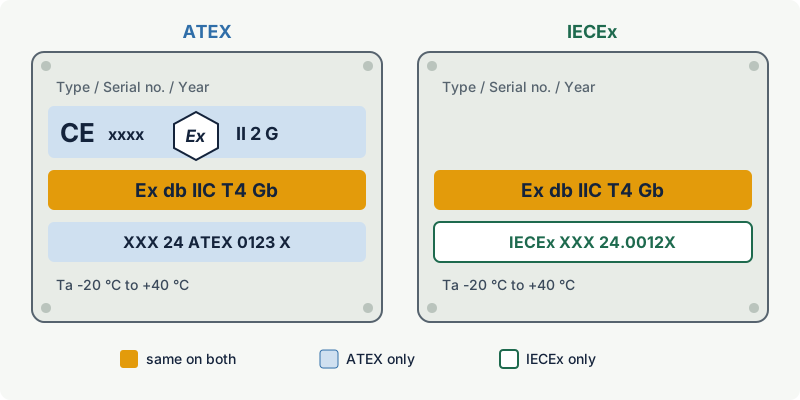
Use the Ex marking check to decode a marking and how to read an Ex marking for the full explanation, including the meaning of X and U suffixes.
Which one do you need?
The answer depends on where the equipment will be installed, not on where it is made.
| Destination | What is normally required |
|---|---|
| EU, EEA, Switzerland, Türkiye | ATEX (CE marking and EU declaration of conformity). IECEx alone is not enough. |
| Great Britain | The UK's own scheme; see Ex certification in other markets |
| Australia | Typically an IECEx CoC; for example, the Queensland regulator states that IECEx certificates demonstrate compliance and that ATEX is generally not accepted |
| Countries with national Ex marks | A national certificate, often issued faster on the basis of an IECEx ExTR and QAR |
| North America | National approvals; see North American hazardous location approvals |
| Projects worldwide | Whatever the project specification asks for; international oil, gas and chemical projects often request IECEx, or both |
Example: A manufacturer of a flameproof gas detector (Ex db IIC T4 Gb, category 2 G) plans sales in Germany, Saudi Arabia and Australia. The test laboratory runs one programme to the current IEC 60079-0 and IEC 60079-1 editions and checks any differences from the EN editions currently harmonised under ATEX. The certification body, acting both as EU notified body and IECEx ExCB, issues an ExTR, an ATEX assessment report and an EU-type examination certificate. One factory audit to ISO/IEC 80079-34 produces both the QAR and the QAN. The IECEx CoC is published online; the manufacturer signs the EU declaration of conformity and puts both references on the nameplate. For Saudi Arabia, an IECEx member country, the manufacturer checks the national requirements, which may accept the IECEx documents directly or use them for a national approval.
Dual certification: how to do it efficiently
- Choose a body that is both an ATEX notified body and an IECEx ExCB (check NANDO and the IECEx website). Using one body avoids duplicate testing and review.
- Test to the IEC editions and confirm the EN equivalents. Where the harmonised EN edition differs from the IEC edition, ask the body to address the differences in the same campaign.
- Combine the factory audits. One audit to ISO/IEC 80079-34 can produce the QAR and the QAN.
- Keep one technical file but remember the ATEX-only items: the EHSR check, the EU declaration of conformity, instructions in the languages of the destination countries, and the CE and Ex hexagon marking.
- Manage changes in parallel. A design change needs an update of both certificates; if one falls behind, products leave the factory that no longer match one of them.
Common mistakes and misconceptions
- "IECEx is accepted in the EU." It is not a legal route. IECEx documents can support the ATEX assessment, but only an ATEX procedure, an EU declaration of conformity and the CE marking allow sale in the EU.
- "ATEX is accepted everywhere." Some regulators, Queensland's for example, state that ATEX certification is generally not accepted because its requirements are similar to but not the same as IECEx.
- "A category 3 product with a certificate has an EU-type examination certificate." Category 3 is self-declared. A third-party certificate for it is voluntary and is not an EU-type examination certificate.
- "An IECEx CoC on paper proves validity." The online database is the master; a printed CoC may have been suspended or cancelled since it was printed.
- "QAN and QAR are the same thing." They are separate approvals under separate rules, even when one audit produces both, and each lapses independently if surveillance is not maintained.
- Confusing category and EPL. Category 2 G corresponds to EPL Gb, but the category belongs to ATEX and the EPL to the IEC standards; a plate may show both.
Frequently asked questions
Is IECEx certification valid in Europe?
Not on its own. To place equipment on the market in the EU, EEA, Switzerland or Türkiye, the manufacturer must follow the ATEX conformity assessment, sign an EU declaration of conformity and affix the CE marking. IECEx test reports can, however, be used as input by a notified body.
Is ATEX or IECEx more stringent?
Neither is simply stricter. IECEx requires third-party certification and factory audits for every protection level and full compliance with the IEC standards. ATEX adds legal obligations, the essential health and safety requirements and EU market surveillance, but allows self-declaration for category 3 equipment.
Do IECEx certificates expire?
IECEx CoCs have no expiry date. They remain valid while the manufacturer passes the regular surveillance audits; the CoC status (current, suspended or cancelled) is shown in the IECEx online database.
What is the difference between a QAN and a QAR?
A QAN is the ATEX notified body's approval of the manufacturer's quality system under Module D or E. A QAR is the IECEx report on the audit of the manufacturing site, required for every CoC. Both are usually assessed against ISO/IEC 80079-34.
Can one test cover both ATEX and IECEx?
Yes, in most cases. The technical standards are essentially the same, and many notified bodies are also IECEx certification bodies, so one test programme and one factory audit can produce both certificates. Differences in standard editions must be addressed in the same campaign.
Which certification should a manufacturer get first?
If the EU is a target market, ATEX is unavoidable, and adding IECEx to the same programme avoids repeating tests and audits later. For a product aimed only at markets that accept IECEx, IECEx alone may be enough.
Related on excodex
- ATEX explained: the two EU directives 2014/34/EU and 1999/92/EC
- EU-Type Examination Certificates and Notified Bodies explained
- The IECEx scheme explained: CoC, ExTR, QAR and the online certificate database
- Quality assurance for Ex manufacturers: QAN, QAR and ISO/IEC 80079-34
- How to verify that an Ex certificate is genuine
- Standards spaces: IECEx, ATEX 2014/34/EU, ISO/IEC 80079-34; tool: Ex marking check
Standards and further reading
- Directive 2014/34/EU on equipment and protective systems intended for use in potentially explosive atmospheres: EUR-Lex
- European Commission ATEX page and ATEX 2014/34/EU Guidelines (6th edition, January 2026): single-market-economy.ec.europa.eu
- IECEx Certified Equipment Scheme FAQ: iecex.com
- IECEx member countries: iecex.com
- IECEx OD 280, guide to certification of non-electrical equipment: iecex.com
- Workplace Health and Safety Queensland, electrical safety with hydrogen equipment (IECEx and ATEX acceptance): worksafe.qld.gov.au
- IEC 60079-0, explosive atmospheres: general requirements for equipment (eighth edition 2026)
- ISO/IEC 80079-34, application of quality systems for Ex product manufacture
- ISO 80079-36 and ISO 80079-37, non-electrical equipment: basic method and requirements; protection by constructional safety, control of ignition sources and liquid immersion
This article is general technical information prepared by the excodex editorial team. It does not replace the applicable standards, the equipment certificates and instructions, national regulations or the assessment of a competent person.