Competence of people working in hazardous areas: IECEx CoPC and other schemes
Abstract
IEC 60079-14, -17 and -19 require competent people for Ex design, installation, inspection and repair. How the IECEx CoPC units Ex 000 to Ex 011 work, how national schemes compare, and why a training certificate is not proof of competence.
Competence in hazardous areas means that a person can actually apply the knowledge and skills an Ex task needs, not just that they attended a course. The installation, inspection and repair standards IEC 60079-14, IEC 60079-17 and IEC 60079-19 all require that the work is done by competent people and describe, in normative annexes, the knowledge, skills and competencies expected of designers, technicians, operatives and responsible persons. The IECEx Certificate of Personnel Competence (CoPC) is the international way to prove it: an IECEx certification body assesses a person, in writing and in practice, against defined units of competence from Ex 000 (site awareness) to Ex 011 (hydrogen safety), and the certificate must be renewed by reassessment, typically every five years.
This article explains what the standards require, how the IECEx units are structured, how national schemes compare, and the difference between training, certification and competence, with a worked example of staffing an inspection campaign.
Key points
- Competence depends on knowledge, skill, experience and training together. A training course on its own does not prove competence; IECEx states that a record of training cannot be used to claim certification.
- IEC 60079-14:2024 has a clause on personnel competency and a normative Annex A on the knowledge, skills and competencies of designers, electricians and technicians, including how they are assessed.
- IEC 60079-17:2023 has a normative Annex B for responsible persons, technical persons with executive function and operatives (skilled personnel) doing inspection and maintenance.
- IEC 60079-19:2025 requires a responsible person for each repair facility site, defines that person's duties, and gives competence requirements for responsible persons and operatives in a normative annex.
- The IECEx CoPC scheme has twelve units, Ex 000 to Ex 011. Each certificate lists the units held and any limitations, for example to certain protection techniques. Certificates can be checked on the public IECEx online system.
- A CoPC is issued only after assessment by an IECEx certification body (ExCB) and is reassessed, typically every five years. It does not replace site induction, permits to work or the employer's own duty to check fitness for a specific task.
What the standards require
The EU framework: training and competent verification
For workplaces in the EU, Directive 1999/92/EC (ATEX "workplace" directive) requires the employer to give people working where explosive atmospheres may occur sufficient and appropriate training in explosion protection. Where the explosion protection document requires it, work must follow written instructions and a permit-to-work system, with permits issued by a person responsible for that function. Before a workplace with hazardous areas is used for the first time, its overall explosion safety must be verified by persons competent in explosion protection through their experience and/or professional training. National law transposes these duties; in Great Britain, regulation 9 of the Dangerous Substances and Explosive Atmospheres Regulations 2002 (DSEAR) covers information, instruction and training.
The directive sets the duty but not the content. The content comes from the IEC 60079 standards and from national rules.
IEC 60079-10-1: area classification
The area classification standard, IEC 60079-10-1:2020, contains a clause on the competence of the personnel who carry out the classification. Classification draws on process, equipment, ventilation and materials knowledge, and is normally done by a team. In the IECEx scheme the matching unit is Ex 002, which explicitly requires a degree, diploma or equivalent in a technical subject.
IEC 60079-14: design, selection and installation
Competence requirements were already part of earlier editions, and the 2024 edition (edition 6) keeps them: a clause on personnel competency is supported by a normative Annex A, "knowledge, skills and competencies of designers, electricians and technicians", which sets out the knowledge and skills for each group, the competencies they must show, and how competence is assessed. In practice, a designer must be able to read the area classification, select protection concepts, equipment and cable systems from markings and certificates, and compile the verification dossier; an installer must master the practical work of the protection techniques on site, such as terminating cables in Ex d and Ex e enclosures or keeping intrinsically safe circuits separated.
IEC 60079-17: inspection and maintenance
IEC 60079-17:2023 (edition 6) changed its clause heading from "qualification" to "competence of personnel". Its normative Annex B covers two levels:
- Responsible persons and technical persons with executive function: the people who manage inspection and maintenance, decide intervals, accept deviations and sign off. The 2023 edition brought the term "technical person with executive function", already used in the standard's continuous supervision clauses, into Annex B, because "responsible person" describes a role more than a set of knowledge and skills.
- Operatives or technicians (skilled personnel): the people who carry out the inspections and the maintenance.
The standard also requires that inspections are independent enough of the immediate demands of maintenance to be reliable, and that competence is maintained with refresher training. See inspection of Ex installations under IEC 60079-17.
IEC 60079-19: repair, overhaul and reclamation
IEC 60079-19 edition 5 (July 2025) gave competence its own subclause and introduced explicit requirements for the responsible person: each service facility site needs one, the standard sets out the person's duties, how they may be delegated and covered during absence, and what applies when a site has none. Its normative Annex B covers the knowledge, skills and competence of responsible persons and operatives, with a separate section on the qualification of reclamation operatives, for example those who rebuild worn flamepath surfaces. The standard takes its definition of competence from ISO/IEC 17024: in short, being able to use knowledge and skills to get the intended results. See repair, overhaul and modification of Ex equipment.
The IECEx Certified Persons scheme
How it works
The IECEx scheme for certification of personnel competence, usually called the IECEx Certified Persons scheme, certifies individuals. The process is:
- The applicant chooses an IECEx certification body (ExCB) approved for personnel certification and shows that they meet the minimum application requirements, for example relevant experience.
- The ExCB assesses knowledge and practical skills through written examinations and practical assessments in the applicant's area of work. Other certificates and training records can support the application but cannot replace the assessment.
- After a successful assessment, the ExCB issues a Personnel Competence Assessment Report (PCAR) and creates the Certificate of Personnel Competence on the IECEx online system, where employers can check it.
- The certificate is typically valid for five years. Renewal requires reassessment, because competence can fade.
The scheme applies the impartiality principles of ISO/IEC 17024, the international standard for bodies that certify persons: an organisation may both train and certify, but a person who trained a candidate may not take part in certifying that candidate.
The units of competence
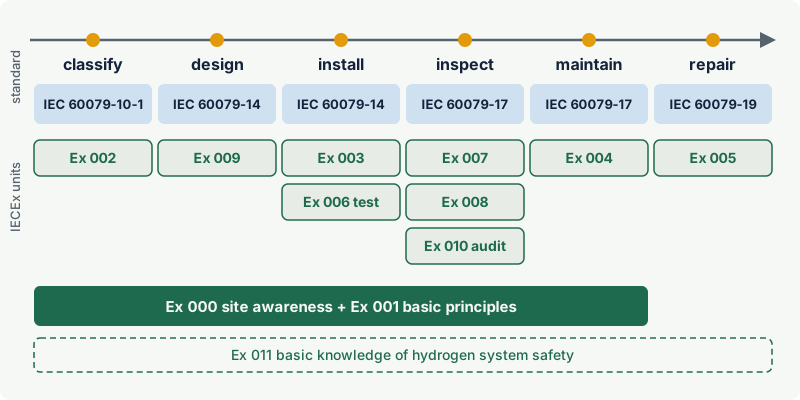
The units are defined in IECEx operational document OD 504 (edition 5.0, October 2022). Certificates are based on work functions from the IEC standards, not on job titles, and a person holds the combination of units that matches their work.
| Unit | Title (IECEx) | Typical holder |
|---|---|---|
| Ex 000 | Basic knowledge and awareness to enter a site that includes a classified hazardous area | Anyone who needs site access; not a qualification for Ex work |
| Ex 001 | Apply basic principles of protection in explosive atmospheres | Knowledge base for all practical units |
| Ex 002 | Perform classification of hazardous areas | Process safety and area classification engineers |
| Ex 003 | Install explosion-protected equipment and wiring systems | Electricians and instrument technicians |
| Ex 004 | Maintain equipment in explosive atmospheres | Maintenance technicians |
| Ex 005 | Overhaul and repair of explosion-protected equipment | Repair workshop staff |
| Ex 006 | Test electrical installations in or associated with explosive atmospheres | Test and commissioning technicians |
| Ex 007 | Perform visual and close inspection of electrical installations | Inspectors, operators doing routine checks |
| Ex 008 | Perform detailed inspection of electrical installations | Inspectors |
| Ex 009 | Design electrical installations in or associated with explosive atmospheres | Electrical and instrument designers |
| Ex 010 | Perform audit inspection of electrical installations | Auditors, client or authority representatives |
| Ex 011 | Basic knowledge of the safety of hydrogen systems | Staff at hydrogen facilities; not a qualification for Ex work |
The units currently focus on electrical equipment; IECEx has indicated that units for non-electrical equipment may follow.
Prerequisites, experience and limitations
OD 504 sets prerequisites for each unit. Highlights:
- Ex 001 is knowledge only; it does not assess practical work. It must be assessed together with, or before, Ex 003, Ex 004, Ex 006 and Ex 007.
- Ex 005 does not require Ex 001, because overhaul and repair are assumed to take place in a workshop outside the hazardous area.
- Ex 002 requires a technical degree, diploma or equivalent.
- Experience: for the installation, maintenance, repair, testing and visual inspection units (Ex 003 to Ex 007), the stated minimum is three years in the relevant field, such as industrial electrical installation or maintenance; for responsible persons, three years of the corresponding Ex work.
- Responsible person level: several units, including Ex 003, Ex 004, Ex 005 and Ex 007, separate the criteria for operatives from those for responsible persons.
- High voltage: for some units, such as Ex 004 and Ex 007, a person working above 1000 V AC or 1500 V DC should also hold high-voltage switching and safe isolation competence.
- Limitations: a unit can be limited by protection technique, product type, equipment group or voltage. A certificate for Ex 003 may, for example, exclude intrinsic safety or dust protection. Always read the limitations on the certificate.
Note: Ex 000 and Ex 011 are awareness units. Ex 000 covers only what a person needs to know to enter a site with hazardous areas safely, and IECEx states that Ex 011 is not intended as a basis for qualifying anyone to work in a hazardous area or on Ex equipment. Neither unit qualifies a person for hands-on Ex work.
Training providers
IECEx also recognises training organisations under its Recognised Training Provider (RTP) programme, governed by operational document OD 521. An RTP has been reviewed for its processes to deliver Ex training. Its courses prepare candidates for assessment, but a course and its record of training are not certification. Only an assessment by an approved ExCB leads to a CoPC.
Other schemes
National schemes predate or run alongside IECEx, and some are required locally.
| Scheme | Where | Structure | Validity |
|---|---|---|---|
| IECEx CoPC | International | Units Ex 000 to Ex 011, ExCB assessment | Typically 5 years, then reassessment |
| CompEx | Originated in the UK, used internationally | Units Ex01 to Ex14 by task and technique, theory exams and practical assessment; accredited to ISO/IEC 17024 | Maximum 5 years, renewal by refresher and assessment |
| EEHA units | Australia and New Zealand | National training units (for example UEEHA0026, maintain equipment associated with hazardous areas) based on AS/NZS 4761.1:2018 | Per national rules and employer requirements |
| National inspection qualifications | For example Germany | Persons qualified for testing in explosion hazard areas under the industrial safety ordinance (BetrSichV) and technical rules such as TRBS 1203 | Per national rules |
CompEx was created by EEMUA, the Engineering Equipment and Materials Users Association, to meet the competence expectations of IEC 60079-10, -14 and -17. Its core units Ex01 to Ex04 cover installation and inspection of Ex d, Ex e, Ex n and Ex p equipment (Ex01, Ex02) and of Ex i equipment (Ex03, Ex04); further units cover dust, fuel filling stations, the water industry, mechanical equipment, designers (Ex12) and technical persons with executive function (Ex14).
In Australia and New Zealand, competence for work on electrical equipment in hazardous areas (EEHA) is built on AS/NZS 4761.1 and delivered through nationally recognised training units. Such units typically require the person to be competent in the same work outside hazardous areas first.
Which scheme a site accepts is decided by national law, the operator and sometimes the client. Many operators accept several equivalent schemes; some require a specific one.
Training, certification and competence
These three words are often used as if they meant the same thing. They do not.
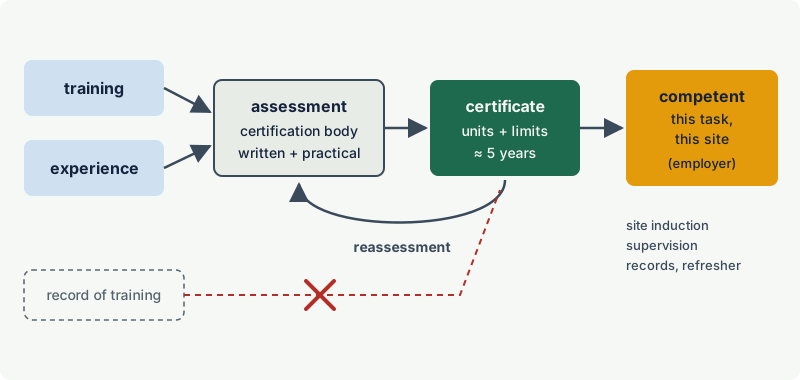
- Training gives knowledge and practises skills. It is necessary but proves only attendance, unless it ends in a real assessment.
- Certification is an independent statement that a person met defined criteria at the time of assessment. It is portable between employers and countries and can be checked.
- Competence is the ability to do a particular job correctly, now, at a particular site. It includes knowing the site's area classification, equipment, procedures and permit system, and it decays without practice.
The employer remains responsible for deciding who may do what. A sound approach combines certification with a written competence matrix (units and limitations needed per task), site-specific induction, supervised work for newcomers, periodic observation and refresher training, and records that an auditor or inspector can follow. IEC 60079-14 expects the competence of the people who designed, installed and inspected an installation to be part of the documentation.
Practical case: staffing an inspection campaign
A gas processing plant plans the periodic detailed inspection of 1,200 Ex items in Zone 1 and Zone 2, mostly Ex d, Ex e and Ex i, with a few pressurised analyser houses (Ex p). The operator writes the competence requirements into the contract:
| Role | Required units | Additional checks |
|---|---|---|
| Inspection lead (technical person with executive function) | Ex 001, Ex 008; Ex 010 for the audit sample | Experience with similar plant; knows IEC 60079-17:2023 |
| Inspectors | Ex 001, Ex 007, Ex 008 | No limitation excluding Ex i or Ex p |
| Technicians correcting defects | Ex 001, Ex 004 | Site permit-to-work training |
| Engineer assessing modifications found | Ex 009 | Access to the verification dossier |
| Area classification queries | Ex 002, or the operator's own classification team | Current classification drawings |
Before mobilisation the operator checks each CoPC on the IECEx online system and finds two problems: one inspector's Ex 008 is limited to Ex d and Ex e, so he is assigned to areas without intrinsically safe loops; another certificate expired three months earlier, so that person may work only as a trainee under supervision until reassessed. Everyone receives site induction, and the inspection lead reviews the first week's findings with each inspector to confirm consistent grading.
Common mistakes
- Treating a course certificate as competence. A record of training shows attendance. Ask for an assessed certificate and check it.
- Ignoring certificate limitations. A unit can exclude protection techniques, dust or high voltage. Match the limitations to the work.
- Accepting Ex 000 for hands-on work. It is an awareness unit for site access only.
- Forgetting expiry. Certificates need reassessment, typically after five years. Keep a register with expiry dates.
- Assuming certification replaces site knowledge. A certified inspector still needs the site's area classification, procedures and permits.
- Leaving designers and buyers out. IEC 60079-14:2024 places competence requirements on designers as well as installers; many installation errors start with wrong selection.
Frequently asked questions
What is an IECEx CoPC?
An IECEx Certificate of Personnel Competence is issued by an IECEx certification body after it has assessed a person's knowledge and practical skills against one or more IECEx units of competence. It lists the units held and any limitations, can be verified on the IECEx online system, and is typically valid for five years before reassessment.
Which IECEx unit do I need to inspect Ex equipment?
Ex 007 covers visual and close inspection, and Ex 008 covers detailed inspection of electrical installations in hazardous areas, both normally together with Ex 001. Ex 010 covers audit inspection. Check that the certificate has no limitation excluding the protection techniques on your site.
Is IECEx CoPC mandatory?
IEC standards require competence but do not mandate a particular certificate. Whether a CoPC, CompEx, a national qualification or an employer's own assessment is accepted depends on national law, the site operator and the contract. Many operators specify IECEx CoPC or an equivalent scheme.
What is the difference between CompEx and IECEx CoPC?
Both certify individual competence in hazardous areas through written and practical assessment, with renewal after a maximum of five years. CompEx originated in the UK and organises its units by task and protection technique (Ex01 to Ex14); IECEx CoPC is the IEC's international scheme with units Ex 000 to Ex 011 defined in OD 504 and certificates on the IECEx online system.
Does an IECEx training course give me a certificate of competence?
No. Courses, including those of IECEx Recognised Training Providers, prepare candidates for assessment. Only an assessment by an approved IECEx certification body leads to a CoPC, and a record of training cannot be used to claim certification.
Related on excodex
- Ex installation basics under IEC 60079-14
- Inspection of Ex installations under IEC 60079-17
- Repair, overhaul and modification of Ex equipment
- The IECEx scheme explained: CoC, ExTR, QAR and the online database
- ATEX explained: the two EU directives
- Hot work permits in hazardous areas
- Standards spaces: IECEx, IEC 60079-14, IEC 60079-17, IEC 60079-19; discussion in the forum
Standards and further reading
- IEC 60079-14:2024, design, selection and erection of electrical installations in explosive atmospheres; personnel competency clause and normative Annex A. Public sample: https://cdn.standards.iteh.ai/samples/103765/564de58c9bf24efdbf0187e8d3027dfc/IEC-60079-14-2024.pdf
- IEC 60079-17:2023, inspection and maintenance of electrical installations; normative Annex B on knowledge, skills and competencies. Public sample: https://cdn.standards.iteh.ai/samples/103114/3f2ed9c915f1449992f376eff09930f4/IEC-60079-17-2023.pdf
- IEC 60079-19:2025 (edition 5), equipment repair, overhaul and reclamation; responsible person and normative Annex B. Preview: https://webstore.ansi.org/preview-pages/IEC/preview_iec60079-19%7Bed5.0%7Den.pdf
- IEC 60079-10-1:2020, classification of areas, explosive gas atmospheres (clause on competence of personnel).
- ISO/IEC 17024, conformity assessment, general requirements for bodies operating certification of persons.
- IECEx Certified Persons scheme, overview and units: https://iecex.com/certification-of-personnel-competencies-scheme/overview
- IECEx OD 504, specification for units of competence assessment outcomes: https://www.iecex.com/dmsdocument/1556
- IECEx Recognised Training Providers: https://www.iecex.com/certification-of-personnel-competencies-scheme/rtps
- IECEx personnel scheme FAQ: https://www.iecex.com/certification-of-personnel-competencies-scheme/f-a-qs-certification-of-personnel-competencies-scheme/
- Directive 1999/92/EC, Annex II (training, permits to work, verification by competent persons): https://www.legislation.gov.uk/eudr/1999/92/annex/II
- DSEAR 2002, regulation 9, information, instruction and training: https://www.legislation.gov.uk/uksi/2002/2776/regulation/9
- CompEx scheme, units and background: https://en.wikipedia.org/wiki/CompEx
- Australian national unit UEEHA0026, maintain equipment associated with hazardous areas (based on AS/NZS 4761.1:2018): https://training.gov.au/TrainingComponentFiles/UEE/UEEHA0026_R1.pdf
This article is general technical information prepared by the excodex editorial team. It does not replace the applicable standards, the equipment certificates and instructions, national regulations or the assessment of a competent person.