Repair, overhaul and modification of Ex equipment (IEC 60079-19)
Abstract
How Ex equipment is repaired, overhauled and reclaimed under IEC 60079-19 without losing its protection: repair vs modification, repair facilities and the responsible person, R marking of repaired equipment and flameproof flamepath repair limits.
Ex equipment can be repaired, overhauled and reclaimed and still keep its explosion protection, provided the work follows IEC 60079-19: a competent service facility with a named responsible person does the work, uses the manufacturer's Schedule Drawings or data wherever they exist, records what was found and done, and marks the item to show on what basis it was repaired. A modification, meaning a design change that the certificate does not cover, is not a repair: the equipment loses its certified status until the manufacturer or a certification body has assessed it again. The current edition is IEC 60079-19:2025 (edition 5.0).
This article explains the vocabulary that decides the status of repaired equipment, what a repair facility must have, how repaired equipment is marked, and the limits that apply to the most sensitive part of a flameproof enclosure, the flamepath.
Key points
- IEC 60079-19 covers overhaul, repair and reclamation of Ex equipment by service facilities, which can be the user, the manufacturer or a third-party repairer; the 2025 edition excludes repair of encapsulation "m" and of Ex Components.
- Repair to the manufacturer's Schedule Drawings or related drawings is the first option; under the 2025 edition, repair "to the standard" is not permitted when Schedule Drawings are available.
- Annex A of IEC 60079-19 defines the repair symbols: equipment repaired to the manufacturer's documents carries an R in a square, and equipment repaired to the type of protection standard without the manufacturer's data carries an R in an inverted triangle.
- A modification changes the design beyond what the certificate describes; it needs a new assessment by the manufacturer or a certification body, and under ATEX a substantial modification brings the product back under Directive 2014/34/EU.
- Every service facility site needs a responsible person who agrees the repair status with the user before work starts and decides whether the item may be returned.
- Flamepath repairs must keep the width at or above the certified minimum, the gap at or below the certified maximum and the surface roughness at or below Ra 6.3 µm; pits must never be filled and gaskets never added.
Repair, overhaul, reclamation, alteration, modification
Five words decide what happens to the certificate after work on Ex equipment. IEC 60079-19 and the IEC vocabulary define them; the table paraphrases the meanings.
| Term | What it means in practice | Status afterwards |
|---|---|---|
| Overhaul | Work to bring serviceable equipment back to full condition, for example a planned motor overhaul | Unchanged if done to the standard and recorded |
| Repair | Work to restore faulty equipment to full serviceable condition in line with its certificate or standard | Unchanged if done to the standard, recorded and marked |
| Reclamation | A repair that adds or removes material to restore a worn or damaged part, for example metal spraying a shaft | Unchanged if within the dimensional limits and recorded |
| Alteration | A change to an alternative construction that the certificate already describes, for example a different entry size listed on the drawings | Unchanged, because the certificate covers it |
| Modification | A change to the design that affects material, fit, form or function and is not covered by the certificate | Certified status lost until assessed again |
The European Commission's ATEX 2014/34/EU Guidelines (6th edition, January 2026) take the same line from the legal side. A repaired product, restored after a defect without new features or other modification, is not placed on the market again, so the directive does not apply to it. A substantially modified product, one whose modification affects the health and safety characteristics or the integrity of a type of protection, falls under the directive again, with conformity assessment and new marking. National workplace rules may still require an assessment of a repaired item before it is reused.
What IEC 60079-19:2025 covers
The fifth edition was published on 16 July 2025 and replaces the 2019 edition. It applies to service facilities, a term that includes the user's own workshop, the original manufacturer and independent repairers. It does not cover cable and wiring systems that may need renewing when the equipment is reinstalled, repair of encapsulation "m", repair of Ex Components, or manufacturers repairing their own products (who are encouraged to use its marking and reporting principles anyway).
After a general part, the standard has one clause per type of protection, now including non-electrical equipment with type of protection "h" (methods "c", "b" and "k"). Normative annexes cover marking (Annex A), competence (Annex B), measurements and tolerances in flameproof equipment (Annex C), the quality management system (Annex D) and copy rewinds of electric machines (Annex E). For rotating machines it works together with IEC 60034-23.
Some changes in the 2025 edition matter directly to users:
- A new clause sets out the status of equipment after overhaul or repair, with a clear order of preference (see the next sections).
- Encapsulated "m" equipment is not repairable; functional and visual inspection is the only way to confirm it is fit for further use.
- Each service facility site needs its own responsible person, with rules for delegation and cover during absence.
- The user report must identify the equipment with its full nameplate and Ex data, give the job number and dates, describe the defects found and the condition "as received" and "as returned", and list replacement parts, now including software and firmware.
- A new paragraph warns that changing the paint finish can change the electrostatic behaviour of an enclosure, a point the ATEX Guidelines also make for refurbished products.
The repair facility and the responsible person
The responsible person is the individual with the authority and competence to control overhaul and repair at a site. Before work starts, the responsible person reviews the equipment and the available documents and agrees with the user what status the item will have after repair. During the job, he or she decides on any question that affects the type of protection, and at the end decides whether the item can be returned as Ex equipment. Operatives work under this person's supervision.
Competence. Annex B lists the knowledge and skills required of responsible persons and operatives, and reclamation techniques such as welding and metal spraying need qualified operatives. Competence is assessed, not assumed from training attendance.
Quality management and records. Annex D sets the quality system requirements. Measuring instruments must be calibrated and traceable, and every job needs records that allow the work to be reconstructed: measurements before and after, material removed or added, test results and the parts fitted.
Third-party certification. The IECEx Certified Service Facilities Scheme assesses repair facilities against IEC 60079-19 and its own quality requirements, and publishes each facility's certificate and assessment report in the IECEx online system. IECEx states clearly that this certificate covers the facility's capability; it does not certify an individual repaired item, an installation or an area classification.
The user has duties too. IEC 60079-19 expects the user to confirm that the chosen facility can demonstrate compliance, to provide the certificate, the instructions, any specific conditions of use (the "X" conditions) and the repair history, and to keep the returned paperwork in the verification dossier required by IEC 60079-14 and IEC 60079-17. Some manufacturers state in their instructions that certain repairs may only be done by them or by repairers they authorise; the ATEX Guidelines confirm that manufacturers may do so.
Status after repair and how repaired equipment is marked
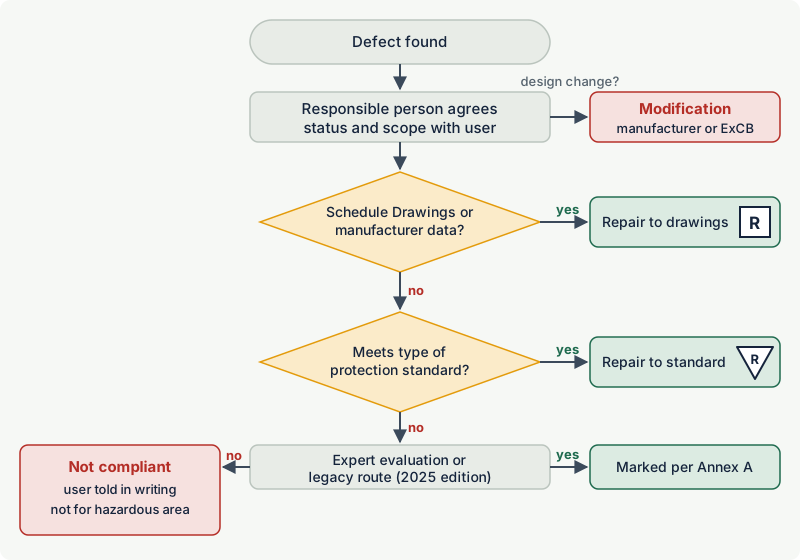
The 2025 edition orders the possible outcomes from most to least preferred. The repair symbols themselves are defined in Annex A of the standard; the two long-established ones are the R in a square and the R in an inverted triangle, as published summaries of the standard describe them.
- Repair to Schedule Drawings or related drawings. The repairer has the manufacturer's certified drawings, or drawings and specifications linked to them, and restores the equipment to them. This is the first option, and repair to the standard alone is not permitted when Schedule Drawings are available. Marking: an R inside a square.
- Repair to the relevant standards. The manufacturer's data cannot be obtained, so the repairer restores the equipment to the requirements of the type of protection standard it was built to. Marking: an R inside an inverted triangle.
- Repair with expert evaluation, and legacy Group II and III equipment repaired with user evaluation. These routes, clarified in the 2025 edition, cover cases where neither of the first two can be fully demonstrated; they rely on documented evaluation by competent persons and are marked as Annex A specifies.
- Not in compliance. If compliance with the relevant standard cannot be shown, the user is told in writing that the equipment is no longer suitable for explosive atmospheres. It must not return to a hazardous area as Ex equipment.
The repair marking is normally a separate, durable label fixed close to the original nameplate, never in place of it. It typically shows the symbol for the repair basis, identifies the repairer and the job reference and gives the date, so an inspector can trace the paperwork. The original nameplate is part of the certification and stays on the equipment; the 2025 edition adds rules for the rare cases where it has to be replaced. Some repair trade associations issue stainless steel repair labels to their qualified members for this purpose.
Note: An R in a square is not "better" in the sense of a higher protection level. Both symbols mean the equipment is fit for its original use; the symbol tells inspectors and future repairers which documents the work was based on.
Flameproof (Ex d) repairs: flamepath limits
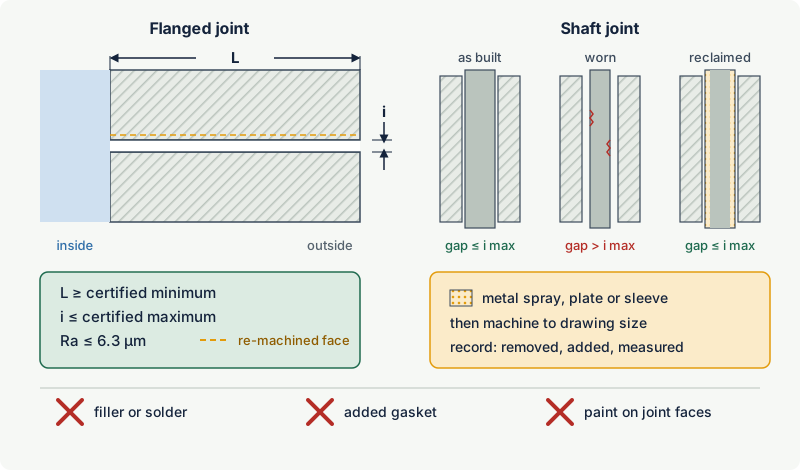
Flameproof enclosures are the most common items in Ex repair shops, and their flamepaths are where most repair decisions are made. A flamepath is the narrow joint between two parts of the enclosure, such as cover and body, shaft and bearing cap, or spindle and bush. Its width L (the length of the path a flame must travel) and its gap i (the clearance between the faces) are what cool escaping gases below the ignition temperature of the surrounding atmosphere. IEC 60079-1 also limits the average surface roughness of flamepath faces to Ra 6.3 µm.
Which dimensions apply
The governing values are those on the Schedule Drawings. IEC 60079-1 tables give the maximum gaps and minimum widths a manufacturer may design to for each gas group and enclosure volume, but a particular enclosure may have been tested and certified with a smaller gap, and its certificate covers only the gaps on its drawings. The standard table is therefore not a licence to open a joint up to the table value. Where no drawings exist, Annex C of IEC 60079-19 gives the normative measurement method and guidance on determining the maximum gap of reclaimed parts.
What a repair facility may do
- Clean and assess. Corrosion products and old grease are removed with non-metallic tools and suitable solvents, then the faces are inspected and measured with traceable instruments.
- Re-machine flanged faces lightly to restore flatness and finish, only while the width stays at or above the certified minimum, the assembled gap stays at or below the maximum and other dimensions (bolt hole positions, wall thickness) are not compromised.
- Reclaim cylindrical and spigot joints and shafts by metal spraying, electroplating, sleeving or other approved processes, then machine back to the drawing dimensions. Metal removal is kept to a minimum.
- Replace parts with the manufacturer's spares when reclamation is not possible.
- Pressure test enclosures where the flameproof clause of the standard requires it, for example after repairs such as welding that can affect their strength.
What is never acceptable
- Filling scratches, pits or corrosion damage with solder, filler, epoxy or metal-loaded paste.
- Adding a gasket, sealant layer or tape to a joint that was not designed for one.
- Machining a joint until the gap exceeds the certified maximum, or accepting a worn shaft joint because "it still runs".
- Re-cutting damaged flameproof threads or drilling new entries on the shop floor without the manufacturer's documentation.
- Painting joint faces.
Worked example: a flameproof motor with a scored shaft joint
An Ex db motor arrives with a seized bearing. The shaft has rubbed the flameproof bearing cap. The responsible person obtains the Schedule Drawing, which (in this illustrative case) specifies a shaft flamepath width of at least 25 mm and a maximum diametral clearance of 0.30 mm. These values are invented for the example; real values always come from the drawing for that motor.
- Measured bore of the bearing cap: 60.12 mm, round and undamaged.
- Measured shaft diameter in the joint after cleaning: 59.70 mm, with circumferential scoring.
- Diametral clearance: 60.12 - 59.70 = 0.42 mm, which exceeds 0.30 mm. The joint is not acceptable as found.
Re-machining the bore would make the gap larger, so the shaft is reclaimed: the worn zone is metal sprayed and then ground back to 59.95 mm. The new clearance is 60.12 - 59.95 = 0.17 mm, within the limit, and the width is unchanged. The job record lists the measurements before and after, the instruments used, the material removed and added and the inspection result. Because the work followed the Schedule Drawing, the motor receives the R-in-a-square label next to its original nameplate, and the user report goes into the plant's verification dossier.
Other types of protection: what changes
| Type of protection | Main repair considerations |
|---|---|
| Increased safety "e" and "ec" | Terminals, insulation and creepage distances as original; IP sealing restored; motor rewinds to the original data so that temperature class and, for "eb" motors, the tE time remain valid |
| Intrinsic safety "i" | Components that affect intrinsic safety replaced only with the types specified in the certificate documentation; circuit changes are modifications that need re-assessment by a certification body |
| Pressurisation "p" | Enclosure leak tightness, purge and pressure controls and their settings verified after repair |
| Dust protection "t" | Gaskets and joints restored to keep the IP rating; surface temperature and dust-tight entries unchanged |
| Encapsulation "m" | Not repairable; only functional and visual inspection to confirm continued use |
| Non-electrical "h" (b, c, k) | Follow the manufacturer's instructions and good engineering practice; ignition hazard assessment basis must stay valid |
For electric machines of any type of protection, the 2025 edition requires that a rewind keeps the same type of winding, and Annex E sets the rules for a copy rewind. Rewound machines are also tested to the relevant industrial machine standards.
Modifications: when repair is no longer the right word
Typical modifications found in the field: an extra entry drilled in a flameproof box, a lamp above the luminaire rating, a different window or seal material, a motor rewound for another voltage or speed, an added component inside an enclosure, or a part that is not the specified spare. None of these is repair. The correct routes are:
- Ask the manufacturer whether the change is an alteration already covered by the certificate, or whether it can be added to the certificate.
- Have the modified item assessed by a certification body, which may issue a new certificate or a supplement.
- Replace the item with one certified for the new duty.
Until then, the item is not Ex equipment and must not be used in a hazardous area. Under ATEX, a substantial modification brings a product that is used or placed on the market again back under Directive 2014/34/EU, with conformity assessment as for a new product.
Common mistakes
- Sending equipment to "any good motor shop". A general workshop without IEC 60079-19 competence and a responsible person cannot issue a valid Ex repair status. Check the facility first.
- Repairing "to standard" when drawings exist. Under the 2025 edition the manufacturer's documents must be used when they are available. Ask for them before the job starts.
- Removing the original nameplate. The repair label is added next to it; the original marking and certificate number must stay readable.
- Treating a worn flamepath as acceptable because the gap is under the IEC 60079-1 table value. The certified drawing governs, and it can be tighter.
- Forgetting the paperwork. Without the user report, the next inspector cannot tell how the item was repaired. File it in the verification dossier.
- Calling a modification a repair. If the design changes, the certificate no longer covers the equipment until it is assessed again.
Frequently asked questions
Can a user repair Ex equipment in its own workshop?
Yes. IEC 60079-19 applies to any service facility, including a user's in-house workshop, provided it meets the same requirements: a responsible person, competent operatives, a quality system, traceable instruments, the manufacturer's documentation where available and complete records. The work and the marking are then the same as for an external repairer.
What does the R in a triangle on an Ex motor mean?
An R in an inverted triangle means the equipment was repaired to the requirements of its type of protection standard because the manufacturer's Schedule Drawings or data were not available. An R in a square means it was repaired to the manufacturer's drawings or specification. Both labels belong next to the original nameplate and refer to a repair record.
Is replacing a part with a non-original spare a repair or a modification?
Fitting the manufacturer's specified spare is a repair. Fitting a different part is a modification unless the certificate documentation or the manufacturer confirms that it is an equivalent covered by the certificate. For intrinsically safe equipment in particular, only the specified components may be used.
Can a damaged flamepath be machined?
Only by a competent repair facility, only to the manufacturer's dimensions and only while the width stays at or above the certified minimum and the gap at or below the certified maximum. Worn cylindrical joints are usually reclaimed by metal spraying, plating or sleeving and then machined back to size, or the part is replaced.
Does a repaired Ex product need a new ATEX certificate?
No, if the work is a repair: according to the European Commission's ATEX Guidelines, a repaired product is not placed on the market again. A new conformity assessment is needed only if the product is substantially modified, meaning the change affects the type of protection or other safety characteristics.
Related on excodex
- Flameproof enclosures (Ex d): how flamepaths stop an internal explosion
- Inspection of Ex installations under IEC 60079-17
- Common Ex inspection findings and how to fix them
- Competence of people working in hazardous areas: IECEx CoPC and other schemes
- The X and U suffixes on Ex certificates and the Ex marking check tool
- Standards spaces: IEC 60079-19, IEC 60079-1, IEC 60079-17, and the forum
Standards and further reading
- IEC 60079-19:2025, equipment repair, overhaul and reclamation (edition 5.0, replaces the 2019 edition): IEC webstore
- IEC 60079-1, equipment protection by flameproof enclosures "d" (flamepath dimensions and surface finish)
- IEC 60079-17, inspection and maintenance of electrical installations; IEC 60079-14, design, selection and installation, including the verification dossier
- IEC 60034-23, repair, overhaul and reclamation of rotating electrical machines
- IECEx Certified Service Facilities Scheme, scope and online facility certificates: iecex.com
- IECEx, frequently asked questions on service facilities and repair marks: iecex.com FAQ
- S. Burian and C. Colda, "General notions regarding Ex repairs", MATEC Web of Conferences 389 (2024), including the meaning of the two repair symbols: paper PDF
- European Commission, ATEX 2014/34/EU Guidelines, 6th edition (January 2026), sections on used, repaired and modified products and on instructions: Guidelines PDF
This article is general technical information prepared by the excodex editorial team. It does not replace the applicable standards, the equipment certificates and instructions, national regulations or the assessment of a competent person.