The X and U suffixes on Ex certificates: specific conditions of use and Ex components
Abstract
An X after an Ex certificate number means specific conditions of use that the installer and user must meet; a U means an Ex component that cannot be used alone. Meaning, typical conditions, who is responsible, and what to do with each.
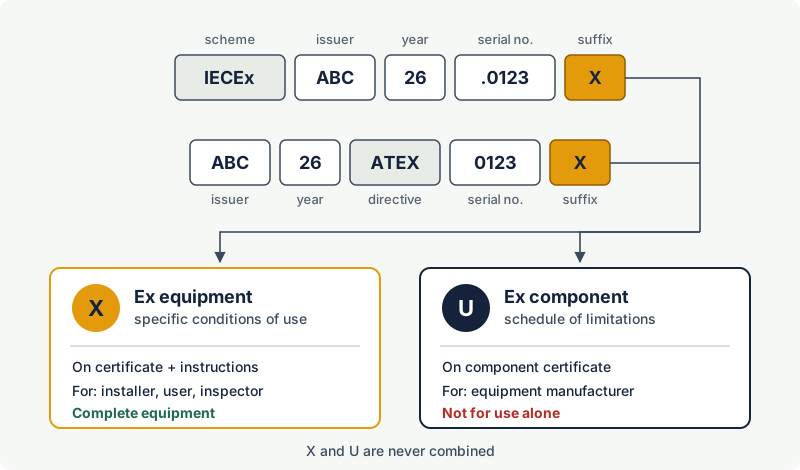
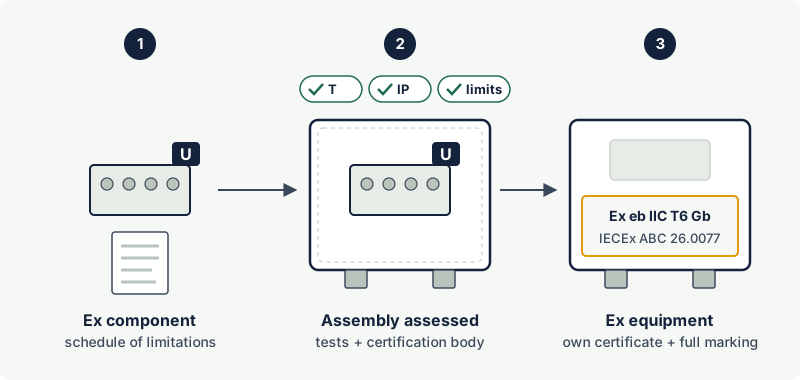
The letter X at the end of an Ex certificate number, as in IECEx ABC 26.0123X or ABC 26 ATEX 0123 X, means that the equipment has specific conditions of use: requirements for installation, use or maintenance that are written on the certificate and in the instructions, and that the installer and user must meet for the equipment to be safe. The letter U means the certificate covers an Ex component, such as an empty flameproof enclosure or an increased-safety terminal, which is incomplete, must not be installed on its own and becomes usable only once it is built into equipment that is assessed and certified as a whole. The two letters are never used together.
This article explains where the suffixes come from, gives typical examples of X conditions, sets out who is responsible for what, and shows why a U component bought from a catalogue is not something you can bolt to a wall in Zone 1.
Key points
- An X after the certificate number tells you that essential information for the installation, use or maintenance of the equipment is in the certificate; the conditions are binding, not advice.
- A U after the certificate number identifies an Ex component: incomplete, not intended to be used alone, and requiring additional assessment when it is incorporated into Ex equipment.
- A component certificate has a schedule of limitations instead of specific conditions of use; it is addressed to the equipment manufacturer, not to the installer.
- The symbols X and U are never used together on one certificate.
- Under ATEX, components carry no CE marking; they come with a written attestation of conformity and assembly instructions instead of an EU declaration of conformity.
- Whoever puts a U component into service by adding the missing parts, for example an enclosure, takes on the role of manufacturer and needs a certificate for the complete equipment.
- X conditions belong in the installation documentation and the equipment register, and they must be checked again at every inspection.
Where the X and U come from
The suffixes are defined in IEC 60079-0, the general requirements standard for Ex equipment, and are used in the same way by IECEx certificates, ATEX EU-type examination certificates and UKEX certificates. The definitions paraphrased here are those of the 2017 edition (EN IEC 60079-0:2018), which the European Commission's ATEX guidelines quote; the eighth edition, published in June 2026, keeps both symbols and tightens the rules around them, as described below.
A certificate number is built from a few parts: the certificate issuer's code, the last two digits of the year, a serial number, and an optional suffix. IECEx certificates use a full stop between year and serial number; ATEX certificates use the word ATEX in that place, and UKEX certificates use UKEX.
| Suffix | Certificate covers | What it tells you | Who must act on it | Accompanying information |
|---|---|---|---|---|
| none | Ex equipment | No specific conditions beyond the instructions | Installer and user, following the instructions | Instructions, marking |
| X | Ex equipment | Specific conditions of use are listed on the certificate | Installer, user, maintainer, inspector | Specific conditions of use on the certificate and in the instructions |
| U | Ex component | Incomplete; not for installation without further evaluation | Manufacturer of the final equipment and its certification body | Schedule of limitations |
The 2017 edition of IEC 60079-0 also allowed an advisory marking or a reference to a specific instruction document on the equipment in place of the X. Published summaries of the 2026 edition report that this informal alternative has been removed: where safety depends on the user or the installation, it must be stated as a specific condition of use with an X. The same summaries report that the X route is closed for electrostatic risks on portable equipment, which must now pass the charge tests or be redesigned. On older equipment you may still meet advisory labels; either way, the conditions themselves are on the certificate, so the certificate remains the place to look.
X: specific conditions of use
What an X really means
Every certificate has an annex or schedule describing the equipment. When the certification body finds that safety depends on something the manufacturer cannot fully control in the factory, it lists that requirement under specific conditions of use (ATEX documents often say "special conditions for safe use") and the certificate number gets an X.
The European Commission's ATEX guidelines (6th edition, 2026) set a clear limit on what such a condition may ask. Specific conditions of use cannot transfer to the user safety measures that belong in manufacturing or in type testing. They must be specific enough for a user without test equipment or design knowledge to follow, and the instructions must explain how. If a condition is so vague that the user cannot meet it, the product does not comply with the directive. The guidelines give real cases: a product with open terminals sold with the condition "needs an enclosure of at least IP65", and a switch certificate stating that the impact tests had not been done. Both are components, not equipment with an X.
An X is therefore not a sign of lower quality. It is a sign that part of the safety case lives at the installation.
Typical specific conditions of use
The table lists conditions that appear frequently on certificates. The exact wording and values are always those on the certificate in hand.
| Type of condition | Typical example | Why it exists |
|---|---|---|
| Electrostatic charging | Non-metallic enclosure or painted surface: clean only with a damp cloth, keep away from charge-generating processes | Insulating surfaces above the size limits of IEC 60079-0 can store an incendive charge |
| Low risk of mechanical damage | Install where the window or enclosure is protected from impact | The item passed the impact test only at the lower energy that the standard allows for low mechanical risk |
| Light metals | Avoid impact or friction sparks, especially for EPL Ga or Group I | Aluminium, magnesium and titanium alloys can produce incendive sparks when struck |
| Flameproof joints | Flamepaths are not intended to be repaired; contact the manufacturer for dimensions | Joint dimensions differ from the standard's tables, so a repairer cannot rely on them |
| Fasteners | Replace cover screws only with the stated grade and property class | Enclosure strength and joint gaps were verified with those fasteners |
| Cable entries | Cable glands for fixed installation only; clamp the cable close to the gland | The gland passed the cable-retention test at reduced values |
| Insulation of intrinsically safe apparatus | The circuit does not withstand the 500 V insulation test to earth | Affects earthing and system design of the intrinsically safe loop |
| Supply protection | Use with an upstream fuse of a stated rating or prospective short-circuit current | The protection concept (often encapsulation or increased safety) relies on it |
| Temperature | Use cables rated for at least a stated temperature; observe a reduced ambient range for some variants | Hot spots at the entry or terminals exceed the default cable rating |
Responsibilities of the installer and user
The certificate creates obligations that run all the way through the life of the installation:
- At design and selection. Read the certificate, not only the nameplate, and check that every condition can be met at the intended location. A condition requiring "low risk of mechanical damage" rules out a position next to a forklift route.
- At installation. Meet each condition and record how. IEC 60079-14 (current edition 2024) requires the installation documentation to include the documents for equipment with specific conditions of use, and its 2024 edition has dedicated requirements on specific conditions of use and on Ex components. The Irish Health and Safety Authority's ATEX verification dossier checklist, for example, asks for copies of the certificates of all equipment and for evidence of compliance with the "special conditions (suffix X)", which can be recorded in the equipment register.
- In operation. Pass conditions that affect daily work, such as cleaning methods, to the people who do that work.
- At inspection and maintenance. Inspectors under IEC 60079-17 need the conditions to check them; maintainers need them before replacing screws, glands or windows. A repairer working under IEC 60079-19 needs flamepath conditions before touching a joint.
- At modification. A change of location, process or neighbouring equipment can break a condition that was met on day one.
Warning: If a specific condition of use cannot be met at a location, the equipment is not suitable for that location, whatever the marking says. Choose another product or change the installation; do not "accept" the condition.
U: Ex components
What an Ex component is
IEC 60079-0 defines an Ex component as a part of Ex equipment that is not intended to be used alone and requires additional consideration when incorporated into Ex equipment. The note to the definition of the U symbol says the item is incomplete and not suitable for installation without further evaluation. An Ex component certificate must state that it is not an Ex equipment certificate.
Typical Ex components are increased-safety terminals, empty flameproof enclosures, flameproof bushings, push-button and switch elements, encapsulated relays, and lamp holders or ballasts intended for Ex luminaires. The ATEX guidelines give a similar list of products that may be placed on the market as components when they are explicitly intended to be built into ATEX products.
The schedule of limitations
A component certificate carries a schedule of limitations instead of specific conditions of use. It tells the equipment manufacturer and its certification body what must still be checked or provided when the component is used. Typical items are:
- the temperature class or surface temperature is to be determined in the final equipment, because it depends on the heat produced inside the enclosure;
- holes, threads or flamepaths that receive the component must meet stated minimum dimensions;
- the component must be secured against rotation or loosening;
- the permitted current, voltage, cable cross-sections or creepage distances;
- tests to be repeated in the final assembly, for example a pressure or flame-transmission test for a flameproof bushing.
The 2026 edition of IEC 60079-0 adds that the temperature range of an Ex component must now be stated in its schedule of limitations.
Component marking is usually reduced: it typically lacks a temperature class, because that can only be assigned to the final equipment. An IECEx decision sheet (DS 2023/002) confirmed that a component which is not sold separately, and is only built in by its own manufacturer under the same quality system, need not carry a marking at all, provided the component certificate says so and traceability is maintained.
ATEX: no CE marking and a different set of papers
Under Directive 2014/34/EU, components are a product category of their own. Their conformity is assessed by the same procedure as the equipment they are meant for, but they do not carry the CE marking (unless other EU legislation requires it) and they come with a written attestation of conformity stating their characteristics and how they must be incorporated, plus instructions for assembling rather than instructions for use. The ATEX guidelines state plainly that the component is not ready for use and that its final conformity assessment is done together with the complete equipment.
Why a U component cannot be used alone
The ATEX guidelines describe an empty flameproof enclosure that was certified with a condition explaining how users should drill holes for cable entries. The notified body had seen an assembled enclosure, but the manufacturer sold empty ones. The guidelines conclude that the product is a component: drilling and assembly are manufacturing steps that must be covered by the manufacturer's quality assurance, and after drilling and fitting, flame-transmission and pressure tests may be needed. The internal temperature and the surface temperature class also depend on what is put inside.
The same logic applies everywhere. A component certificate proves only what the component itself can do. The rest of the explosion protection concept, the enclosure around a terminal, the free volume around a contactor, the heat dissipated by a power supply, is unproven until someone assesses the whole. The guidelines put it directly: if the user has to add items such as an enclosure, the user acts as a manufacturer.
Worked examples
Example 1: a junction box with an X
A contractor receives increased-safety junction boxes marked Ex eb IIC T6 Gb with certificate IECEx ABC 26.0042X. The certificate lists three specific conditions:
- the glass-reinforced polyester enclosure may build up electrostatic charge; clean only with a damp cloth;
- only cable glands and blanking elements certified for Ex e with at least IP66 may be used;
- the number and size of terminals and the maximum current per terminal must follow the table in the instructions.
The contractor checks that none of the boxes sits in a high-velocity dust or spray stream, selects glands certified for the type of protection with the required IP rating, and confirms the terminal loading for each box against the manufacturer's table. Each condition and the evidence go into the equipment register. The site maintenance procedure for that area is amended with the cleaning method. At the first periodic inspection, the inspector finds a replacement gland without an Ex certificate: a breach of condition 2, recorded as a defect.
Example 2: building a control station from U components
A panel builder wants to supply a local control station for Zone 1. It buys an empty flameproof enclosure (... U), flameproof switch elements (... U) and increased-safety terminals (... U), and fits them together.
None of these certificates allows the assembly to be installed. The panel builder is now the manufacturer of new Ex equipment and must:
- obtain an equipment certificate for the assembly, for example an IECEx certificate of conformity with its own test report, or under ATEX an EU-type examination certificate (Module B) followed by either product quality assurance (Module E) or supervised product testing (Module C1), because this is category 2 electrical equipment;
- meet every item in the three schedules of limitations, which usually means temperature tests of the populated enclosure and checks of the holes for the switch elements;
- mark the station with its own full Ex marking and the new equipment certificate number, which may itself carry an X;
- issue the declaration of conformity and instructions for use.
If the end user had bought the same parts and assembled them on site, the end user would have taken on exactly the same obligations.
Common mistakes
- Reading only the nameplate. The X is a pointer, not the information. Download the certificate and read the specific conditions before purchase, not after installation.
- Treating X as "special approval needed". An X does not mean the equipment is restricted to special cases or is less safe. It means some safety measures depend on correct installation and use.
- Installing a U component as if it were equipment. A certified terminal, bushing or empty enclosure is not certified equipment. Without an assessment of the complete assembly, it is uncertified in law and in practice.
- Drilling or modifying an Ex d enclosure on site because the certificate "allows" it. Entries and modifications are manufacturing steps unless the equipment certificate covers exactly that change and its verification.
- Losing the conditions after commissioning. Replacement screws, glands and cleaning methods are where X conditions are broken years later. Keep the conditions in the register and in the inspection schedule.
- Assuming conditions are the same for every issue of a certificate. Certificates are reissued; conditions can be added or changed. Check the issue that matches the product's date of manufacture.
Frequently asked questions
What does X mean on an ATEX or IECEx certificate?
X means the equipment has specific conditions of use, also called special conditions for safe use. They are listed on the certificate and in the manufacturer's instructions and cover installation, use or maintenance. The equipment is only safe, and only compliant, if those conditions are met.
What does U mean on an Ex certificate?
U means the certificate is for an Ex component, such as a terminal, an empty flameproof enclosure or a switch element. The component is incomplete and must be built into Ex equipment, which is then assessed and certified as a whole. A U component must not be installed in a hazardous area on its own.
Can a certificate have both X and U?
No. IEC 60079-0 does not allow the two symbols together. Ex components carry a schedule of limitations, addressed to the equipment manufacturer, instead of specific conditions of use.
Do Ex components have CE marking under ATEX?
No. Under Directive 2014/34/EU, components are not marked with CE unless other EU legislation requires it. They are accompanied by a written attestation of conformity and assembly instructions; the CE marking and EU declaration of conformity belong to the finished equipment.
Who is responsible for meeting the specific conditions of use?
The manufacturer must make the conditions clear and achievable, and the installer, user and maintainer must meet them throughout the life of the installation. Inspectors check them during initial and periodic inspections. If a condition cannot be met at a location, the equipment is not suitable there.
Where do I find the specific conditions of use?
On the certificate, usually in a section headed "Specific Conditions of Use" or in its schedule, and in the manufacturer's instructions. IECEx certificates can be read free of charge in the IECEx online certificate system; ATEX certificates are obtained from the manufacturer or the notified body.
Related on excodex
- How to read an Ex marking: decoding II 2 G Ex db IIC T4 Gb step by step
- EU-Type Examination Certificates and Notified Bodies explained
- The IECEx scheme explained: CoC, ExTR, QAR and the online certificate database
- How to verify that an Ex certificate is genuine
- Ex installation basics under IEC 60079-14
- Repair, overhaul and modification of Ex equipment (IEC 60079-19)
- Tool: Ex marking check; standards spaces: IEC 60079-0, IEC 60079-14, IECEx
Standards and further reading
- IEC 60079-0, explosive atmospheres: general requirements for equipment (definitions of Ex component, X and U symbols, marking, schedule of limitations); 8th edition 2026.
- IEC 60079-14, electrical installation design, selection and installation of equipment, including initial inspection; 6th edition 2024.
- IEC 60079-17, inspection and maintenance of electrical installations.
- IEC 60079-19, equipment repair, overhaul and reclamation.
- European Commission, ATEX 2014/34/EU Guidelines, 6th edition January 2026, sections on components and on the difference between equipment and components: single-market-economy.ec.europa.eu
- US Coast Guard Outer Continental Shelf National Center of Expertise, The Drill Down issue 29 on hazardous location certificate numbers (number structure, X and U): dco.uscg.mil
- IECEx decision sheet DS 2023/002 on marking of Ex components used only by their manufacturer: iecex.com
- Health and Safety Authority (Ireland), contents of an ATEX verification dossier: hsa.ie (PDF)
- IECEx online certificate system: iecex-certs.com
This article is general technical information prepared by the excodex editorial team. It does not replace the applicable standards, the equipment certificates and instructions, national regulations or the assessment of a competent person.